




Roasted Garlic Rustic Sourdough Boule

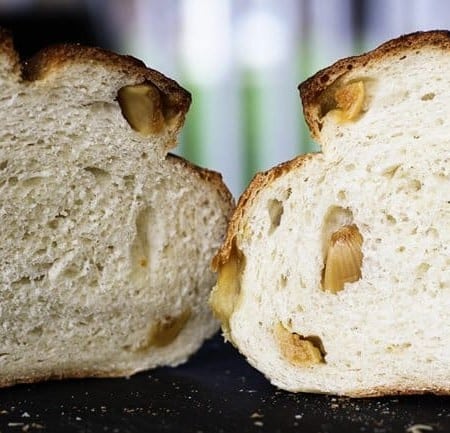
A sliced Roasted Garlic Rustic Sourdough Boule | www.foodiewithfamily.com

After the time I spent at King Arthur Flour’s Blog & Bake™ last week, I came home prepared to fling flour and bake my tush off. Oh, would that baking one’s tush off was an actual possibility. Sadly, I find that most of my baking actually adds to my overall girth since I’m unable to restrain myself around a fresh loaf of good bread. That loaf you see above is a perfect example of what renders me weak in willpower and wobbly in the knees.

You’re looking at a Roasted Garlic Rustic Sourdough Boule. This particular bread is not one we prepared at Blog & Bake, but it makes use both of King Arthur Flour’s rustic sourdough bread recipe and the sourdough starter that I bought at their Baker’s Store. The starter they sell is pedigreed, people; it is descended from one that was born somewhere in the mid-1700s. This means -at least to me- that it’s doubly wonderful. We’re talking about baking with sourdough AND history.

Are you breadphobic?

One of the things I’ve learned over the years here at Foodie with Family is that many people have anxiety that sometimes borders on phobia about baking with yeast. For those of you who are a-okay with yeast baking, please skip to the next paragraph. For those with breadphobia, allow me to offer you some words of encouragement. When you measure your ingredients the right way and follow instructions to the best of your ability, homemade bread seldom turns out inedible. It may not be pretty, it may not be exactly what you hoped, but there are very few occasions when it is too yucky to eat. In those cases, you find a neighborhood dog and make a lifelong friend or break it up and toss it out for the birds. All is not lost; review what you did, what could’ve gone wrong and try again. Someone or something ate well as a result of your efforts. I firmly believe that everyone can bake given the desire to do so and time. I’m here for you and willing to answer any baking questions and so are the experts at King Arthur Flour. In fact, they have a FREE Baker’s Hotline. You can call them at 802-649-3717 or chat live online with their baking experts who can answer simple or complicated baking questions with equal aplomb. I assure you they won’t laugh at any questions, so don’t be shy. We’ll get you baking yeast breads in no time at all!

How to form a rustic loaf of bread

I prepared the rustic sourdough as directed by sheet of instructions included in the purchase of the sourdough starter and decided to change it up a smidge. This was mainly due to the fact that I had already prepared four loaves of rustic sourdough bread according to their recipe (What? Obsessed? Me?!?) and wanted something a little different to dunk in that evening’s soup. The jar of roasted garlic in the refrigerator called to me and we were off and running.

There are a couple of notes you may find helpful when preparing this gorgiferous, crusty, chewy, roasted garlic -studded sourdough bread.

Instead of adding the roasted garlic cloves to the dough, we pat the dough out after the first rise and roll the cloves in before forming the boule. This allows us to have more visible garlic in the finished product instead of smashing it into oblivion while kneading the dough. After we roll the dough up into a long tube, we still have to form the ‘boule’ or dough ball. We do this by pulling the long end toward the center of the loaf, rotating the dough about 45°, gently pulling and folding that toward the center, rotating 45° and repeating the process until we get a wad of dough that is roughly round in shape.

How to form a Roasted Garlic Rustic Sourdough Boule from rolled dough | www.foodiewithfamily.com

Now that you have the dough all bunched up, we flip it upside down so the smooth side is up and cup the dough ball -hands like blades at a 45 degree angle to the countertop- and rotate the dough ball, first pushing with one hand and then pulling back toward you with the other. If you’re doing it correctly, you’ll feel the dough ball firm up and see the ‘skin’ of the dough tighten.

Rolling the dougTightening up the dough for Roasted Garlic Rustic Sourdough Boule by rolling it. | www.foodiewithfamily.com

Don’t overdo this because you don’t want all the roasted garlic bursting through that taut surface of dough. If a few pop through here and there it’s alright, though!

Ball of dough for Roasted Garlic Rustic Sourdough Boule | www.foodiewithfamily.com

I score the tops of the loaves before baking them to allow them to expand without tearing as they bake. It doesn’t hurt that it makes it painfully pretty to look at when it’s done.

Roasted Garlic Rustic Sourdough Boule | www.foodiewithfamily.com

If you leave them like this, you get hearty, classic, chewy, mild-sourdough loaves with cloves of roasted garlic throughout and a shatteringly crisp crust. I’m fond of gilding the lily, however, by brushing the finished loaves generously with extra virgin olive oil and sprinkling with super-fine sea salt. It renders the super-crunchy crust a little softer and chewier. If you’re not a fan of a softer crust, skip this step, but I actually prefer the softer crust for sandwich making purposes. Besides, I take any reason to get garlicky olive oil and salt on my fingers so I can lick them afterward.

What can I say? I’m easy to please.

Roasted Garlic Rustic Sourdough Boule brushed with olive oil and sea salt | www.foodiewithfamily.com

This bread is sturdy enough to hold up to sandwich fillings, toasting and topping with a fried egg, or serving alongside soups and stews to help sop up that last little bit of whatever deliciousness is in your bowl.

Oh, and hey. If you had leftovers that were getting a touch on the stale side, you could turn them into the world’s most enviable croutons.

I have to know! How would you serve this bread?

XO

Rebecca

Roasted Garlic Rustic Sourdough Boule

Rating: 51

Prep Time: 2 hours

Cook Time: 30 minutes

Total Time: 2 hours, 30 minutes

Yield: 2 loaves

Roasted Garlic Rustic Sourdough Boule

A classic, chewy, full-flavoured, rustic sourdough bread gets a little dressed up with roasted garlic cloves that are rolled into the dough when it is shaped. After baking, the loaves are brushed in extra virgin olive oil and sprinkled with super-fine sea salt.

Recipe adapted from and with thanks to King Arthur Flour

Ingredients

  • 1 cup (8 1/2 ounces by weight) ripe sourdough starter
  • 1 1/2 cups (12 ounces by weight) body temperature water
  • 2 1/2 teaspoons salt
  • 1 tablespoon sugar
  • 2 teaspoons instant or active dry yeast (no need to dissolve either in water first.)
  • 5 cups (1 pound, 5 1/4 ounces by weight) King Arthur All-Purpose Flour
  • 1 cup roasted garlic cloves, roughly chopped
  • Optional:
  • extra virgin olive oil for brushing and super-fine sea salt for sprinkling over finished loaves

Instructions

Whisk together the flour, yeast, salt, and sugar in a large mixing bowl (or the bowl of a stand mixer fitted with a dough hook.) Add to that the sourdough starter and water and mix with a bowl scraper, sturdy spoon or dough hook until a shaggy dough forms.

Turn the dough out onto a lightly floured surface, flour your hands, and knead until the dough is smooth and elastic, about 8 minutes. Alternatively, you can use the dough hook to reach the same state. Place the dough in a lightly greased mixing bowl, cover with a clean tea towel or plastic wrap and let rise in a warm, draft-free place until puffy and marshmallowy in appearance and texture. If you gently poke a finger into the dough, an indentation should remain when your finger is removed from it.

Turn the dough onto a lean counter, cut in half (don't rip it, pretty please!) with a bench knife or other sharp knife, and pat each half into a rough rectangle or oval that is about 1/2-inch thick. Divide the roasted garlic between the two dough shapes and spread evenly over the dough. Roll each piece of dough into a log starting with a short side.

To form each piece into a boule or ball, gently tug and pull one coiled end toward the center. Tuck it in place, rotate the dough about 45° and repeat. Continue rotating, pulling and tucking toward the center until you've gone all the way around and your dough is roughly in a ball shape. Flip it over so the smooth side is up and nestle your hands around the dough with your hands at a 45° angle to the counter. Roll the dough between your cupped hands, alternating pulling with one hand and pushing with the other, tightening the dough ball as you go. When the surface is taut, carefully lift the dough ball and place it smooth side up on one side of a parchment lined baking sheet. Repeat with the remaining dough log, placing the finished ball so that there are at least 6 to 8 inches between the two. Cover them lightly with a tea towel and let rise in a warm, draft-free place for 30 minutes.

While the dough balls are rising, preheat the oven to 425°F with an empty cast-iron or other heavy, oven-safe frying pan on the floor of the oven. Bring a pot of water to a boil on the stove top.

Immediately before baking, use a sharp knife or blade to score an 'X' or scallop shape about 1/4-inch into the surface of the bread dough. This allows the bread to expand without tearing as it cooks.

Working quickly, slide the parchment lined pan with the boules into the oven and carefully pour about 1 cup of the boiling water into the empty pan. Be cautious because this will generate a great deal of steam VERY quickly! Close the oven door immediately and set the timer for 20 minutes. After 20 minutes, remove the water pan from the oven, close the door and reset the timer for an additional 10 minutes.

The bread should be deep brown, very firm and measure at least 195°F at the center of the loaf with an instant read thermometer. Transfer the finished loaves to a cooling rack. If desired, brush generously with extra virgin olive oil and sprinkle the surface with super-fine sea salt. Let cool completely before slicing.

Store leftovers at room temperature wrapped in a tea towel.

http://www.foodiewithfamily.com/2013/05/03/roasted-garlic-rustic-sourdough-boule-blog-bake/

Earl Grey Raisin Scones with Sticky Lemon Glaze | Downton Grub Files

Earl Grey Raisin Scones with Sticky Lemon Glaze from Foodie with Family


The body of this post and the printable recipe do NOT contain SPOILERS, however, I cannot make any promises about the comments section. If you are not caught up on Downton Abbey (Episode 1 of Season 3 as of this writing on January 12th, 2013), you may not want to read comments. I also ask -No, I BEG and PLEAD- that our friends overseas (or those who somehow saw all of Season 3 already) refrain from giving away what happens in any episodes past where I am!

Whoopsie! Forgot to include how MUCH cream in the ingredients list. It is fixed now!

I am an unapologetic anglophile from television programs to music to art to literature to food.

It is an idea that started with a simple question on the Foodie with Family facebook page…

“Are there any Downton Abbey fans here?”

In sixteen hours, more than seventy people ‘liked’ the post and there were twenty four comments. I knew I wasn’t the only mega Downton Abbey fan out there. Obviously. I hear internet chatter. I read newspapers. I see the news. I know it’s a big deal. What I didn’t know was how many Foodie with Family readers would be interested in me blathering on about how on Sunday the children are duct taped into bed after I rush home from taking my eldest to youth group at lightning speed just so I can see the Dowager Countess, Lady Grantham, Lady Mary, Sybil, Edith, week-ends, Mr. Bates and Anna, the abhorrent Thomas, Mr. Carson, Mrs. Hughes, Mrs. Pattimore, Daisy, Mrs. O’Brien, upstairs and downstairs, and lush costuming.

OH, THOSE COSTUMES. The dresses! The DRESSES, I tell you!!!!!!

Yes, I record it on the DVR, but if you have to ask that, you’re not getting my point. I want to watch it the very second it’s airing on PBS. I don’t want to wait one fraction of a second to get my weekly Downton fix.

More than I want to dress like Lady Mary, do something jolly with my hair like Edith, or just plain LOOK like Sybil from time to time, I want to be as witty, incorrigible and stalwart as the Dowager Countess Violet. Every time she speaks, I hush the imaginary people in the room with me. Imaginary, because I DO NOT allow anyone in the room with me lest they should talk over, wiggle, or otherwise interrupt my show.

My husband likes to sit in the other room with the door closed and laugh at me as I yell at the t.v. (Thomas, Mrs. O’Brien, and the former Mrs. Bates, I’m looking at you…), swoon (Oh hello, Lady Mary and Matthew, Anna and Mr. Bates. Yes. You all make my heart go pitter patter.), and otherwise sigh, moon, and mope when episodes conclude.  After listening to me watch the conclusion of Season 2, he asked, “Is that what I sound like when I watch football?” My response included something intimating that if football had dresses like that I’d watch it, too.

I was late to the Downton party because of a fun little personality quirk where I deliberately avoid trying anything large crowds of people love. Yeah. That’s working out really well… So far, I can add Harry Potter books, Downton Abbey, and So You Think You Can Dance to that list.* The ONLY advantage to having taken so long to discover the series (midway through Season 2) was that I got to park myself on the couch for an indecent amount of time and watch Season 1 in one sitting.

*To be fair to myself, I can also add the Twilight books, which -after reading- led me to conclude that my personality quirk might actually be useful in some ways. To quote Snorg Tees, “Real men don’t sparkle. Real men defeat dark wizards!”

I quickly discovered that I really couldn’t get through an episode of the show without something to eat since so much of it revolves around time spent at the dinner table or in the kitchen.  Since I love a good theme, I decided to stock myself with British Isles treats to nibble while slowly and inexorably becoming part of my furniture. And here’s where my idea came sidling in like Mr. Carson in the dining room.  Why not post a little of the grub I made to sustain myself during my Downton Abbey marathon sessions? Just as quickly as the thought was hatched, I could almost hear the Dowager Countess saying, “What IS grub?” The Dowager Countess is apparently my grammatical conscience.

Today is my first contribution to the Downton Grub Files and it’s a doozy; Earl Grey Raisin Scones with Sticky Lemon Glaze. These moist, flaky scones are packed with Earl Grey soaked raisins and a touch of lemon zest and topped with a sticky, absolutely, unequivocally un-Downton finger-licking, Sticky Lemon Glaze. Every time you bite into one of the juicy soaked raisins, you get a little subtle pop of Earl Grey tea. I’m pretty sure Mrs. Patimore would be a-okay with slurping the glaze from your fingers, so go for it.

Tune in every Saturday while Downton Abbey airs for a great new classic British fare recipe to eat while you watch on Sundays! Who’s your favourite on Downton? What moments made you GASP? Cry? Scream at the television? (Come on, I can’t be the only one who did it!)

Earl Grey Raisin Scones with Sticky Lemon Glaze | Downton Grub Files

Earl Grey Raisin Scones with Sticky Lemon Glaze | Downton Grub Files

Moist, flaky lightly lemony scones studded with Earl Grey soaked golden raisins are perfect to nibble while watching Downton Abbey or just because you can.

Ingredients

  • 1 cup golden raisins soaked in 1 1/2 cups (12 ounces) hot, extra-strong Earl Grey tea for at least an hour
  • 4 cups (1 pound 1 ounce, by weight) all-purpose flour (preferably King Arthur all-purpose or Galahad flour.)
  • 2 teaspoons salt
  • 2 tablespoons baking powder
  • 2 tablespoons sugar
  • 8 tablespoons (1 a stick of butter or 4 ounces by weight), very cold and cut into 1/4-inch cubes, divided
  • 1 1/2 cups heavy cream
  • zest of one lemon, divided
  • juice of one lemon
  • 1/2 cup sweetened condensed milk

Instructions

Preheat the oven to 400°F. Line a baking sheet with a silpat or parchment paper and set aside.

Pour the raisins and tea into a fine mesh strainer and let drain thoroughly.

Whisk together the flour, salt, baking powder and sugar in a large mixing bowl. Add about 1/2 of the cubed butter and work in with a fork, two knives, a pastry cutter or your fingers until the mixture resembles lentils. Add the remaining butter and work in, leaving some slightly larger pea sized -or even larger- flakes of butter.

Add half of the lemon zest, and the drained raisins to the flour, then toss through gently until evenly distributed, taking care not to mash it in. Add 1 1/2 cups of the cream, sprinkling it over the top, then tossing to combine. Pick up a small amount of the mixture and try squeezing it gently together. If it crumbles, or if there are dry crumbs in the bottom of the bowl, add more cream -1 tablespoon at a time- until you have a mixture that holds together as a shaggy dough when squeezed gently. Use a bench scraper or spatula to gently fold the dough in on itself until it forms a shaggy mass you can turn out onto a very lightly floured surface.

Divide the dough in half and gently pat out the dough into two 7-8 inch discs that are about 3/4 of an inch thick. Carefully transfer the discs to a parchment lined baking sheet. Use a bench knife or Chef's knife to cut each disc into 8 wedges, cutting straight down and not sawing back and forth to help it rise higher in the oven. Gently separate the wedges so there is a little space between them.

Whisk together the remaining lemon zest, the lemon juice and the sweetened condensed milk until smooth. Lightly brush the tops of the unbaked scones with the glaze.

Bake for about 30 minutes, or until the scones are puffy and golden brown on top.

Spoon any leftover glaze on the hot scones and spread it over the tops. Let cool 'til comfortable to handle!

http://www.foodiewithfamily.com/2013/01/12/earl-grey-raisin-scones-with-sticky-lemon-glaze-downton-grub-files/

High Peaks Deep Dish Apple Pie and a {GIVEAWAY!} | WINNER ANNOUNCED!

{UPDATE} The Pick Giveaway Winner plugin chose Christa D. as our winner! Congratulations, Christa! Email me your mailing information and I will forward it onto our friends at Harry & David!

This past summer I had the distinct privilege of traveling to Oregon as part of a group of bloggers brought out by Harry & David to tour their orchards, facilities and community. What a treat! It was wall to wall wonderment, beauty and inspiring people. You don’t get a trip like that every day, I’ll tell ya. Aside from making some great new friends, I came away from it all with a deep respect and affection for Harry & David’s operation and philosophy. They take care of their people – they have employees who have worked there for their entire lives who come from parents who worked their for their entire lives- and the mutual loyalty shows in their products.

As I drove from the very north of Oregon to the very south, I had ample time to admire the pines and peaks of the state. Living in New York, I’m no stranger to mountains and trees, so there was a bit of familiarity mixed in with the newness. Where New York has high peaks, they’re rounded and aged; worn down by elements and time. Oregon’s peaks are young and raw and dramatic. What views!

Harry & David is best known for its pears, but they also have spectacular apples. When they offered to give a gift box to Foodie With Family readers, I had no idea what to pick and posed the question to you all on Facebook. It came down to a tie, so I tossed a coin and was thrilled that the coin favoured a gift box with apples in it, too. It didn’t just have apples though, it had Moose Munch (on which I am now officially dependent), their spectacular pears, summer sausage, cheddar cheese, MASSIVE chocolate covered Oregon cherries, raspeberry galettes, olive oil crackers, and mixed nuts. Oh man. Good choice, people!!! I’m so excited because they sent one to me, too! Whoever wins this thing is going to be one seriously happy camper. (Giveaway details are after the recipe!)

…But first…

We must talk pie. I have said it before and I’ll say it again, pie is the best dessert in the whole world; fruit, crust, sweet, tart, tender fruit, and beauty all in one package. It’s just plain superior to anything else you can make. And I -unsurprisingly, probably- have some very strong opinions on apple pie. Don’t get me wrong, I will eat ANY piece of apple pie put in front of me and take great joy in it, but if I’m making a pie, I’m going to make my favourite version of it and THIS pie is it.

I’m going to tell you right now, I buck tradition in my apple pies. I leave out cinnamon, nutmeg, cloves and whatnot. I have no problems with them, but when I’m making the pie, I prefer it without that. I want the vibrant, clean, sparkly apple to shine through without all those other notes to sully it. (Reminder: I will happily eat any sullied apple pies, too.)

I use home canned boiled cider syrup, but you can buy it commercially or -in a pinch- substitute plain apple cider in its stead. Do whatchoo gotta do, but do make this pie. It is as high as New York’s High Peaks and a nod to the apple growing power houses of New York and Oregon. This pie crams twelve big old apples in between two pie crusts and sings APPLE! A light brushing of milk and a generous sprinkling of coarse sugar brings the whole thing home.

Oh mama.

Cut a wedge out of that pie and look at it.

This is a pie to make memories.

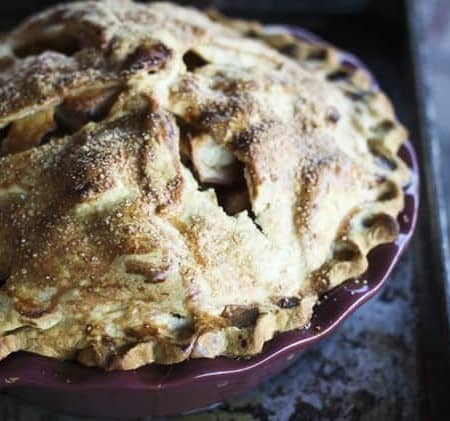
High Peaks Deep Dish Apple Pie and a {GIVEAWAY!}

High Peaks Deep Dish Apple Pie and a {GIVEAWAY!}

This glorious high-peaks, deep-dish apple pie is the ultimate in apple pies. Clean, pure apple flavour shines through and tastes wonderful with whipped cream, vanilla ice cream or a big wedge of aged Cheddar on the side.

Ingredients

  • Pie pastry for a double-crust, 9-inch pie
  • 10-12 apples, peeled, cored and thinly sliced
  • 1/4 cup boiled cider syrup or plain apple cider
  • 2 tablespoons lemon juice
  • 1 teaspoon vanilla extract
  • 1 cup granulated or raw sugar
  • 1/4 cup clearjel or cornstarch
  • Optional: milk and coarse sugar for brushing on the crust

Instructions

Preheat the oven to 425°F.

Roll out half of your pie pastry and line a deep dish pie plate, draping excess over the edges. Set aside.

In a large mixing bowl, toss the apples with the cider syrup, vanilla extract and lemon juice. In another smaller bowl, whisk together the sugar and clearjel or cornstarch until evenly combined. Pour over the apples and toss to evenly distribute. Use your hands to carefully pile and pack the apple slices into the pie plate. You may have to break up some pieces to find a way to get it all in there and it WILL mound up over the crust, just keep the excess pie crust clean and uncovered.

Roll out the second pie crust so that it is large enough to drape over the apples and around the edges of the pie plate a bit. Tuck the top crust under the excess bottom crust and crimp in whatever style you prefer. Cut a couple of vent holes on top of the crust (slits or shapes), brush the crust with milk and sprinkle with coarse sugar.

Put in the oven and bake at 425°F for 15 minutes, lower the heat to 375°F and continue baking for 45-50 minutes or until the juices are bubbly in the pie and the apples are tender when pierced through the vent holes. If the crust starts browning too quickly, tent loosely with foil around the edges.

Cool at least to room temperature before slicing if you want the slices to hold together.

http://www.foodiewithfamily.com/2012/10/25/high-peaks-deep-dish-apple-pie-and-a-giveaway/

Now let’s talk GIVEAWAY! YES! Just look at everything in this Bear Creek Gift Box.

I have a couple of ways for you to enter.

MANDATORY ENTRY: Leave a comment telling me your plans for this gorgeous gift basket. Will you use it for appetizers at a dinner party? Share with friends and neighbors? Hide in the closet and eat it all yourself? (I recommend this last option at least for the Moose Munch and chocolate covered cherries.)

Optional Entry 1: Like Foodie With Family on Facebook.

Optional Entry 2: Like Harry & David on Facebook.

Optional Entry 3: Follow Foodie With Family on Twitter.

Optional Entry 4: Follow Harry & David on Twitter.

Don’t forget to leave a separate comment for each one of the optional entries so I can count them all! The approximate retail value of this gift box is $59.99. I will draw a random name on Saturday, October 27th ! Be sure to come back to see if you’ve won! Good luck, everyone!!

Thai Red Curry Shrimp with Coconut Rice (How to Freeze Rice) | Make Ahead Mondays


My husband doesn’t like curry. …Or at least he SAYS he doesn’t  like curry. He claims it makes him belchy. (Since when did that deter him, I ask…) This is one of my eternal frustrations because I do like it. A lot. It goes both ways.  My husband adores angel hair pasta cooked past al dente served with piles and piles of meat sauce. I say this is sloppy joes on pretend pasta. Ah, love; it’s not all wine and roses. Sometimes it’s burps and mushy noodles. The important thing is that we both recognize that we don’t have to have the last word.

I question how much my husband actually dislikes curry, though, because over the years I have featured at least four recipes in our regular rotation that lean heavily on curry whether in powder or paste form. One of them is one of the most popular posts ever here on Foodie With Family. Another is one of our family favourites and a prize winner. I think it’s more accurate to say that he’s picky about curry. I don’t blame him. In my opinion, the balance of curry is easy to mess up. It can go from complex and tantalizing to muddy and overwhelming if too heavy a hand is used.

I have realized after years of experimentation, that the one kind of curry my husband will invariably love is a Thai curry, specifically a red curry. Red curry is a blend of lemongrass, garlic, Thai ginger and red chiles (among other things). How could you possibly go wrong with that?  When RiceSelect sent me a jar of their Texmati light brown rice*, I knew right away what I was going to do with it. It was getting a red curry topping.

*What I love about this rice is that it cooks quickly like white rice and tastes a great deal like it, but gives you much of the nutritional content of brown rice. As a mom of many, I call that a win.

Because the curry we were making was a Thai curry, we decided to turn our dinner into a party to explore Thai culture along with our meal. In Thailand it’s considered unlucky to eat alone*, so we loaded our table up with friends and family. This is an easy task given that our family makes seven per meal all by itself. Since our dinner party was on Sunday, we all wore red; the traditional colour assigned to Sunday in Thai culture.

*Well, gee. I must be the luckiest woman alive, then. I almost never eat alone. (Unless you count me hiding in the bathroom to inhale a chocolate bar.)

In keeping with the Thai theme, we used bamboo mats on red place mats to decorate the table. My son Ty declared it to be his day. Thai. Ty. Oh my. This same child also selected a knots and rope-work class based on the fact that he should be great at it since his name is Ty. Ty. Tie. Help.

Back to the good stuff…

The curry we had was a Thai Red Curry Shrimp: a dish that appears far too simple to have the complex and comforting flavour that it delivers. Coconut milk and red curry paste simmer with onions, peas and shrimp and are ladled over fragrant coconut rice. A simple scattering of chopped fresh cilantro and basil over the top of the dish seems insignificant until you taste it. The fresh herbs, sweet shrimp, and umami laden curry coconut sauce with vegetables all come together in a symphony of flavour, including all four of the main seasonings of Thai cuisine: salty, sour, bitter, and sweet.

Because the curry itself comes together in very little time, the recipe I’m including here calls for making a larger amount of rice than you’ll need for the meal. Coconut rice freezes and reheats beautifully, so the recipe includes instructions for freezing the extra rice for last minute cravings and nights when you’re on the run. Do take advantage of this!

Coconut rice is a beautiful base for stir-fries, sweet and sour meatballs, hamballs. Coconut rice also adds a little unexpected flair to fried rice; simply use your hands to break up the frozen rice directly into the hot pan.

Give this super-fast, exotic, satisfying meal a whirl some evening. You’ll be so glad you did. It’s way better than mushy angel hair with sloppy joe topping.

Oh shoot. Did I just get the last word?

Thai Red Curry Shrimp with Coconut Rice (How to Freeze Rice) | Make Ahead Mondays

Thai Red Curry Shrimp with Coconut Rice (How to Freeze Rice) | Make Ahead Mondays

Thai Red Curry Shrimp: a dish that appears far too simple to have the complex and comforting flavour that it delivers. Coconut milk and red curry paste simmer with onions, peas and shrimp and are ladled over fragrant coconut rice. A simple scattering of chopped fresh cilantro and basil over the top of the dish seems insignificant until you taste it. The fresh herbs, sweet shrimp, and umami laden curry coconut sauce with vegetables all come together in a symphony of flavour. Instructions on how to freeze extra rice for future meals are included in the recipe.

Ingredients

    For the Coconut Rice:
  • 5 cups Texmati Light Brown Rice
  • 3 cans full-fat Coconut Milk
  • additional water
  • 1 1/2 teaspoons salt
  • For the Thai Red Curry Shrimp:
  • 1 teaspoon coconut oil or vegetable oil
  • 1 medium cooking onion
  • 1 can full-fat coconut milk (13-14 ounces)
  • 1 tablespoon Red Curry Paste
  • 1 tablespoon fish sauce
  • 1 tablespoon raw sugar or light brown sugar
  • 1 cup frozen peas
  • 1/2 cup water
  • 1 pound raw, shelled, cleaned shrimp
  • Chopped fresh basil and cilantro for garnish
  • Optional: 1 teaspoon lemongrass paste (available in the produce section at grocery stores.)

Instructions

To Make Coconut Rice:

Add all of the ingredients to the bowl of a rice cooker, select regular rice cycle (no need to cook on the brown rice cycle) and begin the cycle. When finished, fluff with a fork and serve.

(If you do not have a rice cooker, combine all ingredients in a stockpot. Bring to a boil, stirring once, then cover with a tight fitting lid or foil. Reduce heat and simmer for 20 minutes. Remove the pan from the heat and let stand, undisturbed, for 5-10 minutes. Fluff with a fork before serving.

To Freeze Extra Coconut Rice:

Line a sheet pan with parchment paper or rinse the pan with water and shake off excess. This will keep the rice from sticking. Spread the rice out on the pan and let stand until it is no longer steaming hot. Rinse a measuring cup with water and shake out the excess. Measure meal-sized portions into re-sealable zipper top bags. Use your hands to gently flatten the rice and distribute it evenly in the bag. Seal the bags, label and store in the freezer for up to 6 months.

To Reheat Rice:

Transfer the frozen rice to a microwave safe container and microwave on high in 1 minute bursts, until the rice is hot all the way through. Fluff with a fork before serving.

To Make the Thai Red Curry Shrimp:

Heat the coconut oil over medium high heat in a large saucepan. Add the onions to the pan and saute, stirring or tossing occasionally, until the onions have a touch of brown to them.

Add the coconut milk and red curry paste to the pan and bring to a boil, whisking to combine the red curry paste into the coconut milk. Lower the heat and let it simmer gently for 5 minutes.

Add the fish sauce, sugar and water and return it to a boil. Again, lower the heat and let it simmer for 8 minutes. Add the optional lemongrass paste (if using) and whisk it in carefully.

Add the frozen peas and cook until the peas are hot all the way through, about 2 minutes. Bring the liquid back to a gentle simmer and add the cleaned, shelled shrimp. Cook just until the shrimp are curled and pink. This should take between 3 to 5 minutes.

To Serve the Coconut Rice and Thai Red Curry Shrimp:

Scoop a serving of coconut rice into each bowl and spoon the shrimp with the sauce and vegetables over the rice. Scatter some chopped cilantro and basil over the top and serve immediately.

http://www.foodiewithfamily.com/2012/10/01/thai-red-curry-shrimp-with-coconut-rice-how-to-freeze-rice-make-ahead-mondays/


This post is brought to you by Rice Select. All opinions are, as always, mine alone.

Slow-Cooker Red Beans and Rice and Creole Seasoning | Make Ahead Mondays

I’m going to go ahead and say right now that I have absolutely zero idea how authentically “Cajun” today’s recipe is, having never actually been to the great state of Louisana. All I know is that it is very possibly one of the tastiest things to come out of my kitchen in recent weeks.

There are few things more satisfying than a big bowl of cooked rice topped with saucy, spicy, tender red beans and smoky sausage rounds then crowned with green onions and sour cream. Whether the weather be cold, or whether the weather be hot, as the saying goes, you can weather it better with a bowl of this under your belt. It is one of the few comfort foods that does hot or cold weather conditions equally well.

On a wild hare, I decided to throw my usual red beans and rice ingredients into my slow-cooker and see what happened. I figured that the worst case scenario would be a flavourful mush and the best case scenario would be the world’s easiest and wickedly economical dinner. I turned my best beloved slow-cooker to high, let ‘er rip, and walked away for six hours.

The next six hours were spent trying fervently not to eat everything in the pantry because it smelled so ever loving good in this house that I thought I might die. I repeatedly broke the cardinal rule of slow-cooking and crockpot-ery by lifting the lid and testing and re-testing beans to see if they were (oh please oh please oh please) done yet. After those agonizing six hours were up, I was rewarded with the easiest -and easily the best- red beans and rice I had ever made.

The facts that it didn’t heat up my kitchen and that the hardest part of the whole procedure was keeping myself from eating it before it was done were just gravy. My word, friends, it was so good.

So good, in fact, that I made a double batch again later that week and plan on making it for company when we receive a houseful of family for my brother’s wedding next month. It’ll be just thing; set it up and let it cook while running around for rehearsals, making the wedding cake, and trying to get five boys who’d rather not see the inside of a shower ready for their uncle’s wedding. Pray for me folks. It’s the getting the boys ready that’s giving me palpitations.

There is one grave danger attendant to making this recipe. It smells so good while cooking that there is a very real possibility that you will gnaw off your own leg of that of someone nearby.

I have just a couple of other thoughts to share about this recipe.The Creole Seasoning is wonderful to have on hand for recipes that call for it, to be sure, but we like to use it on other things, too. For instance, we love it on popcorn or homemade tortilla chips.

I like to make it really spicy and then mellow it out in my own bowl with a big dollop of sour cream. I think a fistful of grated Cheddar would do something similar if you’re so inclined. To do this, I tend to use the higher amount of cayenne pepper I specify in the recipe.

On the other hand, you could just keep the spice to a minimum in the first place. If you’d like to keep it on the milder side, cut back on or omit the additional cayenne pepper (above and beyond the small amount that is already in the Creole Seasoning) from the recipe.

I know andouille is the sausage darling of Cajun/Creole cooking, but it can be hard to find in these parts, so I most often make mine with smoked sausage. I absolutely love it this way, so do not feel like your ability to make this spicy, smoky classic hinges on the availability of andouille.

Slow-Cooker Red Beans and Rice and Creole Seasoning | Make Ahead Mondays

Slow-Cooker Red Beans and Rice and Creole Seasoning | Make Ahead Mondays

Whip up a batch of this handy Creole seasoning to add a little oomph to your every day dishes or reserve it for the most wonderfully tantalizing and simple red beans and rice you've ever had. The slow-cooker does the work so you can stay out of the kitchen on hot days. Be forewarned: this smells so good while it's cooking that you may feel ravenous by the time dinner rolls around.

Creole Seasoning adapted from Emeril Lagasse's recipe.

Ingredients

    For the Creole Seasoning:
  • 3 tablespoons paprika
  • 2 tablespoons kosher salt
  • 2 tablespoons garlic powder
  • 1 1/2 tablespoons dried thyme
  • 1 tablespoon onion powder
  • 1 tablespoon cayenne pepper
  • 1 tablespoon dried leaf oregano
  • 2 teaspoons black pepper
  • For the Slow-Cooker Red Beans and Rice:
  • 10 cups water
  • 3 cups small red chili beans (about 1 1/2 pounds), rinsed and picked over
  • 1 pound smoked sausage or andouille, sliced into 1/4 to 1/2-inch rounds
  • 1 red bell pepper, stemmed, seeded and cut into 1-inch pieces
  • 1 medium cooking onion (yellow or white), peeled, trimmed of root and blossom ends, and diced
  • 1 rib celery, cut into 1/2-inch pieces
  • 1 tablespoon Creole Seasoning
  • 1/2 teaspoon dried thyme
  • 1 bay leaf
  • 1/8-1/2 teaspoon ground cayenne pepper (according to heat preference)
  • For Serving: Hot cooked rice and green onions
  • Optional: Sour Cream

Instructions

To Make the Creole Seasoning:

Add all of the ingredients to a small mixing bowl bowl and toss together with a fork or a whisk. Store, tightly covered, in a jar or other airtight container in a cool, dry place. This is good for about a year after mixing.

To Make the Slow-Cooker Red Beans and Rice:

Add the water, beans, sausage, red bell pepper, celery, Creole seasoning, thyme, cayenne pepper, and bay leaf to the bowl of a slow-cooker. Add the lid and turn the heat to "HIGH'. Let it cook for 6 hours, stirring once or twice. After 6 hours, use a spoon to fish out a bean to test. If it is tender, turn off the heat. If it is still underdone, replace the lid and cook for another hour or until the beans are tender. Remove and discard the bay leaf.

Gently stir the contents of the slow-cooker before ladling over bowls of hot, cooked rice. Garnish with chopped green onions and -if desired- sour cream.

Store leftover beans tightly covered in the refrigerator for up to 4 days or freeze in individual portions for longer storage: up to 6 months.

http://www.foodiewithfamily.com/2012/07/16/slow-cooker-red-beans-and-rice-and-creole-seasoning-make-ahead-mondays/

Tocino (Filipino Cured Pork) | Make Ahead Mondays

UPDATE: The National Pork Board has generously extended the deadline for The Foodbank donation partnership with you all because you’ve been asking such great questions! In other words, every question you leave for pork producers in the comments on this post, the Foodie With Family facebook page, or on Twitter with the hashtag #sustainablepork will translate to 1 pound of pork being donated to The Foodbank of Ohio. No strings attached!

Pork.

It’s what’s for dinner in one form or another in our house most nights of the week. We are a porkcentric household. That has probably been pretty obvious here with all my use of bacon, chops, roasts, Cuban Pork, Cola Pulled Pork, Hot Tex Mess, and more (scroll down for porky goodness.) So when the National Pork Board contacted me to see if I wanted to take a tour of a sustainable pork farm, I replied with a pretty quick ‘yes’.  Then they contacted me again and made me an offer I couldn’t refuse.

They are going to donate one pound of pork to The Foodbank in Ohio for every question you all leave here for me to ask them when I go on the tour up to 1,000 pounds. Holy cow. Or should I say holy pig?

Just think of how many people we can feed if you all are curious enough!

Let’s talk for a moment about what I’ll be looking at when I head out to Dayton. According to the information sent to me by the National Pork Board, within a 50 year time frame, pig farmers have reduced their carbon footprint by 35%, reduced water usage by 41% and decreased the amount of land needed to grow feed by 78%. Additionally, we are getting more meat from fewer pigs – which helps reduce the use of natural resources to raise pigs.

 The Pork Checkoff has been honoring the sustainability efforts of pig farmers for 18 years with the Pork Industry Environmental Steward Award. The farm I will be visiting on July 24 was recently honored with this award.

So where do you come in on all of this? Just leave me a question in the comment area below (or on Twitter using the hashtag #SustainablePork ) between now and July 13th. All comments and tweets that have questions for me to ask the farmers and the National Pork Board representatives will count and one pound of pork will be donated per question or tweet.

~~

Now I figure you all know me well enough to realize that I couldn’t talk this much about pork without giving you a great recipe for it. That would just be unkind. Without further ado, I present to you one of my favourite freezer pleasers; Tocino. (Pronounced toe-see-no.)

Tocino is a Filipino dish that I have loved longer than I can remember. Starting with a humble and inexpensive pork shoulder (about $1.29/lb where I shop), a little slicing and a quick cure in some sugar and spice in a resealable zipper top bag, you end with a salty but sweet, crisped pork that tastes like super meaty bacon. It doesn’t take much work, and once you’ve tossed the pork with your sugar and spices, you can stash the bag in the freezer for up to six months before frying or grilling. Low investment, mega-payoff.

The sugary salty cure that enrobes the thin slices of pork keeps the mixture from freezing totally solid, so you can scoop out what you’d like to serve for dinner and leave the rest frozen for future meals. The traditional accompaniment for tocino is garlic fried rice and a fried egg for the classic Filipino breakfast called Tosilog. Doesn’t that sound like just about the best possible way to start a day? I speak from experience when I say it makes one heckuva lunch, dinner or snack, too.

Tocino is traditionally cured with red food colouring or other agents (like the pink salt, or saltpeter, used in curing other meats). I’m not super keen on food colouring, so I use beet powder as recommended by Jun-Belen. That man is a genius. The beet powder adds an appetizing red colour without adding any funky insect or chemical colouring. Lest you fear the beet, let me assure you it does not impart any beet-y flavour to the finished product.

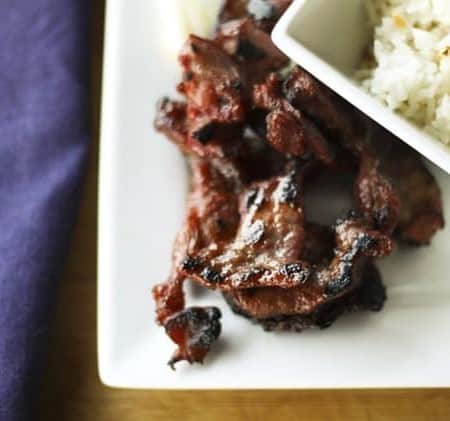
Tocino (Filipino Cured Pork) | Make Ahead Mondays

Tocino (Filipino Cured Pork) | Make Ahead Mondays

Do you love meaty bacon? Give this traditional Filipino, quick-cured, pork a try. An inexpensive pork should gets a boost from the fast-curing sugar, salt and spice combination and yields salty, sweet perfection that is reminiscent of thick cut bacon. It stores beautifully in the freezer for whenever cravings strike.

Ingredients

  • 3 pounds pork shoulder, sliced into 1/8-inch thick pieces
  • 3/4 cup raw or granulated sugar
  • 3/4 cup brown sugar (light or dark)
  • 1 clove garlic, peeled and minced
  • 3 tablespoons kosher salt
  • 3 tablespoons beet powder (you can substitute about 15 drops of red food colouring if you prefer.)
  • 1 tablespoon light soy sauce
  • For Cooking:
  • Vegetable, peanut or canola oil for pan frying

Instructions

Combine both sugars, the garlic, salt, beet powder (or food colouring), and soy sauce in a very large resealable zipper top bag (2 gallons) or a stain-proof container with a tight fitting lid. Close the bag or container tightly and shake to combine ingredients evenly. Open the bag or container, drop the pork slices in and reseal. If using a bag, squeeze the bag to thoroughly coat all of the pork with the sugar and salt mixture. If using a container, use your hands to move the pork around to be sure it is thoroughly coated in the mixture then close the container tightly.

Put the bag or container in the refrigerator and let it cure for at least 2 days before using, but up to 4. Alternatively, you can put the container or bag directly into the freezer (letting it sit for at least a week before using) for up to 6 months.

To Cook the Tocino:

Whether using fresh from the refrigerator or directly from the freezer, remove the amount of tocino you want to cook and let it sit in a colander for several minutes to drain any excess liquid.

You may either grill the tocino over high, direct heat, or pan fry in batches. To pan fry, heat about 2 teaspoons of oil in a heavy-bottomed skillet over medium-high heat. Fry the pieces until cooked through and browned with little charred bits, about 2-3 minutes per side.

Serve, if desired, with garlic fried rice and a fried egg for a traditional Filipino breakfast.

http://www.foodiewithfamily.com/2012/07/09/tocino-filipino-cured-pork-make-ahead-mondays/

Don’t forget to leave your question for the pork farmers and National Pork Board below. Every question you leave will provide a hungry family with a pound of pork!

From July 23-24, I will be attending a tour of an Ohio family’s pig farm with the National Pork Board (NPB) focused on sustainability efforts in the pork industry. NPB will cover the costs of my trip, but all opinions expressed are my own.


Kitchen Sink Hush Puppies | Pepper Jack and Ham Deep Fried Cornbread


I have a deep love for hush puppies that began -as so many things did- in my childhood in Kentucky. I was awfully young when we lived there and don’t have very many concrete memories of the place aside from creek stomping, salamander capturing, and sledding down coal piles in snow suits*, but one thing I do remember vividly is making occasional treks out of the holler and into the biggest nearby town for excursions that almost always ended in a trip to Long John Silver’s.

*No really. We did that. Being a family from Michigan, we missed our sledding hills and winter sports while living in Kentucky. My mom’s clever solution was to kit us out in snow suits and go sledding down a local coal pile.

Now, I know very well that hush puppies weren’t invented by or exclusive to Long John Silver’s  but it was my favourite part of the long haul into town and back. In all likelihood, it was what made me behave in public. Deep fried foods have that power over me and always have.

A fried fish dinner with hush puppies was my inevitable order and -truth be told- I ordered that every time just for the hush puppies. I pushed the fish around the greasy little cardboard clam shell case hoping I’d missed a piece of hush puppy here or there.

Dead crispy, dark golden brown, deep-fried nuggets of cornbread studded with onions: what wasn’t to love? The answer is nothing. And though my time in Kentucky was limited, my adoration for hush puppies remained. My mom didn’t do a ton of deep frying, despite the fact that her affection for all foods fried is as abiding as mine. She did break out the boiling oil for special occasion foods like lumpia and hush puppies, but it wasn’t a regular thing. I think this cemented the idea that fried foods -hush puppies, in particular- equaled celebration food.

I’m a little (okay, a lot) more loosey goosey with the deep fat frying than my mom. I’m pretty easy to persuade that it’s time for some deep-fried something or other.  When I got home from a successful vendor meeting for our local farmers’ market where I was introduced as the newest member of the management team (Shout out to Angelica Farmers’ Market: The best local producer and artisan market in Western New York!) I felt pretty excited. Where some people would take that excitement and go for a run, tidy a room, complete a project, I channeled it into HUSH PUPPIES! …Because that’s just the kind of gal I am.

I cranked up the heat under two inches of oil in a pan, spent five minutes chopping some goodies to toss in, measuring, and mixing, and in the time it took the oil to heat, I was standing by with my little scoopy thingy in hand, ready to get my fry on.

Here’s where the magic happens. When I dropped the first couple of scoops of hush puppy batter into the pan and the scent bubbled up  on the oil, my kids -who had been energetically flying around the yard, climbing trees and living in their imaginary worlds all day long- materialized behind me asking things like, “What smells so good?” and “Are those for us? Please say yes!”. My wee six year old said, “Are those for dinner? Or just part dinner?”

Hush puppies don’t take long, folks. This is not a delayed gratification food. When I pulled the first batch out a mere three minutes after dropping them in, the kids were standing by with forks in hand, ready to skewer on my say so. And skewer they did. Forks rammed down into those hush puppies so fast I feared for my fingers. Little teeth nibbled away and happy groans were heard. The same six year old who had previously asked what part of the meal these would comprise announced, “This is the best part dinner of my whole life. Ever.”

Unlike back in the day of the simple unadorned hush puppy, though, today’s were extraordinary. A plain hush puppy is good enough, mind you, but when you add minced ham, green onions and spicy pepper jack cheese to the usual chopped onions, you get a hush puppy that will, well, hush your puppies. We’re talking about what is essentially craggy, crispy, deep fried corn bread balls stuffed with creamy, spicy pepper jack, salty minced ham and two kinds of onions. These aren’t your standard issue Long John Silver hush puppies, people. Not by a long shot.

What do I serve these with? Mainly I serve them with this sauce and gorge myself, but I suppose there are those of you with more will power than I have and to you I say, “Serve them alongside fish dinners, with soup or salad, with chili or with a good supply of toothpicks and napkins on a buffet table.”

While you whip up something to accompany these, I’ll be over in my chair with my feet up trying to come up with a reasonable explanation for how many of these I ate. Carry on.

Some Notes:

  • I prefer these made with a nice coarsely ground corn meal. The widely available canister cornmeal will do alright, but for the ne plus ultra of hush puppies, go for the really gritty stuff.
  • Please, for the love of all things good in this world, grate your own cheese for these. It doesn’t have to be fancy cheese. It doesn’t have to be expensive, but don’t use the pre-grated cheese-in-a-bag. That cheese is coated with stuff to keep it from clumping which also has the net effect of making it melt in a way that isn’t as happy making. There’s a time and a place for the pre-grated stuff, but it’s not here.
  • Mince your ham into the itty-bittiest pieces you can produce. The same goes for the green onions and the sweet onions. It’s all about the distribution, folks. The finer you mince those things, the better the chances that you’ll get a little of everything in each bite. That is a very good thing. Trust me.
  • Don’t get fancy with the way you drop your batter into the hot oil. You don’t want perfection of shape on these. The irregular, jutting-out parts are the crispiest spots on the hush puppies. Those are the bits that render me powerless against them.

Kitchen Sink Hush Puppies | Pepper Jack and Ham Deep Fried Cornbread

Kitchen Sink Hush Puppies | Pepper Jack and Ham Deep Fried Cornbread

These dressed up hush puppies are craggy, crispy, deep fried corn bread balls stuffed with creamy, spicy pepper jack, salty minced ham and two kinds of onions. Eat them as a stand alone snack or appetizer, or serve alongside fish dinners, soups, salads or chilis.

Ingredients

  • 2 inches of canola, peanut or vegetable oil, or lard in a high-sided, heavy-bottomed pot or skillet (or an electric deep fryer)
  • 1 1/4 cups cornmeal
  • 3/4 cup all purpose flour
  • 1 tablespoon sugar
  • 1/2 teaspoon salt
  • 1/2 teaspoon baking soda
  • 1/4 teaspoon ground black pepper
  • 1/8 teaspoon cayenne pepper
  • 2 tablespoons butter, melted
  • 1 cup plain yogurt or buttermilk
  • 1 large egg
  • 1/4-1/2 cup finely minced or chopped fully cooked ham
  • 1/4 cup finely minced or chopped green onions
  • 1/4 cup finely minced or chopped sweet onion
  • 1/4 cup shredded pepper jack cheese

Instructions

Place the oil-filled pot over medium high heat and bring the oil to 375°F. Line a bowl or baking pan with paper towels and set aside.

In a large mixing bowl, combine the corn meal, flour, salt, sugar, baking soda, black and cayenne pepper with a whisk. In a separate bowl, use the same whisk to thoroughly combine the butter, yogurt or buttermilk and egg. Pour that directly into the flour mixture, add all of the mix-ins, and use a spatula to stir everything together gently, just until no more dry pockets remain and it is combined evenly.

Use a 1 1/2 teaspoon scoop (or simply mound the batter on a teaspoon) to drop the batter into the hot oil. Fry only as many as can comfortably fit into the pan while leaving room for them to move around. Don't overcrowd that pan! Fry the hush puppies for 2-3 minutes per batch, flipping them about halfway through the cooking. Use tongs or a slotted spoon to transfer the finished hush puppies to the paper towel lined bowl or pan and let drain briefly before serving.

These are best when served hot, but are still great warm or room temperature. You can store leftover hush puppies in a paper towel lined, tightly covered container in the refrigerator and reheat them for just a few minutes in a hot oven to re-crisp them.

http://www.foodiewithfamily.com/2012/04/17/kitchen-sink-hush-puppies/

Pasties and Beef Gravy | Make Ahead Monday

Way back in 2008, one of the first recipes I ran on Foodie With Family was for my beloved pasties. (Pronounced PAH-steez, not PAY-steez, thankyouverymuch!) Today’s Make Ahead Monday recipe is a feature of those absolutely wonderful meat pies along with a (tada!) printable recipe and another for *gasp* beef gravy. Read on for why I’m all a-twitter over the gravy.

I was talking with my stepmom, Val, on the phone the other day when she said, “Oh no! Beccy! I have to go!” I said, “Are you alright, Val?” She responded, “I forgot I have to pick up our pasty order from the church. They’re going to close in a couple of minutes.”

All my sympathy and concern that I had queued up for her flew right out the window.

She got to scoot half a mile down the road to pick up a half dozen of the finest Finnish grandmother produced, hand-made, Yooper pasties. I got to drool.

I indulged in a certain amount of self-pity and then roused myself to action. I wheeled on my heel when my husband entered the room and announced, “There WILL be pasties. And it WILL be soon!” imperiously.

While on the whole I find it against my nature to march around making pronouncements, pasties warrant a massive exception. I queened it up big time.

“You must find me a rutabaga! A big one!”

My husband looked at me askance.

“…And we’ll need ketchup!” I added in my most royal tones. Then I said, “You know, Val eats her pasties with gravy. I love her anyway.”

That is where he revolted. “Hey. I know you Yoopers eat ‘em with ketchup and everything, but why? I’d give anything for some gravy with a pasty.”

My every fiber screamed, “NOOOOOOOOOOOOOOOO!”*

 *And here, perhaps, it is time for a brief cultural lesson. People who live in the Upper Peninsula of Michigan are referred to –both by themselves and those below the bridge- as Yoopers. Yoopers love pasties. But even more than Yoopers love pasties, they love ketchup on pasties. Why? I haven’t the foggiest idea, but we do. And the quickest way to find out whether someone is a Yooper by passing them a gravy boat and a ketchup jar. Watch them carefully. A moment’s hesitation, a feint for the gravy boat, and you know without a doubt that you are not in the presence of a honest-to-goodness Yooper.

It was my turn to look askance. And askew. And aghast. “What do you MEAN you want gravy?”

He responded, quite reasonably, “I’m not saying YOU can’t have ketchup, but really, we’re talking about a meat pie with potatoes and stuff. What could be better on that than gravy?”

I had to admit that I didn’t have anything other  a traditional leg to stand upon in the argument.  There was no way I could deny him gravy. I’m not ashamed to admit, though, that my head spun a bit as I whipped up the beef gravy. Through my head whirled jokes family members had made about gravy-on-pasty eaters. I remembered a story my dad told about being at a county fair and overhearing some folks talk about being from the U.P. He then approached the couple and said, “Excuse me. I just have one thing to ask. Ketchup or Gravy?” They clapped him on the shoulder and said, “KETCHUP!” They became fast friends.

I put pasties on plates. I put ketchup and –horrors- a gravy boat on the table and watched quietly as all my offspring and my husband poured gravy on their pasties. I reached for the ketchup and scooped a generous portion onto my plate. (Another argument, but one for another day, is whether you put your ketchup on the side or on top of the pasties. What can I say? It’s cold and very rural. We do what we can to keep things interesting.) And then. Then they looked at me and used on me the argument I always use on them, “Aren’t you even going to try it?”

I sensed my authority hanging in the balance and said, “Oh ALRIGHT. Gimme the gravy boat. I’ll try it.” (I was less than gracious about it, but there’s only so much going back on tradition a woman can take with equanimity.) I poured a bit on the corner of my pasty and took a hearty fork full. And then I about died.

It really was not bad. In fact, it was pretty alright. Oh dang. It was good.

Rats.

I won’t have you believe I chucked my Yooper card and ate it wholesale with gravy. Oh no. I still had my ketchup, too, but I grudgingly admit the gravy will be on the table every time I make pasties.

Darnit.

Yoopers, look away.

In this fresh printable version of the old Yooper Pasty post, I’ve included a lovely beef gravy recipe. Just in case, ya know, you wanna freak out a Yooper you love. Or eat a pasty with it. Sigh.


Pasties and Beef Gravy | Make Ahead Monday

Yield: 16 large pasties

Pasties and Beef Gravy | Make Ahead Monday

This is comfort food at its finest; hand held meat and potatoes pies with rutabaga, carrots and onions. Traditionally, these pasties are served with loads of ketchup, but folks have been known to love (read:inhale) them when covered with good beef gravy, too.

Ingredients

    For the Filling:
  • 1 large rutabaga and 1 small rutabaga
  • 2 large carrots
  • 2 medium onions
  • 8 medium potatoes, preferably a waxy variety like Yukon golds or reds
  • 4 pounds lean ground beef
  • salt and pepper to taste
  • For the Crust:
  • enough sturdy pie dough for eight double crust pies (or eight boxes prepared refrigerated pie crusts) I use a double or triple batch of this pie crust.
  • For the Beef Gravy:
  • 4 tablespoons butter or beef fat drippings
  • 4 tablespoons flour
  • 2 teaspoons browning sauce
  • 2 cups beef stock
  • a pinch of thyme and granulated onion
  • salt and pepper to taste

Instructions

Preheat oven to 375°F.

Slice a sliver off one end of the rutabaga so that it stands sturdily on your cutting board. Then use your biggest, sharpest knife to lob it in half. If it’s freaking you out too much to try to hold a slippery, wax covered, round and really hard vegetable while trying to cut it, feel free to whack it in half with a hatchet or an axe. Just don’t do it on your kitchen counter!

Once you have the brute opened, lay it on the flat side and dismantle it further so your original sphere is in quarters. Take another little bit off the bottom so you can stand the quarters up on their ends and use another sharp knife to remove the peel from the sides.

Cut the rutabaga into 1/4? slices and stack them like a deck of cards. Slice them into 1/4? strips that will then be cut into 1/4? cubes.

Peel and dice the carrots, onions, and potatoes in the same way. Combine all diced vegetables in a gigantic mixing bowl. Break the lean beef over the top, add salt and pepper, and use your hands to mix thoroughly.

Roll out a piece of pie crust to a diameter between 8? and 10?. Lay on a pie plate with the crust hanging over the lip of the plate by about 1/4?. Use your hands or a large spoon to transfer as much filling onto the crust as you can, mounding and pressing down lightly with your hands, to fill the half of the crust that is hanging over the plate.

Now fold the empty part of the pie crust over the filling, pinch the seams together, transfer to your countertop and crimp the edges with a fork.

Transfer to a parchment lined pan and slice a couple of small vents into the top of each pasty.

Slide those pans into the oven and bake for 45 minutes to an hour. Since pasties don’t traditionally get an egg glaze, they won’t be a shiny brown when done, but a deep crispy looking golden brown.

Serve immediately with beef gravy (see below) or cool completely, wrap with foil and freeze for later use.

To Reheat from Frozen:

Place foil wrapped pasty in a preheated 350°F oven on a rimmed baking sheet for 30 minutes. After 30 minutes, open the foil so the top crust of the pasty is exposed and heat for an additional 10 minutes, or until hot all the way through.

To Make the Gravy:

Melt the butter or pan drippings in a heavy skillet or saucepan over medium high heat. Whisk in the flour and cook, whisking often until bubbly and fragrant smelling, at least 2 minutes. Whisk in the cold beef stock, thyme and granulated onion and bring to a boil, stirring frequently. Taste the gravy, adjust the seasonings and serve hot.

http://www.foodiewithfamily.com/2012/03/26/pasties-and-beef-gravy-make-ahead-monday/