Homemade Tortilla Chips Two Ways

Sometimes a gal just needs something good and greasy and salty to make her feel everything is right with the world.  This past weekend was one of those moments.  With the vehic-ules on the semi-permanent fritz, not being able to grocery shop in person (“No, honey.  I know chocolate chips are expensive, but please get them anyway… And yes, we DO need more milk.”), the kids having just recovered from not one, but two pernicious Spring bugs, and a host of other minor annoyances I needed a little bit of pampering.  And I don’t mean Pampers.  I’ve seen enough of THOSE for quite some time, thankyouverymuch.  Not that I’d pay that much for diapers, mind you, but Pampers in the diaper sense as Bandaids are to adhesive bandages.  I mean to say that I needed something that was good for my soul if not for my middle which is a lost cause at this point anyway after carrying and birthing five baby boys.  And -whatever this may say about my imperfections as a human- there is nothing like some fabulous deep fried goodies to lift my spirits.

Because the trips to the store lately have been limited (as in non-existant) I’ve been relying on hitting up my freezer and pantry to feed the beasts (and here I refer to all of us…  I have no ‘girly’ appetite.  I can eat most men under the table.)  I’ve been doing a pretty good job of it and my deep-fried endeavours were no exception.  Whenever I get to town, I reflexively stock up on whatever tortillas I can find most cheaply.  Last time the 28 ounce/ 36 count packages of white corn tortillas at Aldi happened to be the cheapest tortillas on the block.  So I bought 8 packages.  I stuck them in the freezer for a rainy day.  I was using them up bit by bit when my craving struck.  I sacrificed an entire package of the tortillas to make chips for my crew and the family members who visited over the weekend.  Believe me when I tell you this was not overkill.  There were no chips left in the bowl.  If you’ve been lucky enough to eat homemade tortilla chips before this will not shock you.  If, however, you’ve never known the hot, crispy, wonderful phenomenon that is a homemade tortilla chip then you’re in for a treat.

One of the many nice things about making your own chips is the ability to flavor them in any direction you should choose.  There is a small but very vocal contingent around here who prefers their tortilla crisps fried lightly and doused liberally with cinnamon sugar.  The vast majority of the house (including ME!) prefers them fried crackling crispy and dusted generously with a spicy blackened fish seasoning and coarse sea salt.  You see where I’m going with this?  It’s easy to make the exact chips you want.  On a salt-restricted diet?  Leave the salt off entirely and top with whatever spice blend flicks your Bic.  How about cinnamon/nutmeg/powdered sugar?  Or cheese powder, or Old Bay, or Lawry’s Seasoning Salt, or nori flakes and sea salt.  The sky’s the limit!

And let’s talk pocketbook for a second.  Homemade chips are more filling than the variety you get in a bag, so you eat less of them.  And at a whopping $1.25 for 28 ounces of white corn tortillas we’re looking at the homemade equivalent weight of 1 1/2 of the cheapest pounder bags of pre-made tortilla chips known to man.  When you add in the flavorings and oil for the deep frying  (“WHAT? Did she say deep-fry?  I don’t do deep-frying.” Hang on and stick with me.  It’s not all that scary. I’ll help you out.  That’s what I’m here for.) we’re up to about $2.00 for the finished batch of chips.  This is before you even factor in the fact that the homemade tortilla chips are  infinitely tastier than the purchased variety.

Yes.  I said this recipe deep-fries.  I know there are a lot of folks out there who are seriously worried about deep-frying food for a multitude of reasons.  Among them:

  1. Danger:  If done properly, deep-frying is no more dangerous than any other technique in the kitchen.  With a properly sized DRY stable pan on a level stove with the proper amount of oil and no kids playing hacky sack in the room you’re as safe as houses.  I emphasize the word ‘dry’ because a drop of water in your oil (whether it be from a freshly washed pan or a pair of tongs with a lingering bit of water clinging to it) can wreak havoc with heating oil and cause popping like you wouldn’t believe.  But if you observe those cautions and proceed cautiously you’ll be fine!
  2. Expense:  This is a bit trickier.  There is no doubt that oil is expensive these days.  All I can say is that I generally plan to do at least two or three frying sessions with each batch of oil I dedicate to deep-frying.  Of course, you need to do some planning with that.  If you once fry fish in oil, it’s pretty much only good for frying fish or the ubiquitous chips.  If, however, you start the frying party with tortilla chips or French fries or something else intrinsically mild in flavor and at a moderate cooking temperature it should be good for at least one or two more uses if you strain it after using and store it properly.
  3. Health:  Well yes.  You probably don’t want to eat this every day of the week or even every week.  But in moderation it is a soul-satisfying way to cook.  Add this to the wine/cheese/carb/egg/beer/etc… bogeyman list.  If you eat a steady diet of it you’re pretty well assured of dropping before your time.  If you make it an occasional treat to be savored you’ll not only not die instantly, but you’ll appreciate it more.
  4. Mess:  There’s not a whole lot of getting around this.  Deep-frying can be messy if done wrong and sometimes even if done right. If you have all your ducks in a row before starting to fry you’ll have a much easier job of cleaning up.  Some mess is inevitable, but since you’re not eating this real often (see ‘Health’ bullet point above) the small mess you incur is probably worth it to you.

The truth of the matter is that it isn’t the healthiest, tidiest, cheapest, least-fraught-with-potential-for-injury dish to make (Geez.  Do I know how to sell my recipes or what?  I have to be truthful.  I’ve said it before.  My moral compass if firmly pointed toward ‘Honest’.) but sometimes I just don’t care.  I want a chip, dangit, and I’ll be darned if I’m not going to eat one.  Throw some caution to the wind with me and you’ll wind up, at least temporarily, blissed out with a bowl full of the best chips known to mankind.  I’d say that’s worth the risk every once in a while.

I’ve shown you our two favorite toppings below, but go nuts and experiment with this.  Play with your food a little bit.  Worst case scenario is foisting a failed batch on your grateful dogs.  I can almost promise you they won’t mind.

For a printer-friendly, photo-free version of this recipe, click here!

Homemade Tortilla Chips

Ingredients:

  • White corn tortillas
  • at least 2 1/2 cups Neutral oil for frying (like Canola, Corn or Vegetable oil)
  • Optional for topping; salt, sugar, spices.

Cut white corn tortillas into wedges of desired size.

I used a 28 ounce/ 36 count package of white corn tortillas.  You can do this with flour tortillas, too, but they cook a wee bit faster, so adjust your cooking times accordingly.

I used a 28 ounce/ 36 count package of white corn tortillas. You can do this with flour tortillas, too, but they cook a wee bit faster, so adjust your cooking times accordingly.

Sometimes these little tricksters like to stick together.  If you fan them out before cutting them they'll come apart more easily.

Sometimes these little tricksters like to stick together. If you fan them out before cutting them they'll come apart more easily.

Halvsies...

Halvsies...

This makes me think of Dr. Seuss's 'Fox in Socks' where the main character says, "You can make a quick trick brick stack."  There's no good reason for the association other than making a stack of something.  I'm just sharing too much information.

This makes me think of Dr. Seuss's 'Fox in Socks' where the main character says, "You can make a quick trick brick stack." There's no good reason for the association other than making a stack of something. I'm just sharing too much information.

I like to tip my perfect towers of tortillas over into a pile.  It makes me feel like I'm a rebel.

I like to tip my perfect towers of tortillas over into a pile. It makes me feel like I'm a rebel.

Place oil in a good-sized, heavy-bottomed, completely dry pan over medium to medium-high heat (For 2 1/2 cups oil you should use a high-sided pan that has a capacity of at least 2 1/2 quarts).

tortillachips6

Set your pan over a nice medium to medium high flame or heat.

Set your pan over a nice medium to medium high flame or heat.

You should not fill the pan above 1/3 full for safety’s sake.

This is about the depth you're going for.  You sure wouldn't want more than this because it might lean toward boiling over.  But if you put a little less in it wouldn't harm anything.

This is about the depth you're going for. You sure wouldn't want more than this because it might lean toward boiling over. But if you put a little less in it wouldn't harm anything.

Watch the oil.  When it starts getting little lines in it it is becoming hot.  Test the readiness of the oil by inserting the corner of one of the tortillas into the oil.

This oil is not ready yet.  See how there are very few -if any- bubbles licking around the edge of the tortilla?  That's a dead giveaway, in the absence of a thermometer, that your oil needs to heat longer before you fry with it.

This oil is not ready yet. See how there are very few -if any- bubbles licking around the edge of the tortilla? That's a dead giveaway, in the absence of a thermometer, that your oil needs to heat longer before you fry with it.

If many bubbles form quickly around the tortilla and rise to and break the surface then your oil is ready to go.

This is how your chips should look as they cook.  There should be lots of bubbles coming around the edges of your chips and the chips themselves should be moving (but not violently) in the oil.

This is how your chips should look as they cook. There should be lots of bubbles coming around the edges of your chips and the chips themselves should be moving (but not violently) in the oil.

Stir these little fellas around to make sure they're not sticking together.  Your tongs will do the job admirably here.

Stir these little fellas around to make sure they're not sticking together. Your tongs will do the job admirably here.

Your oil should never smoke when preparing these chips, but steam should come from the surface of the oil.  Your nose will tell you the difference.

Carefully slide the tortilla wedges into the oil. Do not throw them into the oil.  You stand a much higher chance of splattering oil on yourself or your stove if you toss in the tortillas.  Add several tortilla wedges to the pan at a time, taking care not to overload the pan.

This is just about the right amount of chips to put in here.  I wouldn't go with too many more.

This is just about the right amount of chips to put in here. I wouldn't go with too many more.

If you overload it you both lower the temperature of the oil, which makes your food take longer to cook/absorb more oil, and raise the level of the oil which increases the risk of boiling oil spilling over the sides of your pan.  THAT would be a bad thing!

If you desire chips that are not super crispy, remove to a paper towel or newspaper lined dish after about 1 minute.

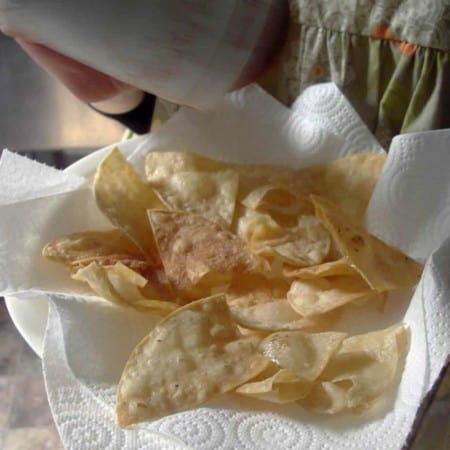
This is the slightly crispy, slighty chewy lighter chip that my cinnamon/sugar lovers adore.  This is after about one minute of frying time.

This is the slightly crispy, slighty chewy lighter chip that my cinnamon/sugar lovers adore. This is after about one minute of frying time.

Can you smell the cinnamon sugar?  Mmmm.  Commence drooling.

Can you smell the cinnamon sugar? Mmmm. Commence drooling.

I had two children hanging off my legs while this picture was taken.  They were not paragons of patience and I can't say I blamed them.

I had two children hanging off my legs while this picture was taken. They were not paragons of patience and I can't say I blamed them.

If you desire crispier chips keep frying them for another minute or so.  Keep in mind that the color of the chips and degree of crispness will increase as they cool on the paper towels.

This is how I like 'em.  Crispy and darker and salty and oooooooh baby.

This is how I like 'em. Crispy and darker and salty and oooooooh baby.

Your feel for the perfect time to remove your chips from the oil will improve as you continue.  If you botch the first batch or so just let them cool and toss them to the dogs.  They won’t care if the chips are overdone and they’ll be grateful for the treat.

As soon as the chips are on paper towels you should season them according to your tastes.  This is a job best done when hot.  Once the chips are cool they’ll lose the power to hold on to all those tasty things you’re shaking all over them.

Blackened fish seasoning.  Don't knock it 'til you've tried it.  It's amazing on chips and you can't buy THAT flavor bag of chips, can you?

Blackened fish seasoning. Don't knock it 'til you've tried it. It's amazing on chips and you can't buy THAT flavor bag of chips, can you?

The Evil Genius says he'd give up any food in the world except for salt.  And coffee.  And chocolate.  He's not real flexible I guess...

The Evil Genius says he'd give up any food in the world except for salt. And coffee. And chocolate. He says he'd rather die. That's why I love him. He knows how to prioritize.

Shortly after snapping this photo I ate the whole blessed batch of chips.

Shortly after snapping this photo I ate the whole blessed batch of chips.

Actually, I didn't eat them all.  Those kids can lay a world of hurt on food in very little time.  I got one solitary chip for all my trouble.  But oh what a chip it was!

Actually, I didn't eat them all. Those kids can lay a world of hurt on food in very little time. I got one solitary chip for all my trouble. But oh what a chip it was!

Serve while still warm for the ultimate homemade chip experience or store leftovers in a tightly closed container lined with a paper towel at room temperature.  If they soften a bit after storage, you can refresh their crispness by tossing them on a pan and into a 350°F oven for just a few minutes…  Remove and serve warm.

Of course, the possiblities for nacho-i-fying these are nearly endless.  You’d never eat a better nacho in your whole life, but these are good enough to eat naked.  The chips I mean.  Not you.  I’ll just eat them in my turtleneck and long pants.  Of course, if you want to eat these naked who am I to judge?  I wouldn’t recommend frying them naked, though…

Now about that oil.  DON’T THROW IT OUT!  Here’s what you do:

tortillachips-22

The fine mesh strainer is the key here...

The fine mesh strainer is the key here...

Pour the oil through the strainer...

Pour the oil through the strainer...

Cap it tightly and stash it somewhere cool and dark for the next fry-daddy go 'round.

Cap it tightly and stash it somewhere cool and dark for the next fry-daddy go 'round.

FMC Mango Salsa

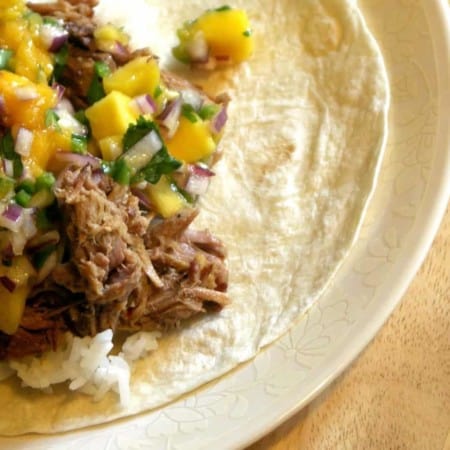
This is the culimation of all the cooking from this week; the Slow-Cooked Cuban Pork with FMC Mango Salsa and steamed jasmine rice on flour tortillas.  And when you eat this life is very, very good.

This is the culmination of all the cooking from this week; the Slow-Cooked Cuban Pork with FMC Mango Salsa and steamed jasmine rice on flour tortillas. And when you eat this life is very, very good.

I am about to become your best friend forever because I am sharing with you the formula for the easiest and most delicious side dish ever, ever, ever.  It is so good that it deserves a ‘Hallelujah’ and ‘Amen’.  My FMC Mango Salsa has its roots in desperation, as most of my favorite recipes do.  One day many moons ago I had grilled a pork tenderloin and planned on accompanying it with a fresh pineapple salsa.  Much to my chagrin I had neglected to put into my grocery cart the crucial pineapple.  There were mangos (goodness knows why I had bought mangos and forgotten pineapples) in my fruit bowl so I did what cooks through the ages have done in times of need.  I substituted.   And woah baby, did I hit pay dirt.  Now I know I’m not the first person to make mango salsa and I sure won’t be the last, but it was a revelation.  The combination of sweet and soft mango cubes with the hot and fruity jalapeno, the pungent red onion, the hot garlic and the tangy lime juice took away my breath.  I practically forgot about the gorgeous grilled tenderloin sitting on my cutting board.  And I surely forgot about the pineapple. *

*Don’t get me wrong.  Fresh pineapple salsa is fabulously delicious, too.  But the unexpected deliciousness of the mango substitute that day quickly dispelled my disappointment at missing the pineapple.   I still loves the pineapple salsa, folks, but given the choice between the two I’d take the mango any day of the week…

If you’ve never tackled a mango, don’t panic.  I can help you.  There are some pretty good tricks (and tools) to get you through the job with fingers and mind intact.  If, however, the thought of choosing and cutting a perfect mango is enough to deter you from trying this recipe and give you the palpitations I have another solution.  Buy a bag of cubed, frozen mango.  In our moderately well-stocked grocery store about 45 minutes from here they carry frozen mango cubes in the ‘Goya’ foods section of the freezers.

But before we get to cutting the mango we need to talk a bit about choosing a good mango.  The perfect mango for our salsa is still firm, but yields a little to gentle pressure from the thumb.  In other words, when you press gently on the mango your thumb shouldn’t poke through the mango skin and cause a geyser of juice to shoot out.  If you look at the skin, there may be a couple wrinkles here and there, but it should be mostly smooth and firm to the touch. And mangos are, in my opinion, easier to pit and cut when they’ve been chilled a bit.

And while we’re talking tips, let me give you a heads-up on fresh jalapenos.  You should probably wear gloves when working with them unless you have impervious asbestos skin.  Jalapenos, on the hot-pepper-pain scale, are relatively low, but all the same…  It’s not so much your hands you want to worry about.  Let me put it this way.  The Evil Genius and I bought a half- bushel of hot peppers we couldn’t identify at the farmer’s market once when we were first married.  We went home, sliced them and boiled them in vinegar to can for later use.  I wore gloves.  He did not.  We were drinking a lot of water while doing the job, hot work and all.  After a couple hours he had to go to the bathroom.  Sadly, this is where not wearing gloves came back to bite him.  Almost literally.  His, er, manly parts were in pain for two days.  Turns out the peppers were serranos.  And yes, they’re much hotter than jalapenos, but remember this…  Each individual hot pepper varies in how much punch they pack.  And if you’re not used to working with them it’s better to be safe than sorry.  If you don’t have gloves (or forget to use them)  follow these simple precautions to keep the burn from getting too bad on your skin.  Before washing hands with hot water, wash first with cold water and soap.  This will keep the pores of your skin from opening up and drinking in the oil from the hot peppers that gives the burning sensation staying power.  Follow the cold water wash with a hot water wash.

If you are worried about the heat and your tongue, be careful to remove all the seeds and membranes when you seed the peppers.  Those are the storage units of heat in any hot pepper.  Once those are gone, a jalapeno is mild and fruity.  Don’t fear the jalapeno.  If you’re unwilling (or medically unable) to go the hot pepper route you can always replace the minced jalapenos with minced bell pepper.

Lest it should escape your notice, this is so healthy and diet friendly it’ll make you sick.  Fruit, vegetables, herbs and salt; that’s all there is.  There’s not a lick of fat in it. And what can this not accompany?  Over rice, with spicy saucy black beans, next to grilled or slow-cooked pork (and here), fish (especially fish), chicken and beef, FMC Mango Salsa is enough to make your tongue slap your brain silly.  It almost makes me weep.  Or was that the onions?

Enough jawing, let’s get cooking.

For a printer-friendly, photo-free version of this recipe, click here!

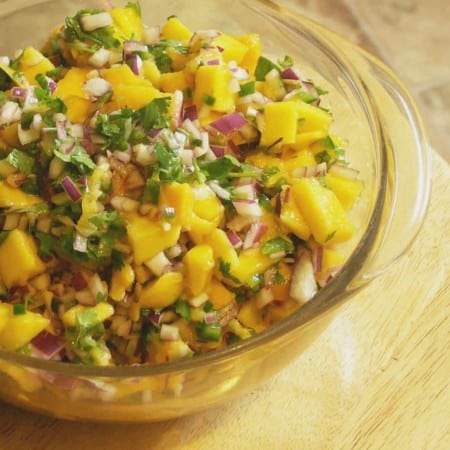
FMC Mango Salsa.  Amen.

Ingredients:

Missing from this picture?  Black pepper.  Fresh ground, please.

Missing from this picture? Black pepper. Fresh ground, please.

  • 2-3 fresh mangos (depending on how much you want to make)
  • 1 medium red onion, diced
  • 3 fresh jalapeno peppers
  • 3 cloves of garlic, minced
  • 1 large handful of fresh cilantro, washed and allowed to air-dry (Hate cilantro?  Use fresh parlsey!)
  • The juice of one lime or orange (or, lacking fresh limes or oranges, 1/4 cup bottled lime or orange juice)
  • 1 teaspoon kosher salt
  • Fresh ground black pepper to taste

Cut the mango halves away from the pits.  Discard the pits. The quickest way to do this is with a mango cutting from OXO,

The goal is to liberate the mango pit from the mango halves.  You can do this with a knife if you don't own this gadget. This little gizmo is supposed to make mango work easier.  The jury is still out on whether or not it's worth the $8.00.  It kind of mangles the tail end of the mango.  Mangled mango is mildly miffing. My bad.  Mind much?

The goal is to liberate the mango pit from the mango halves. You can do this with a knife if you don't own this gadget. This little gizmo is supposed to make mango work easier. The jury is still out on whether or not it's worth the $8.00. It kind of mangles the tail end of the mango. Mangled mango is mildly miffing. My bad. Mind much?

…but you can do this with a knife and a little attention to detail.  The mango pit is a slightly flattened oval that runs in the same direction as the slightly flatter sides of the mango.  Use a knife to cut slabs from the sides (avoiding the pit) of the mango and proceed as directed.  Use a paring knife to get whatever mango flesh you missed from the pits afterward.  To make mango cubes most easily you can:

First slice through to the skin, taking care not to slice THROUGH the skin, at 1/4"-1/2" intervals from end to end.

First slice through to the skin, taking care not to slice THROUGH the skin, at 1/4"-1/2" intervals from end to end.

Now turn the mango 90 degrees and slice the same way across the cuts you've already made.  You'll end up with a nice mango grid.

Now turn the mango 90 degrees and slice the same way across the cuts you've already made. You'll end up with a nice mango grid.

Cup the mango on either side and use your fingers to push up from the underside, inverting the mango.

Cup the mango on either side and use your fingers to push up from the underside, inverting the mango.

Use your paring knife to cut the mango cubes away from the skin.

Use your paring knife to cut the mango cubes away from the skin.

This is what the leftover mango skin looks like.  No matter how careful I am there's always a wee bit of mango left on the skin.  I like to take a break from cookery and gnaw on it a bit.  Do whatever you want.

This is what the leftover mango skin looks like. No matter how careful I am there's always a wee bit of mango left on the skin. I like to take a break from cookery and gnaw on it a bit. Do whatever you want.

Now on to the onions:

Slice an onion half from root to tip at regular intervals, leaving the hairy root end intact to hold the whole works together.  There is a method to the madness...

Slice an onion half from root to tip at regular intervals, leaving the hairy root end intact to hold the whole works together. There is a method to the madness...

Turn the onion 90 degrees and slice across the cuts you already made.  Voila!  Instant dice.  And don't throw away those root tips.  Stash them in a bag dedicated to the purpose in your freezer.  Toss them in when cooking beans, or making stock, or...

Turn the onion 90 degrees and slice across the cuts you already made. Voila! Instant dice. And don't throw away those root tips. Stash them in a bag dedicated to the purpose in your freezer. Toss them in when cooking beans, or making stock, or...

Add the diced onions and minced garlic to a medium-sized mixing bowl.

I like recognizable pieces of garlic in my salsa.  If you're squeamish about that you can grate the garlic on a small-hole grater instead or beat it up with a garlic press.  Follow your preference!

I like recognizable pieces of garlic in my salsa. If you're squeamish about that you can grate the garlic on a small-hole grater instead or beat it up with a garlic press. Follow your preference!

Let’s add some heat.  Stem, halve, seed and mince your jalapenos.

Wear gloves when working with jalapenos, especially if you plan on wiping your eyes or picking your nose in the next 24 hours. Cut the stem ends from the peppers.

Wear gloves when working with jalapenos, especially if you plan on wiping your eyes or picking your nose in the next 24 hours. Cut the stem ends from the peppers.

Cut in half from tip to end.

Cut in half from tip to end.

If you start the spoon at the tip of the jalapeno, the seeds and most of the membranes should come out easy as can be.

If you start the spoon at the tip of the jalapeno and move back toward the stem end, the seeds and most of the membranes should come out easy as can be.

Cut thin, evenish slices from tip to end. Don't sweat this too much.  We're just slicing peppers, people.

Cut thin, evenish slices from tip to end. Don't sweat this too much. We're just slicing peppers, people.

Pretty, no?  A stack like this of your julienned jalapenos will be much easier to dice evenly.

Pretty, no? A stack like this of your julienned jalapenos will be much easier to dice evenly.

See how easy that was?

Almost there...

Diced jalapeno peppers?  Check.

Diced jalapeno peppers? Check.

Pull the cilantro leaves from the stems.

Gently pull the leaves away from the stems. Make a pile of stems and a pile of leaves.

Gently pull the leaves away from the stems. Make a pile of stems and a pile of leaves.

Time for my broken record routine.  Don't throw away those cilantro stems.  Stash them in a zipper top bag in your freezer.  They can add so much flavor to sauces and beans.  Having them in the freezer is like money in the bank.  Except tastier.

Time for my broken record routine. Don't throw away those cilantro stems. Stash them in a zipper top bag in your freezer. They can add so much flavor to sauces and beans. Having them in the freezer is like money in the bank. Except tastier.

Rough chop the cilantro and add to the onions and garlic along with the mango cubes and diced jalapenos.  Sprinkle with salt.

Measuring the salt ultra-scientifically by eyeballing it...

Measuring the salt ultra-scientifically by eyeballing it...

Add lime juice and toss.

fmcmangosalsa-201

fmcmangosalsa-211

Serve immediately.

Just moments after snapping this picture I stuck my face in this bowl.

Just moments after snapping this picture I stuck my face in this bowl.

This is best eaten the day it was made for the sake of texture, but it’s perfectly delicious out of the fridge the next day.  And if you’re looking for a milder bite from the onions and garlic, you may want to deliberately refrigerate it for a day before serving.  Beware, though…  This is seriously addictive.  Consider yourself warned.

Food for thought…

If you end up with a bad mango and live miles from civilization, you can save the salsa by adding some cold, cooked plain black beans and some pieces of orange segments.  Absolutely still excellent and saves you a trip into town.  Unless of course you live in town.  Then do whatever you want.

If you end up with a bad mango and live miles from civilization, you can save the salsa by adding some cold, cooked plain black beans and some pieces of orange segments. Absolutely still excellent and saves you a trip into town. Unless of course you live in town. Then do whatever you want.

On deck for Tuesday: Homemade Tortilla Chips Two Ways

In the hole for Wednesday:  Savory Stuffed Meal-In-One Bread or a Decadent Dessert- You choose!

Spicy Saucy Black Beans

I know I promised the Spicy Saucy Black Bean recipe would be up in the wee hours last night.  I did not get to it. When The Evil Genius got back to our lair we talked, laughed, tucked kids in, and ate our way through an indecent quantity of homemade mint ice cream with deadly chocolate syrup.  And the black beans went and slipped my mind.  But here I am, beans in hand, and I think you’ll find they were worth the wait.

This black bean recipe is the third installment (see one and two) of our bean series encouraging you to eat more of the musical fruit with every meal.  Outside of ‘refried beans’, black beans are probably the most picky-eater friendly. They cook quickly since they are so small and they are wonderful in soups, dips, stews, and on their own.  As with most beans, they freeze well for about a month or two when packaged properly.  You can even prepare this entire dish and freeze it in individual serving portions.  Reheat each portion in the microwave or in a covered saucepan over low heat with a tablespoon or two full of water.  It’s fantastic for you and it’s delicious.  That’s fast food that makes your heart swell with happiness, not clogged arteries.  And it’s vegetarian friendly for the friendly vegetarians in your life.  Hey!  Whaddya know?  I can cook something without bacon fat.  (But I’d be lyin’ if I said I never make this with bacon fat in place of the olive oil.  I am fallible…)

I make it using beans that have been rehydrated and cooked because, well, they taste better and they’re better for you. You can certainly use canned black beans in this recipe, but you will definitely want to cut way back on the salt.  Canned beans come pre-salted, so just adjust salt to taste at the end of the cooking time.

Normally, I’d make these with petite diced tomatoes, but the vehicles are both out of commission.  And as I mentioned before, Hambone, while huge, is not big enough to saddle up and ride into town.  Time to improvise.  Tomato paste mixed with water stands in beautifully here.  If you want to prepare the beans with diced tomatoes, go for it… but don’t make a special trip to the store just for the maters if you have tomato paste in the pantry.

Please make this.  I am not above begging.  Once you’ve tried it you’ll find yourself wondering how something so simple can be so delicious and packed with flavor.  You’ll be serving this over rice by itself, with fried chicken, on tacos, in burritos, on nachos, and on a spoon in the middle of the night.  Beans.  What can’t they do?

I just lurve these beans.

I just lurve these beans.

For a printer-friendly, photo-free version of this recipe, click here!

Spicy Saucy Black Beans

Ingredients:

  • 4 cups cooked black beans
  • 1 (14-18 ounce) can petite diced tomatoes ~or~ 6 ounces tomato paste whisked together with 1 1/4 cups cold water
  • 1 yellow onion
  • 2 Tablespoons olive oil
  • 1 Tablespoon minced, fresh garlic or garlic paste
  • 1 teaspoon kosher salt
  • 1 teaspoon ground cumin
  • 1/2 teaspoon crushed red pepper flakes
  • 1/8-1/4 teaspoon ground cayenne pepper
  • optional, fresh cilantro for garnish

Dice your onion.

Take the tip of the onion off so it will stand still on your cutting board.

Take the tip of the onion off so it will stand still on your cutting board.

Love that flat spot now, no? Slice through the center of the root down through the onion.

Love that flat spot now, no? Slice through the center of the root down through the onion.

Peel away the outside layer leaving the rest of the onion intact.

Peel away the outside layer leaving the rest of the onion intact.

Slice from within 1/4" of the root to the tip from one side of the onion to the other.  Keeping the root end intact helps make the cuts to come easier...

Slice from within 1/4" of the root to the tip from one side of the onion to the other. Keeping the root end intact helps make the cuts to come easier...

Turn the onion 90 degrees and slice down across the slices you've already made for the perfect dice.  And for the love of all that's holy don't throw away that root end of the onion.  Keep it in a bag devoted to the purpose in your freezer.  That has a ton of flavor.  Toss it in when you're cooking dried beans and you'll never go back.

Turn the onion 90 degrees and slice down across the slices you've already made for the perfect dice. And for the love of all that's holy don't throw away that root end of the onion. Keep it in a bag devoted to the purpose in your freezer. That has a ton of flavor. Toss it in when you're cooking dried beans and you'll never go back.

Drizzle the olive oil into a medium, heavy bottomed saucepan.

spicyblackbeans8

Warm the oil over medium-high heat.  When oil is hot, add the onions and sprinkle with the salt and crushed red pepper flakes.

spicyblackbeans9

spicyblackbeans-10

Stir to distribute the salt evenly and cook gently.

spicyblackbeans-11

If onions begin to brown lower heat and continue cooking until the onions are mostly translucent and soft, about 5-7 minutes.  Add remaining ingredients -except the cilantro, if using- and stir well.

spicyblackbeans-12

Like I said... You can use the tomato paste mixed with water OR the can of diced tomatoes.  Both delicious, if different, in the final analysis.

Like I said... You can use the tomato paste mixed with water OR the can of diced tomatoes. Both delicious, if different, in the final analysis.

Gaaaaaahlic.  Mmmm.

Gaaaaaahlic. Mmmm.

spicyblackbeans-15

You can stop the cooking process as soon as it's the thickness you desire.  I like mine mighty thick... so I bubbled it away for another few minutes after this picture.

You can stop the cooking process as soon as it's the thickness you desire. I like mine mighty thick... so I bubbled it away for another few minutes after this picture.

Cook the beans over medium heat until bubbly and thickened, about 10 minutes, stirring frequently to prevent sticking.  Serve the beans, garnished with cilantro if desired, hot, warm, or cold.

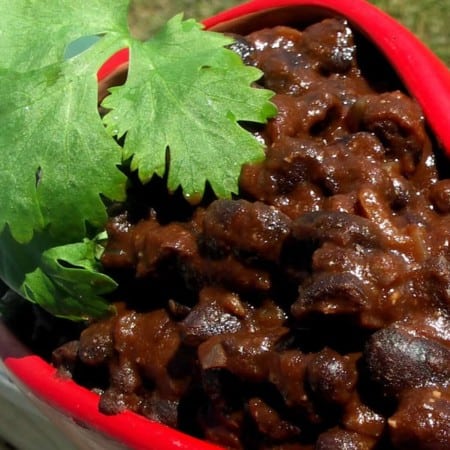
Spicy Saucy Black Beans.  Who doesn't love saucy beans?

Spicy Saucy Black Beans. Who doesn't love saucy beans?

spicyblackbeans2

It is finally Spring, both officially and otherwise. I sat on my porch with my bowl of beans and my feet up and ate the whole blasted thing. I think I may regret that later.

Slow-Cooked Cuban Pork: Part II, Day 3

For a brand new, printable version of this recipe that has all the steps included, click here!

“I meant what I said and I said what I meant.  An elephant’s faithful.  100%!” As promised yesterday,  I am back to show you how to shred that gorgeous slow-cooked Cuban Pork shoulder that should have chilled in your fridge overnight.  Of course, I didn’t forget the sauce or black beans, either, but I’ll post the recipe for spicy black beans later today.  I’m behind schedule.  Why you ask?

Monsieur Le Evil Genius experienced a set-back in his quest for world domination yesterday when his car broke down 1 hour and 25 minutes into his 1 hour and 30 minute commute.  Mercifully, he was within sight of his office’s parking lot and he worked with a man who had a winch.  (Not THAT kind of wench you gutter-brains…  I’m talking about the mechanical sort of winch that attaches to the front of a big ol’ truck.  A wench is…Never mind.)  He got the car to the parking lot, examined it and declared it unable to move until he could procure a fuel pump.  Being the cheapskates that we are, you could also insert the sub-clause “and replace it himself”.  ‘Cause we’ll be darned if we’ll pay someone to replace the fuel pump when Evil Genius can do it himself.  That’s just how we’re wired folks.  Compounding the inconvenience is the fact that our family vehicle, also known as “The Purple People-Eater” is up on ramps in the barn waiting for him to fix it.  And that all boils down to the fact that he had to crash in the city at his sister’s house last night.

This left me to attempt the night-time routine with our five little honyaks all by myself.  And it also left me without my usual evening companionship.  But perhaps the worst of all was that it left me to the remote control.  I am unaccustomed to unimpeded access to the remote control and I took advantage of it by watching scads of ridiculous reality television.  I planted my rear on the couch and watched “American Idol”, “Heroin Nation” (talk about depressing and disturbing), “Make Me a Supermodel” (A whole different kind of depressing and disturbing), and “The Chopping Block” (neither depressing nor disturbing, but would someone please tell Marco Pierre White to wear socks.  All those shots of his bare ankle bones made me cold.  I had to put on a sweater.) This convinces me it is a good thing that the remote control is usually attached to the hand of one of the possessors of XY chromosomes in this house.  My reality t.v. bender also left me behind schedule on laundry and blogging.  But back on the horse…

Let’s get some pork going here.  It does not depress me, disturb me or make me need to wear a sweater.  It makes me happy.  And it makes me forget, just for a moment, that both of my vehicles are out of commission and the dog, while enormous, is not big enough for me to saddle up and ride into town.

For a printer-friendly, photo-free version of this recipe, click here!

Cuban Pork and Sauce: Day 3

Ingredients:

  • Slow-cooked pork shoulder, thoroughly chilled
  • Cooking juices from slow-cooked pork shoulder
  • 2 Tablespoons lime juice
  • 2 Tablespoons white wine or cider vinegar
  • 1 teaspoon minced garlic
  • 1/2 teaspoon crushed red pepper flakes
  • 1/2 teaspoon dried mustard powder
  • 2 drops liquid smoke, optional

Use a spoon to remove the congealed fat from around the pork shoulder.

And THIS is why we let it rest overnight in the fridge.  Look at all that fat!

And THIS is why we let it rest overnight in the fridge. Look at all that fat!

Just run your spoon around the edge and the cold fat should come away as easy as can be.

Just run your spoon around the edge and the cold fat should come away as easy as can be.

Discard the fat.

Ick.  Thankfully I'm not on some Napoleonic Era Man-of-War where I have to save this stuff.  Away with it!

Ick. Thankfully I'm not on some Napoleonic Era Man-of-War where I have to save this stuff. Away with it!

Transfer pork shoulder to a large cutting board, preferably one with a groove to catch juices.  Otherwise, keep the paper towels handy!

cubanporkdayii5

Let sit while attending to the pan juices.

Pour the cooking juices that surrounded the pork through a fine mesh strainer positioned over a saucepan.

cubanporkdayii6

Remove and discard any solids left in the strainer.

Add the lime juice, white wine vinegar, garlic, red pepper flakes, dried mustard powder and liquid smoke to the cooking juices.  Whisk until evenly combined.

Whisk!  Whisk like your life depends on it.  Or not.

Whisk! Whisk like your life depends on it. Or not.

Bring to a boil over medium high heat.

Take note of the level of liquid.  You're going to be reducing this by about 3/4 of it's volume.

Take note of the level of liquid. You're going to be reducing this by about 3/4 of it's volume.

Allow to boil (while working on shredding the pork) until reduced to about 1/4 of the starting volume.

Almost there...

Almost there...

THAT is what you're going for.  We're in business now.

THAT is what you're going for. We're in business now.

Set aside until pork is fully shredded.

Pull the bone out of the pork and discard.

cubanporkdayii-11

Scrape as much fat as you can from the outside of the pork shoulder.

Yes.  I am wearing rubber gloves.  I am thoroughly grossed out by cold, squishy cooked animal fat.  I am imperfect.

Yes. I am wearing rubber gloves. I am thoroughly grossed out by cold, squishy cooked animal fat. I am imperfect.

Throw away the fat or give it to your spoiled and lazy dogs. Pull large chunks of the shoulder apart.  It should naturally come apart at places where there is additional fat you can remove.

cubanporkdayii-15

Take as much of the fat out as you can without wasting meat.

cubanporkdayii-13

Using your hands -or two forks- shred the meat into small pieces.

cubanporkdayii-16

When you’ve shredded all the meat, you can leave it as is or chop through it quickly with a knife to ensure that you have small bite-sized pieces.  It depends on what you’ll do with the pork.  I usually run through it with the knife since I have so many little mouths eating it.

cubanporkdayii-18

When pork is fully shredded (and chopped, if desired) transfer to a 9″ x 13″ baking dish with sides.

cubanporkdayii-19

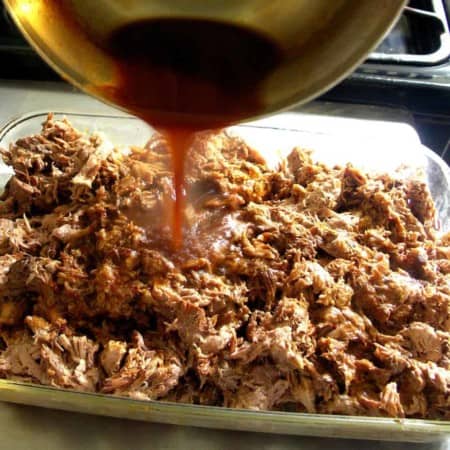
Pour the reduced pan juices over the pork and toss.

cubanporkdayii-22

Tightly cover the pan with foil.  If you plan on serving it immediately, put into a preheated 350ºF oven and heat for 25 minutes, or until hot all the way through.  If you are preparing this ahead of time you can either place the pan directly into the freezer or into the fridge.

To reheat from chilled:

Place, still covered in foil,  in a preheated 350ºF oven for 30 minutes, or until heated through.

To heat from frozen:

Place, still covered in foil, in a preheated 350ºF for 45 minutes, or until heated through.

We serve this on hot flour tortillas with FMC Mango Salsa (coming tomorrow!) and spicy black beans (coming later today!).

On deck for later today:  Spicy Black Beans

In the hole for Friday: FMC Mango Salsa

Slow-Cooked Cuban Pork: Part I

For a brand new, printable version of this recipe that has all the steps included, click here!

Part II of this recipe can be found by clicking this link!

I love to grocery shop.  I love to examine labels, produce, proteins and liquids.  I get giddy trying to decide which mangos and avocados to choose.  I carefully flip through piles of cilantro bunches looking to find the bundle likeliest to survive a week or so in my fridge.  I pick through the ‘Manager’s Special’ carts like a prospector.  And, boy, can I hit a sale. *

*All of this presumes, of course, that the boys are home with their Dad, an Evil Genius- but one heckuva Dad,  and not clinging to my thighs begging for Lucky Charms (they can have those when hell freezes over) or leaning precariously off the back of the cart or accidentally goosing unsuspecting shoppers who magically appeared on the third tile in a rousing game of ‘leap over every third tile or suffer the consequences!’   If they’re with me I run through the store like a woman haunted by cute little demons who conspire to make her forget everything she needs to feed her family that week.  But if they’re not with me?  Well then…

Ah, the sales.  I am a firm believer in bulk buying items that my family uses regularly.  Emphasis intended.  We bulk buy olive oil, canola oil, potatoes, onions, flour, yeast, carrots, coffee (that’s so the Evil Genius is less evil and more genius), tea (so I can maintain some semblance of sanity), dried beans, oats and peanut butter, among other things. (Like toilet paper.  I mean really.  Seven people and two toilets?  We buy toilet paper in bulk.)  We have quite a lot of good frozen meat in our chill chest but every now and then a deal comes along that’s too good to leave alone.  Last week, Monsieur Le Evil Genius was at the grocery store doing my bidding. (Actually he was there with a list for me since we had sick kids and I was housebound myself with the crud.)  He has stumbled upon a sale so good that he felt compelled to stock the heck up: pork shoulder for $0.69 per pound.  Oh yes.  The Evil Genius’s not-so-inner cheapskate was singing for joy.  He came home with three of them.  That would be roughly 30 pounds of pork shoulder for those who haven’t experienced the stuff.  I stuffed two pork shoulders into our crowded freezer and rubbed my greedy little hands together.  A 9-pound pork shoulder means only one thing to me.  Slow-cooked shredded pork.

There are a billion things you can do to pork that are delicious.  But let me tell you, what I did with that pork shoulder last week is my all-time favorite.  I’m going to walk you through making the phantasmagorical Cuban Pork and the two most wonderful side dishes in the world: FMC Mango Salsa and Spicy Black Beans*. Oh.  Let’s just talk about this pork for a minute.  The pork, courtesy of it’s long braise in the slow-cooker, is juicy and so mind-meltingly tender and flavorful that you’ll be sorely tempted to eat until you hurt.

Don’t freak out when I tell you this recipe takes a couple days.  It’s not like you’ll be slaving over a hot pan for those couple days.  It’s actually incredibly simple and the hands on time is less than roasting a chicken or making spaghetti. You just have to plan ahead.  And buy a big, honkin’ pork shoulder.  If you’re wondering whether it’s worth it, just have a gander at this…

Cuban Pork and FMC Mango Salsa with rice on a tortilla. Not pictured? The Spicy Black Beans...

Cuban Pork and FMC Mango Salsa with rice on a tortilla. Not pictured? The Spicy Black Beans...

* See?  The beans again! This week we’ll be doing black beans.  The bean recipe will be here on Friday so you can have the weekend to prepare your feast and then eat off of it all next week.  I got your back!

Yes.  This recipe makes a gigantic amount of pork.  Much too much for even my family to eat in one meal unless we have a good deal of company eating with us.  But that’s the idea.   This falls in the category that I like to call ‘component foods’.  If you make this dish and freeze the leftovers in individual serving sizes, you have instant meals at your fingertips.  You have the leaping-off point for so many good dishes like pulled pork sandwiches, shredded pork and pineapple pizzas, pork burritos and more.  By all means, though, prepare this for a party.  The work is all done ahead of time and you’ll feed your guests like royalty.

This is a strategy food that requires a little forethought.  While that limits the speed with which this can be made, it also makes it the ’do-ahead’ food.  You can prepare it ahead of time and refrigerate it or freeze it.  I have the strategy all mapped out for you.  Here’s how it works.

You cook your pork on ‘Day 1′.  You let it rest overnight in the fridge -call it ‘Day 2′, and shred it on ‘Day 3′.  After you’ve shredded it, it’s good for eating or freezing as is, but there are some fun things you can do to take it to the next level.  For now, though, let’s talk ‘Day 1′.

For a printer-friendly, photo-free version of this recipe, click here!

Cuban Pork: Day 1

Ingredients:

  • 1 (8-1o pound) bone-in pork shoulder, make sure it fits into your slow-cooker.  Cut to fit if necessary.
  • 1/2 cup frozen 100% orange juice concentrate
  • 1/3 cup lime juice (fresh squeezed or bottled)
  • 1 Tablespoon olive oil
  • 8 whole peeled cloves fresh garlic (or 1 Tablespoon granulated dried garlic)
  • 1 Tablespoon (or more, to taste) ground cumin
  • 1 Tablespoon dry oregano leaves
  • 1 Tablespoon or more fresh ground pepper
  • 2 teaspoons kosher or sea salt
  • 1 teaspoon crushed red pepper flakes, optional
  • if available, 2 stems (no leaves, just stems) fresh cilantro

Drizzle the olive oil in the slow-cooker bowl.

cubanpork4

Remove the pork shoulder from packaging and rinse with cold water.

Please pretend this picture is of me removing the packaging and rinsing the roast.  Thank you.

Please pretend this picture is of me removing the packaging and rinsing the roast. Thank you.

Place untrimmed pork, fat side down in the bowl.

Fat side down.

Fat side down.

…Then flip it fat side up.  This coats both sides with a wee bit of olive oil.  Everything’s better with a wee bit of olive oil.

cubanpork6

Sprinkle with salt, pepper, cumin, oregano and crushed red pepper flakes.

Cumin

Cumin

Black pepper.  I loves black pepper.

Black pepper. I loves black pepper.

Oregano.  I rolled my 'r' when I said that.  Try it with me.  O-rrrrr-egano.

Oregano. I rolled my 'r' when I said that. Try it with me. O-rrrrr-egano.

Red pepper flakes.  Be still my heart.  If I could find a way to make this into toothpaste I would.

Red pepper flakes. Be still my heart. If I could find a way to make this into perfume I would. The Evil Genius likes the chiles.

Use a spoon to dollop the frozen orange juice concentrate over the top of the roast.

cubanpork-11

Pour the lime juice around the edges of the roast.

If you have to use bottled stuff it isn't the end of the world.  Use the best bottled stuff you can find.

Fresh is best. We all know that already. But if you have to use bottled stuff it isn't the end of the world. Use the best bottled stuff you can find.

cubanpork-13

Throw garlic cloves around the roast.

Peel your whole garlic cloves easily by pressing down on them firmly with the edge of a bench knife or a heavy pan.

Peel your whole garlic cloves easily by pressing down on them firmly with the edge of a bench knife or a heavy pan. Voila! The skin will come away as easily as can be.

cubanpork-15

Toss on cilantro stems- if using.

I love cilantro.

Please keep your cilantro stems in the freezer in a zipper top bag. Right next to your onion tops. I KNOW I sound so cheap, but there is an incredible amount of flavor in the bits and pieces of food that most of us throw away. Form the habit of saving these and you'll be grateful you did!

cubanpork-17

Cover, and turn cooker to ‘HIGH’.

And away we go!

And away we go!

Allow to cook for 1 hour, turn the heat to ’LOW’  and continue cooking for another 12 hours or until meat falls apart when prodded with a fork. When the meat is tender, turn off slow cooker and place the slow cooker bowl in the fridge. (If your slow-cooker doesn’t have a removable insert, transfer the contents to a large container with a tight-fitting lid and pop that into the fridge.

See you back here on Thursday for shredding and the first of our side dishes: spicy black beans!

On deck for Thursday: Shredding and saucing our Cuban Pork,  and Spicy Black Beans!

In the hole for Friday:  FMC Mango Salsa (a.k.a. The best side dish of all time.  Ever.  Amen.)

Provence White Bean Puree

If you were around yesterday you may have a pot of beans hanging out in your fridge waiting for you. If you are scratching your head and saying, “Huh?” just click here and then rejoin us. It’s okay. We’ll wait…In the meantime, those of us who have beanpots in hand can enjoy this lovely ditty while we wait for the others to play catch up…

[youtube]http://www.youtube.com/watch?v=IpgPJ1uMDsU[/youtube]


Alrighty. We’re all on the same page now? If you made the cannelini yesterday you are in for a tasty treat; Provence White Bean Puree (a.k.a. Mom’s French Bean Dip.) I can get my kids to eat almost anything by pureeing it and calling it dip. This is a trick that you are welcome to borrow to use on picky children or spouses. I promise your secret is safe with me. I prefer the lovely name ‘Provence White Bean Puree’, but when at home do as the homies.  Donc* (that’s ‘therefore’ for the non-Francophiles out there) in my maison, it’s called “Mom’s French Bean Dip”.  My kids get a real charge out of it when I speak to them in French.

*This is where ‘making my parents happy’ comes into play. In case you haven’t noticed yet I am going to liberally pepper, or poivre, this post with random French words and phrases so that my parents feel the money they put into sending me to France for my senior year of high school was l’argent well spent. How about that Maman et Papa?

If you’ve never been acquainted with Herbes de Provence, this seems like a good time to remedy that situation. Herbes de Provence is a blend of, well, herbs that are typically combined in the food of the Provence region of France. Voila! Herbes de Provence. Makes sense, non? The usual players in this blend are thyme, savory, fennel, basil, and lavender flowers and other herbs. Everyone has their own favorite ratio of herbs, but the two constants are that thyme is usually the dominant flavor and there is almost always lavender. Without it, you don’t really have Herbes de Provence. If you’ve never eaten lavender just be brave and try it. I think you’ll be pleasantly surprised.
I wish you could smell this.

I wish you could smell this.

Get a good look at it.

Get a good look at it.

This bean puree is incredibly versatile and it’s more sophisticated than your average bean and cheese spread. Clearly, it’s usually used as a dip ‘round these parts but don’t let that stop you from elevating it to another level entirely. It is equally good when warmed up and served as a base for a grilled firm-fleshed white fish that is simply dressed with salt, pepper and a squeeze of fresh lemon juice. It is wonderful when served hot on toast points with a grilled or broiled shrimp and crispy bacon on top. It’s a sublime touch when stirred into hearty tomato based soups both as a thickener and as a flavoring agent. You catch my drift, right? It’s so very good. C’est si bon.

As if all that wasn’t enough to recommend it, it freezes like a dream since there’s no dairy of any kind in it. You can freeze it in about any zipper top bag or other airtight container (so long as you lay a piece of plastic wrap directly on the surface of the bean puree before adding the lid to prevent the puree’s surface from drying.) You can also freeze it in ice cube trays and then transfer the frozen cubes to a zipper top bag for single-serving convenience. Pop a cube of that in a bowl of soup or stew and you’re in heaven.

Lest we forget, this gorgeous stuff is insanely inexpensive to make and insanely good for you.  Lookie!  Olive oil, lemon juice, beans, salt, pepper and herbs.  Delicious and nutritious.  Can I get a ‘hallelujah’?

For a printer-friendly, photo-free version of the recipe, click here!

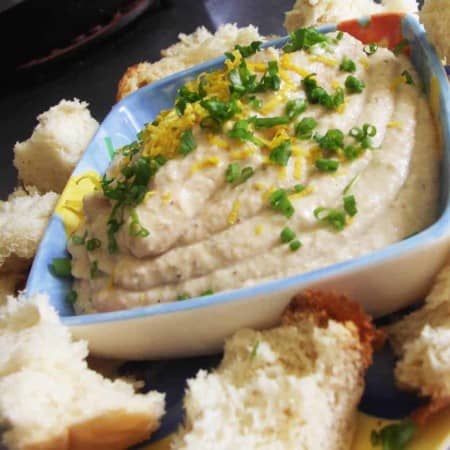
Oh la la!  C'est magnifique.

Oh la la! C'est magnifique.


Provence White Bean Puree

  • 4 cups cooked cannellini beans
  • ¼ cup extra virgin olive oil
  • 1 ½ Tablespoons garlic paste (or chopped garlic)
  • 1 Tablespoon dried herbes de Provence
  • the juice and zest of half a lemon
  • salt and pepper to taste

Use a slotted spoon to add the beans to the bowl of a food processor (No food processor?  No prob.  Just beat the tar out of the ingredients with a potato masher or the bottom of a heavy glass.)  Using a slotted spoon allows most of the bean liquid to drain away without overdraining them.  Did you know you could overdrain beans?  You do now!  Seriously, though, if you drain ALL the liquid away your dip will be too dry.

provencebeandip1

Add the garlic paste, herbes de Provence, salt and pepper, olive oil,  and the juice of the lemon to the bowl of a food processor.

I'm in the middle of Amish country and it's March.  There is very little good, fresh garlic to be had.  This is the next best thing.

I'm in the middle of Amish country and it's March. There is very little good, fresh garlic to be had. This is the next best thing.

provencebeandip4


provencebeandip5

provencebeandip6

provencebeandip7

The eagle eyed among you may notice that I'm squeezing lemon into mighty smooth beans.  I forgot to add the lemon juice before processing the first time.  Whoopsie.  Fixable!

The eagle eyed among you may notice that I'm squeezing lemon into mighty smooth beans. I forgot to add the lemon juice before processing the first time. Whoopsie. Fixable!

Secure the lid and process until smooth. Try a small bite of the dip on bread or a carrot stick (or a spoon!).

provencebeandip-10

Adjust flavor by adding salt and pepper to taste. Stir well and pour into a container with a tight fitting lid. Refrigerate prior to serving, at least an hour, but preferably overnight. This gives the flavors a chance to blend and bloom.

Garnish with lemon zest and finely chopped green onions.

provencebeandip-11

provencebeandip-12

Serve cold with vegetable sticks, pita chips, breadsticks, toast or crackers. You can also serve this warm as an accompaniment to grilled fish or chicken.


A Tutorial on Using Dried Beans

Ah wonderful beans.  We all love them for their taste.  I love them for their nutrition.  My boys love them for their, er, musical properties.

Ah wonderful beans. We all love them for their taste. I love them for their nutrition. My boys love them for their, er, musical properties.

UPDATE (12/10) :Since first writing this post almost two years ago, I have been experimenting with different ways to cook beans.  While I still use the crockpot method most often, I have changed on something.  I use salt at the beginning of the cooking time.  Really!  It doesn’t slow down the cooking of the beans a bit and leaves them much more flavorful than if you add salt at the end of cooking.  I stand (or rather, I sit, at this very moment) corrected.  Salt away!

Beans.  They are the perfect budget food.  They’re chock full of dietary fiber and nutrients, simple to store and able to leap tall buildings with a single bound. And they’re cheap! They’re so cheap (“How cheap ARE they?” screamed the crowd.  “So cheap they’re on the dollar menu!”) that there is no excuse to be without them.  Even if you’re so poor you can’t afford to pay attention, beans are still in your ballpark.   But -keeping it real here- unless you’ve grown up eating them or have been making them for years they can be a little intimidating to prepare and use.  And various well-meaning and well-researched cookbooks have you jumping through a billion hoops just to make a simple pot of unadulterated beans.  Not so beginner-friendly.

Why bother with dried beans and the extra work when you can buy canned beans super cheap?  Dried beans last close to forever when kept in a cool, dry cabinet.  They’re less expensive per pound and taste better than canned beans.  And -perhaps most importantly- they’re better for you than canned beans. When you reconstitute dried beans you control the amount of sodium in them and ultimately in the finished recipe.  When you start with canned beans you’re already starting at a super high sodium level (which can be a major health concern for many people.)  There is more, but I think you get the idea.  If you’ve never made dried beans before just do me a favor and try it at least once.  I am pretty convinced I can convert you…

Here’s my plan.  For the next few weeks, I’ll share a bean recipe with you on Thursday or Friday.  That will give you all weekend to try out your beanerific recipes.  This week, though, I’m going to start you out with a tutorial on how to get the dried little beasties to the point where you can use them in recipes…  And I warn you: My method is so easy that you may not want to prepare them any other way.   You’ll need a slow cooker, but if you don’t have one, you can snap up a basic model for $15 at le Walmart, le Target or le Blue-Light-Special.  Don’t let anyone tell you you need bells and whistles on a slow cooker.  All you really need are a ”HIGH” and a “LOW” setting.  Unless you’re cooking for one, get the largest of the basic slow cookers that you can afford.  I always cook more beans than we can eat in one meal.  You can portion them into individual servings and freeze them to add into soups and stews or make dips or refried beans with later.  We loves the bean dip around here!

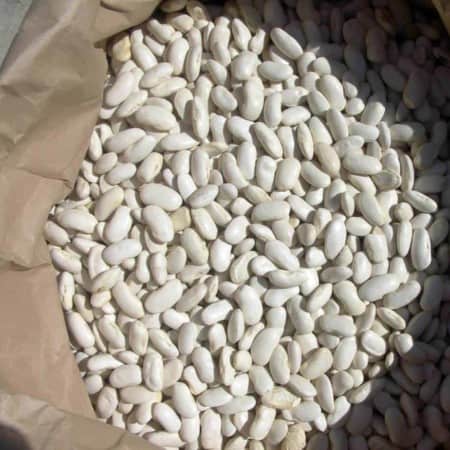
Because it’s what I’m going to be using in tomorrow’s bean recipe, we’ll start out with cannellini (white kidney beans) today, but feel free to kick it off your bean adventure with any dried variety that floats your boat; pinto, chili, black, lima, garbanzo…  If you follow the method, you can make any kind of bean you want!

For a printer-friendly, photo-free version of this tutorial, click here!

Dried Beans: A Tutorial

Necessary equipment:

  • a slow cooker
  • a saucepan to boil water

Ingredients:

  • 1 lb dried beans, (in this case, cannellini), or about 2 cups dried beans
  • 2 bay leaves
  • 2-3 frozen onion tops or 1 cooking onion, peeled and cut in half from root to end
  • 2 quarts boiling water
  • salt to taste


Pour your dried beans into a colander.

Yes.  I sit outside on my porch steps while picking through beans.  It's the hillbilly in me.

Yes. I sit outside on my porch steps while picking through beans. It's the hillbilly in me.

Pick through to find grossly misshapen, discolored or otherwise nasty looking beans or small stones.

It feels nice to run your hands through dried beans.  There's something therapeutic about it.

It feels nice to run your hands through dried beans. There's something therapeutic about it.

These are what Leif calls "Yuck beans."  This is what you want to remove.

These are what Leif calls "Yuck beans." This is what you want to remove.

Because dried beans are about the size and color of some pebbles, it’s not completely bizarro to find little rocks, clumps of dirt or other natural bits and pieces occasionally tucked into the bags.  After you’ve picked through and removed any undesirables, give the beans a good hearty rinse under cold water, rubbing them around in the colander as they’re being cleaned.   This ensures that you remove any dirt your eagle eyes may have missed.  This also gives you a chance to look the beans over one more time.

beantutorial7

Add the beans to the crock of the slow cooker.  Place the bay leaves and onion tops (or onion) on the beans. Sprinkle about a teaspoon of salt, give or take according to taste, over the top.

I told you to hang onto those onion tops.  I may be cheap, but these things add a lot of flavor!

I told you to hang onto those onion tops. I may be cheap, but these things add a lot of flavor!

Pour in the boiling water. (It really does need to be boiling.  That is key!)

Pretty please make sure your water is boiling.  It is superdy duper important.  Just take my word for it.

Pretty please make sure your water is boiling. It is superdy duper important. Just take my word for it.

See?  Two inches of water over the beans.  This is perfect!

See? Two inches of water over the beans. This is perfect!

Quickly put the lid on the slow cooker, turn the cooker to “HIGH” and assess the situation.  If your beans are covered by at least 2 inches of water you’re doing fine.  If they’re covered by less than that, you’ll want to put some more water on the boil to add as soon as possible.  Set your timer for 3 hours and go do a crossword puzzle or play a board game with the family.

When three hours are up, you’re going to do a test.  Use a spoon to reach into the cooker and quickly extract a couple beans, replacing the lid immediately.  Hold them a few inches from your face and blow on them gently.  If the skins curl up off the beans, they’re most likely done.  Carefully take a bite through the center of one of the beans.  If it’s tender, you’re all set.  When you cook black beans or pinto beans, it’s not unusual for them to be done that quickly, especially if they’re relatively new beans.  If they are done, you can use them immediately, divide them into containers for the freezer or stick straight into the fridge -tightly covered- in their own liquid for use within four or five days.

If you’re cooking a larger (or harder) bean -such as cannellini, garbanzo, butter bean, etc…- you’ll likely find that the beans are not yet tender in the center.  Turn the slow cooker to the “LOW” setting, add additional boiling water (if needed) to cover the beans, and allow to continue cooking for about four hours before checking again.  Repeat the test; extracting a couple beans quickly and replacing the lid, blowing on the beans and biting them. If they’re tender, pull them from the heat and use immediately or store for later.  If they’re still tough, give them a couple more hours -making sure they have water to cover- and repeat the test. Do this until they test done.  The batch of cannellini beans I cooked in the photos for this tutorial simmered overnight on “LOW” before they were done.

Done!  Not looking gorgeous, but tasting fi-ine!  Pop a lid on this, stash in the fridge and come back tomorrow to make bean dip with me!

Done! Not looking gorgeous, but tasting fi-ine! Pop a lid on this, stash in the fridge and come back tomorrow to make bean dip with me!

In my own experience, garbanzo beans (the stuff of my hummus dreams) have taken the longest time to cook by far.  Just be prepared to let them cook away.  And, for pete’s sake, don’t sweat testing it if you have to let it cook overnight.  Beans are pretty resilient as long as you’re cooking them in enough water.  And if you overcook them there’s always bean dip!

If you choose to freeze the beans for later use, divide the beans into one or two cup servings between containers.  Be sure to leave enough room to ladle cooking liquid over them so they don’t dry out and to account for expansion of the liquid as it freezes.  Make sure the lid of the container fits tightly and stash in the freezer for later use.  (Alternately, you can carefully scoop the beans and their liquid into zipper-top freezer bags taking care to seal them completely.  The bonus of this method is they lay flat to freeze and thus take up less room.)  Frozen beans will keep well for about two to three months in the deep chill.  After that they begin to deteriorate a bit in texture and in taste.  Not the end of the world, but after that point they’re only good for bean dip.  (All roads lead to bean dip in this house.)

Tomorrow:  Come back for a wonderful *gasp* bean dip that can be served hot or cold.  Get those pita chips or veggie sticks ready!

Happy St. Patrick’s Day. Muppet style.

I’ll toast all your health and wealth with a nice glass of Nyquil tonight. At least it’s still green. In the meantime, enjoy this classic:

Sláinte is táinte! Beannachtaí na Féile Pádraig!

[youtube]http://www.youtube.com/watch?v=OCbuRA_D3KU[/youtube]