
Risotto

We’ve been enjoying a lot of the foods that go along with this season, hot teas and cocoa, soups, homemade breads and muffins, and I’ve been coming up with some interesting combinations as I work through my pantry.  In one of my ‘what will I find in here today’ searches, I found a lonely cup or so of arborio rice. For those of you who are familiar with this rice, you know it is THE rice to use to make risotto, a creamy, flavorful and often cheesy Italian dish. It’s comparatively easy to make, but does take some time and patience since it requires close to continual stirring for about 20 minutes, but while it is often served as a side dish, it can serve as the main part of your meal–add a little salad or some grapes or sliced fruit, a little glass of wine, and you’re good to go.

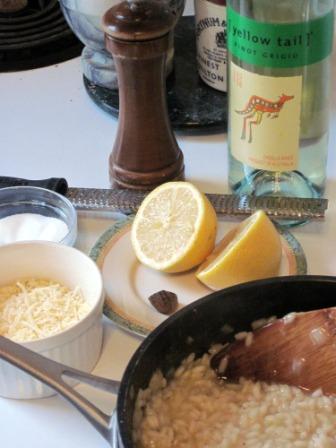
Some basic risotto ingredients

I was going to try a crockpot risotto recipe, but I decided to stick with the tried and true–it had been so long since I’d made this, I wanted to be sure we would enjoy the end product, especially since it was going to be the main course.

As mentioned earlier, the main essential to a good risotto is good arborio rice; you can usually find it in most good grocery stores, or through a whole foods co-op, or (gasp!) Amazon!

I’ve been checking out alternate sources for certain grocery items, and sometimes Amazon has the best price, and with free shipping, there are no additional costs.  They also offer ‘subscription’ service which means you set up an automatic order for 1, 3 or 6 month terms, which entitles you to an additional 15% off the regular price. I ordered an 11 pound bag of rice today that normally cost $22.00, but came to 18.70 after the discount, coming to $1.70 per pound, much cheaper than at the grocery store, and 35 cents per pound cheaper than what my co-op could offer, and to get their best price I would have had to order 50 pounds at once.  I can just see my husband’s face as I ask him to carry that bag to the basement!

Good olive oil, butter, and savories such as onion, shallots, leeks, garlic, herbs–there’s a lot of room for some variety there. White wine is usually one of the ingredients, and I definitely prefer the version with wine than without–it helps cut some of the richness, adding a bit of a sharp note against the cheese that is added later. Broth is the main liquid; I’ve most often seen chicken broth used, but a light beef broth would probably work, or a good flavorful veggie broth.

Freshly shredded parmesan is best if you have it; if not, I get shredded parmesan in 2 lb. bags from our local restaurant supply, and keep it in the freezer to use in dishes like this. The per pound price is cheaper than most of the grated parmesan products in regular stores, and the flavor much better. Regular grated parm can be used, but try to find a brand that is as close to 100% cheese as possible.  Cream and extra butter is often stirred in at the end, but we no longer do that–we like the risotto just a little lighter.  Final touch for me is grated lemon rind and a good squeeze or three of lemon juice. Like the wine, it helps balance out the cheese in the dish.

Adding veggies to the dish? No problem. I really enjoy peas or mushrooms in risotto, and I usually prepare them separately and add the last couple of minutes before serving, so they just heat through but don’t have time to really cook any more. Mushrooms I sautee until browned, peas are simply cooked in a little salted water till just done. (If using the petite peas, I often just let them thaw, heating them through in the end–I like them to have a bit of a bite.)

As I mentioned earlier, this is an easy dish, but does take some attention. It’s a good time for listening to your favorite music, or just enjoying some quiet time at the stove (quiet time at the stove is probably something we empty nesters enjoy more often than some!).  Without further ado, here is the recipe I made last night.

Risotto with Parmesan and Lemon

1 cup arborio rice

4 cups chicken or veggie broth, kept hot in saucepan

1 small onion, chopped fine

2 cloves garlic, chopped fine or pressed

2 T. olive oil

2 T. butter

1 t. dried thyme

1/4 t. nutmeg, freshly grated

1/2 cup dry white wine

2/3 c. shredded parmesan

Ground black pepper to taste

Grated rind of one lemon

juice of 1/2 large lemon, or whole small lemon

Heat broth in a separate pan, and keep warm while you prepare the risotto.

Heat olive oil and butter in a larger flat-bottomed saucepan over medium heat. Toss in onion and garlic, and sautee until transparent. Stir in rice, and mix until the rice is all coated, then add thyme and nutmeg, stirring till well mixed.

Add the 1/2 cup of wine, and stir for a few minutes until the wine is absorbed and your spoon leaves a clear path on the bottom of the pan; at this point add about a half cup of broth, again stirring until it is absorbed. Keep repeating this a few times more.  If the broth seems to absorb to quickly, you should turn down your heat a bit so you won’t run out of broth before your rice is cooked.

After about 20 minutes or so have elapsed, taste a grain of rice to check for doneness. It should be firm, but not at all crunchy. If more time is needed, continue to add the broth and testing the rice every couple of minutes. Once the rice is fully cooked, and you have a nice creamy sauce holding it together, it’s time to add the cheese and lemon. I add the cheese and lemon rind together, making sure it is well incorporated, then squeeze in the lemon juice. I usually have to taste a couple of times before I’m satisfied with the balance–I definitely want the lemon to come through, but not to overpower the dish.

This is also the point where you would stir in a little heavy cream, a little extra butter, and any veggies you would like to add.

And that’s it. Serve it up in some nice bowls, sprinkle with a little extra parmesan (I had a tiny bit of extra nutmeg on mine),  have a nice plate of freshly sliced kiwi fruit nearby, and pour yourself a glass of that nice dry white wine.  I have to say, that is as close to a perfect meal as I’ve had in a while!

Just something I wanted to S.H.A.R.E. with you all

Well, it’s been a while since I last posted; some of you may remember a posting from Beccy back in June when she shared I’d been diagnosed with breast cancer. Since then, I’ve had a couple of surgeries, some chemo, and radiation, which is now ongoing, and except for the cancer, I’m in really good health! During much of the recovery from surgeries and from the treatment itself, I’ve been feeling like I’m draggin’ my wagon, both physically and mentally. But things are much improved, and I’m happy to be finally sharing another post with you all.

This won’t include a recipe, but I did want to share some thoughts about feeling the pinch. Financially, that is. While we have excellent insurance, the deductibles and copays for all our visits to the medical world have taken a substantial bite from our budget, and that along with the fact that I’ve had to give up my part time job with the local library means a little less coming in. Fortunately, I’ve been able to find some ways of stretching the food budget, and I thought I’d share these with you.

First, I’m finally using up things from my pantry.  I told Beccy that I seem to still have the impulse for stocking the shelves the way I used to when we were feeding the kids before we entered the empty nest stage. I have enough rice, flour, brown sugar, dried beans of various sorts to last us through much of this year, but I find myself still picking up some extras when they are on sale. (Valerie, Just Say No!) I’ve been making myself stop when tempted to do that, reminding myself of the sagging shelves at home. (By the way kids, birthday presents this year will probably be jars of jams, jellies and preserves…I’m sure they are still good!)

Another thing I’m doing is trying to cook for two instead of 8 or 10. Leftovers are all right with some things, but not so attractive with others, and it’s nice to end a meal without having to add more dishes to the refrigerator with a bit of this and a dollop of that. Too many of those already in the refrigerator (okay, today’s the day I get rid of those…no comment from the husband, please.) Let me emphasize that I am NOT anti-leftovers—certain kinds make wonderful soups, casseroles, etc., but there are certain things that just are not better after a day or two in the refrigerator.

Eating from the freezer—much like using pantry items up, freezer items don’t stay nice forever, so it’s better to use these up rather than keeping them for ‘someday.’  I think part of my problem is I get a degree of security from seeing loaded shelves, and I want to get over that. There is enough food, and I can get more if I need it.

Another problem—false sense of deprivation. This kicks into play when you are gifted with or able to buy some special item that you don’t normally get, and you put it on the shelf, waiting for that special moment when you will get the maximum enjoyment from that item. What happens? The months, nay, the years(!) pass, that item gets pushed to the back of the shelf, and by the time it sees the light of day, you don’t even have the courage to open it, much less taste it.  Special foods?  Carpe diem! Seize the day!  Enjoy it now, for tomorrow may not come! (Sorry for the drama, but it works for me.)

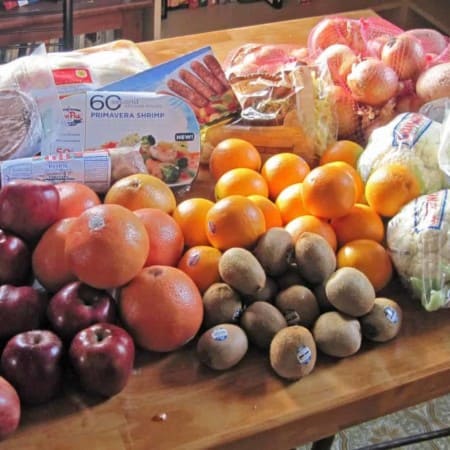
One other very good and helpful thing is the S.H.A.R.E program. Beccy has mentioned Angel Food Ministries in the past, and S.H.A.R.E is much the same. It provides basic foods on a monthly basis for less than most of us would pay at the store.  The picture I’ve included in this post shows the foods that we picked up today, for a total cost of 43.90. This included their main box of food (25.00) which includes meats, fish, poultry, usually pasta of some kind and a few canned goods and/or mixes for quick breads, as well as 9 to 10 pounds of fresh produce. You are able to select separate items as well, and I ordered two more portions of the fresh produce ($14.00).  There is a 10% shipping charge ($3.90) and a $1.00 handling fee.   This month’s box included the following items:

5 lb. chicken leg quarters

1 lb. ground beef patties

1 lb. pork tenderloin

1 lb. tilapia fillets

12 oz. brown and serve sausages

12 oz. precooked cut up chicken

1 8-oz. shrimp, vegetable and pasta meal (For Jim, I’m not that into Shrimp)

12 oz. egg noodles

1 qt. wild mushroom marinara sauce

1 can cling peaches

1 can peas (erk, it’s been a long time since I’ve looked one of these in the eye)

4 oz. jar chopped garlic

6 grapefruit

15 oranges

15 red delicious apples

15 kiwi fruits

3 lbs carrots

3 cauliflower

3 3-lb. bags potatoes

3 2 lb. bags onions

They also offer a couple of organic items, usually some kind of meat or poultry, and a box of produce is always offered, 10 or more pounds of mixed fruits and veggies for $15.00.  I order these when the budget is a little more healthy, and the variety and quality is always excellent.

Where we live, here in the Northern U.P. of Michigan, it’s not that easy to find good fresh produce at these prices. Summer and fall offer better options, but we still can’t get the variety of meats and produce for this price. And it’s definitely enough for the two of us. And with my attempts to eat out of the pantry and freezer, there is very little we have to purchase at the store. Milk, eggs, cheese, a few more fruits and veggies (usually the ones on sale) and the odd baking supplies now and then seems to take care of what we need.

My goal for the next 3 months is to come in at under $100 for each month; in January, we spent just under $90.00.  In February we might go over a bit due to a larger order I’ll be making from our co-op that includes almond milk.  But we should be at least close.  I’ll be writing more about this later.

All that being said, I hope all our readers are enjoying these winter months.  I thought it would be nice to include a picture of our own status today–sunshine is abundant, sky is clear, and it is COLD.

Here is how things are looking for us right now at home.

Blueberry Cobbler

I meant to post this a while ago, but life got in the way. I’m getting ready to repeat this particular dessert in a couple of days with some frozen berries, and remembered that I had never gotten around to sharing this with you all. So here ’tis!


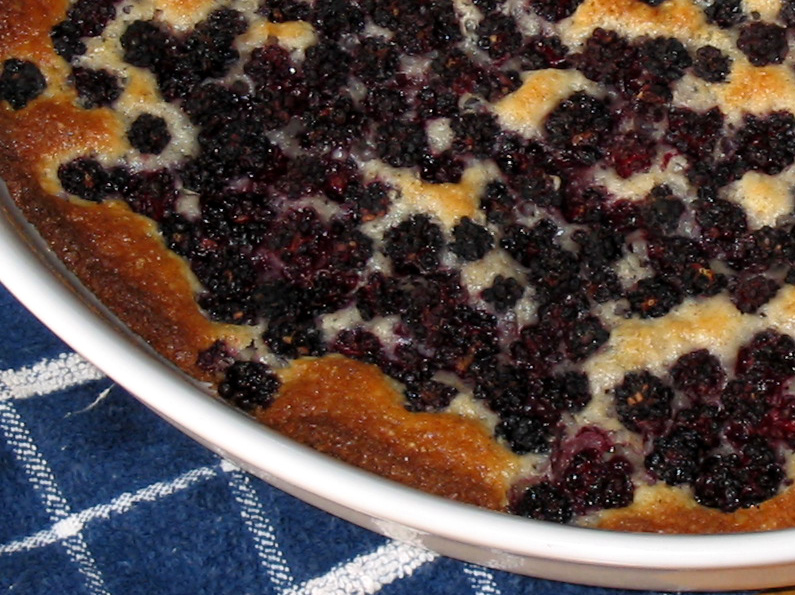
A few weeks ago, Jim picked what appeared to be the last of the berries in the patches near us at camp. He ended up with a good couple of cups of black raspberries and a handful of wild blueberries.


(Aren’t they purty?)

We ate a few of them as is, but the rest went into a very simple berry cobbler, taken from Jane Brody’s Good Food Book, which I purchased several years ago. It could not be simpler to make, and is fairly quick to whip together for a quick dessert or treat to share with unexpected guests.  I usually make it with frozen blueberries or with a frozen triple berry mix (blackberries, raspberries and blueberries are the favorites).  It’s especially good served warm with a small scoop (or two!) of vanilla ice cream on the side. (I know, I keep putting the ice cream in there…)


Blueberry Cobbler


From Jane Brody’s Good Food Book


2/3 c. all purpose flour

1/2 c. sugar

1 1/2 t. baking powder

1/4 t. salt

2/3 c. skim milk (I use whatever is on hand)

2 T. butter, melted

2 c. blueberries (I use fresh or frozen)


1. In a medium bowl, combine the flour, sugar, baking powder and salt. Stir in the milk, and mix the batter until it is smooth.

2. Pour the melted butter or margarine into a 1 or 1 1/2 qt. casserole type baking dish. Pour in the batter, and sprinkle the blueberries on top.

3. Bake the cobbler in a preheated 350 degree oven for 40 to 45 minutes or until it is lightly browned. Spoon out the cobbler onto individual dishes to serve.


Some of my tweaks:  VANILLA!!  I always add vanilla to this–it tastes fine without it, but I find I miss the vanilla flavor if I don’t put it in. Also, I put my baking dish into the oven while it is preheating, and let the butter melt right in it–saves cleaning a pan, and gets the cobbler off to a good start in it’s baking–we like the brown crispy edge it gets when prepared this way.  And of course, I add a good 1/2 teaspoon of freshly grated nutmeg to the batter–great flavor partner to be the berries. Grated lemon rind makes a nice touch if you have one on hand–just whisk it right into the batter.


Brown Butter Plum Cake

Well, as promised, here is the Brown Butter Plum Cake recipe. I connected with it via a link in Tastespotting, and that link took me to Patent and the Pantry, another foodie-related site. As the host there said, one of the wonderful things about cooking is the freedom to make recipes your own, and it really is fun to watch recipes morph as they go from hand to hand, each change reflecting the invididual tastes of the cooks involved.  Gwendolyn, the host of that site, found the recipe on another site, hosted by a Julie, and I took the recipe and made some changes of my own. (You can see the original recipe by clicking on the earlier link for Patent and the Pantry.)
 
The changes I made were simply taste changes–I like more fruit, I love vanilla and spices, and I had some cinnamon sugar to use up. When I was young and first learning to cook and bake, I would stick pretty closely to the recipes, but after a while, once I learned something of the science of food, how ingredients work together, and began to see how  flavorings, spices and condiments could combine and recombine to provide a wide variety of tastes, I was able to  begin to play with things without being too worried about the result. Once in a great while there would be a culinary bomb (Jim reminds me of the great Carrot Ginger Soup Fiasco), but overall, what I make ends up being at least edible, and at times, pretty darn good.  So at age 53, I have a bit more confidence than I did at the age of 23, I know what kinds of flavors tend to work together, I know what kinds of amounts will work, and so there has opened up a whole field of play in the world of food. I love being able to relax and not worry about things as I mess around in the kitchen.
 
So, here is the recipe, and help yourself to any changes you might want to make! Be bold! Or be cautious! Be whatever you need to be, but do enjoy yourself!
 
By the way, this is great with vanilla ice cream (I know I say that a lot, but so many things are good with vanilla ice cream, it just can’t be helped!)


Brown Butter Plum Cake—Valerie’s Version


§             16 to 20 prune plums, or 8 or so larger fruits—plums, peaches, etc.

§             3/4 cup + 3 Tbsp. sugar, divided

§              1 tsp. cinnamon

§             ½ t. nutmeg

§             1/2 cup butter

§             2 large eggs

§             1 cup all-purpose flour

§             Pinch of salt

§             ½ t. baking powder

§              1 t. vanilla


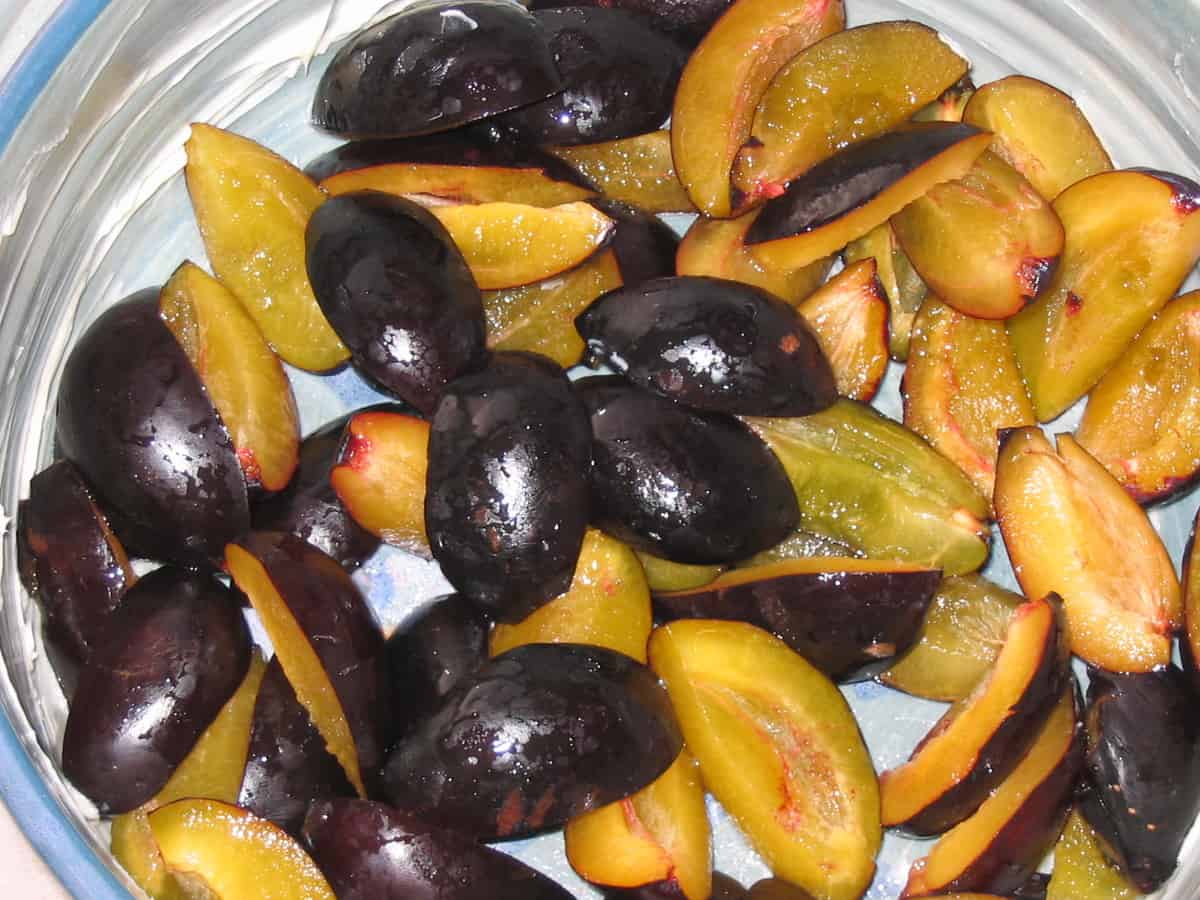
Preheat the oven to 350F and butter a pie plate or 2 qt. casserole dish.   Pit and quarter your fruit and place in prepared dish.


Combine 3 T. sugar with cinnamon and nutmeg, and sprinkle 2 T. of the mixture over the sliced fruit.


Melt the butter in a saucepan or small frying pan and keep cooking it for about five minutes until it turns golden. Swirl and stir the butter as you watch it, because it can burn easily. When it becomes a lovely caramel brown under the foam, remove immediately from heat.


This is the lovely dark amber caramel color you are aiming for with the browned butter

This is the lovely dark amber caramel color you are aiming for with the browned butter


Slightly beat eggs, adding vanilla.  Whisk together the flour, ¾ c. sugar, baking powder and a pinch of salt. Pour the butter into a bowl and add flour mixture and eggs, mixing well.


The batter takes on the beautiful color of the butter...

The batter takes on the beautiful color of the butter...


Pour and spread over the fruit and sprinkle with remaining spiced sugar. Bake for 40 to 45 minutes until golden and the juices are coming up around the edges.  Let cool for a few minutes before serving.


Pickled Plums

Dusky, ripe, juicy plums....

Dusky, ripe, juicy plums....


I am sure that many of you are aware of Tastespotting, a site that serves to display pictures submitted by other websites; and these are not just ANY pictures–these are pictures selected to meet a certain aesthetic, and they are absolutely beautiful. For those of you not familiar with this resource, you can link with it here:   Tastespotting


Anyway, on to the plums….this being the season for plums and all, the pictures on Tastespotting that featured recipes using this fruit continued to catch my eye, and I finally gave in to two items in particular:  Sweet and Sour Plums with Vanilla and Bay Leaf (a kind of pickled plum) and Brown Butter Plum Cake. (Tastespotting has a search tool–enter the word “plum” and you should be able to find pictures of each of these.)  I picked up a half bushel of the lovelies from our local fruit vendor (much more cost effective in bulk!) and carried them home to be transformed:  First, the sweet and sour plums…


Well, I found I needed my daughter’s help with this recipe, because when I clicked on the picture, it took me to a lovely website, Hedonistin Blogspot, but all was in German. Having had French in school, I can usually wrangle some degree of meaning from French and even Spanish language texts, but German is beyond me. Fortunately, my daughter spent her senior year of high school Germany and is proficient enough in the language that she was able to help me out with this. As a result, I now have two gallons of these plums chilling nicely in my refrigerator, the result of putting together four batches over the last two days. They are simple to put together, absolutely delicious, with a nice spicy bite from the vinegar and the grated fresh ginger in the syrup. We had some with vanilla ice cream, and the combination was delicious.


Here, with Christina’s help, is the recipe as translated from the Hedonistin site:


SWEET AND SOUR PLUMS


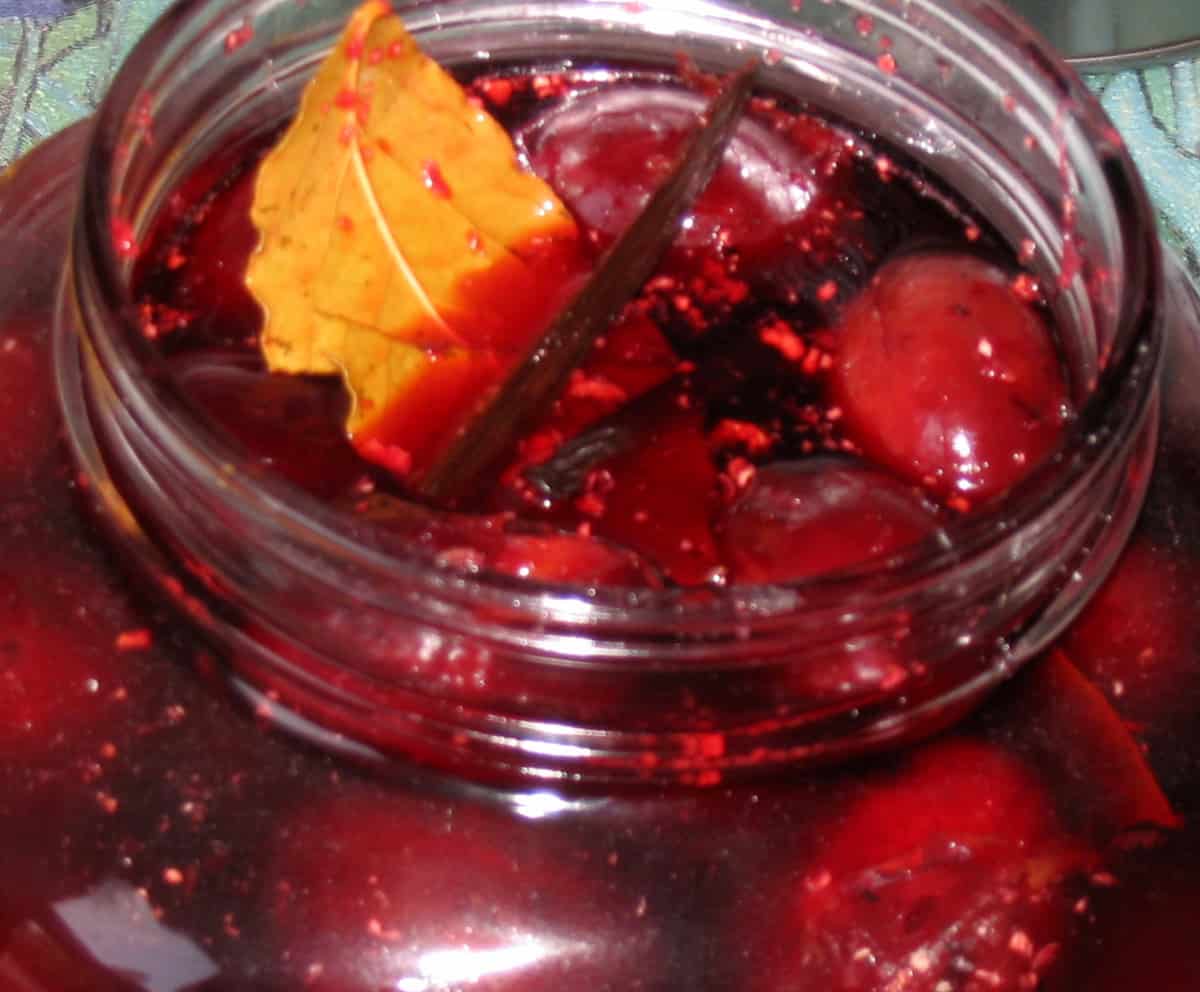
The picture is a bit fuzzy, but I think you can see how pretty these are; that is a bay leaf and a bit of vanilla bean lying across the top.


1.5kg  little plums ripe, but firm (3.25 lbs–I used prune plums)

750 ml vinegar (I’m guessing white distilled)

250 g. sugar ( about 9 oz., a little over a cup)

1 vanilla bean, split and seeded (if you have no vanilla bean, add a little vanilla to the syrup before pouring over plums at the end

3-4 laurel leaves (bay leaves), fresh (I only had the dried version)

1 thumb-sized piece of ginger, finely grated

Have two quart jars or four pint jars clean and sterilized, with either plastic lids or rings and lids if you prefer. These can be stored in the refrigerator for 3 to 4 months; no instructions were given for sealing for longer storage.

Simmer the vinegar with the sugar and spices in an enameled or stainless steel pan (they suggest putting the ginger bay leaves in a tea-ball  or infuser, but I put them directly in the syrup).  Wash and dry the plums, and then pierce the skin all around with the point of a paring knife (5 or 6 pokes seemed to do it).

Lay the plums next to each other evenly in the vinegar- the fruit shouldn’t lay over each other, and poach the plums for a few minutes, making sure that the skins don’t burst (the skins will burst a little bit, but the slower the simmer, the less they burst). Get them out with a slotted spoon, drain well, and put into a jar.  When all the plums are cooked, continue to cook the liquid for 10 minutes (reduce). 

Pour the vinegar reduction over the plums making sure they are completely covered, and they should keep for 3-4months in the fridge. I kept the bay leaves and vanilla beans in the jars as well…I like the way it looks, and I think it should only help the flavor intensify. We’ll see!  One of these jars will be going to Christina when we visit at Thanksgiving–it’s the least I can do for my very own translator!

Tomorrow I will share with you the my version of the recipe for Brown Butter Plum Cake…tonight, I will just eat some!

Carrot Cauliflower Soup with Sesame Yogurt Cream

Remember all the salad bar goodies mentioned in my last post? Well, I decided I really needed to use up a lot of those carrots, and being a lover of warm soup on cool days, I naturally went in that direction. The soup I ended up making is fairly simple and quite flexible, and is a good way of using up some of those leftover veggies. I also had a small amount of yogurt which always works well with creamy soups, as well as a couple lonely slices of bread, which would work well for croutons. The bread had sesame seeds, which made me think of toasting some sesame seeds to sprinkle on top of the soup, as well as adding a little sesame oil to the yogurt for flavor. As a lot of you are already most likely aware, one thing leads to another in the kitchen…and using up all these bits and pieces gave me sort of a warm, frugal feeling all over, if you know what I mean. Anyway, to the soup…


Carrot Cauliflower Soup with Sesame Yogurt Cream

The sesame yogurt cream, sesame seeds and croutons took this simple soup to an amazing place!

The sesame yogurt cream, sesame seeds and croutons took this simple soup to an amazing place!


The instructions for all the condiments for this soup are at the bottom of this post, and they can easily be prepared while the soup is simmering away.


For the soup:

1 large onion, chopped

3 cloves garlic, chopped

2 tablespoons olive oil, or half oil and half butter

2 lbs. carrots, chopped, peeled or not, as you like

1 to 2 cups cauliflower florets

2 medium potatoes, cut in large chunks, peel left on

6 cups water, veggie broth or chicken broth

1 teaspoon dried thyme leaf (1 tablespoon if fresh)

Salt and pepper to taste


In a large pot, heat oil, then add onion and garlic, saute for 3 or four minutes. Add the remaining vegetables, water or stock and seasonings, bring to a boil, and simmer till the vegetables are soft, about 20 to 25 minutes. In batches, carefully puree soup in a blender or food processor: NOTE: IF YOU ARE USING A BLENDER, LEAVE THE LID PARTIALLY OPEN, AND HOLD LID WITH A DISHTOWEL–YOU NEED TO LEAVE SPACE FOR THE STEAM TO ESCAPE WHEN BLENDING. IF YOU PUT THE LID ON TIGHTLY, IT WILL EXPLODE OFF THE TOP AND WILL COVER YOU AND YOUR KITCHEN WITH VERY HOT SOUP.


Once the soup is pureed, correct for seasoning, and ladle into warm bowls. Drizzle with sesame yogurt cream, and sprinkle with croutons (recipes follow) and toasted sesames seeds. Sit in a comfortable chair, preferably by a warm fireplace or woodstove, and slowly savor the goodness.


For the cream:


1/2 c. yogurt

1 t. sesame oil

pinch of salt


Whisk together all ingredients, and put to one side.


For the croutons:

2 slices whole grain bread

2 T. olive oil, or half oil and half butter


Heat oil in a large skillet, large enough to hold the bread cubes in a single layer. While the oil heats, cut bread into 1/2 to 3/4 inch cubes. Toss in hot oil, and toast in the pan, tossing now and then, till the croutons are crunchy and a nice deep golden brown. Set aside.


Toasted Sesame Seeds:

For this recipe, I used 3 tablespoons of sesame seed. Whenever toasting seeds or nuts, be sure to have a small bowl or plate handy to put the seeds on as soon as they are toasted; this will allow the toasting to stop immediately, for if you keep the seeds in the pan even with the heat off, they will continue to toast.


Place the seeds in a skillet large enough to hold them in a single layer and begin heating over medium high heat, gently stirring now and then. It will take a while for them to brown but be patient–once they begin to brown, they finish very quickly. You will see the pan begin to show signs of an oil appearance as the seeds begin to release some of their oil. The browning should begin shortly thereafter. As soon as they have browned to your liking, pour them into a small bowl to cool, and set aside.

Blue, Blue, Blueberry Cornmeal Muffins


In an earlier post this summer, I raved about The Cornbread Gospels by Crescent Dragonwagon (that name always makes me smile) and the two versions of cornbread salad we had tried out, both receiving enthusiastic reviews. Well, since then, it’s been hard for me to NOT bake and cook without cornmeal. Cornmeal breads, muffins, pancakes, etc. And my latest favorite muffin is her recipe for Blue, Blue Blueberry Muffins.  All the blue is the result of using blue cornmeal  and serving the muffins with a Blueberry-Cream Cheese-Honey Butter. Okay, have I your attention now? Are you hooked? Shall I start reeling you in???


These are unbelievably tender and moist, and the main spice in the recipe, nutmeg, sets off the flavor of the blueberries and the cornmeal beautifully. (I am somewhat biased—most dishes are considered incomplete without at least a little nutmeg thrown in). And when you top the warm muffins with the meltingly delicious blueberry butter—moment of silence, please.


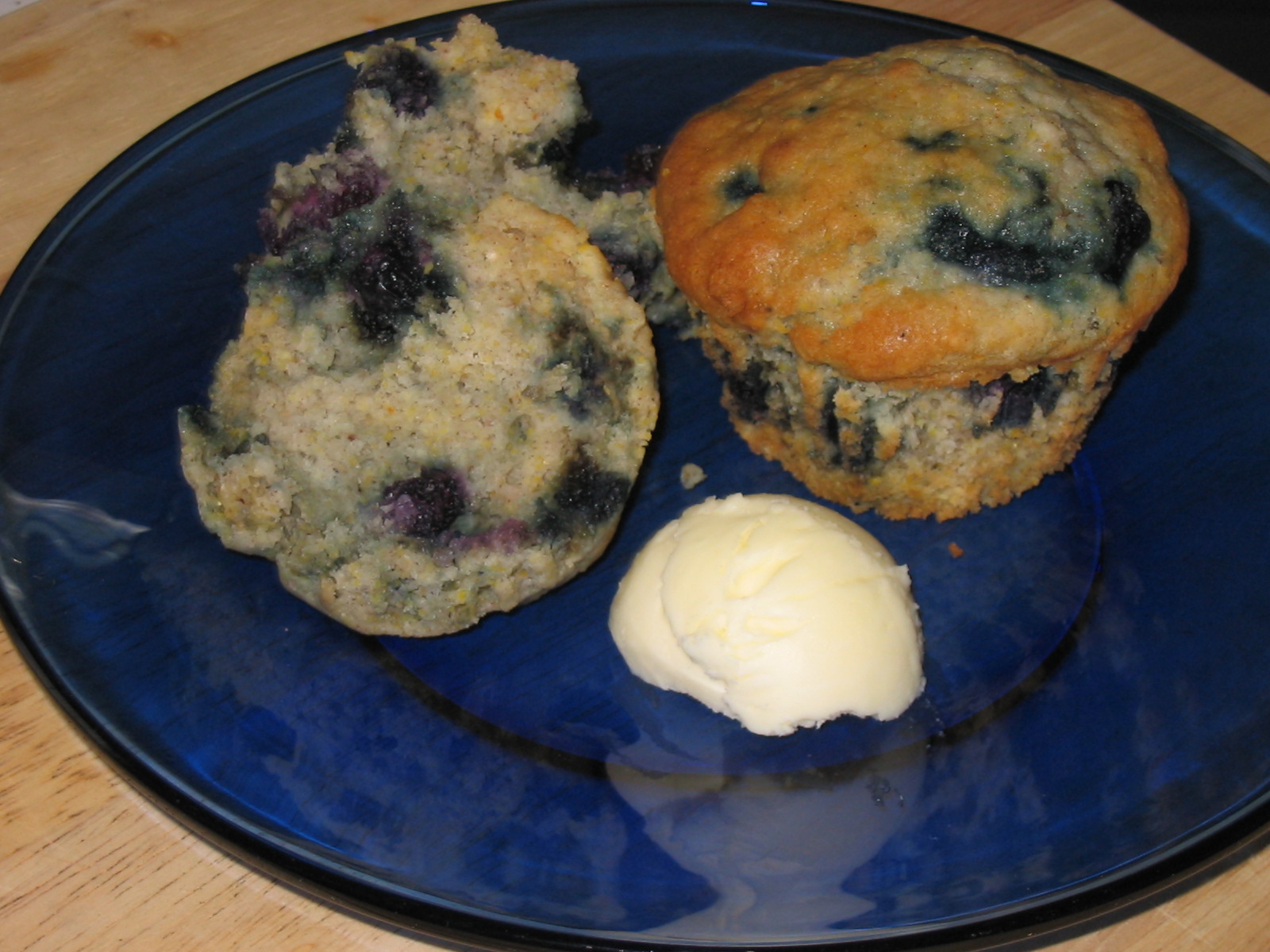
Now, if you are not able to find blue cornmeal, yellow is fine, and you end up with another lovely version, just less blue! Blue cornmeal is not easily accessible up here where I live in northern MI, so I’ve made these frequently with yellow cornmeal, as you can see here—


So if you have stockpiled a good amount of end-of-the-summer blueberries  AND you are a lover of corn AND need some muffins to warm you up on the crisp mornings arriving with the turn of the season, this recipe is for you. One note: When I made these muffins, I did notice that it only made 12 of what I would call standard sized muffins—if I had tried to make 18 muffins out of this, they would have definitely been on the small side.


Blue, Blue Blueberry Corn Muffins

From The Cornbread Gospels by Crescent Dragonwagon


Vegetable Oil cooking spray or muffin papers

1 2/3 c. unbleached white flour, divided

1/3 c. stone-ground blue cornmeal

½ t. salt

1 T. baking powder

½ t. baking soda

1/3 cup butter, at room temperature

½  c. sugar

1 egg

½ t. pure vanilla extract

¼ t. freshly grated nutmeg

1 cup low-fat milk, plain or vanilla

    Soy milk, or a combination (see Note)

1 cup blueberries

½ c. chopped toasted walnuts (optional)


1.       Preheat the oven to 425 degrees F. Spray 18 standard-size or 12 large muffin-tin

      cups with oil, or line the cups with papers.

2.       Stir together the flour, blue cornmeal, salt, baking powder, and baking soda into a large bowl. Set aside.

3.       Cream together the butter and sugar in a small bowl, then beat in the egg, vanilla and nutmeg.

4.       Stir the creamed mixture into the dry mixture along with the milk, until not quite blended. Then add the blueberries and the walnuts, if using, with just a couple of strokes, so the mixture is just barely combined. Spoon into the prepared muffin cups.

5.       Bake until the edges of the muffins are golden brown and the caps are rounded and also golden, 22 to 27 minutes. Let cool for just a few minutes, then remove from the cups. Serve warm with blueberry-cream cheese-honey butter if you like.

Mango Custard

Mangoes…I love them…just have a hard time finding a good one at times.


The first time I ate a mango, it was somewhat underripe, and actually cutting the mango up was a little bit frustrating, due to the monster pit waiting inside that lovely yellow flesh. But even under-ripe, the fruit was delicious, and that bit of piney undertone to the flavor was addicting.


Finally encountering a ripe mango, I was completely transported–I had no idea that fruit could send you to another dimension. Well, perhaps I exaggerate, but it was darn good. My problem over the years has been finding mangoes at that peak of perfection. I’ve discovered the color on the outside does not seem to be a good indicator, but the touch test is helpful–if the fruit yields to gentle pressure, you may be in for some good eating. If the fruit yields to the point of being able to touch the pit, it’s been around a little too long. If it is rock hard, it may ripen for you, but may actually begin spoiling before it is ripe enough to enjoy.


If you are lucky enough to find good ripe mangoes, cutting them up is actually easy, if messy. Starting at the top of the fruit, with stem down, and with the narrow side facing you, bring the blade of your chef’s knife down across the top and slice down through the fruit slightly off center; when you encounter some resistance, curve the knife out away from the pit a bit, and use the pit as a guide for your knife as you finish slicing through the bottom. Repeat the same slicing on the other half, and be careful, because the open portion of the mango is pretty slippery. Laying the mango halves skin side down, you can cut the fruit in a cross-hatch fashion, going vertically through to the skin (not through the skin), and then horizontally, so you end up with cubed mango pieces, still connected. Pick up that mango half, press up against the skin so that the mango curves up and out, and the skin is now concave. Grab a spoon and half a lime, squeeze the lime over the mango and dig in.  (Lime is one of mango’s best friends, by the way.) Or you can do what a friend of ours does, and forego the spoon. Just have a bowl handy to catch the drips.


Now, there is some good mango left on that pit, and I just take my paring knife and trim off the peel that is left as well as removing all the fruit that still clings to the pit. Cook’s Treat!


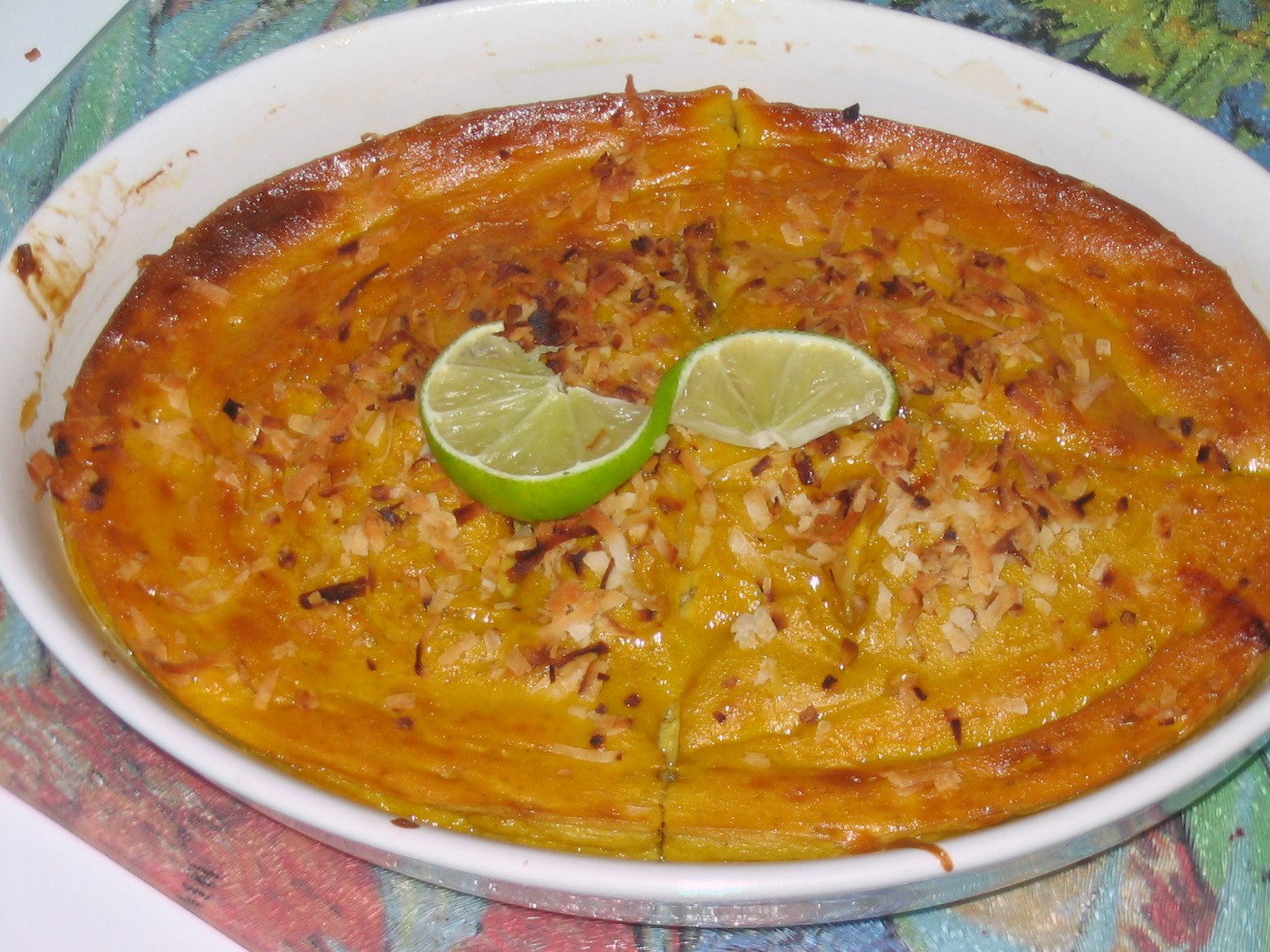
Once in a while you will find that even though the fruit is good and ripe, the flesh is very stringy and unappealing for eating as is. When I encounter that, I either use the mango in a fruit smoothie, or I make Mango Custard, which is a lovely and simple sugar-free dessert.


Mango Custard


3 mangos, peeled, pitted and sliced

1/4 t. nutmeg

1/8 t. salt

Grated peel of one lime

Juice of one lime

3 large eggs

2 T. shredded coconut


Lightly butter a 1 quart baking dish, set aside and preheat oven to 325 degrees.


Place mango, nutmeg, salt, lime rind and juice in the blender, and blend on medium. You may have to pulse and scrape down the blender a couple of times as the mixture will be quite thick. When most of the fruit has been pureed, add the eggs and blend again until thoroughly mixed and smooth. Pour into prepared dish and bake for 40 to 50 minutes, until a knife inserted halfway to the middle comes out clean.  While the custard bakes, lightly toast the coconut in a small skillet for a few minutes until toasted to a nice golden brown, and set aside to cool.

When the custard is done, set it aside to cool, and you can either serve at room temperature or chill before serving. When you are ready to serve, sprinkle the top with coconut, a nice lime slice if you have one handy, and dish it up. Jim and I found that we really like it with extra lime juice squeezed over the top–a really nice contrast to the sweetness of the mango.