Slow-Simmered Collard Greens

This is a continuation of my Southern New Year’s Foods series.  And it comes with an executive decision.  I was unable to get photos of the dish, but I wanted you to have the recipe before New Year’s Eve.  So up it goes sans photos of the greens!  If I get photos of it at a later date, I’ll post those on here.  Happy New Year!

Black-eyed peas, collard greens, cornbread… all these foods are indelibly linked to the South.  No matter which city, town, county or mountain holler you call home, if you’re from the South it’s a pretty safe bet that you have a family recipe for these rattling around somewhere.  I have not one, not two, but three recipes for greens all written longhand by my Grandma Shaffer on laminated recipe cards.  They are my heirlooms.

grandmas83rd

grandmasrecipes

Collard greens are one of the foods that are traditionally served in southern homes on New Year’s Day.  While black-eyed peas represent coins, collard greens represent paper money.  Combining the two dishes for the first meal eaten in the New Year traditionally represents a forthcoming time of prosperity. Since my family is worth much more than its weight in gold, I’d say the practice has been effective.

There is some disagreement among collard green lovers as to how long they should be simmered.  My vote is for however long it takes for them to become fall-apart tender. I think it is nearly impossible to overcook collard greens.  On the stove top this usually translates to anywhere between one and a half hours to four hours.  In a slow-cooker -provided you have enough ‘pot liquor’ (cooking liquid) you can easily let them simmer away overnight.  (Assuming you can sleep with the glorious smell of greens wafting through your home.)

There is a small but vocal crowd who like their greens chewier and would simmer their greens for a far shorter time than I would. I ignore them.

This is my special occasion version of greens and nothing screams,”Special Occasion!” quite like salted pork products.  I do believe my Grandpa Shaffer would’ve agreed with me heartily. Provided, that is, that your special occasion is not a dinner party for your vegetarian friends.  You always have the option of making this vegetarian friendly by omitting the salt pork and replacing the pan drippings with olive or canola oil.

For a photo-free, printer-friendly version of this recipe, click here!

Slow-Simmered Collard Greens

Ingredients:

  • 3 pounds washed, trimmed and cut collard greens
  • 1 large red onion
  • 6 ounces salt pork
  • 4-8 cloves garlic, according to preference, thinly sliced
  • 2 cups water, plus additional water as needed
  • 1-1/2 cups dry white wine or chicken broth
  • Coarsely ground black pepper, to taste (I like a great deal of pepper and usually use between two teaspoons and a tablespoon.)
  • 1/2 teaspoon Kosher salt

Thinly slice the salt pork (about 1/8 of an inch thick) then cut the slices into thin strips (about 1/4 of an inch thick.)  Transfer salt pork strips to a deep, heavy bottomed skillet, pot or dutch oven with a tight fitting lid over medium heat.  Stirring frequently -taking care because salt pork pops and spits a lot as it browns- cook the salt pork until crispy all over and golden brown.  Use a slotted spoon to transfer the crispy salt pork strips to a paper towel lined plate and set aside.*  Remove any excess fat drippings from the pan, leaving only 1/4 cup of drippings in the pan.

*The reserved crispy salt pork can either be scattered over the greens before serving or baked into the best cornbread you’ll ever taste.  I’ve done both and I’ve loved them equally.

Cut onion in half and peel.  Lay -cut side down- on the cutting board and slice into moderately sized half-moons (between 1/4 and 1/2 of an inch thick.)  Move onions and garlic into the pork drippings in the hot pan still over medium heat.  Cook for one to two minutes or until fragrant but not browned.

Add a handful or two of greens to the pot and stir until reduced slightly in size (about one minute).  Repeat with greens, one handful or two at a time, until all the greens have been incorporated and slightly wilted.  Add water, white wine, salt and black pepper and stir.  Bring liquids to a boil, tightly lid the pan and turn the heat to low.  Allow to simmer for about one and a half hours, checking liquids and adding as necessary, or until the greens are fall-apart tender.

Serve hot with cornbread, black-eyed peas and hot pepper vinegar for greens are so good they’ll make you say, “Well, shave my legs and call me smoothy.”  Because I’m pretty sure  that’s what my Grandpa would’ve said…

grandpa on swintg

Pimiento Cheese

This is the second installment of my Southern New Year’s Foods series.  Happy New Year!

pimientocheese5

Really, The Evil Genius and I complete each other. While I sit here on the couch with the laptop, contemplating pimiento cheese, he is watching ‘Alien vs. Predator’ and talking about which characters he thinks will be eaten. So see? We’re both thinking about food.

This family marches on its stomach. Long before I met my southern transplant husband, I was learning to cook southern food from my Arkansan grandma. And while I’m certain he didn’t marry me just for  Grandma’s pimiento cheese, collard greens, and cornbread recipes, I’m equally certain that the ability to execute those dishes well contributed to my charms.

Although I wouldn’t swear to it, I do believe that I detected tears of joy in his gorgeous blue eyes when I placed a dish of this pimiento cheese along with a plate of crackers in front of him so many years ago. Just for the record, there’s no shame in a good ole boy weeping over food like Grandma used to make… He may be Evil, but he still loves his Mammy.

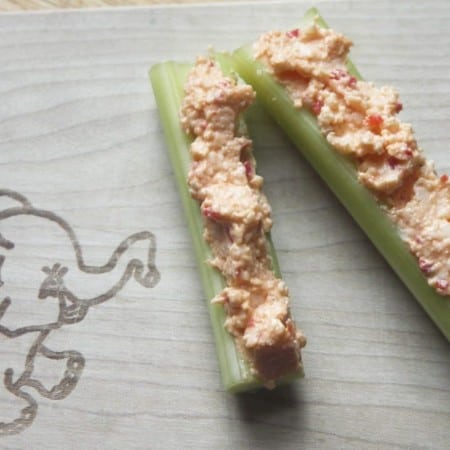
Pimiento cheese is a food that is as big a part of the South as the phrase “y’all”.  This flavorful creamy cheese spread is flecked with bits of sharp cheddar and bright roasted red peppers.  It is as at-home on an elegant buffet table as it is on humble celery sticks for an after-school snack.  Thrown together in a flash, pimiento cheese is big on flavor and low on effort.

pimientocheese6

Don’t just stop with at the crudites and crackers, though.  Whether you trim the crusts and add watercress for sophisticated tea-time  sandwiches or slap it between two slices of buttery white bread, pimiento cheese makes a delicious and satisfying savoury sandwich filling.  You can’t get much more Southern than a having a pimiento cheese sandwich and a glass of sweet tea for lunch on the front porch. And you just may have the best grilled cheese of your life if you toast two slices of hearty wheat bread filled with pimiento cheese.

A party just isn’t a party without pimiento cheese in some form, and New Year’s Eve is the biggest fete of the year!  So break out a bowl this festive spread and have copies of the recipe handy to pass out, because you will be asked.  It is that good.

Happy New Year Y’all!

For a printer friendly, photo free version of this recipe, click here!

Pimiento Cheese

Ingredients:

  • 1 (3 ounce) package cream cheese, softened to room temperature
  • 16 ounces grated Cheddar cheese (I like to use a blend of extra sharp and sharp cheddar.)
  • 1/2 cup mayonnaise
  • 1/2 of a small onion
  • 2-3 Tablespoons pimientos (or roasted red peppers) smashed with juice from the jar.
  • 1/2 teaspoon each granulated garlic, granulated onion, coarse salt and freshly ground black pepper

Add the cream cheese, mayonnaise, granulated garlic and onion, salt and freshly ground pepper to the work bowl of your food processor that has been fitted with the blade.

Grate the onion into the the food processor on top of the other ingredients.

pimientocheese1

Pulse until smooth.

pimientocheese2

Scrape down the sides of the bowl and add the shredded cheddar.  Pulse seven or eight short bursts; just until the cheese is mixed into the cream cheese.  Scrape down the bowl again and add the pimientos with their juice.

pimientocheese3

Pulse four or five more short bursts; just until the pimientos are chopped to the point where they are blended in, but still in recognizable pieces.

pimientocheese4

Use a silicone scraper or spatula to transfer the mixture to a serving dish or storage container.  Cover tightly with plastic wrap and refrigerate for about an hour prior to serving to allow the flavors to meld.

Leftovers can be kept tightly wrapped in the refrigerator for up to a week.

*If you do not have a food processor simply combine all the ingredients in a large bowl and stir vigorously with a sturdy spoon until thoroughly blended.

Now slather this on some celery sticks, pour yourself a tall glass of sweet tea and say y’all a few times.  You might just like it.

pimientocheese7

Recession Caviar (Black-Eyed Pea Salsa)

Thank you all so much for spending time with me here at Foodie with Family.  To those of you who have visited me regularly through the year, thank you for your continued support.  It has meant the world to me to get to know you all.  And to those who are new, Welcome!  I hope you stick around.  I’ll put on a pot of tea! Hearing from you -whether it is questions or comments about recipes, a story, or sharing a recipe of your own- is one of the highlights of my days.  Even if I’m a total dork and forget to respond, rest assured you’ve put a smile on my face.  For this, my long-suffering kids thank you.

To all of you: I hope your New Year’s Eve and New Year’s Day are full of wonder, loved ones, great food and better memories.  And more than that, I hope that your upcoming year is even better than those two days.

This week, I am going to post a series of my version of the traditional Southern New Year’s meal.  Yes, there will be greens and pork products.  Yes, there will be cheese spread.  There will be much delicious soul food.  It’ll be here.  I’ll be here.  I hope you will be, too!

~~~~~~~~         ~~~~~~~~

recessioncaviar 10

So.  Who’s ready for a brand-spankin’, shiny New Year?  A blank slate full of possibility? Another three hundred and sixty five opportunities to make your life exactly what you want it to be?  Oh, I am.  I so am.

I’m not exactly the resolution type.  My anti-authoritarian streak runs so strong that I even rebel against the rules I make for myself.  (Side note to my parents:  I can hear you snickering from here. ) But I am crazy about the idea of self-improvement, on my own schedule and without pressure or someone telling me what to do, thankyouverymuch.

Instead of resolutions against which I would inevitably rail, I reflect on Longfellow’s ‘A Psalm of Life’ (full text below the recipe.) My favorite stanza from the poem reads:

“Let us, then, be up and doing,
With a heart for any fate ;
Still achieving, still pursuing,
Learn to labor and to wait.”

This poem is my little pep talk to myself at the beginning of each new year.   It points my head and heart in the right direction.  And as we celebrate the ending of a year and the possibilities that lie ahead, I turn to poetry and food.  Food and poetry:  Sustenance for the romantic heart and the sensual stomach.

Because really, it isn’t a celebration if there isn’t food.  And New Year’s Eve comes with a set of dishes as traditional and romantic as Christmas geese and Thanksgiving turkeys.  I may have mentioned before that I married into a good Southern family and that my maternal grandparents are both Deep South born and bred.  New Year’s Day means you need black eyed peas.  And I don’t mean Fergie and her impossibly tight black leather pants. I mean the humble black-eyed pea or cowpea; the legume with the animal/vegetable name.

recessioncaviar 12

Southern tradition dictates that you improve your chances of having a great year if the first food you consume in the new year is black-eyed peas. The practice of eating black-eyed peas for luck on New Year’s Day dates back to around the Civil War era.  According to Wikipedia (who we all know is never, ever wrong) this came about when the Northern troops continually “stripped the countryside of all stored food, crops, and livestock, and destroyed whatever they couldn’t carry away. At that time, Northerners considered “field peas” [black-eyed peas, among others] and field corn suitable only for animal fodder, and didn’t steal or destroy these humble foods.”  Ha!  The joke is on us, Yankees.  Those black-eyed peas are the bees knees.  Especially when tossed together with snappy corn, vibrant jalapenos and big old flavors in Recession Caviar.

But back to the legend.  The black-eyed peas are supposed to represent coins.  Tradition dictates that by pairing the black-eyed peas with greens (I’ll post a killer green recipe later this week), which represent paper money, that you are starting your year out with wealth and the rest of the year will follow suit.  Now, I don’t know about all that, but I do know that starting the year out with a recipe that sure to save you some money can’t be a bad thing.

Long a standard recipe in my family, budget-friendly Recession Caviar comes in many forms (made with black beans or chili beans instead of the black-eyed peas) and has many names (Lindamood Caviar, Hillbilly Caviar, Texas Caviar, et al.) depending on the occasion.  Of course, this being for New Year’s we’ll be making it with the ubiquitous black-eyed peas. I recently made a giant bowlful of this for a gathering  of family at The Evil Genius’s Aunt Patty’s home (would that make her my Aunt-in-law?). This room full of Virginians, Texans, Georgians, Floridians, and a couple assorted Yankee spouses (meself included) gave it the ultimate stamp of approval; an empty bowl.  I’d say that’s some pretty universal appeal  with  hearty representation from the drawl-contingent.

And true to the name I’ve given it, it’s suitable for recession-stressed budgets.  Beans -both canned and dried- are a perennially inexpensive and nutritious source of protein, fiber, iron, vitamins, minerals and other vague nebulous nutrients*.  In fact, beans are, pound for pound, one of the least expensive and most nutritious foods you can introduce at your table.

*Vague and nebulous don’t do it for you?  Have a look at The American Journal of Clinical Nutrition’s ‘legumes and soybeans’ page. There is a wealth of information beyond my simplistic explanation.  But trust me.  Beans are good for you.  And your heart.  Because the more you eat, the more you…  I’m sorry.  You DO remember I have five sons, right?

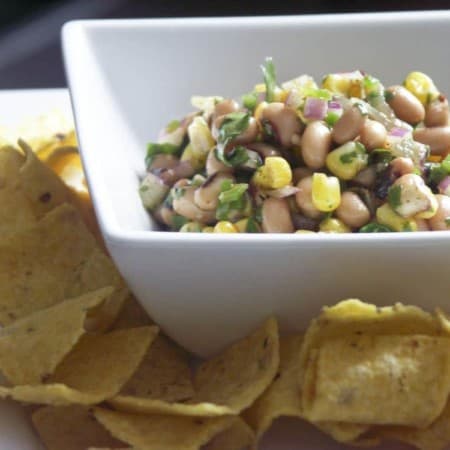
Recession Caviar isn’t just easy on the pocketbook; it is a versatile contributor at the dinner table, snack time and parties, too.  Whether served with tortilla or corn chips, spooned into a burrito or on top of tacos, or as a side dish to fish, chicken, or pork, it is certain to impress with its big, bold flavors and fresh texture. You can always change out the black-eyed peas for black beans or chili beans and throw any other fresh vegetables you have into the mix.  Think of this a jumping off point…

Psst…  Remember it’s  good for you, too!  Consider this; you can ring in the New Year with proper Southern pride, please your belly, impress your guests, and watch your waistline all at the same time.  Who loves ya, baby?  Me!  That’s who!

For a photo-free, printer friendly version of this recipe, click here!

Recession Caviar (Black-Eyed Pea Salsa)

Ingredients:

  • 3 cans (14.5 ounces each) Black-Eyed Peas, drained and rinsed
  • 3 cups frozen corn, thawed
  • 1/2 of a large red onion, or more to taste
  • 1-4 fresh jalapeno peppers, according to preference
  • 1-4 cloves of fresh garlic, according to preference, minced
  • 1 large handful of fresh cilantro, rinsed and air-dried
  • 2 Tablespoons light olive oil or canola oil
  • 1 Tablespoon chili powder
  • the juice of two fresh limes (You can use bottled lime juice if necessary.)
  • 1 teaspoon Kosher salt
  • Fresh ground black pepper to taste

Peel the red onion half and lay down on its cut side. Slice parallel cuts 1/8- 1/4 of an inch apart across the onion leaving the root end intact.  Turn the onion 90 degrees and slice across the cuts for a small dice. And really, don’t sweat trying for perfection on this one.  Part of the charm of Recession Caviar is its rustic appearance.

recessioncaviar2

Add diced onions, corn and the rinsed black-eyed peas to a mixing bowl with the garlic.  Set aside.

Slice jalapeno peppers in half and use the tip of a spoon to remove the seeds, membranes and stems.

recessioncaviar3

Slice the peppers into thin strips, turn the strips 90 degrees and slice across the strips to finely dice the peppers.

recessioncaviar4

recessioncaviar5

recessioncaviar6

Transfer to the mixing bowl with the black-eyed peas, garlic and onions.

Roughly chop the cilantro and stir into the black-eyed pea mixture along with the oil, chili powder, lime juice, kosher salt and black pepper.

recessioncaviar7

Allow to sit, covered at room temperature for an hour prior to serving or in the fridge for at least four hours prior to serving.  Store leftovers for up to 5 days tightly covered in the refrigerator.

recessioncaviar9

recessioncaviar 11

~~~~~~~~        ~~~~~~~~

As promised, one of my favorite ways to ring in the New Year.

A PSALM OF LIFE

by Henry Wadsworth Longfellow

WHAT THE HEART OF THE YOUNG MAN
SAID TO THE PSALMIST

TELL me not, in mournful numbers,
Life is but an empty dream ! —
For the soul is dead that slumbers,
And things are not what they seem.

Life is real !   Life is earnest!
And the grave is not its goal ;
Dust thou art, to dust returnest,
Was not spoken of the soul.

Not enjoyment, and not sorrow,
Is our destined end or way ;
But to act, that each to-morrow
Find us farther than to-day.

Art is long, and Time is fleeting,
And our hearts, though stout and brave,
Still, like muffled drums, are beating
Funeral marches to the grave.

In the world’s broad field of battle,
In the bivouac of Life,
Be not like dumb, driven cattle !
Be a hero in the strife !

Trust no Future, howe’er pleasant !
Let the dead Past bury its dead !
Act,— act in the living Present !
Heart within, and God o’erhead !

Lives of great men all remind us
We can make our lives sublime,
And, departing, leave behind us
Footprints on the sands of time ;

Footprints, that perhaps another,
Sailing o’er life’s solemn main,
A forlorn and shipwrecked brother,
Seeing, shall take heart again.

Let us, then, be up and doing,
With a heart for any fate ;
Still achieving, still pursuing,
Learn to labor and to wait.

Chicken and Pork Potstickers

Tradition;  that inexplicable tie that binds across generations. It’s the only reasonable way to explain an entire nation of people roasting turkeys on the fourth Thursday of November and grilling on the fourth day of  July.  Without it we would be hard-pressed to justify hundreds of people gathering annually in a tiny town in Pennsylvania on the second day of February waiting excitedly for a little ground-dwelling mammal to emerge from its burrow.

Tradition isn’t only defining on a grand scale.  Whether we accept or reject tradition forms a large part of how people view us and how we view ourselves.  Traditions are like a collective cultural memory.  Much more personally, though, traditions are the source of many of our most memorable family moments; weddings, funerals, Christmases, Independence Days, Thanksgivings, Easters… all spent in gathered around the table with loved ones.

When The Evil Genius and I started dating seriously (as opposed to when we were dating humorously), we carried on a tradition from his family; weekly dinners at Kam Wah Chinese Restaurant in Penfield, New York.  The Lindamood Viking Horde had been going there since my husband’s junior year of high school.  Considering the fact that he had established his Evil Empire long before I met him, you can imagine there was some lapse of time there.  The Evil Father-In-Law was good friends with the restaurant’s owner, Mr. Wong.  (a.k.a. Uncle Wong.)  Uncle Wong and his staff welcomed me as a part of the Lindamood Horde and treated me to off-menu items like Vicki’s Dumpling Dipping Sauce and his own private stash of homemade kimchi.  As the years passed, we celebrated our engagement there; ate our first post-honeymoon dinner there; ate there the night we learned we were pregnant for our first child (and second, third, fourth, and fifth child…); celebrated buying our first home, and generally ate there every time we wanted to treat ourselves or impress someone we were taking out to eat.

We took our whole family to eat at Kam Wah’s on a semi-regular basis.  As we added more kids to our brood, our ability to dine out diminished, but we got up there after each baby was born. Uncle Wong would insist that we eat unencumbered and would carry the babies around and show them off while we dined.  The wall by the cash register bore pictures drawn by and photos of my children.  In short, we were in.

Then one fateful day two years ago The Evil Genius told me that his brother, The Slightly-Less-Evil Lewis, called to say he heard Kam Wah’s had been closed.  I was sure he was wrong and told my husband so while frantically dialing Kam Wah’s phone number.  No answer.  I called again.  No answer.  I called again.  No answer.  At this point, you might consider my behavior stalking, but wait.  There’s more!  I sent my husband forty minutes out of his way on his morning commute to check the restaurant.  He reported back that it was locked up, the lights were out and there was a sign on the door explaining that it was closed.  I went into shock.

I called The Evil Father-In-Law in Florida who was, likewise, shocked.  He called Mr. Wong’s home phone.  It took us two weeks to find out that Uncle Wong had closed the restaurant for the most ridiculous of reasons.  He was old and wanted to retire.  Pshaw.  Unkind! He hadn’t told any regulars because he didn’t want us to try to talk him out of it.  I wanted my potstickers with Vicki’s sauce, House Special Soup with deep fried filled wontons floating in it, pork shreds in garlic sauce (extra broccoli, please!), and sesame beef (extra crispy, please!) with a bowl of Uncle Wong’s kimchi.  My kids wanted the little paper umbrellas and bags of sweets that Uncle Wong sent home with them after every visit.  And The Evil Genius wanted Szechuan beef and shrimp (extra spicy, please!) and the restaurant that had been a part of all the major events of his adult life.  And we didn’t even get a chance to lobby Uncle Wong to change his mind.  (I had persuasive lines to use, too.  How about this one?  “Retire?  You can rest when you’re dead!  I want my dinner!”)  No dice.  He stayed retired and Kam Wah’s stayed closed. And I stayed hungry.

In the past two years, after completing four of the five stages of grief over the closure of my favorite restaurant I’ve finally reached stage five; acceptance*. And with acceptance comes desperation.  I needed the food more than anything else.  The hunt for the perfect potstickers began in earnest. (To my mind, the one food more than any other that I associated with Kam Wah’s was and is potstickers.)  I tried every brand available at our local (and by local I mean an hour and a half away) Asian foods market.  They were good, but they weren’t just right.  I am too stubborn to settle for okay.

*My version of acceptance anyway.  In this version, I acknowledge that Uncle Wong has retired and I accept that he could still change his mind at any time and reopen the restaurant.  That works, right?

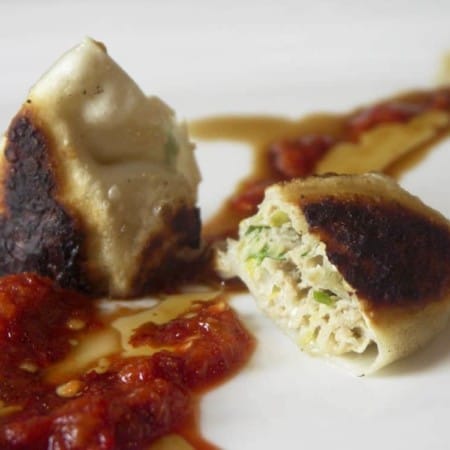
Potstickers fill my dreams because of their perfection; steaming hot, crisp-bottomed and soft-topped dumplings filled with moist gingery, garlicky meat and flecked with tiny bits of Chinese cabbage and scallions.  When served over chili-garlic sauce, soy sauce, and sesame oil or laying on a bed of Momofuku’s Ginger Scallion Mother Sauce, there is no food more satisfying in all of the world. Salty, crispy, meaty, garlicky, gingery, scallion-y, they are the ultimate in umami.

chickenandporkpotstickers1

I could say I slaved over this recipe trying bazillions of different combinations, but I won’t.  (And I will now proceed to contradict myself from three paragraphs ago.) This one is close enough to the flavors I remember of Kammie’s dumplings that I don’t mess too much with it.  I make small alterations each time I make it, but I’m moving incrementally toward perfection.  This particular combination is as close to the Kam Wah recipe as I have ever gotten.  I suspect they used all ground pork with a little minced shrimp in there, but I haven’t gotten around to that attempt yet.  And in the meantime this recipe is great. It’s delicious.  It’s everyting a dumpling should be (shy of being made by the chefs at Kam Wah.)

This Chicken and Pork Potsticker recipe allows me to put into motion another tradition I’ve been meaning to start-  Chinese food on Christmas Eve.    This tradition I borrowed from our dear friends, the Wilsons.  Every Christmas for as long as I’ve known them they’ve had Chinese takeout on Christmas Eve.  This is a tradition behind which I can firmly plant myself.  But seeing as there is a dearth of decent Chinese food in Amish country, I’m on my own.  The food has to be made by me or it won’t exist at all.

One of the beautiful things about making the potstickers is that you can prepare the dumplings ahead of time and freeze them.  You pull just as many as you’d like from the freezer, heat the pan and fry the little beauties to perfection all in under ten minutes.  If that doesn’t make it the perfect prelude to a night filled with present wrapping and stocking stuffing then I don’t know what does!

I told my kids they’d get cooler presents this year if they left out a plate of potstickers instead of cookies. Hey, Santa baby.  Check these out!

chickenandporkpotstickers2

For a photo-free, printer friendly version of this recipe, click here!

Chicken and Pork Potstickers

Ingredients:

  • 1 pound ground pork
  • 2 pounds ground chicken
  • 1 small head Chinese, Napa or Savoy cabbage, minced
  • 1-1/2 bunches green onions, washed and trimmed of roots and any dry ends
  • 8 cloves garlic, minced or pressed
  • 1/4- 1/2 cup peeled, minced or grated fresh ginger root
  • 1/4 cup soy sauce
  • 1 Tablespoon dark sesame oil
  • 1 teaspoon fish sauce
  • 1 package dumpling (gyoza) wrappers
  • 1 teaspoon cornstarch mixed with 1 Tablespoon cold water

Lay green onions on the cutting board.  If you have onions with large bulb ends, you can cut them in half lengthwise before slicing to insure you have small enough pieces.  Slice the green onions thinly on an angle.

chickenandporkpotstickers 11

chickenandporkpotstickers 10

chickenandporkpotstickers 12Set the onions aside.

Mix together pork, chicken, garlic, ginger, soy sauce, sesame oil, and fish sauce with your hands until everything is evenly distributed.

chickenandporkpotstickers9

At this point, I usually pull about a cup of filling out for the anti-vegetable crowd around here.

Add the cabbage and sliced green onions to the pork mixture and thoroughly combine until evenly mixed.

chickenandporkpotstickers 14

chickenandporkpotstickers 15

Have you ever bought dumpling wrappers?  This is what the packages look like at my favorite market.

chickenandporkpotstickers 16

Mound 1-1/2 teaspoons of the filling into the center of a dumpling wrapper.

chickenandporkpotstickers 18

chickenandporkpotstickers 19

Moisten a finger tip in the cornstarch and water mixture then rub along the edge of the dumpling skin.

chickenandporkpotstickers 20

chickenandporkpotstickers 21

Pull both sides up -like a taco- around the filling and pinch together the excess dumpling skin.

chickenandporkpotstickers 22

Try to squeeze as much air out of the dumpling as you can while you firmly press together the sides.  Squeezing the air out keeps them from bursting while cooking.

chickenandporkpotstickers 23

It will look like a pierogy at this point. This is proof that every single decent ethnic food features a delicious stuffed dough type thing.  Pierogies, potstickers, ravioli… Need I go on?

chickenandporkpotstickers 24

When it is completely closed and sealed start in the center, pull and fold a pleat of the pinched dumpling skin toward the middle. Pinch firmly until it sticks.

chickenandporkpotstickers 25

Continue by forming two more pleats on that end of the dumpling.

chickenandporkpotstickers 26

Repeat in the opposite direction on the other end. Place finished dumpling on a cookie sheet.

chickenandporkpotstickers 27

chickenandporkpotstickers 28

Make as many dumplings as your filling and wrappers will allow.  You can freeze the dumplings on the cookie sheet then transfer to a zipper top bag in your freezer if desired or you can cook them immediately.  You can also tightly wrap and freeze any leftover filling or wrappers for your next round of dumpling making.

To Cook the Dumplings:

Pour one tablespoon of neutral oil (Canola, Vegetable, or Peanut) into a heavy non-stick skillet with a tight fitting lid.  Place the pan over medium high heat.  When oil is hot, swirl the pan to coat the bottom.  Place several dumplings in the pan taking care not to crowd the pan.

chickenandporkpotstickers 29

Fry the potstickers for three minutes.  Add 1/2 cup of warm water to the pan and immediately place the lid on the pan.  If cooking fresh potstickers, steam with the lid on for 5 minutes.  If starting with frozen potstickers, steam with the lid on for 8 minutes.  When the time is up, remove the lid and cook for 1-2 minutes more so the potstickers can crisp back up on the bottom.

chickenandporkpotstickers 30

Serve with desired condiments; we like chili garlic sauce, soy sauce, Sriracha, and Mae Ploy the best.

.

Hotter Than the Hinges of Hell Habanero Jelly

hotterthanthehingesofhelljelly2

Ow.  Ouch.  Owwie.  Ooooooh.  Oooooch.  Oh it hurts!

I want you to be aware that this recipe is not for the faint of heart or wimpy of tongue.  It is a pure habanero relish.  As in lots and lots of chopped fresh habanero peppers.

Habaneros, for those who do not know, are one of the hottest fresh peppers that are widely available.  They usually range between 100,000 and 350,000 Scoville Units*.  And for comparison’s sake, a fresh jalapeno pepper runs between 2,000 and 10,000 Scoville Units.  Just so’s you know.

*Scoville Units are the standardized unit of measure for the ‘hotness’ of hot peppers.  According to Wikipedia, “Scoville scale measures the hotness or piquancy of a chili pepper, as defined by the amount of capsaicin it contains. Capsaicin is a chemical compound which stimulates chemoreceptor nerve endings in the skin, especially the mucous membranes. The number of Scoville heat units (SHU) indicates the amount of capsaicin present.” In other words, it gives you a pretty good idea how much it is going to hurt to eat a particular pepper.

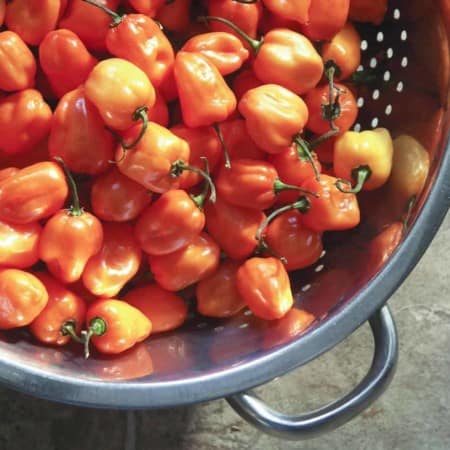
Habaneros are beautiful. So pretty but so dangerous.  You’re looking at two pounds of fresh habanero peppers.  I used every last one of them in a fresh batch of Hotter Than the Hinges of Hell Habanero Jelly.* And I coughed and coughed and coughed and my eyes watered and my nose ran.  And I was prepared for it.  I’ve made this once a year for at least six years. I’m going to say this now: I will litter this post (straight up LITTER it) with warnings.  Because you have to be careful when making this.

*For the record, I know it’s not technically a jelly since it has abundant little bitty pieces of habanero laced through it.  A jelly is smooth.  This?  Is not.

Okay, so it’s a jelly that isn’t a jelly and it’s painfully hot.  Why in heck would you want to make this? Because the flavor is out of this world.  It’s hot, sweet, fruity, and tangy at the same time.  Chile heads: this is a slow-burn and it lasts.  If you like habaneros you will love this.  It’s a stunningly beautiful flame orange with flecks of habanero suspended throughout.  Serve over cream cheese on crackers or loosened up with a fork and brushed onto grilled meat.

Give the gift of painful taste to the chile heads in your life.  They’ll love you forever!

For a photo-free, printer friendly version of this recipe, click here!

Hotter Than the Hinges of Hell Habanero Jelly

Ingredients:

  • 2 pounds fresh habanero peppers
  • 5 cups granulated sugar (measured into a separate bowl before starting)
  • 1 box powdered pectin
  • 1 cup cider vinegar

Wear gloves!  Wear gloves!

hotterthanthehingesofhelljelly4

Trust me.  Even if you think you’re impervious to capsaicin you have no idea how painful it can be to deal with two pounds of habaneros without gloves. Before you start, it’s a good idea to line a bowl with a disposable plastic bag to hold all your stems and seeds.  Thusly:

hotterthanthehingesofhelljelly3

Cut the stem off each pepper and cut in half. If you want face-meltingly hot pepper jelly you can leave the seeds and membranes intact in the peppers.  If you want a milder jelly (in which case you may want to consider jelly making with something other than habaneros?) you can use the tip of a spoon to dislodge the seeds and as much of the membrane as possible.

hotterthanthehingesofhelljelly5

I normally seed about half of the peppers and leave seeds in the other half.  We like-a it hot!

hotterthanthehingesofhelljelly7

Add half the peppers to the bowl of a food processor fitted with a stainless steel blade.  Pulse until the peppers are minced but not liquified. Now.  BE CAREFUL WHEN REMOVING THE LID!  When you pulse the peppers you are atomizing some of the oils they contain.  Stand with your face well away from the bowl when you remove the lid. This is a big old measuring cup full of pain.

hotterthanthehingesofhelljelly8

Scrape the minced peppers into an 8 quart stainless steel pot. Repeat with the remaining peppers.  This is the remaining pepper detritus.  This should go straight into the compost.  Do not pass go!

hotterthanthehingesofhelljelly6

Stir the cider vinegar and powdered pectin into the minced peppers and place over  ‘HIGH’ heat. Do NOT, I repeat, do not put your face over the pan while it is boiling.  It will hurt.  It will make you cough.  It will make your eyes water uncontrollably.  You don’t want to breathe the fumes in on this.  Bring the mixture to a full rolling boil (a boil that does not stop when stirred) stirring constantly.It will look much like this:

hotterthanthehingesofhelljelly9

When the mixture reaches a full boil dump in all the sugar at once and stir quickly.  Bring the mixture again to a full rolling boil, stirring constantly. Again, be careful.  Don’t breathe in too deeply near the boiling pot.  It will look like this before it reaches a boil.

hotterthanthehingesofhelljelly10

As soon as it reaches a full boil, begin timing it and allow to boil hard for exactly one minute.  After the minute has passed, remove from heat and ladle quickly into clean, sterile jars (for instructions on how to do this, click here!) For the love of all that is holy, BE CAREFUL!  Now you’re not only dealing with hot pepper oils, you’re dealing with BOILING hot pepper oils and hot jelly.  It sticks on your skin and hurts like a son of a gun!

Wipe the rims, add clean lids and gently screw rings onto the jars.  Process for 10 minutes at a full rolling boil.  (For instructions on how to do THIS, click here!)

When the jars are done processing, carefully remove from the water bath and place on a cooling rack positioned over a tea towel.  If you pull the jars straight up and out jelly will not leak and endanger the seal.  Don’t worry about the water on top, it will seep out under the rings and onto the towel.

The jars look like they’re on fire.  Metaphorically speaking, they are!

hotterthanthehingesofhelljelly 11

Is it my imagination or is this jar a little misshapen?  Could it be the heat from the peppers?

hotterthanthehingesofhelljelly 12

Better Than Yesterday Pizza

I want to give you all a gift.  It’s that time of year, after all.  Taste, beauty, aroma, thrift; this gift has it all.  As a big thank you to keeping me company on the big old internet for this past year I want to give you all the gift of…

Leftover pizza.

It’s more exciting than it sounds.

Really.

Stick with me and I’ll prove it.  But first?

You should know I am devoted to pizza.  I could happily eat some variation of it three days out of the week (Publicly speaking that is.  In my own head I admit I could eat it five days a week and be perfectly content.  Oh.  Did I type that?  I meant to think it.) Crispy crusts, gooey cheese, salty toppings, and garlic; flecked all over with charred bits and molten marinara sauce.  Is my preoccupation any wonder?

For all my love of fresh, hot pizza, I used to think I disliked leftover pizza (and as I type that sentence I can hear my Dad yelling, “WHAT?  What is wrong with my child?” all the way from the Yoop.) To me, the great appeal* of pizza is threefold; melted cheese, crispy crust bottom, and a chewy-yet-soft inner crust.

*Allo!  Allo?  Iz ziss sing on?  Pizza a-peal?  Pizza peal? This is what my boys call a ‘get it?’ joke.

Now.  Raise your hand if you think you dislike reheated pizza.  It’s okay.  I’m not judging.  Because until a few years ago I thought I disliked it, too.  My problem was the texture of pizza after it was reheated in the microwave or in the oven.  It seemed a pale shadow of its former glory; gummy or congealed cheese, muddy flavors, and soggy crusts if reheated in the oven. Or worse yet -if microwaved to hot-  almost inedibly chewy crust and translucent cheese that was unevenly melted.  Gaggy.

I stumbled upon a way to reheat pizza that makes the leftover pizza better than the fresh pizza ever was.  Hence: Better Than Yesterday Pizza. (This may seem like a tangent, but it’s important.)  My Dad always makes grilled cheeses by toasting the sandwiches then tossing a little water in the pan and covering it to make sure the cheese is melted and gooey all the way through.  One day, many moons ago, while staring down the barrel of a fridge laden with cold, leftover pizza it occured to me that Dad’s method might just make it edible.

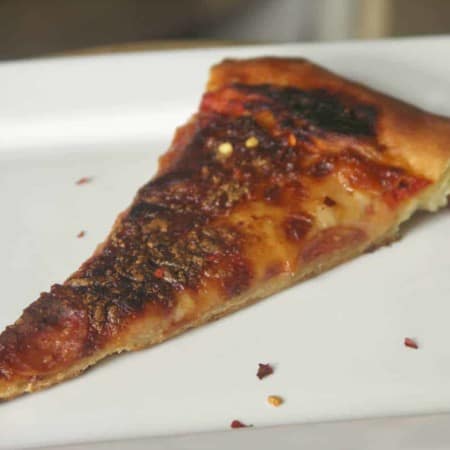
It was more than edible.  It was sublime.  So good that it is the only way we’ve reheated leftover pizza since.  And let me tell you something.   Perfectly melted and gooey cheese, hot interior, crackling crisp bottom crust and a top dotted with crunchy charred bits make this so good it’s better than the original pizza.  In fact, I deliberately make double the amount of pizza we can eat on pizza nights just so we can eat Better Than Yesterday Pizza.

A word of caution, though.  This process lands you with a piece of pizza that is fresh and hot and well-nigh irresistible.  But oh, try to resist.  It’s pizza oven hot.  And if, like me, you dive straight into eating, you can kiss the skin on the roof of your mouth goodbye.  Here are the instructions.  I’m going to go suck on some ice cubes.  Right after I eat this other piece of pizza.

betterthanyesterdaypizza1

Better Than Yesterday Pizza

You will need a heavy cast-iron or non-stick skillet with a tight fitting lid.

Ingredients per slice:

  • 1 teaspoon extra virgin olive oil (you can substitute canola oil, but olive oil has the best taste here.)
  • 1 slice cold, leftover pizza

betterthanyesterdaypizza5

  • 1 teaspoon water

Place a heavy cast-iron or non-stick skillet over medium high heat.

Add the oil to the pan and swirl until hot and evenly coated.  Place slice of pizza, topping side DOWN in the pan.

betterthanyesterdaypizza6

Allow to cook for one minute (longer for more charred bits).

After one minute, carefully slide a spatula under the pizza and flip crust side down.

betterthanyesterdaypizza7

Add the teaspoon of water and immediately place the lid on the pan.  Cook for an additional minute.

betterthanyesterdaypizza8

Remove the lid and cook for one to one and a half minutes or until all water has cooked off and the bottom crust is crispy.  Transfer to a plate.  If desired, sprinkle with crushed red pepper plates to complete the pizzeria taste and experience!

betterthanyesterdaypizza3

Taco Soup

Is it soup yet?

tacosoup5

We lived in Le Roy for just over a decade.  We loved our home, our church, our community. We had rebuilt the house while living in it.  (This process was helped along by the fact that it was bare studs, floors and outer walls and absolutely-nothing-else when we bought it.)  We could’ve stayed and stayed and stayed until we passed beyond the veil.  So why did we leave?  By the time we made an offer on our current home, we were a family of seven with two morbidly obese dogs and many musical instruments crammed into a 1300 square foot home.

It started way back with the birth of my first son.  When we brought Liam home, the phone was ringing and it was the community outreach coordinator from church.  She informed me that it was the practice of the church women to provide meals to new mothers for the first two weeks after a baby was born.  I accepted (because how can you say no to that?) but secretly thought to myself that I didn’t know why they thought I wouldn’t be able to make our family’s meals.  I learned.  Quickly.

Those meals came for fourteen days and fourteen nights and they were good.

When, two months later, baby Liam was rushed to the hospital for a life-saving surgery, the women once again provided meals so we could focus on helping Liam recover.

Two years later, just before Aidan was born, my meal angel called again.  I was shocked.  I said, “I thought the meals were just for new mothers!”  She laughed and said, “Well, this baby will be new, won’t he?”  I gratefully accepted the offer and the meals.  This time, since I had a c-section, the meals were the only thing standing stalwartly between us and a steady diet of cold cereal.

And once again,  the meals came for fourteen days and fourteen nights and they were good.

Another two years on, and another beautiful baby boy, the meals rolled in for another two weeks.  Ty nursed happily.  I reheated happily. I cherished the food I received after the births of my children.  You could say they were like manna from heaven.  After the births of Leif and Rowan, they kept the meals a-coming like the loaves and the fishes.

I don’t mean to suggest that I carried on having more kids in order to get the free meals from those amazing cooks over at Calvary.  That would be just wrong.  It’s pure coincidence that I haven’t had any more kids since moving. I kept having children because I loved my boys.  Okay. And the meals. Those women were GOOD cooks.

~~~   ~~~   ~~~

If you happen to find yourself in Le Roy, New York on a Sunday morning, stop in at the golf-ball church.  The preaching is great, the people are friendly and if you’re lucky they’ll be hosting a potluck or a fellowship meal.  It’s worth your time.  Trust me.

~~~    ~~~   ~~~

This family-favorite, Taco Soup, was one of those fabulous meals and was brought to us by my dear friend, Carolyn.  It has graced our table many times, and in many forms, over the years since Carolyn came into my kitchen bearing a steaming crock of soup, tortilla chips, grated cheese, and sour cream.

This is a memory soup.  One whiff of this bubbling away on the stovetop and my entire body remembers the feeling of cradling a sweet smelling, impossibly soft newborn.  I watch my boys eat this and remember their little balled fists resting on my chest as they nursed to sleep.  When I eat this I remember my friends who tramped through snow storms  to bring my family sustenance and companionship.

When I cook this, I remember taking it to my little sister, Jessamine, after her baby boy, Ezra was born.  That time it had a little extra something special in it.  When Jessie sat down later that evening to eat it, she found a spider floating in her soup.  Whether it came with the soup from my house or jumped in in a fit of despair somewhere else along the road we’ll never know.  Her husband ate it anyway.  The soup, that is.

As with most soups, many of the ingredients are changeable.  Don’t fancy chili beans or pinto beans?  Add some pork and beans or kidney beans instead.  Do you prefer home-cooked beans?  Believe me when I tell you this soup is sublime with them.  Replace the chicken broth with beer, add a couple handfuls of masa and you will have an excellent pot of chili. To make a hearty vegetarian soup, replace the chicken broth with beer or vegetable broth, and omit the meat.  You can leave as is or add in crumbles or TVP.  Feel free to add spiders if you like ‘em.  My sister and I will go without.

It’s cold out there.  You need soup.  You need this soup!

For a photo-free, printer friendly version, click here!


Taco Soup

Ingredients:

  • 1 pound ground beef, browned and drained ~or~ 3 cups leftover cooked meat, chopped
  • 1 can (28 ounces) crushed or diced tomatoes
  • 2-3 cups chicken broth or stock (Depending on how soupy you like your soup. Using less broth will result in a thicker soup.)
  • 1 packet Ranch Dressing Mix
  • 1 packet taco or enchilada seasoning (If using seasoned meat, this can be omitted!)
  • 1 can black beans, drained and rinsed
  • 1 can chili beans with sauce
  • 1 can pinto beans, drained and rinsed
  • 2 cups frozen corn kernels

Optional for serving:

  • Tortilla or corn chips
  • Grated cheese
  • Sour Cream or plain yogurt
  • Sliced green onions
  • Minced fresh cilantro
  • Diced tomatoes

Slow Cooker Directions (see below for Stove top directions):

In a slow cooker crock stir together meat, tomatoes, dressing and seasoning mixes (if using), black beans, chili beans with sauce, pinto beans and corn.  Place lid on crock, turn slow cooker to ‘LOW’ and cook for 6-8 hours.

Serve with or without toppings.

tacosoup3

tacosoup1

Store leftovers, tightly covered, in the refrigerator for up to a week.  You can also portion the leftover soup into individual servings and store in the freezer for up to 6 months.

Stove top Directions:

Stir together meat, tomatoes, dressing and seasoning mixes (if using), black beans, chili beans with sauce, pinto beans and corn in an appropriately sized soup pot.  Place lid on pot, put pot over medium low heat and bring to a simmer.  Remove the lid and allow to simmer gently for 30-40 minutes or until soup is slightly thickened.

Serve with or without toppings.  Store leftovers, tightly covered, in the refrigerator for up to a week.  You can also portion the leftover soup into individual servings and store in the freezer for up to 6 months.

tacosoup2

Hot Chocolate on a Stick

Now that I have the attention of the entire state of Minnesota, please allow me to expound.

hotchocolateonastick 14

This is one of the most clever ideas I’ve seen out of the King Arthur Flour Baker’s Circle lately.  (And they’re no creative slouches over at King Arthur.)  In the most recent e-newsletter* from their test kitchen they included a recipe for Cocoa Blocks.

*If you’d like to receive their free e-newsletter, you can click this link and look for the sign-up box in the lower right hand corner of the page.

Oh sweet merciful heavens.  Cocoa blocks.  Very utilitarian name, no?  Nothing against my King Arthur folks, because I really do love them, but I think the name doesn’t do justice to these little beauties.  I’ve renamed them.  Henceforth, they shall be called Hot Chocolate On A Stick.

Hot Chocolate on a Stick is a creamy chocolate confection that is much like an ultra-rich fudge.  You can, as the new title indicates, put these blocks of chocolatey goodness on sticks for ease in swirling it in hot milk or nibbling.

hotchocolateonastick 13

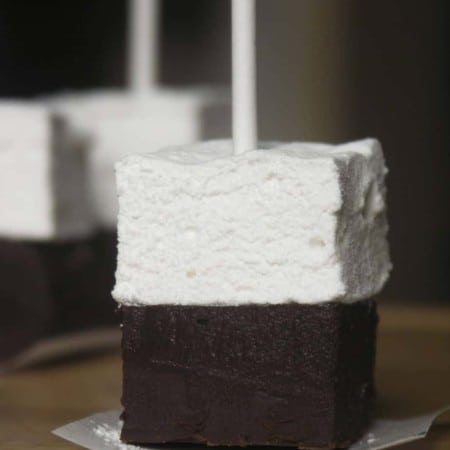
Or, if you’re a rebel (or not from the Midwest), you can simply leave the squares alone and stir them into your hot drinks.  Or you can go another step, as I am wont to do, and skewer a marshmallow on top of the block of chocolate.

hotchocolateonastick 12

And since we’re playing with marshmallows already, why not make them homemade*?  That opens up the possibilities of all kinds of decadent flavor combinations; mocha chocolate with cocoa marshmallows, orange chocolate with vanilla marshmallows, plain chocolate with raspberry marshmallows, or pure chocolate and vanilla marshmallows.

~~~   ~~~

*Last year Val posted a homemade marshmallow recipe in our Homemade Christmas Gifts series.  (See that post here!)  Homemade marshmallows, if you’ve never had them, are a completely different animal than those little round foam-like jobbies you get in bags at the grocery store.  They’re ethereally light, sweet and endlessly customizable.  Have a hankering for an orange flavored marshmallow without the nasty food coloring?  It can be done.  Want a mocha marshmallow?  (Just try finding THAT at your local mega-mart.)  It’s only moments away.  You get my drift, right?

So if you combine luscious, velvety, rich fudge with light-as-air homemade marshmallows it should follow that what you’ve created is heavenly.  And it is.  Oh, it is!  Not to put too fine a point on it, but having these in my kitchen was the only thing standing between me and a potential sale of my children to the gypsies early career apprenticeship commitment for my children.  I hid in the bathroom with a  ‘Hot Chocolate on a Stick’ and nibbled my irritation away.

I could’ve taken a cup of hot milk to the bathroom with me, but I was in a hurry, people.  I needed the chocolate and I needed it fast.  The kids, on the other hand, found the stash while I was hiding (and small price to pay for the peace it brought me) and stirred theirs into hot cups of milk.  I hear tell that they enjoyed it immensely.  The chocolate rings around their mouths bore out their testimony.

Kid tested.  Mother approved.

hotchocolateonastick 15

hotchocolateonastick 16

hotchocolateonastick 17


~~~   ~~~

May I recommend that you whip up a batch or two or three of these?  Keep one batch for yourself.  Wrap one batch in plastic and pretty ribbons for gift-giving.  And that last batch?  Well, give it away one at a time to your kids’ teachers, bus drivers, your preacher, the mail carrier, the elderly man or woman down the road who lost their spouse this year, the gal in the apartment two doors down who looks a little lonely, or anyone else who looks like they could use a good dose of seasonal cheer.


Let’s do a quick refresher on the marshmallows:

Homemade Marshmallows

Follow this link for the original post and a printable version of this recipe.

This is mainly Val’s recipe, but I’ve added a few of my own notes.

Ingredients:

  • .75-oz unflavored gelatin (3 envelopes of Knox gelatin)
  • 1/2 cup cold water
  • 2 cups granulated sugar
  • 2/3 cups light corn syrup
  • 1/4 cup water
  • 1/4 teaspoon salt
  • 1 tablespoon vanilla extract (or other flavor extract)
  • Confectioners’ sugar

Line 9 x 9-inch or 8 x 8-inch pan with plastic wrap and lightly oil it using your fingers or non-stick cooking spray. Set aside.

In the bowl of an electric mixer, sprinkle gelatin over 1/2 cup cold water. Soak for about 10 minutes.

Meanwhile, combine sugar, corn syrup and 1/4 cup water in a small saucepan. Bring the mixture to a rapid boil.  As soon as it is boiling, set the timer and allow to boil hard for 1 minute.

Carefully pour the boiling syrup into soaked gelatin and turn on the mixer, using the whisk attachment, starting on low and moving up to high speed. Add the salt and beat for between 10 and 12 minutes, or until fluffy and mostly cooled to almost room temperature. After it reaches that stage, add in the extract and beat to incorporate.

Grease your hands and a rubber or silicone scraper with neutral oil and transfer marshmallow into the prepared pan. Use your greased hands to press the marshmallow into the pan evenly.  Take another piece of lightly oiled plastic wrap and press lightly on top of the marshmallow, creating a seal. Let mixture sit for a few hours, or overnight, until cooled and firmly set.

hotchocolateonastick4

Sprinkle a cutting surface very generously with confectioner’s sugar.

hotchocolateonastick5

Remove marshmallow from pan and lay on top of the sugar.

hotchocolateonastick6

Dust the top generously with sugar as well.

hotchocolateonastick7

Use a large, sharp knife to cut into squares.

hotchocolateonastick8

Separate pieces and toss to coat all surfaces with the sugar.
Store in an airtight container.

Now for the Hot Chocolate on a Stick!

Hot Chocolate on a Stick

Scroll to the bottom for an easy-print version of this recipe!

Ingredients:


  • ½ cup heavy cream
  • 14-ounce can sweetened condensed milk (1 1/4 cups)
  • 3 cups semisweet chocolate (3 cups chopped chocolate bars or chips)
  • 3/4 cup unsweetened baking chocolate (4 ounces)
  • wooden sticks, lollipop sticks, candy canes or bamboo skewers
  • optional, crushed candy canes, marshmallows and/or cocoa powder

Line an 8 x 8-inch pan or a 9 x 9-inch pan with foil and set aside.

hotchocolateonastick1

Combine the cream and sweetened condensed milk in a heavy bottomed saucepan over medium heat.  Heat until it is steaming, but not boiling, stirring occasionally to keep from scorching.

Add all of the chocolate and remove from the heat.  Allow the chocolate to melt, undisturbed, for 10 minutes.

hotchocolateonastick2

After 10 minutes, whisk firmly until it is thick and shiny.  You can add a few drops of flavoring extract or oil at this point, or add some powdered espresso or vanilla.  Whisk vigorously again to incorporate the flavoring (if used.)

Use a rubber or silicone spatula to spread the mixture out evenly in your prepared, foil-lined pan.

hotchocolateonastick3

Allow to cool at room temperature 12 hours or overnight so that it firms slowly.

Take the fudge from the pan and remove the foil.  Place on a cutting board.

Using a knife heated with hot water and wiped dry, cut the fudge into 36 equal-sized cubes.  You can either stick a lollipop stick (or candy cane) into the center of each block or leave as is.  Additionally, you can press the cut sides of the fudge into crushed candy canes, roll them in cocoa powder or top with marshmallows.

Eat immediately or wrap tightly and store at room temperature.

hotchocolateonastick 14

hotchocolateonastick 18

If you make more than one batch and use different flavorings for the marshmallows or chocolate, you can use different colored ribbons to indicate the flavors.  Silver for mocha chocolate and vanilla marshmallows, gold for plain chocolate and raspberry marshmallows, for instance…

hotchocolateonastick 19

hotchocolateonastick 21

Hey… Someone’s snuck off with my raspberry marshmallow Hot Chocolate on a Stick…

Oh well, I’ll make more.

Remember, it’s Christmas time!

Hot Chocolate on a Stick
Author: 
Recipe type: dessert, candy
Prep time: 
Cook time: 
Total time: 

Serves: 36
 

This creamy chocolate fudge confection can be nibbled in its pure form, skewered on a stick alone or with homemade marshmallows and simply eaten or swirled into hot milk for a hot chocolate that is second to none.
Ingredients
  • ½ cup heavy cream
  • 14-ounce can sweetened condensed milk (1¼ cups)
  • 3 cups semisweet chocolate (3 cups chopped chocolate bars or chips)
  • ¾ cup unsweetened baking chocolate (4 ounces)
  • wooden sticks, lollipop sticks, candy canes or bamboo skewers
  • optional, crushed candy canes, marshmallows and/or cocoa powder

Instructions
  1. Line an 8 x 8-inch pan or a 9 x 9-inch pan with foil and set aside.
  2. Combine the cream and sweetened condensed milk in a heavy bottomed saucepan over medium heat. Heat until it is steaming, but not boiling, stirring occasionally to keep from scorching.
  3. Add all of the chocolate and remove from the heat. Allow the chocolate to melt, undisturbed, for 10 minutes. After 10 minutes, whisk firmly until it is thick and shiny. You can add a few drops of flavoring extract or oil at this point, or add some powdered espresso or vanilla. Whisk vigorously again to incorporate the flavoring (if used.)
  4. Use a rubber or silicone spatula to spread the mixture out evenly in your prepared, foil-lined pan. Allow to cool at room temperature 12 hours or overnight so that it firms slowly.
  5. Take the fudge from the pan and remove the foil. Place on a cutting board.
  6. Using a knife heated with hot water and wiped dry, cut the fudge into 36 equal-sized cubes. You can either stick a lollipop stick (or candy cane) into the center of each block or leave as is. Additionally, you can press the cut sides of the fudge into crushed candy canes, roll them in cocoa powder or top with marshmallows.
  7. Wrap tightly and store at room temperature.