Barbecue Pulled Pork Pizza

Today I have the second of the three pizzas I planned to share with you for Pizza Week. You can see the dough recipe here and the Spinach and Garlic Alfredo Pizza here. Hooray for pizza! Now, I can’t speak for your own mother, but I -for one- would be thrilled with a homemade pizza for Mother’s Day.

By now you all know how I feel about pizza, but there’s one very big reason to love it that I haven’t mentioned yet. It’s frugal. Oh, baby, it is the frugal hausfrau’s best friend. You can put nearly anything on a pizza, so it’s great for using up odds and ends in from the refrigerator and the pantry. Granted, not every combination will be a winner. A good rule of thumb to keep in mind when figuring out what to load onto your crust is “Would this taste great together on a sandwich?” If you answer yourself with a yes, chances are good that it will make a wonderful pizza.

With my own rule in mind, I raided my chill chest and put together today’s pizza. Using a little leftover pulled pork (I used this from one of my most popular posts ever here on Foodie With Family but this one would be great, too!)  barbecue sauce, enchilada sauce, pepper jack cheese and onions from hamburgers, I put together this beautiful Barbecue Pulled Pork Pizza.  It was a handful of this and a fistful of that and a pinch of another thing. We’re talking about little ingredients that so easily could’ve been lost in some forgotten corner of the refrigerator, but they became dinner. In fact, they became a glorious barbecue pulled pork crossed with pizza. How could that be anything less than wonderful?

Another great advantage of making pizza at home is the infinite ability to adjust it to your own preferences. You’re not an onion lover? Leave them off! You dislike barbecue sauce? Replace it with pizza sauce or hot sauce. The world is your oyster, or rather, your pizza!

Barbecue Pulled Pork Pizza

Barbecue Pulled Pork Pizza

This pizza is a delicious multi-tasker. Yes, it tastes amazing- pizza meets pulled barbecue pork on a crackly crisp crust- but it's also a great user-upper of leftovers from the refrigerator.

Ingredients

  • 1 piece, about 5 ounces or the size of a large plum, of No-Knead Whole-Wheat Semolina Pizza Dough
  • 1 to 1 1/2 cups leftover pulled pork (like this or this.) | http://www.foodiewithfamily.com/2009/03/24/cuban-pork-part-i-slow-cookin-good-lookin/]
  • 1/4 cup barbecue sauce (I use this but you can use whichever is your favourite.)
  • 1 cup shredded pepper jack cheese
  • 1/2 cup shredded part-skim mozzarella cheese
  • 2 tablespoons hot sauce or enchilada sauce
  • Optional, but tasty:
  • 2-3 quarter-inch thick, half moon slices of onions
  • mixed salad greens
  • additional hot sauce

Instructions

With a pizza stone situated in the bottom third, preheat the oven as high as you can get it. We use a 500°F setting on our oven.

Lightly flour your work surface. Form your pizza dough into a ball by gently stretching the top of the dough underneath itself. Place the dough on the floured work surface and pat it out gently with your hands into a disc shape until you cannot make it any wider. Flour a rolling pin and gently roll the pizza dough out. This works best if you look at the pizza dough as a clock. Start rolling from the center of the circle toward 12 o'clock, rotate your pin and roll from the center to 3 o'clock, then from the center to 6 o'clock, and so forth, ending back at 12 o'clock. Do this until you have a circle that is about 10-inches in diameter.

Sprinkle a pizza peel generously with semolina flour or cornmeal. Carefully transfer the dough to the peel. Shake gently to be sure no part of the dough sticks. This is crucial. You will be shaking the peel gently after each addition of toppings to make sure the dough can still move freely. If at any point the dough sticks, gently lift the offending area and throw a bunch of semolina or cornmeal under it.

Dot the barbecue sauce over the dough to within a 1/2-inch of the edges. Shake the dough to make sure it's not stuck.

Pull the pork apart with your hands and arrange it over the barbecue sauce to within a 1/2-inch of the edges. Again, shake to be sure it isn't stuck

Sprinkle the pepper jack and mozzarella cheese over the pork and then drizzle with the 2 tablespoons of hot sauce or enchilada sauce. If you're using the onion, separate the slices into individual pieces and arrange over the top. Shake! Shake! Shake! To be sure it isn't sticking.

Open your oven, position your peel over the back edge of the pizza stone. Flick your wrist to get the dough moving, pulling the peel back as you transfer the dough to the stone. Shut the oven and let the pizza bake on the stone for 8-10 minutes, or until the crust is the desired colour and the cheese is melted and bubbly with golden brown or charred areas. Slip the peel back under the pizza and give a little jerk to move it safely onto the peel. Transfer the cooked pizza onto a cutting board. Let it rest 3-5 minutes before slicing.

If you'd like to, and I almost always do, serve the slices with a handful of fresh salad greens and another drizzle of hot sauce over the top.

http://www.foodiewithfamily.com/2012/05/11/barbecue-pulled-pork-pizza/

Spinach and Garlic Alfredo Pizza (With or Without Onions and Anchovies)

Monday, I declared this week to be Pizza Week. Today is the first pizza in the series. All of these pizzas will use the No-Knead Whole-Wheat Semolina Pizza Dough recipe I posted Monday.

As much as I love a good, plain old pepperoni and cheese pizza, there is something about pizza that makes me wildly experimental.  The pizza shell is my canvas and I go all Jackson Pollack on it. Today, I will go all Jackson Pollack on this post. Disjointed. Scattershot. Yeah. Um, stick with me. The pizza is totally worth it.

I’ve played around with white pizzas over the years but until recently was never blown away by the results. The solution was two-fold.

  1. I found the perfect crust. (See yesterday’s post!)
  2. I started using garlic Alfredo sauce instead of olive oil and garlic.

I have to tell you that Alfredo sauce is my six-year old’s specialty in the kitchen. Granted, I measure the ingredients into a bowl for him, but he does all the grunt work. He whisks the ingredients together while I work on pizza crusts. We’re a well-oiled team. Actually, we’re a well-buttered team. The Alfredo sauce is pretty buttery. And creamy. And cheesy. This is mainly due to the fact that Alfredo sauce is made almost entirely of butter, cheese, and eggs with heavy cream thrown in for good measure.  Because really, butter, eggs, and cheese aren’t rich enough on their own. Oy.

To that rich, velvety, hubba hubba base, we add a touch of garlic, parsley and black pepper. Voila! You have a sauce that makes pizzas sing and pasta weep with joy. It also makes a pretty darned irresistible perfume if you’re married to someone like the guy I married!

Speaking of things that my husband can’t resist, I must broach the subject of anchovies. Full disclosure: I am an unapologetic anchovy cheerleader. I love them. I adore them. I pink puffy hearts love everything about them. I do know, however, that not everybody is in my camp. If the thought of the hairy, spooky little fish fillets on your pizza skeeves you out, might I suggest that you chop at least one and add it to your Alfredo sauce? You will be shocked -SHOCKED, I say- at the subtle boost the presence of the little fishy adds. If you just can’t leap that hurdle, mentally, it’s alright. I’m still here for you. I am still going to dangle anchovies proverbially in front of you from time to time until you feel brave enough to try them. That’s right. I am big sister to the world.

In short, if you don’t like anchovies and onions, don’t put them on the pizza.

…And since we’re on the subject of dangling things in front of people until they try them, let’s talk spinach. My kids -thanks to a friend who fed them spinach in my absence- are pretty keen on spinach. Even two of the founding members of my anti-veg contingent like spinach. Proving the aforementioned friend’s theory right again, combining spinach and Alfredo sauce on this pizza is -at least in my imagination- probably what it was like when someone first stuck a chocolate bar in a jar of peanut butter.  Heavenly angels singing comes to mind…

We can’t forget to talk about the crust! I made many promises about this crust in the post with the dough recipe. I cut the pizza and The Evil Genius swooped in (sans cape) to snatch the first piece after I photographed it.

He declared, “You must show them a picture of the bottom of the crust. That’s the key! That’s how they’ll know this is one crust to rule them all.” And to further drive his point home, this man -the one who I am convinced wears a hat in order to have something to pull over his face when I aim the camera at him- offered to hold the pizza up (after taking a bite, of course) and let his hand be in the picture.  It’s a banner day people. I present to you “Perfect Crust in a Manly Hand”.

Now let’s make a pizza -an AWESOME pizza- together, shall we?

Spinach and Garlic Alfredo Pizza (With or Without Onions and Anchovies)

Spinach and Garlic Alfredo Pizza (With or Without Onions and Anchovies)

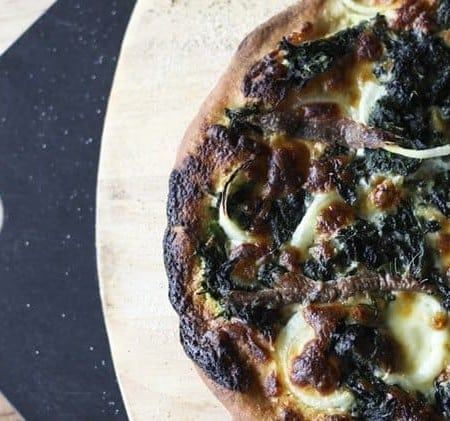
The perfect pizza dough is topped with a creamy, rich Garlic Alfredo, spinach, and mozzarella (and anchovies and onions in our house!) and baked to crackly crisp perfection with little charred bits on the crust and golden brown cheese. This is one white pizza to rule them all!

Ingredients

    For the Garlic Alfredo Sauce:
  • 1 cup (8 ounces by weight) butter
  • 2 to 2-1/2 cups grated Parmesan or Romano cheese (or a blend)
  • 3/4 cup heavy cream
  • 2 eggs
  • 1 garlic clove, minced or pressed
  • 1 teaspoon dried parsley flakes (or 1 tablespoon fresh, minced parsley)
  • freshly ground black pepper, to taste
  • For the Pizza:
  • 1 piece, about 5 ounces or the size of a large plum, of No-Knead Whole-Wheat Semolina Pizza Dough
  • 1/2 cup to 2/3 cup of Garlic Alfredo Sauce
  • 1 1/2 cups shredded part-skim mozzarella cheese
  • 2 cups of frozen spinach, thawed and squeezed to remove most of the moisture
  • cornmeal or semolina for the peel
  • Optional but ever so tasty:
  • 2 (1/8 to 1/4-inch thick) slices of a peeled onion, cut into half moons.
  • 6 whole anchovy fillets (the packed in olive oil variety), blotted gently

Instructions

To Make the Garlic Alfredo Sauce:

Melt the butter in a microwave safe bowl. Whisk in all additional ingredients and refrigerate -tightly covered- until ready to use. Leftovers should be used within 3 days.

To Make the Pizza:

With a pizza stone situated in the bottom third, preheat the oven as high as you can get it. We use a 500°F setting on our oven.

Lightly flour your work surface. Form your pizza dough into a ball by gently stretching the top of the dough underneath itself. Place the dough on the floured work surface and pat it out gently with your hands into a disc shape until you cannot make it any wider. Flour a rolling pin and gently roll the pizza dough out. This works best if you look at the pizza dough as a clock. Start rolling from the center of the circle toward 12 o'clock, rotate your pin and roll from the center to 3 o'clock, then from the center to 6 o'clock, and so forth, ending back at 12 o'clock. Do this until you have a circle that is about 10-inches in diameter.

Sprinkle a pizza peel generously with semolina flour or cornmeal. Carefully transfer the dough to the peel. Shake gently to be sure no part of the dough sticks. This is crucial. You will be shaking the peel gently after each addition of toppings to make sure the dough can still move freely. If at any point the dough sticks, gently lift the offending area and throw a bunch of semolina or cornmeal under it.

Spread the Garlic Alfredo sauce over the dough to within a 1/2-inch of the edges. Shake the dough to make sure it's not stuck.

Sprinkle most of the grated cheese, reserving about 1/4 cup, over the Garlic Alfredo sauce. Pull off peanut-in-the-shell sized hunks of spinach and dot them over the cheese. If using the onions and anchovies, pull the onions into individual pieces and distribute them and the anchovies evenly over the top. Toss the reserved 1/4 cup of mozzarella cheese over the top. Gently shake the pizza to make sure it's not stuck.

Open your oven, position your peel over the back edge of the pizza stone. Flick your wrist to get the dough moving, pulling the peel back as you transfer the dough to the stone. Shut the oven and let the pizza bake on the stone for 8-10 minutes, or until the crust is the desired colour and the cheese is melted and bubbly with golden brown or charred areas. Slip the peel back under the pizza and give a little jerk to move it safely onto the peel. Transfer the cooked pizza onto a cutting board and let it rest 3-5 minutes before slicing.

http://www.foodiewithfamily.com/2012/05/09/spinach-alfredo-pizza-with-or-without-onions-and-anchovies/


No-Knead Whole-Wheat Semolina Pizza Dough | Make Ahead Mondays

I’m about to do something I’ve wanted to do for a long, long time. I declare this week to be pizza week.

I’ve run a handful of pizza recipes (this, this, this and this) but I’ve never gone deep into pizza territory in this space. This -to put it mildly- is nuts. Why? Because I am certifiably obsessed with pizza. I love pizza truly, madly and deeply. It is my happy food. I’m not talking about cardboard take out pizzas (although I’ll eat those, too.) I am talking about homemade pizza whether it’s thin and crispy, thick pan pizza, or anything in between.

Way back when The Evil Genius and I were first wed, we went on our first of many food kicks. We had a collective hankering for a pizza fresh from the oven with a thin, crispy and chewy crust. We bought a pizza stone and peel, researched recipes, and ate pizza nearly every night for a month. We were thrilled with our results, but there was always one little piece that didn’t quite meet our expectations: that crust.

Good golly. Who knew that a little piece of dough could create such frustration? We tried stiffer dough, slacker dough, dough made from various flours, enriched dough, plain dough, new dough and aged dough. It seemed like no matter what, it just wasn’t exactly what we had pictured.

The years passed and we still loved homemade pizza infinitely better than takeout*. We liked our crust and put aside our quest for crust perfection while we were busy with our five baby boys. About a year ago, though, the pizza crust bug bit again. I decided to go a direction I had never gone with my dough.

*I like a variety of ingredients on my pizza. Sometimes I like ham, sometimes bacon, sometimes artichoke hearts, pineapple, roast beef, provolone, crusts rubbed with garlic, extra char on the crusts, caramelized onions, anchovies, shaved asparagus, bleu cheese, barbecue sauce, shredded chicken, a combination of those things or something else entirely. Aside from the fact that our local pizzeria just doesn’t carry half of those, I’m a little to embarrassed to order the world’s most high maintenance pizza, and I’m too cheap to pay for it. I’d far rather make twice as much at home for the same price and preserve my dignity.

I weighed flours and ingredients as I dumped them into my dough bucket and stirred. I let it rise and fall, got my oven screaming hot, sprinkled flour over the surface of the dough, pulled off a piece the size of an orange, rolled it out*, transferred it to the peel, topped it and baked it.

*This may horrify some pizza purists and hand-tossing devotees, but the truth is simple. I prefer to roll out my pizza crusts. I like a relatively uniform shape and whenever I toss the dough, I end up with amoeba shaped pizzas. While that’s not a terrible thing, it’s a little harder to evenly cut it. Yes, I am a control freak. We’ve already covered that. Feel free to hand-stretch or toss your crusts. My rolling pin and I will happily carry on doing what we’re doing.

I moved the pizza to the cutting board, let it rest for a couple of minutes then sliced it. Unlike the usual approach to pizza night, where I call everyone to grab pizza and settle in at the table, I slid over into the corner of the kitchen where no one can see me unless they come all the way into the room and took a bite. Oh yes. This was the crust I’d wanted all those years. Crackly crisp on the outside but chewy on the inside, slight bits of char here and there, sturdy enough to hold the toppings I love, but delicate, too. Oh yes. This was pizza love. I served the pizza to my family without telling my husband what I had changed.

He took a bite and looked at me. “This crust! This is the crust! What did you do? This is perfect!”

So here’s the skinny. Today, for Make Ahead Mondays, I am giving you the crust recipe in handy-dandy printable form. Get a batch of this mixed up and into your refrigerator, because this week, we make pizza, and lots of it.

Those of you with good memories may recognize this recipe as being very similar to one I’ve posted before. It’s true, I did! The only difference between the previously posted recipe and the one being posted today is the presence of white whole wheat flour in today’s version. There’s something about that white whole wheat that perfects what was an already good dough. This is the dough that fulfilled the pizza crust fantasy. This is crust upon which dreams are built.

Is it hyperbole? I’ll let you be the judge.

No-Knead Whole-Wheat Semolina Pizza Dough | Make Ahead Mondays

Prep Time: 10 minutes

No-Knead Whole-Wheat Semolina Pizza Dough | Make Ahead Mondays

This is our favourite pizza crust. The easy to mix and work with dough yields a crispy and chewy, flavourful crust that holds up to anything you put on it. Thankfully, the large batch keeps well for up to 10 days in the refrigerator. For longer storage, divide into individual sized portions in oiled zipper top bags and freeze for up to 3 months.

Ingredients

  • 5 1/2 cups room temperature water
  • 1/2 cup extra virgin olive oil
  • 3 tablespoons instant yeast
  • 2 tablespoons kosher salt
  • 2 tablespoons sugar (raw or granulated)
  • 4 cups (1 pound 1 ounce by weight) white whole wheat flour
  • 7 cups (1 pounds, 14 3/4 ounces by weight) all-purpose flour
  • 2 cups (11 ounces by weight) semolina flour

Instructions

Mix the yeast, salt, sugar, olive oil and water in a 12 quart capacity bucket. (This recipe can be halved if you do not have a large enough container.)

Stir in the flour until no dry pockets remain. You do not have to knead it, but I find the easiest way to have it thoroughly mixed is to wet one hand and forearm and use that one to mix it in completely.

Cover lightly (Do not put a lid on tight. Trust me.) and let rest at room temperature until the dough has doubled and collapsed. (Or at least until dough is very, very puffy.) This takes a less than 2 hours in warm weather and more than 2 hours in cool or cold temperatures.

You can use the dough immediately. If you have leftovers, you can store them in the container, lightly covered (again, do not use a tight lid!) for up to 10 days. If you need to store the dough beyond that time, divide into individual pizza sized servings. Freeze in re-sealable plastic bags that have about a teaspoon of olive oil smeared around inside each for up to 3 months.

http://www.foodiewithfamily.com/2012/05/07/no-knead-whole-wheat-semolina-pizza-dough-make-ahead-mondays/

Kimchi Pancake (Kimchijeon)

Back in the day -when I worked early hours as a prep cook and late nights as a slinger of pub grub- I wondered more than once how I’d ever find true love when I always smelled like garlic, onions and a fryolater. It was a valid concern folks… I remember one particularly busy week (the café where I worked was in a tourist town that hosted an insanely well attended annual festival) when I broke apart,  peeled, and minced hundreds of heads of garlic and almost as many onions. I spent hours upon hours on my feet frying onion rings and French fries and Monte Cristo sandwiches and dill pickles. I went to a social event at my college after getting off of my shift without hitting the shower first. I heard no fewer than five people say -as they walked by me- something like, “Woah! Are they making garlic fries? I totally smell garlic fries.” or “Something smells like old oil!”

I  was sure that I had to give up cooking or live a lonely life. As it was, I was looking at it all wrong. I just had to find a man who loved garlic, onions and French fries.

…And find him I did. Well, actually, he found me, but that’s a story for another day. My beloved Evil Genius doesn’t just love garlic, onions and fries, he loves almost all stinky food. In fact, more often than not, the stinkier the better. The day my husband discovered kimchi was one of the happiest days of his life.

Our well-loved and now defunct (sob) favourite restaurant was the scene of that happy day. We sat at our usual table and the owner approached us with a small bowl of some vibrant red salady looking stuff. Since we trusted Mr. Wong, we dug in before asking what it was while he told us, “This is my homemade kimchi!” We were both instantly hooked, but my husband’s love of kimchi was stratospheric.

He started buying kimchi at the local Asian market to keep in our refrigerator for occasional snacks, but soon that wasn’t enough. He would walk across the street from his office to the market to buy containers of their funkiest, bubbliest kimchi to have for lunch in his cubicle.

…Do you see where this is going?…

He ate kimchi in a cube farm. Now, I know they’ve improved cubicles and made them look almost like little pods in very chi-chi offices, but whatever they’ve done, they still don’t have technology to contain smells within the airy vertical confines of a cubicle.

He cracked open the jar of kimchi and almost instantly heard people saying, “Oh my gosh. Do you smell that?” “I think there’s something dead in here. Call maintenance!” He stood up, mouth ringed with red hot pepper sauce, and said, “I don’t smell anything!” and sat back down. This carried on for a few days before his colleagues realized the source of the smell and he was asked, in very specific language, to keep his kimchi in the break room.

The next day he retreated to the lunch room to eat his kimchi. Within minutes, a posse of his co-workers showed up to beg him not to eat it in the office ever again. He offered to share to defuse the situation. They didn’t take him up on it. He was forced to take his kimchi love back underground. He brought his chopsticks and kimchi home and stashed the jar in the fridge mumbling something along the lines of, “This wouldn’t be a problem if we were in Korea. Dangit.”

The man is my soul mate.

I’ll be the first to admit that kimchi is rather odiferous. But people, if you put that aside and taste it your rewards will be many and glorious. It is crispy, spicy, juicy, garlicky and a power-packed-punch of umami. It is, for lack of a better description, spicy Korean sauerkraut. Yes. It is fermented. Sometimes (if you’re really lucky) it’s bubbly and wild. There is nothing better than a jug of kimchi that needs to be stored over a rimmed container to catch bubbling juices.

Now just imagine if you will a bunch of this fabulous stuff chopped up, mixed into a batter and pan fried to form a crispy, savoury snack cake. Hello, gorgeous! That wicked smell that accompanies kimchi transforms into a magical, alluring, irresistible smell when it is cooked. I whipped up a batch of kimchi pancakes at a local church during a children’s cooking class. When I tell you this church is big, that doesn’t begin to tell you the size of the building. People were coming from all over saying, “What smells so good?”, “It smells like the best Chinese restaurant ever in here!”, “Whatever you’re making, can I try it?” There were people who don’t venture past meat and potatoes asking for a taste. It’s like a siren song. It’s like alchemy. It’s like Rumpelstiltskin spinning kimchi into gold. In short, it’s what you want to eat. In abundance. And no one will ask you to leave the building, but they might ask you to share.


Kimchi Pancake (Kimchijeon)

Kimchi Pancake (Kimchijeon)

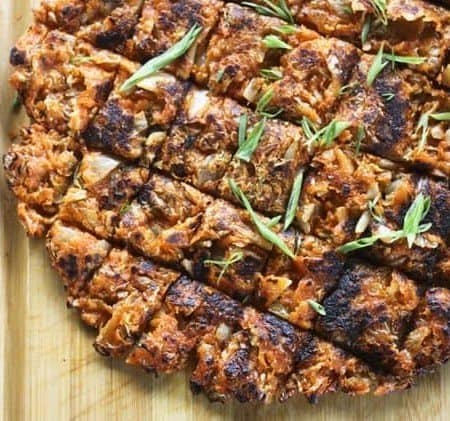
Kimchi undergoes a magical transformation in this crispy, savoury snack cake from something for die-hard lovers only to something that even unadventurous eaters want to try. Beware, though, this is so good it's habit forming!

Ingredients

  • 1 cup chopped kimchi
  • 3 tablespoons of kimchi juice (the liquid in which kimchi is packed)
  • 2 tablespoons chopped green onion
  • ½ cup water
  • ½ cup all-purpose flour
  • ½ teaspoon salt
  • Neutral oil for frying (canola, peanut, grapeseed, vegetable, etc…)
  • Optional:
  • ½ cup cooked peeled shrimp, chopped
  • ½ cup cooked, shredded pork
  • Chopped green onions for garnish

Instructions

In a mixing bowl, stir together all of the ingredients (except for the frying oil) until the mixture is evenly coloured and there are no dry flour spots.

Add about an 1/8-inch coating of neutral oil to a heavy-bottomed 10 to 12-inch skillet (cast-iron or nonstick) over medium high heat. Spread the kimchi pancake batter thinly in the pan and fry until the bottom is crisp and the top is cooked most of the way through (some wet patches of batter, but mostly cooked batter on top.) Carefully flip the pancake using two spatulas for control, then continue cooking the pancake until the underside is crisp and has some charred bits. Flip the pancake over again and cook the first side for 1 minute more.

Serve garnished with chopped green onions whole in a platter for people to pull apart with fingers or chopsticks, or cut into bite sized pieces.

http://www.foodiewithfamily.com/2012/05/04/kimchi-pancake-kimchijeon/


Asian Marinated Cucumber Salad

I have something special for you today.

Yesterday, I gave you my husband’s all-time favourite entrée. Today, I’m giving you his all-time favourite salad. Tomorrow, I’ll give you his all-time favourite appetizer. If I believed in keeping secret recipes*, these three would be at the top of the list because they make you look so talented when you serve them.

*But I don’t believe in secret recipes or lessipe (leaving out an ingredient or process when sharing a recipe). In fact, you might have to pay me NOT to share a recipe with you. The true joy in food -at least for me- comes from sharing it. Refusing to share a recipe or a crucial step in one is tantamount to blowing a big, fat, wet raspberry at someone when they ask you for help. In other words, it ain’t right.

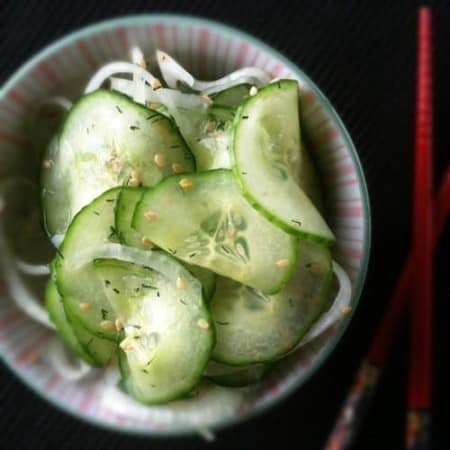
Here’s the thing; the food looks stunning and tastes amazing but takes so little effort you’ll be left feeling a little funny accepting all the inevitable praise that comes from serving it. For instance, we have the salad pictured above.

This is the recipe equivalent of the town where I spent all of my elementary and middle school and some of my high school years; if you blink you’ll miss it. You slice cucumbers and onions, you pour a couple things on top and toss then refrigerate. Then you eat it. And again, like my small town, if you blink it will be gone. For a salad that is so easy and has so few ingredients, the taste will blow you away. It is clean, fresh, bright and accompanies Japanese Salmon over Linguine beautifully, yes, but it is also good with all sorts of seafood, chicken and pork,  or even stashed on sandwiches in place of pickles.

…Or eaten furtively with a fork straight from the refrigerator while holding the door open with your pajama clad knee. Not that I’ve done that. Today.

Here comes the recipe, don’t you blink!

Asian Marinated Cucumber Salad

Prep Time: 10 minutes

Asian Marinated Cucumber Salad

This delicate, fresh, vibrant, crisp, marinated cucumber salad is the perfect accompaniment to seafood, chicken and pork dishes.

Ingredients

  • 1 large English (seedless) cucumber, very thinly sliced
  • ¼ of a sweet onion, very thinly sliced
  • 1/3 cup rice vinegar
  • 1 tablespoon toasted sesame seeds
  • 1 tablespoon minced fresh dill or ½ teaspoon dried dill weed
  • ¾ teaspoon salt
  • 3/4 teaspoon sugar
  • ¼ teaspoon crushed red pepper flakes

Instructions

Gently toss together all of the ingredients until everything is evenly coated. Put in a container with a tight fitting lid and refrigerate for at least an hour prior to serving. This keeps well, refrigerated for up to 5 days. Gently toss again before serving.

Cooking Notes:

I use a mandoline to slice my cucumber and onion paper thin. If this is not available to you, use the sharpest knife you can and slice as thinly as is possible. It will still be great if you can't get paper thin slices, it just won't be quite as delicate.

http://www.foodiewithfamily.com/2012/05/03/asian-marinated-cucumber-salad/

Japanese Salmon over Linguine

There are some dishes that come to define special occasions. We have a few of them…

The boys’ birthdays almost inevitably have Sticky Chicky Bones and Pig Tails. Thanksgiving means Cranberry Upside Down Cake and Baked Chocolate Custards. Christmas Eve is our potsticker extravaganza. Easter always brings Bunny Bread. Just as much as we can count on these dishes making an appearance to help mark the passage of the year, I can count on my husband’s response to me asking him what he’d like for his birthday dinner.

“I’d love Japanese Salmon over Linguine, please!”

His answer comes as surely as rain in the spring. Since seeing this dish made on an episode of “Calling All Cooks” over ten years ago, it has become a staple festive dish for us. Almost always served on my husband’s birthday and every so often on Father’s Day, it is also a dish we trot out when we want to serve the best we have to dinner guests.

To be sure, the appearance isn’t as refined as some party foods, but it is lovely in its simple, unfussy appearance. The ease of preparation is a bonus. There isn’t a lick of engineering that goes into the dish, it is as simple to prepare as anything can be. As with many Asian foods, the bulk of the work comes before you turn on the heat under a pan.

When my two eldest boys did the 30 Hour Famine last week, they deliberately ate lightly at the breaking-of-the-fast-feast because they knew that dinner that evening was going to be Japanese Salmon over Linguine. The announcement of it for dinner always elicits happy moans. Even the anti-green-stuff contingent bends their rules and happily shovels green onion flecked salmon to their lips.

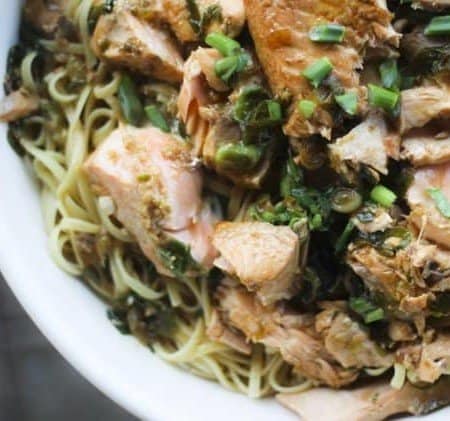
That salmon. Boy. It is exceptionally exquisite. Moist, gingery, and garlicky, it cooks gently in a sauce made of its own juices, sake, soy sauce and green onions. The salmon is flaked over cooked linguine piled in a deep bowl and then the glorious pan juices are poured over the whole thing. Then there is silence because silence is the only option available to worshipfully eat a plate full of Japanese Salmon over Linguine.

And if, per chance, you have managed somehow to make enough of the dish to have leftovers, be aware that you will have to fight for them. The chilled, non-reheated leftovers of this dish command bidding wars of the ultimate urgency. People offer to do chores for each other, hand over the remote control for a week, and/or go to bed early on purpose so Mommy can have free time just for the chance to have the last serving. It is really that good.

Cooking Notes:

You want the ginger ground or grated to a paste for the best results in this dish. I find it is easiest to accomplish this by wrapping a piece of fresh ginger root in plastic wrap and freezing overnight before approaching the grater with it. As long as it is reasonably young ginger (one which you could scrape clean of its peel by using the side of a spoon) you don’t even have to bother peeling it before grating it.When it is frozen solid, grate it on the finest section of a box grater or a microplane grater.

The garlic -much like the ginger- should be mashed, grated on a microplane or the finest setting of a box grater, or obliterated in a garlic press. The goal is to have a paste made of the ginger and garlic that you can smear over the fish.


Japanese Salmon over Linguine

Prep Time: 10 minutes

Cook Time: 15 minutes

Japanese Salmon over Linguine

This moist, gingery, and garlicky salmon cooks gently in a sauce made of its own juices, sake, soy sauce and green onions. The salmon is flaked over cooked linguine piled in a deep bowl and then the glorious pan juices are poured over the whole thing. This is a true family favourite.

Adapted from The Food Network

Ingredients

  • 1/3 cup olive oil (preferably plain olive oil, not extra virgin)
  • 4 skin-on salmon fillets (about 1 1/2 pounds)
  • 3 cloves of garlic, grated, mashed to a paste or pushed through a press
  • 2-inch piece of ginger, frozen and then grated
  • 1 bunch green onions (scallions)
  • 1/4 cup soy sauce
  • 1/4 cup sake
  • 1 pound linguine, cooked according to package instructions and drained

Instructions

In a 2 or 4-cup measuring cup, combine the soy sauce and sake. Set aside. Trim the hairy ends from the green onions and slice the green onions quite thinly on an angle. Add the green onions to the soy sauce and sake and use a spoon to toss them, making sure all of the onions are evenly wet.

Pour the olive oil into a 12-inch high-sided skillet with a tight fitting lid. Blot the salmon fillets with a paper towel and then lay the fillets skin side up in the olive oil. Flip the fillets skin side down divide the garlic and ginger evenly among the fillets and rub them gently. Spoon about half of the soy sauce/sake/onion mixture over the fillets, place the lid on the pan and turn the heat on to medium under the pan. Cook for 5 minutes, or until the fillets are cooked most of the way up the sides. Gently flip them, add the remaining soy sauce/sake/onion mixture, replace the lid and continue to cook for another couple of minutes: just until the salmon is opaque all the way through.

Remove the pan from the heat and pull the skin off of the fillets. It should come away quite easily. Discard the skin. Break the salmon up into large pieces and arrange them over the cooked linguine in a serving bowl. Pour the pan juices over the top of the salmon. Serve hot, warm, room temperature or cold.

http://www.foodiewithfamily.com/2012/05/02/japanese-salmon-over-linguine/