


Roasted Garlic Rustic Sourdough Boule

A sliced Roasted Garlic Rustic Sourdough Boule | www.foodiewithfamily.com

After the time I spent at King Arthur Flour’s Blog & Bake™ last week, I came home prepared to fling flour and bake my tush off. Oh, would that baking one’s tush off was an actual possibility. Sadly, I find that most of my baking actually adds to my overall girth since I’m unable to restrain myself around a fresh loaf of good bread. That loaf you see above is a perfect example of what renders me weak in willpower and wobbly in the knees.

You’re looking at a Roasted Garlic Rustic Sourdough Boule. This particular bread is not one we prepared at Blog & Bake, but it makes use both of King Arthur Flour’s rustic sourdough bread recipe and the sourdough starter that I bought at their Baker’s Store. The starter they sell is pedigreed, people; it is descended from one that was born somewhere in the mid-1700s. This means -at least to me- that it’s doubly wonderful. We’re talking about baking with sourdough AND history.

Are you breadphobic?

One of the things I’ve learned over the years here at Foodie with Family is that many people have anxiety that sometimes borders on phobia about baking with yeast. For those of you who are a-okay with yeast baking, please skip to the next paragraph. For those with breadphobia, allow me to offer you some words of encouragement. When you measure your ingredients the right way and follow instructions to the best of your ability, homemade bread seldom turns out inedible. It may not be pretty, it may not be exactly what you hoped, but there are very few occasions when it is too yucky to eat. In those cases, you find a neighborhood dog and make a lifelong friend or break it up and toss it out for the birds. All is not lost; review what you did, what could’ve gone wrong and try again. Someone or something ate well as a result of your efforts. I firmly believe that everyone can bake given the desire to do so and time. I’m here for you and willing to answer any baking questions and so are the experts at King Arthur Flour. In fact, they have a FREE Baker’s Hotline. You can call them at 802-649-3717 or chat live online with their baking experts who can answer simple or complicated baking questions with equal aplomb. I assure you they won’t laugh at any questions, so don’t be shy. We’ll get you baking yeast breads in no time at all!

How to form a rustic loaf of bread

I prepared the rustic sourdough as directed by sheet of instructions included in the purchase of the sourdough starter and decided to change it up a smidge. This was mainly due to the fact that I had already prepared four loaves of rustic sourdough bread according to their recipe (What? Obsessed? Me?!?) and wanted something a little different to dunk in that evening’s soup. The jar of roasted garlic in the refrigerator called to me and we were off and running.

There are a couple of notes you may find helpful when preparing this gorgiferous, crusty, chewy, roasted garlic -studded sourdough bread.

Instead of adding the roasted garlic cloves to the dough, we pat the dough out after the first rise and roll the cloves in before forming the boule. This allows us to have more visible garlic in the finished product instead of smashing it into oblivion while kneading the dough. After we roll the dough up into a long tube, we still have to form the ‘boule’ or dough ball. We do this by pulling the long end toward the center of the loaf, rotating the dough about 45°, gently pulling and folding that toward the center, rotating 45° and repeating the process until we get a wad of dough that is roughly round in shape.

How to form a Roasted Garlic Rustic Sourdough Boule from rolled dough | www.foodiewithfamily.com

Now that you have the dough all bunched up, we flip it upside down so the smooth side is up and cup the dough ball -hands like blades at a 45 degree angle to the countertop- and rotate the dough ball, first pushing with one hand and then pulling back toward you with the other. If you’re doing it correctly, you’ll feel the dough ball firm up and see the ‘skin’ of the dough tighten.

Rolling the dougTightening up the dough for Roasted Garlic Rustic Sourdough Boule by rolling it. | www.foodiewithfamily.com

Don’t overdo this because you don’t want all the roasted garlic bursting through that taut surface of dough. If a few pop through here and there it’s alright, though!

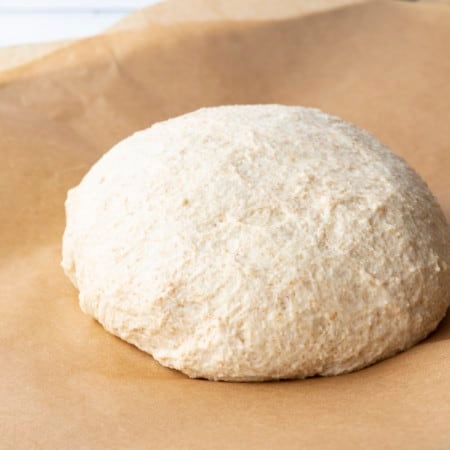
Ball of dough for Roasted Garlic Rustic Sourdough Boule | www.foodiewithfamily.com

I score the tops of the loaves before baking them to allow them to expand without tearing as they bake. It doesn’t hurt that it makes it painfully pretty to look at when it’s done.

Roasted Garlic Rustic Sourdough Boule | www.foodiewithfamily.com

If you leave them like this, you get hearty, classic, chewy, mild-sourdough loaves with cloves of roasted garlic throughout and a shatteringly crisp crust. I’m fond of gilding the lily, however, by brushing the finished loaves generously with extra virgin olive oil and sprinkling with super-fine sea salt. It renders the super-crunchy crust a little softer and chewier. If you’re not a fan of a softer crust, skip this step, but I actually prefer the softer crust for sandwich making purposes. Besides, I take any reason to get garlicky olive oil and salt on my fingers so I can lick them afterward.

What can I say? I’m easy to please.

Roasted Garlic Rustic Sourdough Boule brushed with olive oil and sea salt | www.foodiewithfamily.com

This bread is sturdy enough to hold up to sandwich fillings, toasting and topping with a fried egg, or serving alongside soups and stews to help sop up that last little bit of whatever deliciousness is in your bowl.

Oh, and hey. If you had leftovers that were getting a touch on the stale side, you could turn them into the world’s most enviable croutons.

I have to know! How would you serve this bread?

XO

Rebecca

Roasted Garlic Rustic Sourdough Boule

Rating: 51

Prep Time: 2 hours

Cook Time: 30 minutes

Total Time: 2 hours, 30 minutes

Yield: 2 loaves

Roasted Garlic Rustic Sourdough Boule

A classic, chewy, full-flavoured, rustic sourdough bread gets a little dressed up with roasted garlic cloves that are rolled into the dough when it is shaped. After baking, the loaves are brushed in extra virgin olive oil and sprinkled with super-fine sea salt.

Recipe adapted from and with thanks to King Arthur Flour

Ingredients

  • 1 cup (8 1/2 ounces by weight) ripe sourdough starter
  • 1 1/2 cups (12 ounces by weight) body temperature water
  • 2 1/2 teaspoons salt
  • 1 tablespoon sugar
  • 2 teaspoons instant or active dry yeast (no need to dissolve either in water first.)
  • 5 cups (1 pound, 5 1/4 ounces by weight) King Arthur All-Purpose Flour
  • 1 cup roasted garlic cloves, roughly chopped
  • Optional:
  • extra virgin olive oil for brushing and super-fine sea salt for sprinkling over finished loaves

Instructions

Whisk together the flour, yeast, salt, and sugar in a large mixing bowl (or the bowl of a stand mixer fitted with a dough hook.) Add to that the sourdough starter and water and mix with a bowl scraper, sturdy spoon or dough hook until a shaggy dough forms.

Turn the dough out onto a lightly floured surface, flour your hands, and knead until the dough is smooth and elastic, about 8 minutes. Alternatively, you can use the dough hook to reach the same state. Place the dough in a lightly greased mixing bowl, cover with a clean tea towel or plastic wrap and let rise in a warm, draft-free place until puffy and marshmallowy in appearance and texture. If you gently poke a finger into the dough, an indentation should remain when your finger is removed from it.

Turn the dough onto a lean counter, cut in half (don't rip it, pretty please!) with a bench knife or other sharp knife, and pat each half into a rough rectangle or oval that is about 1/2-inch thick. Divide the roasted garlic between the two dough shapes and spread evenly over the dough. Roll each piece of dough into a log starting with a short side.

To form each piece into a boule or ball, gently tug and pull one coiled end toward the center. Tuck it in place, rotate the dough about 45° and repeat. Continue rotating, pulling and tucking toward the center until you've gone all the way around and your dough is roughly in a ball shape. Flip it over so the smooth side is up and nestle your hands around the dough with your hands at a 45° angle to the counter. Roll the dough between your cupped hands, alternating pulling with one hand and pushing with the other, tightening the dough ball as you go. When the surface is taut, carefully lift the dough ball and place it smooth side up on one side of a parchment lined baking sheet. Repeat with the remaining dough log, placing the finished ball so that there are at least 6 to 8 inches between the two. Cover them lightly with a tea towel and let rise in a warm, draft-free place for 30 minutes.

While the dough balls are rising, preheat the oven to 425°F with an empty cast-iron or other heavy, oven-safe frying pan on the floor of the oven. Bring a pot of water to a boil on the stove top.

Immediately before baking, use a sharp knife or blade to score an 'X' or scallop shape about 1/4-inch into the surface of the bread dough. This allows the bread to expand without tearing as it cooks.

Working quickly, slide the parchment lined pan with the boules into the oven and carefully pour about 1 cup of the boiling water into the empty pan. Be cautious because this will generate a great deal of steam VERY quickly! Close the oven door immediately and set the timer for 20 minutes. After 20 minutes, remove the water pan from the oven, close the door and reset the timer for an additional 10 minutes.

The bread should be deep brown, very firm and measure at least 195°F at the center of the loaf with an instant read thermometer. Transfer the finished loaves to a cooling rack. If desired, brush generously with extra virgin olive oil and sprinkle the surface with super-fine sea salt. Let cool completely before slicing.

Store leftovers at room temperature wrapped in a tea towel.

http://www.foodiewithfamily.com/2013/05/03/roasted-garlic-rustic-sourdough-boule-blog-bake/

Black Olive Sandwich Rolls

Black Olive Sandwich Rolls from Foodie with Family

I have this little self-indulgent thing I do every time I go REAL grocery shopping. By real grocery shopping, I mean the kind where my husband stays home with the boys so that I don’t have to fend off requests for everything from Japanese rice crackers to day-glo cereals to a giant ham to adult diapers (because can you even imagine how hilarious it would be if we bought those to wear to youth group over our pants?)

My routine is this… I drive to the nearest biggish town and hit Aldi first where I probably look for all the world like a doomsday prepper with the amount of tuna and chili beans I’m buying (my kids snack on chili beans. I know. I KNOW. We’re weird.) I move onto The Wal-Marts where I again look like I’m stocking up for armageddon by virtue of the sheer volume of toilet tissue I’m purchasing. These exercises in embarrassment over, I move onto Wegman’s where I get beautiful produce, meats, jugs of olive oil and one little thing just for me. I always get myself a little roll from the bakery section and it’s almost always a crusty olive roll.

When I’ve crammed our little gas-efficient, tiny clown car with all the groceries I think we’ll need for three or four weeks (because I can take the bonnie wee thing instead of the massive purple van when I go solo), I sit in the car, listen to the classical music station and eat my crusty roll to reward myself for not filling my cart entirely with avocados and dark chocolate.

Now, I’ll tell ya, I like those crusty rolls perfectly well, but they’re so crusty, I can’t see making a sandwich on them unless I add some steel reinforcement to my teeth. I can eat a roll just fine, but if you add fillings you have to bite through, I think it might take more jaw work than I want to put into a meal because I like my sandwiches piled up-to-the-sky with innards.

I kept thinking about how much I’d love to have sandwich bread studded with those briny, fabulous olives, though, so the only recourse was to make it mahself. So I did.

The result was a seriously happy moment. Chewy outer crust, yielding and soft inner crumb and enough oil-cured olives to make my olive-loving heart sing.

The key to making these rolls is in the forming of them. Duh, right? No really, there is a technique that gives you that bakery-perfect round shape with the smooth top (with just a few olives lurking enticingly beneath the surface.) I had my eldest son shoot a quick video to show you how it’s done, it was a last minute idea and done with my iPhone, so please forgive any quality issues.

You’re really going to want to make these, both because there’s really not a happier vehicle for a sandwich and because you will most definitely want them on hand for a recipe I’m sharing in the next week or so. It involves feta, roasted garlic, and lots and lots of happy sighs.

In the meantime, I’d suggest you whip up a batch of these to make some very marvelous sandwiches. My sister thought they’d be great piled high with garden veggies… Clearly we’re dreaming of spring. I think they’d be fab for mopping up pasta sauce or stuffing with roasted turkey or chicken, cheese, and lots and lots of lettuce. How would you serve these?

Black Olive Sandwich Rolls

Rating: 51

Black Olive Sandwich Rolls

These fabulous sandwich rolls have a chewy outer crust, yielding and soft inner crumb and enough oil-cured olives to make any olive-loving heart sing.

Ingredients

  • 4 cups (1 pound, 1 ounce, by weight) all-purpose flour
  • 2 cups (11½ ounces, by weight) semolina flour
  • 3 teaspoons SAF or instant yeast
  • 3 teaspoons kosher salt
  • 2 tablespoons sugar
  • 4 tablespoons extra virgin olive oil
  • 2 cups (16 ounces, by weight or volume) lukewarm water
  • 1 1/2 cups pitted oil-cured or kalamata olives, broken up coarsely with your hands
  • 1/2 cup water
  • 1/2 teaspoon cornstarch

Instructions

To Mix Dough By Hand:

Add all ingredients except for olives, cornstarch and 1/2 cup of the water to a large mixing bowl and stir together with a sturdy wooden spoon until you form a shaggy but cohesive dough. Let the dough rest for 30 minutes, covered with a clean towel. Turn out onto a lightly floured counter top and knead until smooth and elastic, about 10 minutes. Transfer dough to a clean bowl, cover with a damp towel and let rise in a warm, draft-free place until doubled in size, about 2 hours.

To Mix Dough By Stand Mixer:

Add all ingredients except for olives, cornstarch and 1/2 cup of the water to the work bowl of your stand mixer fitted with the dough hook. Turn mixer onto the lowest setting and mix until a shiny, elastic dough forms. Remove the bowl from the mixer, cover the bowl with a damp towel and let rise in a warm, draft-free place until doubled in size, about 2 hours.

To Mix Dough By Bread Machine:

Add all ingredients except for olives, cornstarch and 1/2 cup of the water to the pan of your bread machine that has been fitted with the dough paddle(s). Set the bread machine on the dough setting and press start. When the cycle is completed, proceed with shaping…

To Shape the Rolls:

Line two baking sheets with silpats or parchment paper. Set aside.

Turn the dough out onto a clean and very lightly floured surface or silicone mat. Roll it out into a rectangle that is about 12-inches by 18-inches. Scatter the olives over the surface of the dough, leaving about an inch clear of olives on the side farthest from you.

Gently lift the edge closest to you and fold away from yourself over the olives.

Continue to carefully lift and roll the dough away from you until you have a long tube. Pinch the seam closed.Use a bench knife or serrated knife to cut the dough into 16 equally-sized pieces.

Hold a piece of dough with the cut sides out. Use your thumbs to pull the top of the dough over the cut sides toward the bottom. Push that up under the roll toward the center, rotate the dough ball a half turn and repeat. Put the dough ball on the counter and cup your hand around it, rotating in one direction until the top of the dough is taut. (See the video in the blog post for an example of how to do this.) Place this on your lined baking sheets. Repeat, leaving plenty of room between the rolls for expansion in rising and baking.

Cover the rolls with a tea towel and let rise in a warm, draft-free place for about 30 minutes, or until they look a little puffy.

While they rise, use a fork to whisk a small amount of the water into the cornstarch in a microwave safe container or a small saucepan, forming a paste. Use the fork to whisk in the remaining water and microwave on HIGH for 30-60 seconds or boil until it is glassy.

Preheat the oven to 400°F. Brush the rolls with the cornstarch glaze and use a sharp knife to make three to four cuts of about 1/8-inch deep each to the top of the roll. I like to do a scallop pattern, but you could also do a tic-tac-toe pattern. This allows the roll to expand while baking without tearing that beautifully taut top you worked so hard to create.

Bake for 23-26 minutes, or until deep golden brown. Remove the pan from the oven and transfer the rolls to a wire rack to cool completely before slicing. These are good for up to three days.

http://www.foodiewithfamily.com/2013/03/05/black-olive-sandwich-rolls/

Soft Pretzel Sandwich Rolls

Soft Pretzel Sandwich Rolls by Foodie with Family

There are few things I like more than a soft pretzel. A soft pretzel ROLL, though? That’s taking soft pretzels to a whole new level of glory. Crusty, chewy, glossy, deep brown covered with coarse pretzel salt, a soft pretzel roll is the ultimate vehicle for any sandwich you fancy. Have you ever had a hamburger on a pretzel roll? Ungh. So good.

For me, though, the apotheosis of sandwich-i-tude is a soft pretzel roll split in half, piled high with shaved smoked ham, blanketed with a thin slice of Swiss cheese, the top half of the roll, then shoved into the oven just until the cheese has melted enough to hug the sides of the roll and run down onto the pan a bit. A hearty squirt of spicy brown mustard and a side of coleslaw makes a lunch worthy of the most beloved diner. But you get bonus points because you can eat it in yoga pants and bunny slippers and a really tatty ponytail.

The truth is, you can skip the sandwich filling and just throw a bunch of mustard on top… I won’t tell. These are big, round, soft pretzels. If you weren’t tempted, I’d wonder a little.

Soft Pretzel Rolls from Foodie with Family

Were you to divide a pretzel roll and smear the inside with Nutella? Well, all I’m saying is that you wouldn’t regret it. Here’s what I’m driving at, friends. Soft Pretzel Rolls are happy food. They make everything just that much better. Boy, do they. You need these in your life, pronto.

Don’t panic when you see the length of the recipe. It is only that long because I’ve included three options for mixing up your dough: by hand, by stand mixer, and by bread machine. Everyone needs soft pretzel rolls regardless of what kitchen gear you own. EVERYONE.

Soft Pretzel Sandwich Rolls

Rating: 51

Yield: 12 Sandwich sized rolls.

Soft Pretzel Sandwich Rolls

Crusty, chewy, deep brown, salty Soft Pretzel Rolls are the ultimate in sandwich bread.

Ingredients

    Ingredients for dough:
  • 4 cups (1 pound 1 ounce, by weight) bread flour
  • 1 tablespoon non-diastatic malt powder (preferably) or sugar
  • 1¼ teaspoons kosher salt
  • 1 cup whole milk
  • ½ cup hot tap water
  • 2 teaspoons SAF or instant yeast
  • Ingredients for pretzel boil:
  • 2 quarts water
  • 2 tablespoons baking soda
  • Ingredients for toppings:
  • 1 egg white, whisked until frothy
  • Coarse sea salt, kosher salt or pretzel salt

Instructions

To Make the Dough by Hand:

In a large mixing bowl, whisk together the flour, salt, malt powder or sugar and yeast. Set the whisk aside and switch to a sturdy wooden spoon. Stir in the milk and tap water until a soft dough forms. Turn onto a generously floured surface and knead, adding small amounts of flour as needed to keep the dough from adhering to the counter. You do not want a firm dough… it should be fairly slack, a little tacky and soft, yet smooth. Place dough in a clean bowl, cover with a damp tea towel and set aside to rise in a warm, draft-free place until nearly doubled in bulk and puffy, about an hour or so.

To Make the Dough by Stand Mixer:

In the work-bowl of a stand mixer fitted with a dough hook, combine the flour, salt, malt powder or sugar and yeast. Mix on low just to combine dry ingredients. With mixer still on low, carefully pour in the milk and water. Continue mixing on low until you have a smooth, soft, slightly tacky dough. Remove bowl from the mixer, cover with a damp tea towel and set aside to rise in a warm, draft-free place until nearly doubled in bulk and puffy, about an hour or so.

To Make the Dough by Bread Machine:

Add the milk, water, flour, malt powder or sugar, and yeast to the pan of your bread machine in the order recommended by the manufacturer. Select the “Dough” or “Dough Only” cycle and hit start. Allow the cycle to complete.

To Form Soft Pretzel Rolls:

Line a 11×13-inch baking sheet with a silicone or teflon pan liner. Alternatively, use an unglazed stoneware pan. Set next to your work area.

Turn the dough out onto a very lightly floured surface. Use a bench knife to cut the dough into four pieces. Cut each of those quarters into 3 pieces. Working with one piece at a time, form the dough into a ball, then cup your hand around the outside of the ball and roll clockwise until the top of the roll is perfectly smooth and the dough is tensely stretched over the top.

Transfer the dough balls onto the lined baking sheet, three to a row. They will expand both as they rise and again as they boil and bake. When you have dealt with all the dough, cover the pan with a tea towel and let rise in a warm, draft-free place until puffy looking, about 20 minutes.

To Cook the Pretzels:

Preheat oven to 400°F. Bring 2 quarts of water to a boil in a stainless steel or other non-reactive pan (enameled cast-iron, tempered glass, etc…) When water boils, add the baking soda. Gently lift the pretzel rolls one at a time into the boiling water. (You can boil more than one at a time, but be sure not to crowd the the pan as they will expand as they boil. Let simmer for about 45 seconds, flip the pieces and simmer for another 45 seconds-1 minute.

Use a slotted spoon to drain and return each piece to its place on the pan. Continue until all rolls have been boiled and returned to the pan. They will look a little puckery and shriveled. Do not fear! This will all work out!

Brush all of the rolls with the frothy egg white and sprinkle with coarse salt. Use a sharp knife or lame to cut an x 1/8- to 1/4-inch deep.

Place pans in oven and bake at least until golden brown, about 25 minutes, but you can bake until they are deep brown as I prefer them, closer to 35 mintues. It’s up to you!

Remove the pans from the oven and transfer the rolls to a cooling rack. Cool completely before slicing and serving.

Notes

You can cut the dough into 24 equal sized pieces for slider sized rolls, if you prefer.

http://www.foodiewithfamily.com/2013/02/06/soft-pretzel-sandwich-rolls/


No-Knead Cottage Cheese Dill Bread | Papa’s Dilly Bread

Full sized no knead Dilly Bread from Foodie with Family

I have spent my entire life thinking my dad is pretty much the bees-knees and since he just keeps improving with age like a fine wine (or a stinky cheese, as he would say), I’ll just keep carrying on that way. My dad has always been that perfect blend of serious, goofy, cautious and devil-may-care. For example, he’d make sure you put your seatbelt on before driving on roads that were closed due to weather conditions just because he could.

Dad is one of those renaissance men. He’s equally at home screaming at a hockey match, speaking in churches, ploughing snow, operating his ham radios, working on his local volunteer ambulance squad, fishing, reading books, crafting groan-inducing puns, felling trees on a dime, listening to beautiful music, dandling grandkids on his knees, pulling campers on water skis around a lake in a speed boat, putting nervous parents at ease on airplanes, and hiking the vast wilderness trails near where he lives.

With a list of attributes like that, is it any wonder I’m an unapologetic daddy’s girl?

But that’s not all. My dad can bake. He has a specialty bread -one that most everyone who spends a decent amount of time with him gets a chance to taste at some point or another. Dilly Bread. Many years ago, dad took the recipe from the “Deaf Smith Country Cookbook” and made it his own. Translation: he made it better.

To begin with, this recipe is a no-knead recipe. No knead to tinker with that. Ahem.

You just mix the lot up in a big bowl with a sturdy spoon and let it rise in a warm corner. As for the changes, the original recipe called for honey as the sweetener. Dad has mainly used sugar over the years, mainly because -as he says- that’s what he had handy. I stick with the sugar vs. honey, both because it’s easier to measure and it’s a less expensive ingredient. Dad also played with the type and proportion of onion in the recipe. He suggests using minced dehydrated onions because “it’s easier to add more onion to the dough.” I stick with the minced dehydrated onions not only for that reason, but also because this is a very slack, moist dough and the dehydrated onions soak up a bit of that moisture, making it easier to work with. When I asked Dad what kind of flour he prefers (because the book didn’t specify) he said, “Whatever I have on hand, but I did try  making it with all whole wheat once and it didn’t rise enough for my liking.” I personally like to toss a little whole wheat in there, so I go for about a 2:1 ratio of all-purpose flour to white whole wheat. Then you get that wonderful toasting quality of whole wheat along with the more impressive rising ability of all purpose.

Now, once your dough is rising, you need to turn your attention to what you’ll use to bake it. I had a double batch of this rising on the counter the other day when I realized that my oven had (once again!) broken. The potential two-fold horror of wasting A.) a batch of perfectly good bread dough for my favourite bread that has B.) four full cups of cottage cheese ($$$$$) in it made me get really creative really quickly. I determined that my little old toaster oven could fit two standard loaf pans in it side-by-side, but that wouldn’t account for the other two loaves worth of dough. I brought out and greased a fistful of ramekins in a fit of desperation and found that it made BEAUTIFUL little individual loaves when baked.

Miniature Dilly Bread

Mini Dilly Breads from Foodie with Family

The little loaves somehow skirt the “don’t cut when hot” rule. Why is this? Well, mainly because a tiny, hot loaf of bread just hollers, “Top me with a cold pat of butter and watch it melt!”

Sliced miniature No Knead Dilly Bread from Foodie with Family

And if you do that, you have to do this…

Mini Dilly Bread from Foodie with Family

Right?

So- you’re left with choices… standard loaf pans, ramekins, or…by extrapolation… pretty oven-safe bowls. The nice thing about using ramekins for dough was that I had leftover dough that wouldn’t fit anywhere I could bake it before over-rising.

How is this a nice thing now when it’s usually to be avoided?

It’s time I introduce you to yet another one of my dad’s finer ideas… The Baker’s Tax. This is the reason you want to be at my dad’s house when he’s baking. He deliberately ACCIDENTALLY puts a little too much of everything into his mixing bowl so he has too much dough to fit in available pans. He then rolls little bits of the dough out as thin as he can without ripping it, melts an indecent quantity of butter in a cast-iron skillet…

Butter in a pan for bakers tax from Foodie with Family

…And fries those rounds of dilly, oniony, cheese-studded dough.

Bakers tax in the pan from Foodie with Family

Behold the brilliance of The Baker’s Tax.

Bakers tax from Foodie with Family

If you are nearby when these are fresh from the oven and you have a single lick of sense, you will beat a hot path for the kitchen and be not proud about eating as many of these little rounds of glory as you possibly can. If you should somehow make an entire batch of dough into these, I will tell you that you probably couldn’t find a better possible flat bread to wrap around smoked turkey breast, lettuce and onion with a smear of spicy mustard. But that scenario would presuppose you hadn’t already eaten them all, so we’ll just leave that one alone.

In the meantime, while you’re waiting for your standard loaves of the stuff to bake, contemplate how you want to serve the finished product. Sliced thin, this is just about the best deli-meat sandwich vehicle you’ll ever eat. Toasted on one side in a pan with butter, you can’t imagine a better accompaniment to a fried egg, mug full of soup, or bowl full of stew.

But if you were to slice a couple of hearty pieces of bread, butter them both and stack them around some nice melty cheese, then slowly fry it in a pan until it was deep golden brown and the cheese was gooey, you might just yawp from the pure joy of the thing.

Six out six sturgeon faces agree: any way you slice it, Papa’s Dilly Bread makes people happy.

sturgeonfacesatthesturgeonriver


No-Knead Cottage Cheese Dill Bread | Papa’s Dilly Bread

Rating: 51

No-Knead Cottage Cheese Dill Bread | Papa’s Dilly Bread

This no-knead sandwich bread is flecked with aromatic and flavourful dill and onion and enriched and kept moist by the addition of cottage cheese. The little melted pockets of cheese make this bread one of the ultimate choices for toast. When baked in ramekins, the dough makes beautiful little individual loaves ideal for accompanying meals.

Ingredients

  • 2 tablespoons yeast
  • 1/2 cup warm water plus a pinch of sugar
  • 2 cups small curd cottage cheese
  • 1/4 cup milk
  • 2 tablespoons neutral oil (like canola, vegetable, or corn)
  • 2 tablespoons raw or granulated sugar
  • 6 tablespoons dried minced onion
  • 1 tablespoon dried dill SEED
  • 1 teaspoon dried dill WEED
  • 2 teaspoons kosher salt
  • 2 eggs, beaten
  • 3 1/2 cups all-purpose flour
  • 1 1/2 cups white whole wheat flour (*See Notes)

Instructions

Gently stir the yeast into the warm water with the pinch of sugar in the bottom of a large mixing bowl. Let stand for 5 minutes, or until the yeast is frothy. While that rests, whisk together the cottage cheese, milk, oil, sugar, minced onion, dill seed and weed, salt and eggs in a saucepan over low heat just until lukewarm.

Add that to the yeast mixture and stir. Add the flour all at once and use a sturdy spoon to mix until there are no dry pockets of flour and everything is evenly moist. The dough will be shaggy, but that is as it should be. Don't get zealous and try to over work it.

Cover with a damp tea-towel and let rise in a warm place for about an hour and a half, or until almost doubled in bulk.

Grease the pans you want to use to cook them (it will yield 2 standard loaf pans but can also be divided among ramekins or baked in oven-proof bowls.) Divide the dough to fill the greased pans by about 1/3. Reserve any leftover dough for The Baker's Tax (See Notes).

Cover the loaf pans with a damp tea towel and let rise in a warm, draft-free place for about 30 minutes while you preheat the oven to 350°F. Bake the risen dough for 30-40 minutes for full-sized loaves or 25-30 minutes for ramekin sized individual loaves.

Remove from the oven and let the loaves rest in the pans for 5 minutes before turning onto a wire rack to finish cooling. Store loaves wrapped in a clean towel at room temperature for up to three days, or wrap cooled loaves in a double layer of plastic wrap and freeze for up to three months.

Notes

*If you don't have white whole wheat flour, you can simply substitute an equal amount of all-purpose flour. It will still be delicious.

The Baker's Tax is simply walnut sized pieces of leftover dough rolled out about 1/4-inch thin and fried in melted butter in a cast-iron skillet until deep golden brown and cooked through. It's a reward for baking that you might just like so much you plan ahead to have leftover dough the next time!

http://www.foodiewithfamily.com/2013/01/23/no-knead-cottage-cheese-dill-bread-papas-dilly-bread/

Earl Grey Raisin Scones with Sticky Lemon Glaze | Downton Grub Files

Earl Grey Raisin Scones with Sticky Lemon Glaze from Foodie with Family


The body of this post and the printable recipe do NOT contain SPOILERS, however, I cannot make any promises about the comments section. If you are not caught up on Downton Abbey (Episode 1 of Season 3 as of this writing on January 12th, 2013), you may not want to read comments. I also ask -No, I BEG and PLEAD- that our friends overseas (or those who somehow saw all of Season 3 already) refrain from giving away what happens in any episodes past where I am!

Whoopsie! Forgot to include how MUCH cream in the ingredients list. It is fixed now!

I am an unapologetic anglophile from television programs to music to art to literature to food.

It is an idea that started with a simple question on the Foodie with Family facebook page…

“Are there any Downton Abbey fans here?”

In sixteen hours, more than seventy people ‘liked’ the post and there were twenty four comments. I knew I wasn’t the only mega Downton Abbey fan out there. Obviously. I hear internet chatter. I read newspapers. I see the news. I know it’s a big deal. What I didn’t know was how many Foodie with Family readers would be interested in me blathering on about how on Sunday the children are duct taped into bed after I rush home from taking my eldest to youth group at lightning speed just so I can see the Dowager Countess, Lady Grantham, Lady Mary, Sybil, Edith, week-ends, Mr. Bates and Anna, the abhorrent Thomas, Mr. Carson, Mrs. Hughes, Mrs. Pattimore, Daisy, Mrs. O’Brien, upstairs and downstairs, and lush costuming.

OH, THOSE COSTUMES. The dresses! The DRESSES, I tell you!!!!!!

Yes, I record it on the DVR, but if you have to ask that, you’re not getting my point. I want to watch it the very second it’s airing on PBS. I don’t want to wait one fraction of a second to get my weekly Downton fix.

More than I want to dress like Lady Mary, do something jolly with my hair like Edith, or just plain LOOK like Sybil from time to time, I want to be as witty, incorrigible and stalwart as the Dowager Countess Violet. Every time she speaks, I hush the imaginary people in the room with me. Imaginary, because I DO NOT allow anyone in the room with me lest they should talk over, wiggle, or otherwise interrupt my show.

My husband likes to sit in the other room with the door closed and laugh at me as I yell at the t.v. (Thomas, Mrs. O’Brien, and the former Mrs. Bates, I’m looking at you…), swoon (Oh hello, Lady Mary and Matthew, Anna and Mr. Bates. Yes. You all make my heart go pitter patter.), and otherwise sigh, moon, and mope when episodes conclude.  After listening to me watch the conclusion of Season 2, he asked, “Is that what I sound like when I watch football?” My response included something intimating that if football had dresses like that I’d watch it, too.

I was late to the Downton party because of a fun little personality quirk where I deliberately avoid trying anything large crowds of people love. Yeah. That’s working out really well… So far, I can add Harry Potter books, Downton Abbey, and So You Think You Can Dance to that list.* The ONLY advantage to having taken so long to discover the series (midway through Season 2) was that I got to park myself on the couch for an indecent amount of time and watch Season 1 in one sitting.

*To be fair to myself, I can also add the Twilight books, which -after reading- led me to conclude that my personality quirk might actually be useful in some ways. To quote Snorg Tees, “Real men don’t sparkle. Real men defeat dark wizards!”

I quickly discovered that I really couldn’t get through an episode of the show without something to eat since so much of it revolves around time spent at the dinner table or in the kitchen.  Since I love a good theme, I decided to stock myself with British Isles treats to nibble while slowly and inexorably becoming part of my furniture. And here’s where my idea came sidling in like Mr. Carson in the dining room.  Why not post a little of the grub I made to sustain myself during my Downton Abbey marathon sessions? Just as quickly as the thought was hatched, I could almost hear the Dowager Countess saying, “What IS grub?” The Dowager Countess is apparently my grammatical conscience.

Today is my first contribution to the Downton Grub Files and it’s a doozy; Earl Grey Raisin Scones with Sticky Lemon Glaze. These moist, flaky scones are packed with Earl Grey soaked raisins and a touch of lemon zest and topped with a sticky, absolutely, unequivocally un-Downton finger-licking, Sticky Lemon Glaze. Every time you bite into one of the juicy soaked raisins, you get a little subtle pop of Earl Grey tea. I’m pretty sure Mrs. Patimore would be a-okay with slurping the glaze from your fingers, so go for it.

Tune in every Saturday while Downton Abbey airs for a great new classic British fare recipe to eat while you watch on Sundays! Who’s your favourite on Downton? What moments made you GASP? Cry? Scream at the television? (Come on, I can’t be the only one who did it!)

Earl Grey Raisin Scones with Sticky Lemon Glaze | Downton Grub Files

Earl Grey Raisin Scones with Sticky Lemon Glaze | Downton Grub Files

Moist, flaky lightly lemony scones studded with Earl Grey soaked golden raisins are perfect to nibble while watching Downton Abbey or just because you can.

Ingredients

  • 1 cup golden raisins soaked in 1 1/2 cups (12 ounces) hot, extra-strong Earl Grey tea for at least an hour
  • 4 cups (1 pound 1 ounce, by weight) all-purpose flour (preferably King Arthur all-purpose or Galahad flour.)
  • 2 teaspoons salt
  • 2 tablespoons baking powder
  • 2 tablespoons sugar
  • 8 tablespoons (1 a stick of butter or 4 ounces by weight), very cold and cut into 1/4-inch cubes, divided
  • 1 1/2 cups heavy cream
  • zest of one lemon, divided
  • juice of one lemon
  • 1/2 cup sweetened condensed milk

Instructions

Preheat the oven to 400°F. Line a baking sheet with a silpat or parchment paper and set aside.

Pour the raisins and tea into a fine mesh strainer and let drain thoroughly.

Whisk together the flour, salt, baking powder and sugar in a large mixing bowl. Add about 1/2 of the cubed butter and work in with a fork, two knives, a pastry cutter or your fingers until the mixture resembles lentils. Add the remaining butter and work in, leaving some slightly larger pea sized -or even larger- flakes of butter.

Add half of the lemon zest, and the drained raisins to the flour, then toss through gently until evenly distributed, taking care not to mash it in. Add 1 1/2 cups of the cream, sprinkling it over the top, then tossing to combine. Pick up a small amount of the mixture and try squeezing it gently together. If it crumbles, or if there are dry crumbs in the bottom of the bowl, add more cream -1 tablespoon at a time- until you have a mixture that holds together as a shaggy dough when squeezed gently. Use a bench scraper or spatula to gently fold the dough in on itself until it forms a shaggy mass you can turn out onto a very lightly floured surface.

Divide the dough in half and gently pat out the dough into two 7-8 inch discs that are about 3/4 of an inch thick. Carefully transfer the discs to a parchment lined baking sheet. Use a bench knife or Chef's knife to cut each disc into 8 wedges, cutting straight down and not sawing back and forth to help it rise higher in the oven. Gently separate the wedges so there is a little space between them.

Whisk together the remaining lemon zest, the lemon juice and the sweetened condensed milk until smooth. Lightly brush the tops of the unbaked scones with the glaze.

Bake for about 30 minutes, or until the scones are puffy and golden brown on top.

Spoon any leftover glaze on the hot scones and spread it over the tops. Let cool 'til comfortable to handle!

http://www.foodiewithfamily.com/2013/01/12/earl-grey-raisin-scones-with-sticky-lemon-glaze-downton-grub-files/

Ranch Bake-In-Slices Bread

Ranch Pull Apart Bread

This is going to be a little crazy all over the place, so please bear with me, but I have a lot of ground to cover.

First -and most importantly- my entire family thanks you for all the condolences and expressions of support you’ve shared with us after the loss of Val. It means more to me personally than I can possibly say to know that you all are thinking of and praying for us. As weird as it feels to get back to doing normal, every day things, it really does have to happen, so here I am!

Next, I hope you’ve noticed the pretty new dress Foodie with Family is wearing. It was a while in the making, but I love the new look. There are a couple of little upgrades and tweaks I wanted to point out to you that will -hopefully- make hanging out here and menu planning a little easier and more pleasant.

  • If you hover your cursor over the “Recipes” tab directly below the header, you will see three options. Clicking on Recipes will -as always- take you to my recipe archive page where every single recipe (hopefully!) that has ever been on Foodie with Family can be found in one handy-dandy page. Clicking on Shopping List will allow you to put ingredients from our recipes onto a -what else- shopping list! courtesy of Ziplist. (Those are the same nice folks who created the plug-in that I use to provide printable recipes here.) Directly below that is the Grocery Deals option. This nifty function -again, courtesy of Ziplist- allows you to specify which grocery chains are near you and see what the advertised sales are in your area. I encourage you to to play around a little bit with those options. Hooray for streamlining the menu planning process!

recipe tab capture

  • We have pretty new (and much, much more user friendly) options for subscribing to Foodie with Family via RSS or reader, send me an email or follow me on Twitter, and Facebook. Please join me in any or all of those. I do so love your company.

Social Media Icons

  • In the sidebar, there is a more fwf section featuring some older posts that you just might find a.) interesting, b.) hilarious (it’s a process, right? Tell me I’ve grown.) and c.) delicious.

Now, I know there are bound to be hiccups here and there as there always are with changes,  so I hope you all will let me know if you find a broken link or wonky image anywhere. I do love my new look, though. What do you all think?

Finally, there’s this bread. Oh, this Ranch Bake-In-Slices Bread is the bees-knees. It’s bread that’s baked in such a way that no slicing is necessary afterward. Why bother? Well… Lemme tell you. Most folks know you’re not supposed to slice hot bread because it ruins the texture of the rest of the loaf, right? This loaf is superior BECAUSE YOU CAN EAT HOT SLICES OF BREAD WITHOUT WAITING FOR IT TO COOL. That’s where you hear angels singing, right? Of course, there’s more. There’s the fact that it’s brushed lavishly with butter and sprinkled with Ranch dressing mix before being stacked deck-of-cards-like into the also lavishly buttered bread pan. And there’s also the fact that you can make this with homemade or purchased bread dough… There’s the perfection of a sunny-side up egg on top of a slice. Or the fact that grilled cheese sandwiches made on slices of this bread are pretty much the best tasting things ever, if a little funny looking. I’ve sopped soup, sauce and egg yolks with slices of this. Take your pick. Any one of those is reason enough for me.

My favourite, though, is simply turning the freshly baked loaf of pre-sliced bread out onto a cooling rack and peeling back then inhaling the heel pieces. Yes. That is comfort food writ large, folks. Happy sigh.

Ranch Bake-In-Slices Bread

Ranch Bake-In-Slices Bread

Ranch Bake-In-Slices Bread is a wonderfully versatile snacking bread that bakes itself into slices. Eat hot straight from the oven, sop up soup, stew or sauce, or use to make the most spectacular grilled cheese sandwich this side of heaven.

Ingredients

  • 1 pound sandwich bread dough (homemade like this or purchased)
  • 1 stick (4 ounces by weight, 8 tablespoons) of unsalted butter, melted, plus extra for buttering the loaf pan.
  • 1 tablespoon plus 2 teaspoon of dry Ranch salad dressing mix
  • 1 teaspoon dried dill weed

Instructions

On a clean, lightly floured surface, roll the bread dough out into a rectangle that is about 1/4 of an inch thick. Pour the melted butter over the rectangle and use a pastry brush to more or less evenly distribute it. Sprinkle the dry Ranch dressing mix and dried dill weed over the dough. Cut the dough into pieces that are roughly the size of a playing card.

Butter a standard loaf pan and prop one end up on a box of toothpicks or something similar so that the pan tilts up at on end. Stack five pieces of the dough at a time and place in the pan, starting at the lower end so gravity holds it in place. Repeat until you've added all of the dough to the pan. Cover lightly with plastic wrap and let rise for 30 minutes at room temperature.

While the dough rises, preheat the oven to 350°F. Uncover the dough and bake for 30-40 minutes, or until the top of the bread is deep golden brown. Let the bread rest in the pan for 5 minutes before turning out onto a plate or cooling rack. Eat immediately or store wrapped with a clean towel at room temperature.

http://www.foodiewithfamily.com/2013/01/04/ranch-bake-in-slices-bread/

Freeze and Bake Bacon Cheddar Scallion Scones | Make Ahead Mondays {GIVEAWAY CLOSED}

Update: The Pick Giveaway Winner plugin chose Jana as the winner of our Folgers Holiday Exclusive Gift Pack. Congratulations, Jana! Check your email!

A couple months ago, I hauled out of bed on a Saturday morning, pulled back my hair and put on my face, put some clothes on that I hoped were cute (who can tell anymore? I’m so out of touch!) and hopped in the car for an hour and a half drive. It was snowing, it was cold, it was a good day to stay home. So why did I go anywhere?

Because in a warm building at the Genesee Country Village and Museum an hour and a half away, there was a King Arthur Flour baking demonstration that was open to the community. I was going to this on a dreary day because I am utterly and completely devoted to King Arthur Flour. I buy it by the fifty pound bag from my Amish friends. As in, multiple fifty pound bags: one of all-purpose, one of high-gluten, and one of white wheat. Yes. I use that much flour. I’m King Arthur Flour’s biggest fan in a non-creepy, not-Kathy-Bates-in-Misery kind of way.

I’d never been to one of their demonstrations, not for lack of desire, but because I lived too far from their baking center. When I learned that there was a local-ish one I could attend, I hopped on it! I really didn’t know what to expect other than the topic was going to be pie crusts, scones and biscuits.

**insert drooling and panting here**

I can’t help myself when it comes to pie crusts, scones and biscuits. They are the holy trinity of me losing what’s left of my pea-sized mind while inhaling food in a frenzy of crumbs, eye-rolling and happy noises. It’s not pretty to watch. Pies, scones and biscuits. I am powerless over you.

Pie crusts, scones and biscuits have more commonality than the equally abysmal self control I exhibit around all three; they’re pretty much made the same way. I hate to admit that with all my baking experience, I had never really thought of that. God bless Irene -King Arthur Flour Baking Expert Extraordinaire!- who made the connection crystal clear. To super simplify the whole process, it is essentially dry things whisked together, cold fat cut into it, and wet stuff tossed in until it is clumpy. Irene shared a tip with me that I’d never heard before and it totally re-invigorated my pie crust/scone/biscuit making. She said to work the fat into the dry ingredients in two separate additions. *FACEPALM* Seriously. Why? Because this ensures both that you have fat worked through which gives it tenderness and larger bits of butter/shortening/lard that gives you flakiness. If you work it in all at once, you won’t be able to achieve that highly sought after flaky/tender combo.  I love Irene.*

*Besides, any woman who can stand in front of a room filled with two hundred strangers and ask in response to an audience question -with a straight face and angelic tone of voice- whether someone’s pie bird ‘pukes up pie filling’ when it bakes has my loyalty forever.

She turned out the most gorgiferous apple pie and then moved onto scones where she casually said something that pretty much rocked my universe, even more than the ‘these three things are pretty much the same’ revelation. She suggested making and forming scone dough ahead of time and flash freezing them (laying the scones on a parchment lined pan to freeze solid before wrapping and transferring them to a freezer bag) and baking them off on Christmas morning. Good golly. I’d done this for years with biscuits, why oh WHY had I not translated this to scones?

I had visions of popping frozen scones on a pan and into a pre-heated oven*, sitting in my easy chair in my flannel jammies on Christmas morning while the kids opened presents, and standing up only when I hear the timer just in time to pull a tray of steaming hot, tender, bacon and scallion flecked scones from the oven. The fantasy goes on to being able to start our Christmas feast in a spotlessly clean kitchen later in the day because all I had to do was crumble the parchment and rinse the pan on which the scones baked.

*Yes, even in my fantasies, I pre-heat my oven.

Irene, we will be singing your praises with mouths full of tender flaky scones Christmas morning. Thank you!

Freeze and Bake Bacon Cheddar Scallion Scones | {GIVEAWAY} and Make Ahead Mondays

Freeze and Bake Bacon Cheddar Scallion Scones | {GIVEAWAY} and Make Ahead Mondays

Having a bag of these frozen pre-formed scones in the oven is your secret holiday breakfast or brunch weapon. Simply remove desired number of scones from the freezer, place on a parchment lined pan and bake. Forty five minutes later you have piping hot, tender, flaky scones studded with crispy bacon, minced scallion and tiny pockets of melted Cheddar cheese.

Very gently adapted from and with thanks to King Arthur Flour

Ingredients

  • 4 cups (1 pound 1 ounce, by weight) all-purpose flour (preferably King Arthur all-purpose or Galahad flour.)
  • 2 teaspoons salt
  • 2 tablespoons baking powder
  • 4 teaspoons sugar
  • 8 tablespoons (1 a stick of butter or 4 ounces by weight), very cold and cut into 1/4-inch cubes, divided
  • 1 1/2 cups finely diced Cheddar cheese
  • 1/2 cup finely minced scallion tops (green onions)
  • 1 pound of bacon, cooked 'til crispy, then cooled and crumbled or chopped
  • 1 1/2 cups heavy cream or half and half plus 1/4 cup (plus more, if needed, to make a cohesive dough.)
  • For Baking:
  • Additional cream for brushing prior to baking

Instructions

Whisk together the flour, salt, baking powder and sugar in a large mixing bowl. Add about 1/2 of the cubed butter and work in with a fork, two knives, a pastry cutter or your fingers until the mixture resembles lentils. Add the remaining butter and work in, leaving some slightly larger pea sized -or even larger- flakes of butter.

Add the cheese, bacon and scallion tops and toss through gently until evenly distributed, taking care not to mash it in. Add 1 1/2 cups of the cream, sprinkling it over the top, then tossing to combine. Pick up a small amount of the mixture and try squeezing it gently together. If it crumbles, or if there are dry crumbs in the bottom of the bowl, add more cream -1 tablespoon at a time- until you have a mixture that holds together as a shaggy dough when squeezed gently. Use a bench scraper or spatula to gently fold the dough in on itself until it forms a shaggy mass you can turn out onto a very lightly floured surface.

Divide the dough in half and gently pat out the dough into two 7-8 inch discs that are about 3/4 of an inch thick. Carefully transfer the discs to a parchment lined baking sheet. Use a bench knife or Chef's knife to cut each disc into 8 wedges, cutting straight down and not sawing back and forth to help it rise higher in the oven. Gently separate the wedges so there is a little space between them.

Place the pan directly into the freezer. When the scones are frozen solid, individually wrap each of them tightly with plastic wrap then add to a resealable freezer bag. Keep frozen for up to three months.

Ready to Bake?

Preheat the oven to 425°F. Remove desired number of scones from the freezer, unwrap and arrange with some space between them on a parchment lined baking sheet. Brush lightly with heavy cream and bake for 45 minutes or until browned and puffy.

Notes

Don't be afraid to add more heavy cream (or LESS for that matter) than specified in the recipe. Irene from King Arthur Flour suggests that you should use visual cues to determine how much or little to add. Start at the lower end of the recommended amount and watch how the dough behaves. If there are large amounts clumping together and little pockets of dry-ish crumbly bits, move the large clumps to the side and sprinkle just a little cream over the crumbly bits until they behave like the clumps. It takes patience, but the end result is so worth it!

http://www.foodiewithfamily.com/2012/12/18/freeze-and-bake-bacon-cheddar-scallion-scones-giveaway-and-make-ahead-mondays/

Now, another GIVEAWAY! The folks at Folgers have offered a Folgers Holiday Exclusives Coffee Kit (ARV: $150) to one very lucky Foodie with Family reader! This promotion is to introduce their brand new Folgers Wakin’ Up Club. If you join the Folger’s Wakin’ Up Club, you get coupons, news on promotions and chances to win weekly prizes at Folgers.com. You can also download the new Folgers Wakin’ Up App to help spread some extra holiday cheer with friends and family this season. Sounds fun to me!

What’s in the kit?

  • A Variety of Folgers Products: Classic Roast, Black Silk and 100% Colombian (My husband loves the Fresh Breaks for business travel. He says they’re infinitely better than the drip coffee in hotel rooms. Instant coffee has come a long way, baby.)
  • Crate and Barrel Gingerbread Mug
  • L.L. Bean Comfy Flannel Pajama Set (Who doesn’t love warm jammies? These are the comfiest ones in town!)
  • Red Holiday Socks (WARM TOOTSIES!)
  • Pottery Barn Coffee and Warm Socks Framed Print

Here’s how to enter to win that a great bunch of goodies!

MANDATORY ENTRY:

Leave a comment here telling me what your favourite part of the holiday season is. Is it the food? Family? Friends? Smell of pine everywhere? Talk to me!

Optional Entries. Be sure to leave a separate comment for each entry so that it’s sure to be counted!:

You don’t have a ton of time, folks because we’re closing the giveaway on this Friday, December 21st. Get your entries in quickly like bunnies! Merry Christmas to you all!
DISCLOSURE: Folgers is providing a gift pack for one reader and sent one to me for review. All opinions, thoughts, and writing are my own.

Grandma’s Buttermilk Cornbread


A couple nights ago I had a sudden and overwhelming desire to stuff my face full of my Grandma’s cornbread. It’s hard to explain if you didn’t grow up on cornbread, but the drive to consume it can be a powerful force. So powerful, in fact, that I actually made two pans full at ten thirty at night just so I could eat a huge wedge warm from the oven and have an untouched pan to take to a friend’s house the next day.

The smell of toasty corn bread baking up in a coal-black cast-iron pan is pretty close to one of the best things on earth. I have a Pavlovian response to the aroma of cornbread. By that, I don’t mean I bark and run around in circles, but I may have been caught panting and drooling and maybe even wagging my tail a time or two.

I’ll get it out o the way right now and say that cornbread is not sweet. That’s cake. Corn cake, if you want, but it’s cake. And I’m not saying that’s nasty, I’m just saying it’s not cornbread.

The cornbread I’m sharing with you today is the be all and end all of cornbreads to me.

My Arkansan grandma made this cornbread for me probably less often than I have in my memory, but often enough for it to define Grandma’s cooking in my mind. I know it was always at our Thanksgiving table, often in the stuffing, but just as often in a bread basket in gloriously big yellow squares. I remember getting a wedge from the cast-iron pan right after it was pulled from the stove; a sinfully large pat of cold butter melting and sliding right off of the top of the steaming bread.

When I was first married, I quizzed Grandma on why this was her favourite cornbread recipe of all. She grew up on a very plain cornbread; one that was almost pure cornmeal and water and a smidge of egg. No leavening, no nothing. It was a corn-lover’s dream, but very crumbly. She told me, “That bread crumbled if you looked at it.” As an adult, she got all that great corn-y flavour of the cornbread she knew and loved in a package that held together when she discovered the Buttermilk Cornbread recipe that she wrote out by hand for me.

I still have that recipe card, laminated and caked with flour over the years, written in Grandma’s own hand. Although I have it memorized, I still look at the card every time I prepare it. It’s like a sweet hug from Grandma.

Now, if you want to get really stratospherically happy, there really isn’t anything better than a pan full of Grandma’s Buttermilk Cornbread with a potful of bubbling hot beans. Oh mercy. Seriously. Just typing that sentence made me start drooling like a baby. That’s a complete meal in and of itself, but you can up the vegetable content by adding a BIG GREEN SALAD alongside it if you want.

The cornbread is equally at home accompanying chili or soup. More than once, I’ve used the cornbread batter to coat corndogs or top a casserole dish or chili for tamale pie. Most often, though, it’s a cast-iron skillet, a stick of cold butter, a fistful of napkins and me flying solo. Butter dripping down the sides of a steaming hot wedge of golden, fragrant cornbread and my fingers digging in to pull off piece after piece.Grandma said I could.

Thank you, Grandma!

Grandma’s Buttermilk Cornbread

Grandma’s Buttermilk Cornbread

As long as I live, there will not be anything that tempts me as powerfully as a hot-from-the-oven wedge of golden cornbread freshly taken from the cast-iron pan with a pat of cold butter melting and sliding right off of it.

Ingredients

  • 1/2 cup flour
  • 1 1/2 cups yellow cornmeal (not self-rising)
  • 3/4 teaspoon baking soda
  • 2 teaspoons baking powder
  • 1 1/2 tablespoons sugar
  • 1 teaspoon salt
  • 2 eggs, beaten
  • 3 tablespoons melted butter
  • 1 1/4 cups buttermilk
  • bacon grease or butter for the pan

Instructions

Preheat oven to 425°F.

In a large mixing bowl, whisk together all of the dry ingredients. In a separate bowl, whisk together the wet ingredients. Pour the wet ingredients into the dry ingredients and use a whisk to gently combine them, ensuring there are no dry pockets of cornmeal.

Pour into a generously greased 8-inch or 10-inch cast iron skillet, preferably, or an 8-inch by 8-inch square cake pan, or 8-inch round cake pan. Pour the cornbread batter into the greased pan and bake for about 30 minutes, or until a skewer or toothpick inserted in the center comes out clean.

Serve warm for best flavour. Leftovers can be stored -wrapped in a towel or plastic wrap- at room temperature for up to 48 hours, but will taste best if reheated slightly before serving. If your cornbread gets a little old and stale, crumble it and use for the best Cornbread stuffing that you will ever eat in your lifetime. Guaranteed.

http://www.foodiewithfamily.com/2012/09/28/grandmas-buttermilk-cornbread/