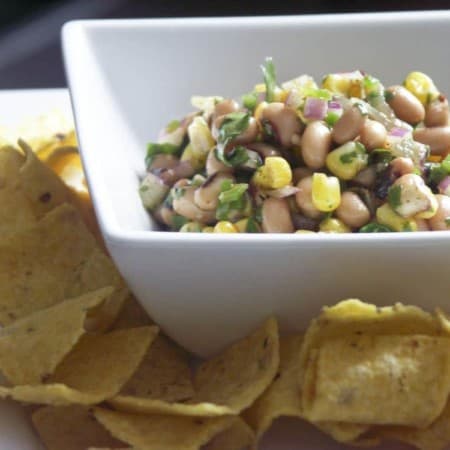
Recession Caviar (Black-Eyed Pea Salsa)

Thank you all so much for spending time with me here at Foodie with Family.  To those of you who have visited me regularly through the year, thank you for your continued support.  It has meant the world to me to get to know you all.  And to those who are new, Welcome!  I hope you stick around.  I’ll put on a pot of tea! Hearing from you -whether it is questions or comments about recipes, a story, or sharing a recipe of your own- is one of the highlights of my days.  Even if I’m a total dork and forget to respond, rest assured you’ve put a smile on my face.  For this, my long-suffering kids thank you.

To all of you: I hope your New Year’s Eve and New Year’s Day are full of wonder, loved ones, great food and better memories.  And more than that, I hope that your upcoming year is even better than those two days.

This week, I am going to post a series of my version of the traditional Southern New Year’s meal.  Yes, there will be greens and pork products.  Yes, there will be cheese spread.  There will be much delicious soul food.  It’ll be here.  I’ll be here.  I hope you will be, too!

~~~~~~~~         ~~~~~~~~

recessioncaviar 10

So.  Who’s ready for a brand-spankin’, shiny New Year?  A blank slate full of possibility? Another three hundred and sixty five opportunities to make your life exactly what you want it to be?  Oh, I am.  I so am.

I’m not exactly the resolution type.  My anti-authoritarian streak runs so strong that I even rebel against the rules I make for myself.  (Side note to my parents:  I can hear you snickering from here. ) But I am crazy about the idea of self-improvement, on my own schedule and without pressure or someone telling me what to do, thankyouverymuch.

Instead of resolutions against which I would inevitably rail, I reflect on Longfellow’s ‘A Psalm of Life’ (full text below the recipe.) My favorite stanza from the poem reads:

“Let us, then, be up and doing,
With a heart for any fate ;
Still achieving, still pursuing,
Learn to labor and to wait.”

This poem is my little pep talk to myself at the beginning of each new year.   It points my head and heart in the right direction.  And as we celebrate the ending of a year and the possibilities that lie ahead, I turn to poetry and food.  Food and poetry:  Sustenance for the romantic heart and the sensual stomach.

Because really, it isn’t a celebration if there isn’t food.  And New Year’s Eve comes with a set of dishes as traditional and romantic as Christmas geese and Thanksgiving turkeys.  I may have mentioned before that I married into a good Southern family and that my maternal grandparents are both Deep South born and bred.  New Year’s Day means you need black eyed peas.  And I don’t mean Fergie and her impossibly tight black leather pants. I mean the humble black-eyed pea or cowpea; the legume with the animal/vegetable name.

recessioncaviar 12

Southern tradition dictates that you improve your chances of having a great year if the first food you consume in the new year is black-eyed peas. The practice of eating black-eyed peas for luck on New Year’s Day dates back to around the Civil War era.  According to Wikipedia (who we all know is never, ever wrong) this came about when the Northern troops continually “stripped the countryside of all stored food, crops, and livestock, and destroyed whatever they couldn’t carry away. At that time, Northerners considered “field peas” [black-eyed peas, among others] and field corn suitable only for animal fodder, and didn’t steal or destroy these humble foods.”  Ha!  The joke is on us, Yankees.  Those black-eyed peas are the bees knees.  Especially when tossed together with snappy corn, vibrant jalapenos and big old flavors in Recession Caviar.

But back to the legend.  The black-eyed peas are supposed to represent coins.  Tradition dictates that by pairing the black-eyed peas with greens (I’ll post a killer green recipe later this week), which represent paper money, that you are starting your year out with wealth and the rest of the year will follow suit.  Now, I don’t know about all that, but I do know that starting the year out with a recipe that sure to save you some money can’t be a bad thing.

Long a standard recipe in my family, budget-friendly Recession Caviar comes in many forms (made with black beans or chili beans instead of the black-eyed peas) and has many names (Lindamood Caviar, Hillbilly Caviar, Texas Caviar, et al.) depending on the occasion.  Of course, this being for New Year’s we’ll be making it with the ubiquitous black-eyed peas. I recently made a giant bowlful of this for a gathering  of family at The Evil Genius’s Aunt Patty’s home (would that make her my Aunt-in-law?). This room full of Virginians, Texans, Georgians, Floridians, and a couple assorted Yankee spouses (meself included) gave it the ultimate stamp of approval; an empty bowl.  I’d say that’s some pretty universal appeal  with  hearty representation from the drawl-contingent.

And true to the name I’ve given it, it’s suitable for recession-stressed budgets.  Beans -both canned and dried- are a perennially inexpensive and nutritious source of protein, fiber, iron, vitamins, minerals and other vague nebulous nutrients*.  In fact, beans are, pound for pound, one of the least expensive and most nutritious foods you can introduce at your table.

*Vague and nebulous don’t do it for you?  Have a look at The American Journal of Clinical Nutrition’s ‘legumes and soybeans’ page. There is a wealth of information beyond my simplistic explanation.  But trust me.  Beans are good for you.  And your heart.  Because the more you eat, the more you…  I’m sorry.  You DO remember I have five sons, right?

Recession Caviar isn’t just easy on the pocketbook; it is a versatile contributor at the dinner table, snack time and parties, too.  Whether served with tortilla or corn chips, spooned into a burrito or on top of tacos, or as a side dish to fish, chicken, or pork, it is certain to impress with its big, bold flavors and fresh texture. You can always change out the black-eyed peas for black beans or chili beans and throw any other fresh vegetables you have into the mix.  Think of this a jumping off point…

Psst…  Remember it’s  good for you, too!  Consider this; you can ring in the New Year with proper Southern pride, please your belly, impress your guests, and watch your waistline all at the same time.  Who loves ya, baby?  Me!  That’s who!

For a photo-free, printer friendly version of this recipe, click here!

Recession Caviar (Black-Eyed Pea Salsa)

Ingredients:

  • 3 cans (14.5 ounces each) Black-Eyed Peas, drained and rinsed
  • 3 cups frozen corn, thawed
  • 1/2 of a large red onion, or more to taste
  • 1-4 fresh jalapeno peppers, according to preference
  • 1-4 cloves of fresh garlic, according to preference, minced
  • 1 large handful of fresh cilantro, rinsed and air-dried
  • 2 Tablespoons light olive oil or canola oil
  • 1 Tablespoon chili powder
  • the juice of two fresh limes (You can use bottled lime juice if necessary.)
  • 1 teaspoon Kosher salt
  • Fresh ground black pepper to taste

Peel the red onion half and lay down on its cut side. Slice parallel cuts 1/8- 1/4 of an inch apart across the onion leaving the root end intact.  Turn the onion 90 degrees and slice across the cuts for a small dice. And really, don’t sweat trying for perfection on this one.  Part of the charm of Recession Caviar is its rustic appearance.

recessioncaviar2

Add diced onions, corn and the rinsed black-eyed peas to a mixing bowl with the garlic.  Set aside.

Slice jalapeno peppers in half and use the tip of a spoon to remove the seeds, membranes and stems.

recessioncaviar3

Slice the peppers into thin strips, turn the strips 90 degrees and slice across the strips to finely dice the peppers.

recessioncaviar4

recessioncaviar5

recessioncaviar6

Transfer to the mixing bowl with the black-eyed peas, garlic and onions.

Roughly chop the cilantro and stir into the black-eyed pea mixture along with the oil, chili powder, lime juice, kosher salt and black pepper.

recessioncaviar7

Allow to sit, covered at room temperature for an hour prior to serving or in the fridge for at least four hours prior to serving.  Store leftovers for up to 5 days tightly covered in the refrigerator.

recessioncaviar9

recessioncaviar 11

~~~~~~~~        ~~~~~~~~

As promised, one of my favorite ways to ring in the New Year.

A PSALM OF LIFE

by Henry Wadsworth Longfellow

WHAT THE HEART OF THE YOUNG MAN
SAID TO THE PSALMIST

TELL me not, in mournful numbers,
Life is but an empty dream ! —
For the soul is dead that slumbers,
And things are not what they seem.

Life is real !   Life is earnest!
And the grave is not its goal ;
Dust thou art, to dust returnest,
Was not spoken of the soul.

Not enjoyment, and not sorrow,
Is our destined end or way ;
But to act, that each to-morrow
Find us farther than to-day.

Art is long, and Time is fleeting,
And our hearts, though stout and brave,
Still, like muffled drums, are beating
Funeral marches to the grave.

In the world’s broad field of battle,
In the bivouac of Life,
Be not like dumb, driven cattle !
Be a hero in the strife !

Trust no Future, howe’er pleasant !
Let the dead Past bury its dead !
Act,— act in the living Present !
Heart within, and God o’erhead !

Lives of great men all remind us
We can make our lives sublime,
And, departing, leave behind us
Footprints on the sands of time ;

Footprints, that perhaps another,
Sailing o’er life’s solemn main,
A forlorn and shipwrecked brother,
Seeing, shall take heart again.

Let us, then, be up and doing,
With a heart for any fate ;
Still achieving, still pursuing,
Learn to labor and to wait.

A Tutorial on Using Dried Beans

Ah wonderful beans.  We all love them for their taste.  I love them for their nutrition.  My boys love them for their, er, musical properties.

Ah wonderful beans. We all love them for their taste. I love them for their nutrition. My boys love them for their, er, musical properties.

UPDATE (12/10) :Since first writing this post almost two years ago, I have been experimenting with different ways to cook beans.  While I still use the crockpot method most often, I have changed on something.  I use salt at the beginning of the cooking time.  Really!  It doesn’t slow down the cooking of the beans a bit and leaves them much more flavorful than if you add salt at the end of cooking.  I stand (or rather, I sit, at this very moment) corrected.  Salt away!

Beans.  They are the perfect budget food.  They’re chock full of dietary fiber and nutrients, simple to store and able to leap tall buildings with a single bound. And they’re cheap! They’re so cheap (“How cheap ARE they?” screamed the crowd.  “So cheap they’re on the dollar menu!”) that there is no excuse to be without them.  Even if you’re so poor you can’t afford to pay attention, beans are still in your ballpark.   But -keeping it real here- unless you’ve grown up eating them or have been making them for years they can be a little intimidating to prepare and use.  And various well-meaning and well-researched cookbooks have you jumping through a billion hoops just to make a simple pot of unadulterated beans.  Not so beginner-friendly.

Why bother with dried beans and the extra work when you can buy canned beans super cheap?  Dried beans last close to forever when kept in a cool, dry cabinet.  They’re less expensive per pound and taste better than canned beans.  And -perhaps most importantly- they’re better for you than canned beans. When you reconstitute dried beans you control the amount of sodium in them and ultimately in the finished recipe.  When you start with canned beans you’re already starting at a super high sodium level (which can be a major health concern for many people.)  There is more, but I think you get the idea.  If you’ve never made dried beans before just do me a favor and try it at least once.  I am pretty convinced I can convert you…

Here’s my plan.  For the next few weeks, I’ll share a bean recipe with you on Thursday or Friday.  That will give you all weekend to try out your beanerific recipes.  This week, though, I’m going to start you out with a tutorial on how to get the dried little beasties to the point where you can use them in recipes…  And I warn you: My method is so easy that you may not want to prepare them any other way.   You’ll need a slow cooker, but if you don’t have one, you can snap up a basic model for $15 at le Walmart, le Target or le Blue-Light-Special.  Don’t let anyone tell you you need bells and whistles on a slow cooker.  All you really need are a ”HIGH” and a “LOW” setting.  Unless you’re cooking for one, get the largest of the basic slow cookers that you can afford.  I always cook more beans than we can eat in one meal.  You can portion them into individual servings and freeze them to add into soups and stews or make dips or refried beans with later.  We loves the bean dip around here!

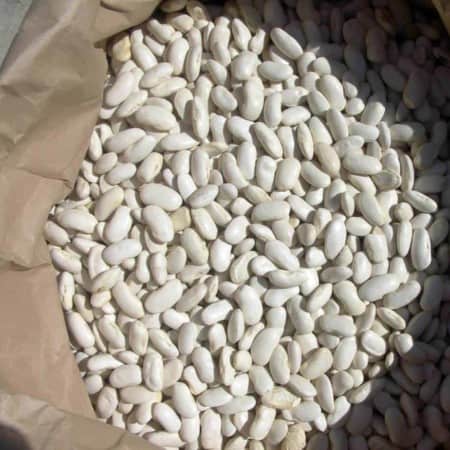
Because it’s what I’m going to be using in tomorrow’s bean recipe, we’ll start out with cannellini (white kidney beans) today, but feel free to kick it off your bean adventure with any dried variety that floats your boat; pinto, chili, black, lima, garbanzo…  If you follow the method, you can make any kind of bean you want!

For a printer-friendly, photo-free version of this tutorial, click here!

Dried Beans: A Tutorial

Necessary equipment:

  • a slow cooker
  • a saucepan to boil water

Ingredients:

  • 1 lb dried beans, (in this case, cannellini), or about 2 cups dried beans
  • 2 bay leaves
  • 2-3 frozen onion tops or 1 cooking onion, peeled and cut in half from root to end
  • 2 quarts boiling water
  • salt to taste


Pour your dried beans into a colander.

Yes.  I sit outside on my porch steps while picking through beans.  It's the hillbilly in me.

Yes. I sit outside on my porch steps while picking through beans. It's the hillbilly in me.

Pick through to find grossly misshapen, discolored or otherwise nasty looking beans or small stones.

It feels nice to run your hands through dried beans.  There's something therapeutic about it.

It feels nice to run your hands through dried beans. There's something therapeutic about it.

These are what Leif calls "Yuck beans."  This is what you want to remove.

These are what Leif calls "Yuck beans." This is what you want to remove.

Because dried beans are about the size and color of some pebbles, it’s not completely bizarro to find little rocks, clumps of dirt or other natural bits and pieces occasionally tucked into the bags.  After you’ve picked through and removed any undesirables, give the beans a good hearty rinse under cold water, rubbing them around in the colander as they’re being cleaned.   This ensures that you remove any dirt your eagle eyes may have missed.  This also gives you a chance to look the beans over one more time.

beantutorial7

Add the beans to the crock of the slow cooker.  Place the bay leaves and onion tops (or onion) on the beans. Sprinkle about a teaspoon of salt, give or take according to taste, over the top.

I told you to hang onto those onion tops.  I may be cheap, but these things add a lot of flavor!

I told you to hang onto those onion tops. I may be cheap, but these things add a lot of flavor!

Pour in the boiling water. (It really does need to be boiling.  That is key!)

Pretty please make sure your water is boiling.  It is superdy duper important.  Just take my word for it.

Pretty please make sure your water is boiling. It is superdy duper important. Just take my word for it.

See?  Two inches of water over the beans.  This is perfect!

See? Two inches of water over the beans. This is perfect!

Quickly put the lid on the slow cooker, turn the cooker to “HIGH” and assess the situation.  If your beans are covered by at least 2 inches of water you’re doing fine.  If they’re covered by less than that, you’ll want to put some more water on the boil to add as soon as possible.  Set your timer for 3 hours and go do a crossword puzzle or play a board game with the family.

When three hours are up, you’re going to do a test.  Use a spoon to reach into the cooker and quickly extract a couple beans, replacing the lid immediately.  Hold them a few inches from your face and blow on them gently.  If the skins curl up off the beans, they’re most likely done.  Carefully take a bite through the center of one of the beans.  If it’s tender, you’re all set.  When you cook black beans or pinto beans, it’s not unusual for them to be done that quickly, especially if they’re relatively new beans.  If they are done, you can use them immediately, divide them into containers for the freezer or stick straight into the fridge -tightly covered- in their own liquid for use within four or five days.

If you’re cooking a larger (or harder) bean -such as cannellini, garbanzo, butter bean, etc…- you’ll likely find that the beans are not yet tender in the center.  Turn the slow cooker to the “LOW” setting, add additional boiling water (if needed) to cover the beans, and allow to continue cooking for about four hours before checking again.  Repeat the test; extracting a couple beans quickly and replacing the lid, blowing on the beans and biting them. If they’re tender, pull them from the heat and use immediately or store for later.  If they’re still tough, give them a couple more hours -making sure they have water to cover- and repeat the test. Do this until they test done.  The batch of cannellini beans I cooked in the photos for this tutorial simmered overnight on “LOW” before they were done.

Done!  Not looking gorgeous, but tasting fi-ine!  Pop a lid on this, stash in the fridge and come back tomorrow to make bean dip with me!

Done! Not looking gorgeous, but tasting fi-ine! Pop a lid on this, stash in the fridge and come back tomorrow to make bean dip with me!

In my own experience, garbanzo beans (the stuff of my hummus dreams) have taken the longest time to cook by far.  Just be prepared to let them cook away.  And, for pete’s sake, don’t sweat testing it if you have to let it cook overnight.  Beans are pretty resilient as long as you’re cooking them in enough water.  And if you overcook them there’s always bean dip!

If you choose to freeze the beans for later use, divide the beans into one or two cup servings between containers.  Be sure to leave enough room to ladle cooking liquid over them so they don’t dry out and to account for expansion of the liquid as it freezes.  Make sure the lid of the container fits tightly and stash in the freezer for later use.  (Alternately, you can carefully scoop the beans and their liquid into zipper-top freezer bags taking care to seal them completely.  The bonus of this method is they lay flat to freeze and thus take up less room.)  Frozen beans will keep well for about two to three months in the deep chill.  After that they begin to deteriorate a bit in texture and in taste.  Not the end of the world, but after that point they’re only good for bean dip.  (All roads lead to bean dip in this house.)

Tomorrow:  Come back for a wonderful *gasp* bean dip that can be served hot or cold.  Get those pita chips or veggie sticks ready!