
Amish Haystack Suppers


Today’s weather was glorious and made for driving about the backroads doing country errands.  While stocking up on oats, sugar, and other sundries at the small bulk foods store run by a local Amish woman I saw her husband out gathering hay in their field.    The field was beautiful with the clean cut green topped with regular mounds of hay that had been painstakingly baled by hand.  Since the Amish eschew most farm equipment for religious reasons, he was manually baling the hay.


Each large mound of hay was comprised of many small, hand-tied bales propped up on their ends with their heads resting together and another bale perched on top.  Aaron explained to me that this is the way it’s been done for centuries and when the sun is shining and the breeze was blowing as it was today that the hay would dry out in record time.  Of course!  How did I not connect the saying, “Make hay while the sun shines”?  I always thought it was a naughty aphorism.  It’s a good thing we moved here.   I needed Amish neighbors to get my mind out of the gutter.


In addition to improving the aim of my moral compass, my Amish neighbors have taught me how to make some simple, frugal meals such as the following Haystack Suppers recipe.  The beauty of Haystack suppers is that it can take advantage of odds and ends you have in the fridge and can be as complex or as simple as you want it to be. 


Since it was so gorgeous I really didn’t want to spend a whole lot of time in the kitchen and took a cue from Aaron.  He stacked hay in his field, I made Haystack Suppers in my home.  Haystack Suppers, for those of you who’ve never tried them, are basically a tall bed of plain spaghetti topped with anything your heart desires EXCEPT for any sauce even remotely Italian.  Most of the folks who’ve shared this dish with me tend to top it off with taco type accoutrements like ground beef, chopped tomatoes, onions, shredded cheddar and salsa.


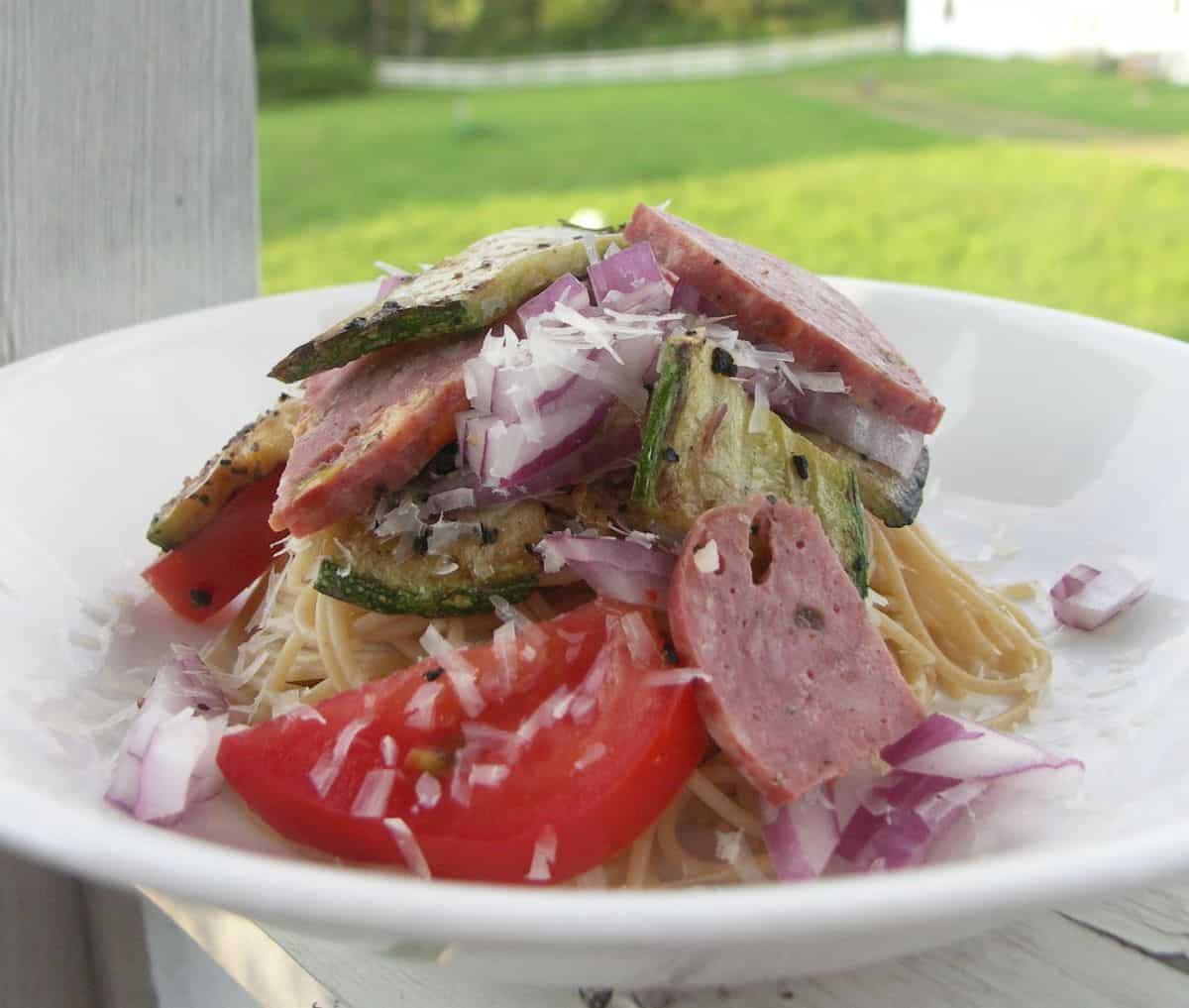
Tonight’s Haystack Suppers are my entry for our Second Tuesdays Déjà Food Event because they used up some leftover jalapeno summer sausage from Bell’s Meat & Poultry in Kane, PA.*  I could lie and say it used up leftover tomatoes, zucchini and red onion, but I didn’t.  (See?  My moral compass is firmly pointed toward “Honest”!)   I pan fried some fresh zucchini from our garden in olive oil, rough chopped some tomatoes and red onion and put out a huge hunk of fresh parmesan cheese along with the sliced summer sausage.


*If you have ever tasted the Mom’s Blend Beef Log from Bell’s you know that you do NOT, under any circumstances EVER, waste one molecule of it.  Ever, ever, ever!

Englisher* Haystack Suppers

*“Englisher” is the term the Amish use to describe their non-Amish neighbors.  And since I’m not Amish, well, you know…  And normally I do not rinse my pasta, but my Amish friends insisted it was an important part of this dinner because the pasta was not supposed to be at all sticky. 

Ingredients:

  • 1 lb of spaghetti, cooked according to directions on box and then drained and rinsed in cool water.(We used 2 lbs of Barilla Whole Grain- but I realize that most people aren’t feeding the number of people we are per meal so I did the math and downsized for you!  )
  • 1 large or 2 medium sized zucchini, washed and sliced end to end into 1/4″ slices
  • 1 medium red onion, peeled, thinly sliced and then rough chopped
  • 4 large tomatoes, cored and rough chopped
  • 1 cup thinly sliced Summer Sausage or other fully cooked sausage
  • 2 Tablespoons olive oil
  • Montreal Steak Seasoning (or fresh ground black pepper and kosher salt), to taste


Lay zucchini out on a plate and sprinkle both sides with Montreal Steak Seasoning to taste.Heat an empty large, heavy bottomed skillet (cast iron is best) over high heat.  When wisps of smoke rise from the pan, drizzle the olive oil and carefully swirl the pan to evenly coat the bottom.  Lay the zucchini in the pan and let it sizzle and pop about 3-4 minutes per side or until slices get a slight brown crust on either side.  Remove to a cutting board and slice into 1/2″ strips.


To Plate:


Mound a large amount of spaghetti high in the center of your plate.  Top with desired amounts of fried zucchini, tomatoes, onions, Summer Sausage and a great deal of grated cheese.  Serve immediately!


How did we like this recipe?


Englisher Haystack Suppers got 14 enthusiastic thumbs up out of a possible 14.  It was especially approved by the children who like to avoid zucchini on their plates.  We all liked this enough to repeat it weekly in one variation or another.  Oh. My. Goodness.  What’s not to love?  It’s wicked inexpensive.  It can be as elegant or as simple as the ingredients used to top it and everyone can tailor their own plate to suit their individual tastes (or lack thereof!)  We all highly recommend trying these.  Soon.

Blueberry Jam

In yesterday’s post I offered the world’s easiest blueberry preservation technique- freezing.  I also promised to provide an overview on how to make blueberry jam.  I’m a gal of my word, so as promised, I put together a primer on making and canning blueberry jam.  First, a couple words of caution:


  1. This recipe is specifically for blueberries.  While the principles of canning remain the same if you’re using other fruits, you cannot switch out blueberries for something else in the preparation of the recipe.  If you have other fruit, use a recipe tailored for that fruit so you can maintain the proper levels of acidity and sugar to preserve your jam best. 
  2. Have your mise en place ready to go.  (Repetitively redundant, I know…)  Think of making this like you would  a stir-fry.  If you try to measure things out and run around to find implements you’ll run the risk of ruining it.  This is not a walk-away-and-do-other-things project.
  3. Once you make your own jam you will be very, very bitter if you have to purchase jam at the store.  The flavor and cost of homemade jam will convert you powerfully fast!

Onto business…


Blueberry Jam Primer and Recipe


Ingredients for approximately 6 cups of jam:

  • 4 cups sugar, measured into a mixing bowl
  • 6 cups whole, clean, very fresh blueberries
  • 1 package powdered pectin (not liquid!)


Sugar, blueberries and pectin for jam.


Hardware Needed for Canning 6 Cups of Jam:

  • 1 or 2 extra sterlized half pint jars (just in case you have a bit of extra)
  • Sterilized rings in the proper size for each jar (regular or wide mouth)
  • New lids in the proper size for each jar (regular or wide mouth)
  • Large stainless steel or other non-reactive* stockpot (not pictured below)
  • Long handled wooden or stainless steel spoon (not pictured below)
  • A timer or a clock with a minute hand (not pictured below- and don’t laugh.  I know people who are not in possession of these things on purpose!)

*I’m going to keep using the phrase “non-reactive” during canning season.  Basically, all you need to really know about this is that you should use stainless steel, glass or enamelware.  Anything else (aluminum, etc…) can chemically react to the food and create off-flavors during the process of preserving food.  That is most assuredly to be avoided.


Necessary gear for canning jam.


Helpful Gear (that is not strictly necessary) for Canning Jam:

  • A large boiling water canner
  • Canning tongs
  • Canning funnel
  • Silicone hot mitts
  • Potato Masher
  • Stainless steel or other non-reactive ladle


Boiling water canner, canning tongs and funnel, silicone hot mitts, potato masher and ladle.  Canning made easy!

The Process:


  • Before you start smashing berries and boiling stuff like the witches in Macbeth, you need to have your jars, lids and rims ready to go.


Have your jars prepared so that when the jam is done you can fill them immediately!

  • Pour blueberries into a large bowl.  Please, please don’t use a small bowl:  You’ll be chasing blueberries around the countertop and floor if you do.  Using a potato masher or the bottom of a drinking glass or jar, smash the daylights out of the blueberries.  If you’re in a hurry, you can pulse the berries in a food processor- but don’t purée them.  Jam is supposed to have bits of fruit in it!


How your berries look while mashing.

How your berries look when ready to continue to the next step… Smashing, no?


  • Pour your 4 cups of smashed blueberries- you did measure again, didn’t you?- into a large non-reactive stockpot.
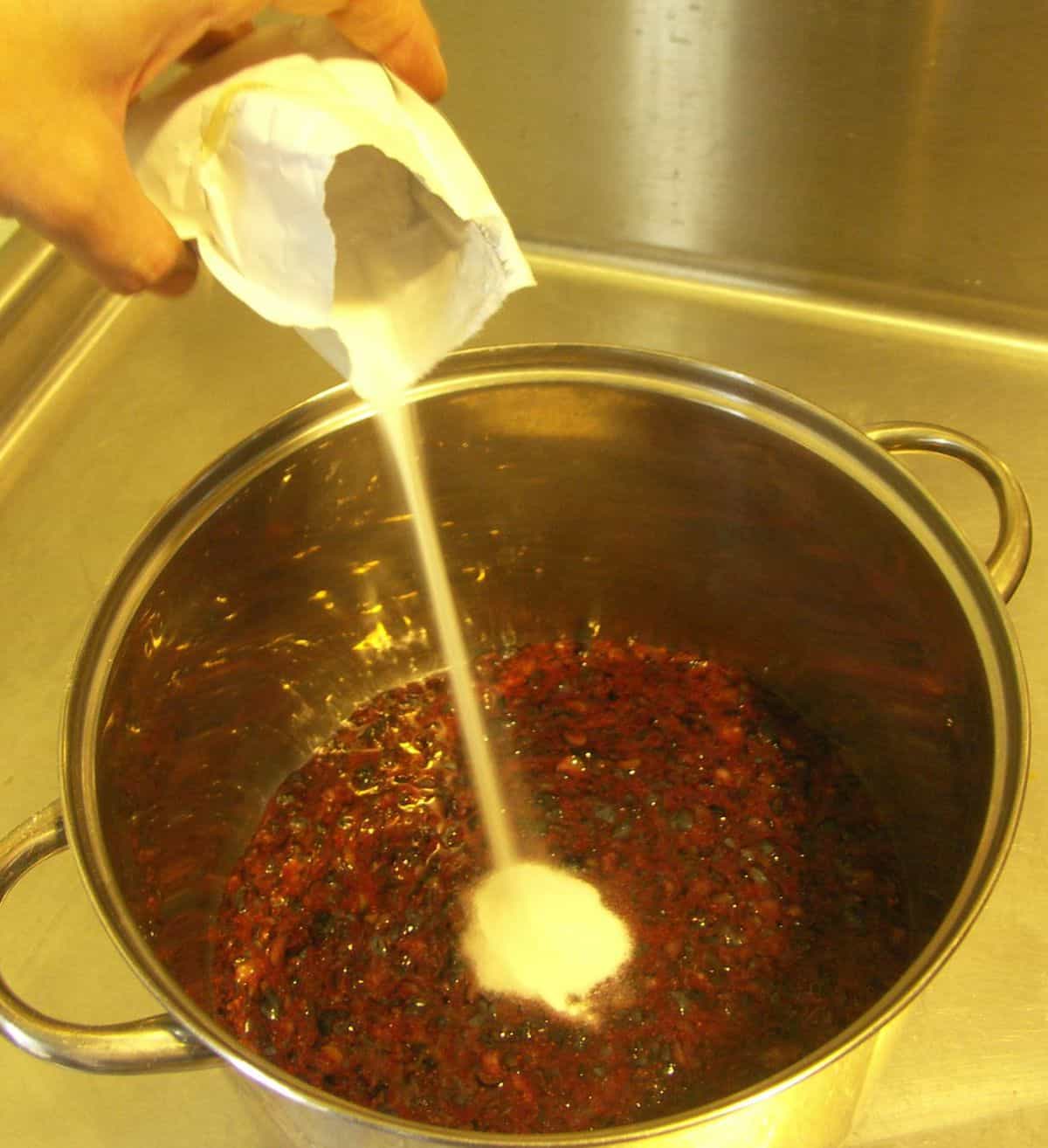
  • Sprinkle powdered pectin over the surface of the blueberries.


Yes, I said sprinkle but this picture shows me dumping the pectin.  I am not so coordinated that I can gracefully sprinkle pectin and take a picture simultaneously. 

  • Stir the pectin into the fruit thoroughly.


If you dump it in, don’t panic.  You’ll just have to do more stirring.

  • Bring the mixture to a boil over high heat, stirring constantly.  Do not walk away.  Burned blueberries smell very, very bad.
  • When mixture reaches a full rolling boil*, add the sugar all at once and quickly stir it in completely.

*A full rolling boil is when it does not stop boiling even when stirred- which you’re supposed to be doing anyway, right?


Do not step away from the pan.  I repeat.  Do not step away from the pan.  Keep stirring!


  • Bring back to a full rolling boil.  As soon as it reaches the full boil, begin timing.  Allow to boil hard for EXACTLY 1 MINUTE!  Do not overcook.  Kill the heat as soon as the timer goes off!
  • As soon as you have removed the stockpot from the heat, begin ladling (or scooping by whatever sterile means are at your disposal) the jam into the jars.  And for the love of all that is holy- this stuff is HOT and it HURTS if you splash it on your bare skin so be careful!
  • Using a clean, damp paper towel, wipe the rims of the jars clean.  You don’t want gunk of the rims because that increases the risk of spoilage.


These jars are filled, wiped clean and ready to be lidded and processed.

  • Place a lid, seal side down, on top of each clean jar.  Add a ring and screw it into place.  Don’t overtighten! 
  • Put all jars into the empty canner (or other deep pot with a fitted lid) and fill with water to completely cover all jars.
  • Place lid on pot and bring to a full rolling boil.  When water reaches a full rolling boil*, start timer for 10 minutes**. 

*Again with the full rolling boil.  It’s important!


Doesn’t this look like a Macbeth moment?  You know- “When the hurly burly’s done.  When the battle’s lost and won,” and whatnot?

**If you’re using a larger size jar, adjust processing time accordingly.  Quarts process for 15 minutes.

  • When jars have processed for the appropriate amount of time, carefully remove all jars to a cooling rack.


Can you tell I have wicked hard water?


  • All that remains is to remove the rings carefully, wipe down the jars with a damp cloth, and check your seals.
  • If you have any seals that failed, simply put those jars into the fridge to use right away.  All sealed jars can be stored in a single layer on a shelf without their rings!


Voila y voila!  Blueberry jam! 


I hope I’ve convinced you that it’s worth your time and effort to make this.  …But just in case I haven’t convinced you yet, here are a couple other great reasons to try it:

  • It goes without saying that this jam is out of this world on toast but don’t stop there.  Put a couple spoonfuls in a bowl and mash about with a fork.  Then spoon that softened jam over vanilla ice cream (are you sensing the ice-cream-for-life-theme here?) 
  • Throw a quarter cup into a blender with plain yogurt, frozen berries and purée for a fantastic blueberry smoothie. 
  • Glaze roasted pork with softened blueberry jam.   


You can do so much with this stuff.  Get creative!

Blueberry Crisp and How to Freeze Blueberries

“One berry, two berry, pick me a blueberry.

Hat berry, shoe berry in my canoeberry.

Under the bridge and over the dam.

Looking for berries.  Berries for jam!”

from ‘Jamberry’ by Bruce Degen


It’s blueberry season!  Find a local U-Pick place, grab your large kitchen bowls and get yourself some blue gold. 


Blueberries are serious power food.  Not only are they delicious, but they are very low on the glycemic index, which makes it wonderful for folks battling blood sugar problems or struggling with their weight.  They’re jam (ha!) packed with incredibly high levels of antioxidants, flavanoids, fiber, Vitamin C and folic acid.   In lab tests, blueberries have been shown to reduce the risk of cancer, heart disease, ill effects of aging (um, what are good effects of aging?), vision loss, and urinary tract infections.  They’ve also been proven to make you more attractive.  (Not really, just making sure you’re paying attention!)


Adding to blueberries’ charms is the fact that they’re super simple to prepare.  You don’t have to peel, pit, chop or core them. 


And since this is my birthday week -because I stretch my birthday festivities out to cover an entire week*- I decided to haul the kids out to the blueberry patch for the day.  While the kids covered themselves in SPF 4000, I pulled a gallon of water, sliced a loaf of bread for power-munching with berries, grabbed a bag of chips and a container of dip and slid the lot into our cooler.  I hauled the cooler and every large mixing bowl I own to the van and we hit the road.


*As I have officially been 29 for a few years now, I feel the need to make my birthdays a little more exciting.  Therefore, I am extending the party (and demands for special treatment) by a couple days in either direction.  I think that’s okay since I’m the only girl around here…


I adore blueberry picking.  It’s by far the easiest berry to pick and preserve.  This, combined with the obvious health benefits and the fact that it’s my favorite berry to eat, makes us prodigious pickers.   


Putting up blueberries is one of our big summer projects around here.  We usually eat our way through three or four batches of blueberry jam and several gallon-size freezer bags of frozen blueberries per year.  Not surprisingly, the quantity we consume is steadily growing.  With five little boys I expect that I’m going to have to pick more every year until they are grown and they move away.  I’m already drawing close to needing a separate chest freezer just for fruit.  Most years we pop about 45 pounds of blueberries into the freezer and process about 20 pounds of berries into blueberry jam.  (See tomorrow’s post for a primer on Blueberry jam making and processing!)


Since we do this every year, we’ve had a chance to establish a good many traditions to go along with the picking.  We dust off our copy of ‘Jamberry’ every year and read it before hitting the patch for the first time.  We make sure we have a picnic lunch and a great deal of cold water to keep us going.  And, most importantly, the first berry we touch is not with our hands.  When we get to the blueberry bushes, our first berry needs to be picked with our teeth.  It doesn’t get any fresher than that!  Have you ever eaten a blueberry still warm from resting on the bush in the sun?  If not, I highly recommend trying it.  It seriously re-arranges your outlook on life for the better.


This year we had to try a new patch since the one we’ve picked at for the last 10 years was stripped clean in only two weeks.  We tried out “Blueberry Hill” in Franklinville, NY.  This is an unoffically organic patch.  It is obvious that they’re putting a great deal of effort into their work.  Good stuff!  And mercy, but it was cheap. They charged $0.75 a pound!  Holy wuh!  Unless you’re growing them yourself, or you have a relative who lets you pick for free you cannot beat that!  We managed to come away with a little more than 21 pounds.  Not enough, but it’s a good start. 


Here are a couple things that can make blueberry picking easier for the first timer in the patch. 


  1. Do not pick green or white berries.  Blueberries do not ripen after picking.
  2. A ripe berry will come easily off the bush.
  3. A ripe berry will have a deep purple or blackish blue color and a waxy looking coating- this is a natural protection for the berry and is desirable.
  4. The size of the berry does not matter.  If it has a deep color and comes easily from the bush it is ripe!
  5. Ripe blueberries are plump.  Don’t bother with the ones that are wrinkled- the birds will love those.
  6. Move branches and leaves to check the undersides.  Often those are the places with the largest amounts of ripe berries.
  7. Cut the top off of a gallon milk container, leaving the handle intact.  Use a rope or scarf to tie the jug around your waist so you can use two hands while picking.
  8. The blueberries are perishable and sensitive to the sun.  Go straight home after picking and don’t leave your berries in direct sun.  Put them in the fridge until you decide what you’ll be doing with them.


So this brings me to what to do with the bounty.  


I usually get the easiest thing out of the way first and freeze vast quantities of berries.  


If you pick at a blueberry patch that doesn’t spray with chemicals, three quarters of the work is already done.  You don’t need to wash the blueberries because they have not been in contact with anything that needs to be removed from them.  Blueberries naturally create their own protective covering (the waxy coating present to a greater or lesser degree on all ripe berries) that help prevent spoilage.  It is absolutely unnecessary to wash them before freezing if they come from a no-spray patch. 


Worried about bugs?  Don’t be.  Any bug left in with your blueberries isn’t going to last 10 minutes in the freezer.  Using the method described below gives you a chance to weed out any frozen critters before packaging for long term storage.


How to Freeze Blueberries


If your berries are from a patch where they spray pesticides, or if you’re unsure of the berries origins, you’ll want to carefully wash them in cool water and allow them to dry completely before proceeding to the first step.


  1. Spread berries loosely on a clean, dry rimmed sheet pan or roasting pan. 
  2. Place pan in freezer for about 1 hour, or until hardened.
  3. Transfer frozen berries quickly, with minimal touching, to gallon or quart sized freezer bags. 
  4. Put bags immediately into a freezer that is at about 0°F.


That’s it!  Could it be any easier?  Having frozen blueberries is like having money in the bank.  You can use them straight from the freezer almost interchangeably with fresh blueberries.    Toss a handful into buttermilk pancakes, waffles, muffins, crumb cake, etc…  Throw some on your breakfast cereal, lunch salad or evening bowl of vanilla ice cream.  (What?  You don’t have an evening bowl of ice cream?  You probably should.  Life is mighty fine when you do!)


Here’s a recipe for a wondrously simple old-fashioned blueberry crisp that you can make with either fresh or frozen blueberries.  If you’re using frozen blueberries, don’t worry about thawing them first.  Just add a few minutes to the cooking time.  And don’t skimp on the cinnamon.  That’s another power food… but that’s another post!


This crisp is simply delicious served alone straight from the pan, but it’s simply decadent served with vanilla ice cream or frozen custard. 


Blueberry Crisp

Ingredients:


  • 3 cups fresh or frozen blueberries
  • 2 Tablespoons plus 1/2 cup all-purpose flour
  • 3 Tablespoons light brown sugar
  • 3/4 teaspoon ground cinnamon
  • 1/4 teaspoon freshly grated nutmeg
  • 4 Tablespoons cold butter


Spray a 8″ oven-safe baking dish with non-stick cooking spray.  Set aside and preheat oven to 350°F.


Scatter blueberries evenly into prepared baking dish.  In  a separate bowl, combine brown sugar, cinnamon and remaining flour and use two butter knifes to cut butter into the mixture until crumbly.  Sprinkle the flour/butter mixture evenly over the berries.


Bake for 25-30 minutes (or more for frozen berries) or until the berries are bubbly and the topping is golden brown and delicious. 


Last non-food post. You know what I’m sayin’?

We’re home safe and sound from our weekend get-away. I have to say two more unrelated food things and then I’ll get back to the business at hand.

  1. It was unbelievably wonderful to spend some time alone with my husband.
  2. It was unbelievably wonderful to come home to my kids and their hugs.


Okay, one last non-food related item.  Weird Al was hilarious and I highly recommend catching one of his shows.  They combine his musicality (astonishingly good) with his humour (astonishingly juvenile.)  That’s the perfect recipe for a hilarious night! 

They aired this “interview” at the show on Saturday.   It was a very, very, good time!


White and Nerdy!

I am taking the weekend off!  My husband and I are going to get away for a night for the first time since we’ve had kids (that equals 10 years for those of you who wonder…)


I’ve spent the night away from the kids before, but it was when I was in the hospital having more kids, so I’m pretty sure that doesn’t count as “getting away”. 


We’re going to revel in our nerditude (New word.  I just made it up but it describes us to a tee.  When we were dating my husband’s niece and nephews called us ‘King and Queen Geek’.)  We’re going to catch a Weird Al show. 


White & Nerdy from waymoby on Vimeo.
 

When my husband bought these tickets for me as a Mother’s Day present he told some of his co-workers about our plans.  One of them said, “Weird Al?  That’s cool!”  To which my husband, The Evil Genius, replied, “No.  No it isn’t.  And that’s why we’re going.”  I love him.


We’re going to get dinner at a real, honest-to-goodness restaurant where I will pay people to cook for me and clean up after me.  We will have wine with dinner and we will,


*wait for it because it’s worth it*,


go home IN THE MORNING!


Thank you for the gratis babysitting, Nana.  You rock.

Walking on Broken Glass

“Lift me up and take me back
Don’t let me keep on walking…
Walking on broken glass

Walking on walking on broken glass”

Annie Lennox


This song has been tearing through my head lately.  We have had an abnormally high number of broken dishes around chez us lately.  In the last two weeks someone or another has broken one plate, a pasta bowl, three drinking jars (I use them for canning, too…), and the gallon jar that was used for storing granola.  I was doing mostly fine with it.  I only freaked out a little over the gallon jar, but that’s because it fell off the top of the fridge, hit a teapot and my Kitchen Aid mixer on the way down, shattered on the countertop and then the remaining pieces shattered on the floor.  That was a bit of work.  Thankfully, The Evil Genius was home and -between the two of us- we kept the kids out of the way and got the glass cleaned up thoroughly. 


My eyes have had a great work-out while searching really hard for every last shard each time something broke so that I wouldn’t have to dig it out of a little tootsie.  I was even okay when one of my jars lost its bottom in the canner yesterday.  I didn’t even think about the fact that I lost a potential jar of pickles more than twice…


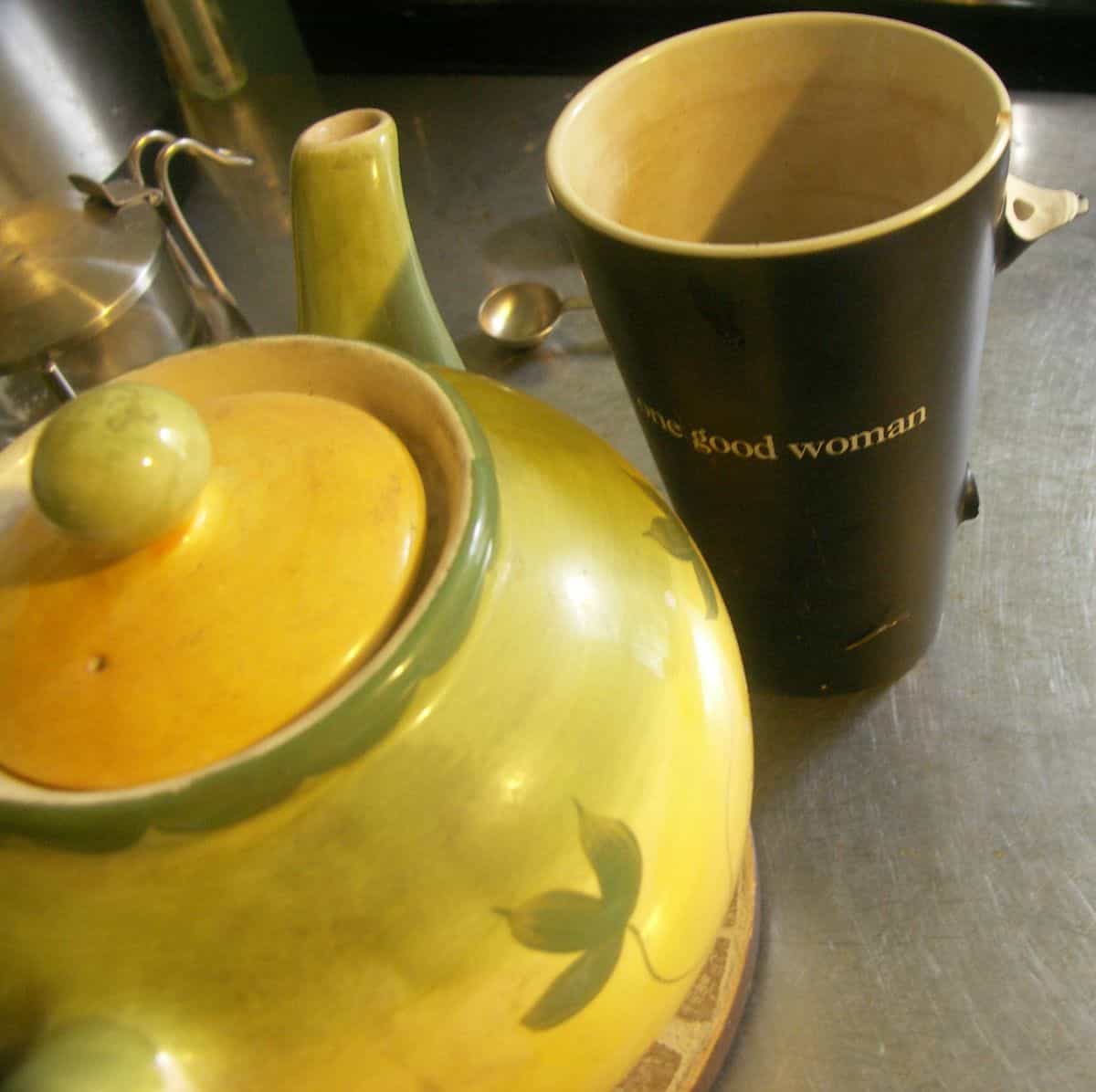
…Then “it” happened.  Ty was spinning around on a rotating stool. (WHY did we put those near the computer desk?)  He twirled around once, kicked my favorite tea cup (the big, well-used, well-loved “One Good Woman” mug) and somehow when the cup hit the cabinet, the handle broke.  The combination of the weight of the mug and the sharp jutting piece where the handle was cut Ty’s foot pretty badly on the way down.  Look at the sharp edge on that thing!  Poor kid.  He didn’t worry about his foot- he worried that I’d be sad my favorite mug was now done-for. 


Well, he didn’t worry about his foot until he saw it bleeding rather profusely.  “MOM!  There’s BLOOD!  Lots of BLOOD!”  Thankfully, it was a good, clean cut and a little pressure stopped the bleeding quickly.  After a wad of gauze and half a roll of surgical tape- because how in the world do you get an adhesive bandage to stay on a 6-year-old’s foot?- Ty was back in the business of being a happy-go-lucky kid.


The glass clean-up wasn’t so bad, either, because the handle didn’t shatter.  I could pick the pieces up mostly with my hands.  A quick pass of the broom took care of the rest. 


..But boy, am I tired of walking on, walking on broken glass.


Home Canned Garlic Dill Pickles

Yesterday was my first day of the year full of the manic joy that is canning season.  My garden unexpectedly delivered a colander full of pickling cucumbers.  Some of the cucumbers had been doing a good job of hiding and were pretty huge.  My job was clear.  Pickle them while they’re fresh!  The large ones were sliced thin for hamburger dill slices in order to make them fit into jars. I was rewarded for my work with two quarts and four pints of Green Garlic Dill Pickles.


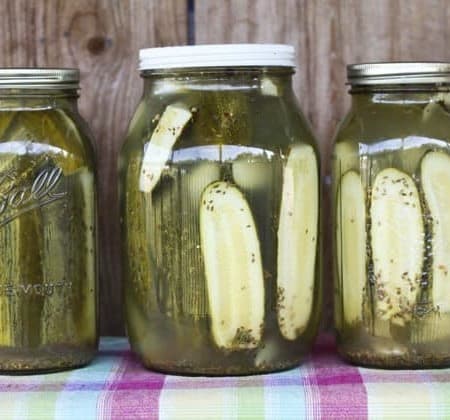
Two pints Hamburger Dill Slices and one quart Green Garlic Dill Pickles.


I know a lot of folks out there are intimidated by canning.  I understand it…  The food police have scared us with their constant semi-subliminal message that the only food safe to eat comes hermetically sealed in jars and boxes barely touched by human hands.  Look at all the things that can go wrong, botchulism, salmonella, mold, etc…  The truth is, though, that canning is an incredibly safe and economical way to provide outstanding food for your table. 


I’ve put together a little primer on making garlic dill pickles; by far the easiest thing outside of jam to can.


Dill Pickle Recipe Primer


There are really only three things you need to do to ensure successful pickles. 

  1. Keep everything clean.
  2. Use the freshest produce available. 
  3. Keep your hands impeccably clean.  As in Howard Hughes clean.


For starters, you’ll need intact glass canning jars that come with new two part lids.  The ones with hinge lids are pretty, but they don’t seal as consistently… For now, leave those for short term storage.  How many will you need?  That depends on how many pickling cucumbers you have.  One peck of pickling cucumbers yields approximately 12 quart jars of pickles.  I’ll give the recipe in a “per quart” format.  That will make it easy for you to scale up to however many cukes you have available.


…And forgive me if this sounds obvious, but to make sure you’ll get nice, crunchy pickles you need to buy pickling cucumbers.  Salad or slicing cucumbers, while delicious, don’t hold up to the canning process as well and yield softer pickles.  They’re not bad, they’re just not as good as they could be.  How do you know you’re in possesion of pickling cucumbers?  If you slice one open you should not see many seeds; if there are seeds they should be small.  The skin of a pickling cucumber is more delicate than a slicing or salad cucumber.  When perfectly fresh, the pickling cucumber’s skin should yield easily to a knife or your teeth.  (Well, you have to test the quality of your product, don’t you?)


Garlic Dill Pickles


For each quart of pickles you will need:

For the spices:

  • 3-4 heads fresh dill (or 1 Tablespoon dried whole dill seed- not weed.)
  • 2-3 large cloves garlic, peeled
  • 12 whole black peppercorns
  • 1/2 a small bay leaf
  • 1/4 teaspoon whole mustard seed
  • 1/2 teaspoon crushed red pepper flakes or 3 dried habaneros (optional)

For the brine:

  • 1 cup cider or white wine vinegar (Cider gives you a more classic pickle flavor, white wine gives you a more delicate pickle.)
  • 2 cups water
  • 1 Tablespoon pickling salt (That’s basically any non-iodized salt.  Kosher salt works well here.)


Clean and sterilize your jars, lids and rings and a ladle or heat-proof measuring cup with a handle, and  a chopstick or butterknife.  You can do this one of two ways.  Either wash in your dishwasher and use the heat dry cycle or immerse jars and rings, ladle and butterknife in boiling water for five minutes and hold in the hot water while preparing the cucumbers.  To sterilize the lids with boiling water, place them in a bowl and pour the boiling water over them.  I opt for the dishwasher.  Getting a dishwasher changed my canning life! 


To make the pickles, scrub the cucumbers and take a small slice off the blossom end of the cucumber.  Taking off about 1/16″ from the end of the cucumber is a little more crunchy pickle insurance.  If left intact, the blossom end can release a compound that causes soft pickles.


If needed, trim cucumbers down to a size that will fit in your jars. 


Now for the fun part (and I mean that!)


Eyeball your cucumbers and make a rough estimate of how many jars you’ll be filling.  Line your jars up on the counter and into each of them put the spices and garlic listed above in the quantities given.  Pack the cucumbers in on top of the spices and garlic.  Don’t squish the cucumbers when packing them in, but you don’t have to be shy about trying to make the most of the space available in the jar, either.  Leave 1/2″ of space between the top cucumber and the rim of the jar.  This is called headspace and it is important in creating the seal that stands between your delicious food and nasty bacteria and mold. 


Scale the brine recipe to the appropriate level (Are you making 4 quarts?  Use 4 cups cider vinegar, 8 cups water, 4 Tablespoons pickling salt, etc…)  Add all brine ingredients to a large stockpot and bring to a boil.  While still boiling, pour (I use a ladle for the job) into cucumber filled jars.  Again, respect the 1/2″ headspace. 


You may find that you need to pour a little more brine in after it settles into the spaces.  This is fine.  When you’ve brined all your jars, gently insert your sterile chopstick or butterknife down the sides of the jar to release air bubbles.  If you need to add more brine at this point to reach the 1/2″ mark, do so.


*If you have leftover brine, don’t sweat it.  You can save it in the fridge for your next batch of pickles or use it to cook beet greens, or any number of other things.  It’s better to make more than you think you need so that you don’t have to scramble to prepare more brine before processing your pickles!


Using a clean paper towel, gently wipe the rims of the jars, place a clean lid on the jar and thread a ring onto the jar to keep the lid in place.  Don’t crank on the ring with brute force.  It’s not the ring that is protecting your food.  The ring merely holds the lid in place until a good seal forms.  Just turn it until it provides resistance.  This will hold the lid on tight enough to prevent water from entering the jar, but loose enough that air can be forced out of it during processing.


When all your jars are filled, turn your attention to processing.  You’ll need a pot with a tight fitting lid deep enough to allow boiling water one inch higher that your tallest jar when full of jars.   To test this, place filled jars (with tightened lids and rings) in the pot.  Fill with water to one inch higher than the tallest jar.  Leaving the water in the pot, carefully remove jars.  Place pot over burner, cover, and bring to a full boil.  When water reaches a rolling boil, carefully place jars in the pot.  (It is helpful, but not strictly necessary,  to have a spiffy rack for raising and lower jars in the pot.  You can also make due with a long silicone oven mitt or a jar lifter- another nifty canning gadget.)


Put the lid on your pot and bring water back to a rolling boil.  Once it reaches a rolling boil, start timing!  For quart jars you process them for 20 minutes.  For pints, process for 15 minutes.  Do not underprocess these jars.  The processing time is your safety mechanism.  It kills nasties that might be on or in the jars and it kick-starts the melding of the flavors.  Contrary to what seems might happen, underprocessing can result in mushy, soft pickles.  Ewwwww.


When processing time is up, carefully remove jars to a sturdy cooling rack over a dish towel.  As the jars cool, you’ll occasionally hear a “pop” sound.  Don’t freak out.  This is a good thing.  This is the sound of the jars sealing.  Allow the jars to cool overnight.  In the morning, use a damp paper towel to wipe down the jars and check the seals.  If you press gently in the center of the lid it should not give at all and should not pop back up.  If you have some seals that failed, don’t worry.  Just store those in your fridge!  They’re still good to eat, they’re just not shelf-stable.  Label your jars with their contents and the date they were made.  They will be ready to eat in 6 weeks.


To store the pickles, put them in a single layer on a shelf in a cool, dry place.  A closed cupboard or basement shelf is perfect.  Homemade pickles are at their delicious best when served super cold. 


Don’t panic about that bent ring! I’ll explain why…


Now I’m going to tell you another thing that seems contrary to common sense.  Remove the rings from the jars when you set them on your shelves to store them.  Remember I told you the rings are there just to hold the lid in place?  Left on the jar they can actually prevent you from knowing a problem exists both before and after storage.  After processing, the ring has performed the duty it was meant to do.  It held the lid in place long enough to form a seal.  Removing the ring allows you to inspect the seal before storage (and refrigerate any jars with questionable seals.)  It can give you an obvious sign that things inside the jar have gone awry.


In ten years of canning, I’ve only had one item go bad.   It was a jar of blueberry jam.  I had laughed at my Grandma’s advice to leave the ring off, but had  listened to her and done it anyway.  I went down to my basement to retrieve a jar of something-or-other and saw that the lid had blown off of a jar of blueberry jam.  That is an indicator of a bad thing.  Now, there was hairy mold and it was slightly off-smelling, too, but I might not have checked it over so carefully had that lid not blown off.   Save yourself some trouble and do what my Grandma said!


Which brings me to what most people fear about canning; contamination.  Pickles are pretty fool-proof with their super high levels of vinegar and salt, but ever so occasionally, things can go wrong.  I’ve never had a problem with pickles, but I am not fool enough to think I’m impervious.  Thankfully, it’s pretty obvious when home-canned goods go bad.  If you see any of the following signs, or you even suspect a problem, throw it out.  Don’t be a martyr!


Signs your canned goods have gone bad:

  • The lid has popped up and/or makes a clicky sound when pressed down in the center.
  • The lid is off the jar entirely.
  • When removed, the lid offers no resistance and/or makes no sound.
  • There is hairy growth on top of the food in the jar.
  • The contents of the jar smell off or foul.


Bread: Fully Loaded! And a book review.

Yesterday was B.U.S.Y!  Aside from the normal frenetic pace of life that goes hand in glove with having five sons ages 10 and under we had other pressing matters.  I am milking goats for friends up the road while they visit family, planning for a wedding rehearsal dinner I’m catering in August, helping put up firewood for the winter, and picking up more household chores and yard work while my husband tries to put batten up every night after work.  To top it all off I discovered yesterday morning that our garden had produced-seemingly overnight- mammoth pickling cucumbers. (My tried and tested pickle recipe will be in my next post.)  Because fresher cucumbers equal crunchier pickles I knew I was going to be pickling last night after making dinner, but before milking goats.  Phew!


Dinner was going to have to be fast and easy. 


I recently procured a copy of “Artisan Bread in Five Minutes a Day” by Jeff Hertzberg and Zoë Franςois.  Before reading the book I had regarded it with more than just a touch of suspicion.  I am a long time sourdough, poolish, and pâte fermenté baker and I didn’t think anything could come close to the time-honored methods. 


The premise of the book is that you mix up master bread doughs and store them in your fridge, taking a portion from the dough mass each day to bake.  I was interested, but still skeptical.  I mixed up one of the basic boule dough from the book.  Jeff Hertzberg, in the book, says:


“Amaze your friends with the “6-3-3-13″ rule:  If you want to store enough for eight one-pound loaves, here’s a simple mnemonic for the recipe:  6,3,3, and 13.  It’s 6 cups water, 3 tablespoons salt, 3 tablespoons yeast, and then add 13 cups of flour.  Store in a 10-quart lidded container.  That’s it.  It will amaze your friends when you do this in their homes without a recipe- but tell them to buy this book anyway!”


The day after mixing this up, I made naan from it.  It was outrageously delicious and tasted *gasp* authentic.  Yesterday was the perfect time to put the “6, 3, 3, 13 dough” through some more paces.

*And I interrupt myself to say just how wonderful it was to have that dough in the fridge for just such a crazy day. 

I busted out *cough, cough* 2 pounds of bacon.  Don’t judge.  I’m feeding a lot of people.  After slicing it into lardons, I par cooked it 3/4 of the way to where I like bacon;  just shy of charcoal- super crispy, please!  Next came an indecent quantity of thinly sliced onions sauteed in bacon fat with a small amount of white wine and a large amount of cracked black pepper.


 I cooked the onions in bacon fat and some bacon was left in it. I loved life at that moment.

Next on deck: Dracula-repelling piles of minced garlic, a hint of gorgonzola, a large amount of garlic and herbed chevre, some minced fresh rosemary and parsley and healthy drizzles olive oil, all strewn over some of the “6, 3, 3, 13 dough” that had been stretched to cover a half sheet pan.


It baked in the oven for 35 minutes.  That gave me ample time to load my jars for the pickles I was making and snap this picture.  Aren’t kids great? 


How did it turn out?  Ohmyohmyohmy.  It was so good.  The crust had just the right amount of crispiness on the bottom and chewiness in the center.  It had a wonderful wheaty smell while baking and browned to a luscious shade on the few spots I left clear on my crazy topping binge.  I mean, really, look at this!


So, I’m left with two things to review… The book and the recipe (see end of post for recipe.)


The Book

The book gets 2 thumbs up out of 2 for usefulness.  The recipes in it are easy and the science is good.  I expect to get a great deal of use out of this book.  I’d recommend it for anyone who loves good, bakery style loaves.   I have a feeling this would also be a great book for folks who are intimidated by baking.  It is laid out clearly, it is encouraging, and it is simple. 


I highly recommend purchasing or borrowing this book from the library because the technique is somewhat unusual.  It’s not difficult at all. It’s just a departure from normal bread techniques and you need to consult the book to really get the desired result.


It also gets 14 thumbs up out of 14 for the recipes we’ve tried.  The master dough is versatile, delicious and simple to put together and store.  By my math that’s better than a hat trick. 

The Recipe

No question.  This got 14 thumbs up out of a possible 14.  It was outstanding and will be repeated orphan  frequently.  (That is your free Gilbert and Sullivan joke for the day.)  The aroma of this baking was enough to make me want to chew my own leg off.  So exercise caution…


Bread: Fully Loaded!

(Again, in this recipe I’m halving what I make for us, so you’ll note that while I used 2 pounds of bacon I’m giving you a recipe that calls for 1 pound.  I made two half sheet pans of this bread last night.  If ya’ll can eat 2 pans worth of this, by all means, double my quantities given below!)

Ingredients:

  • 1 1/2 lbs master bread dough from Artisan Bread in Five Minutes a Day
  • 4 Tablespoons olive oil, preferably extra virgin olive oil
  • 2 Tablespoons semolina flour or cornmeal, for sprinkling over pan
  • 1 lb bacon, sliced into lardons
  • 4 medium yellow cooking onions
  • 2 cloves garlic, peeled and sliced thin
  • 1 teaspoon fresh cracked black pepper
  • 1/4 cup white wine (I used Pinot Grigio)
  • 1/4 cup crumbled Gorgonzola cheese
  • 4-5 ounces crumbled herbed garlic chevre (for recipe, click here)
  • 2 sprigs fresh rosemary, finely minced
  • 1 handful fresh parsley, minced


Drizzle 2 tablespoons of olive oil over the bottom of a rimmed half sheet pan or large rimmed cookie sheet.  Sprinkle the semolina or cornmeal evenly over the oil and pan.  Set aside.


In a large, heavy bottomed skillet, cook bacon lardons over medium heat until bacon is cooked to about 3/4 of the state you usually cook it.  Line a bowl of plate with a double thickness of paper towels.  Remove the pan from the heat and use a slotted spoon to transfer the cooked bacon to the paper towels.  Carefully pour the bacon grease into a bowl to cool. (And use for home fries later.  Yeah!  Home fries in bacon fat rule!)  Do not wipe out the pan under any circumstances.  You’ll use the fat that remains to help cook your onions.


Add the onions to the bacony good pan and return the pan to the burner.  Pour the white wine in the pan and use a spoon to scrape up the browned bits that are stuck to the pan:  That’s the best part!  Add the cracked pepper and a pinch of Kosher salt and lower the heat to medium low.  The goal is to soften these onions, not to brown them.  If you brown them they’ll blacken in the oven.  Let them cook gently while you turn your attention to the dough.


On a lightly floured surface, use your hands and a rolling pin to work the dough out to approximately the size of your pan.  Gently move the dough to the prepared pan.  If the dough shrinks or changes shape in transit, stretch the dough into the corners and against the sides.  Set aside and preheat oven to 425°F.


By the time your dough is done, your onions should be softened to the point where they’ll flop when you pick one up, but it’ll still have a little toothsomeness in the center when you bite into one.  That’s the way you want them so kill the heat. 


Scatter the following ingredients evenly over the dough in this order: bacon, gorgonzola, onions, chevre, and rosemary.  Drizzle the whole thing with the remaining 2 tablespoons of olive oil.  Pop the pan into your preheated oven and bake for 30-35 minutes or until it reaches the degree of golden brown deliciousness you want.


Remove the bread from the oven, sprinkle with the minced parsley and let sit for 5 minutes prior to slicing.  This was amazingly good with a glass of Pinot Grigio.  Oh yes!


This is a slice of heavenly Bread: Fully Loaded!  Look at the irregular holes in the crumb.
  That is the mark of success.