Mandazi

When I read Beccy’s post yesterday, it immediately triggered a memory from my college years–well, my second round of college years. I had originally gone to college right after high school, but in my sophomore year, it was required that we declare a major, and I had NO idea what I wanted to focus on as my major. So, rather settle for ‘whatever,’ I left school, and didn’t return until I returned to that same college town with my two young children, to work and to finish my degree. That small college town was home to many international students, and over the course of our time there, several of these students came into our home, some to share the living space for a while, some just to visit and share some home cooked meals. Some of them also introduced us to some of their favorite foods from back home, and one of the favorites that we have carried with us is Mandazi, an East African fried dough.  I remember standing with Patrick, a student from Kenya, in my small apartment kitchen as he walked me through the recipe from beginning to end. He and his wife and children, along with me, my children and a few others, happily munched through the evening on this fast and frugal treat from his home.

I’ve made these several times over the years since then, and one of the wonderful things about them is their flexibility–they can be a breakfast bread, a snack, and even as a dinner bread made with less sugar and without the confectioners sugar topping.

Since I had not made them recently, I thought I would try to find the recipe online to confirm the recipe ingredients and amounts. And I found several sources for the recipe, but there were a couple of big differences:  All the recipes I found required kneading, offering the option of using yeast instead of baking powder, and required cutting and forming the dough before baking. Now, I enjoy the yeast bread process immensely, but part of the joy of the recipe Patrick shared with me was the fact that it could be whipped up quickly, very spur of the moment, and the dough, thick and sticky, could just be scooped into the hot oil to fry. Why mess with a good thing? Why fix it if it’s not broken? Besides, Jim and I wanted mandazi NOW, not in a couple of hours. So I stuck with my remembered recipe, and here I share it with you.

Mandazi

Oil for deep frying

1.5 cups flour

1/2 cup sugar

1 1/2  teaspoons baking powder

1/2 teaspoon salt

1 t. spice of your choice (cinnamon, nutmeg, ginger, garam masala, cardamom, or a mix of your choice)

1/2 cup milk

1 egg

2 tablespoons melted butter

Confectioners sugar, optional

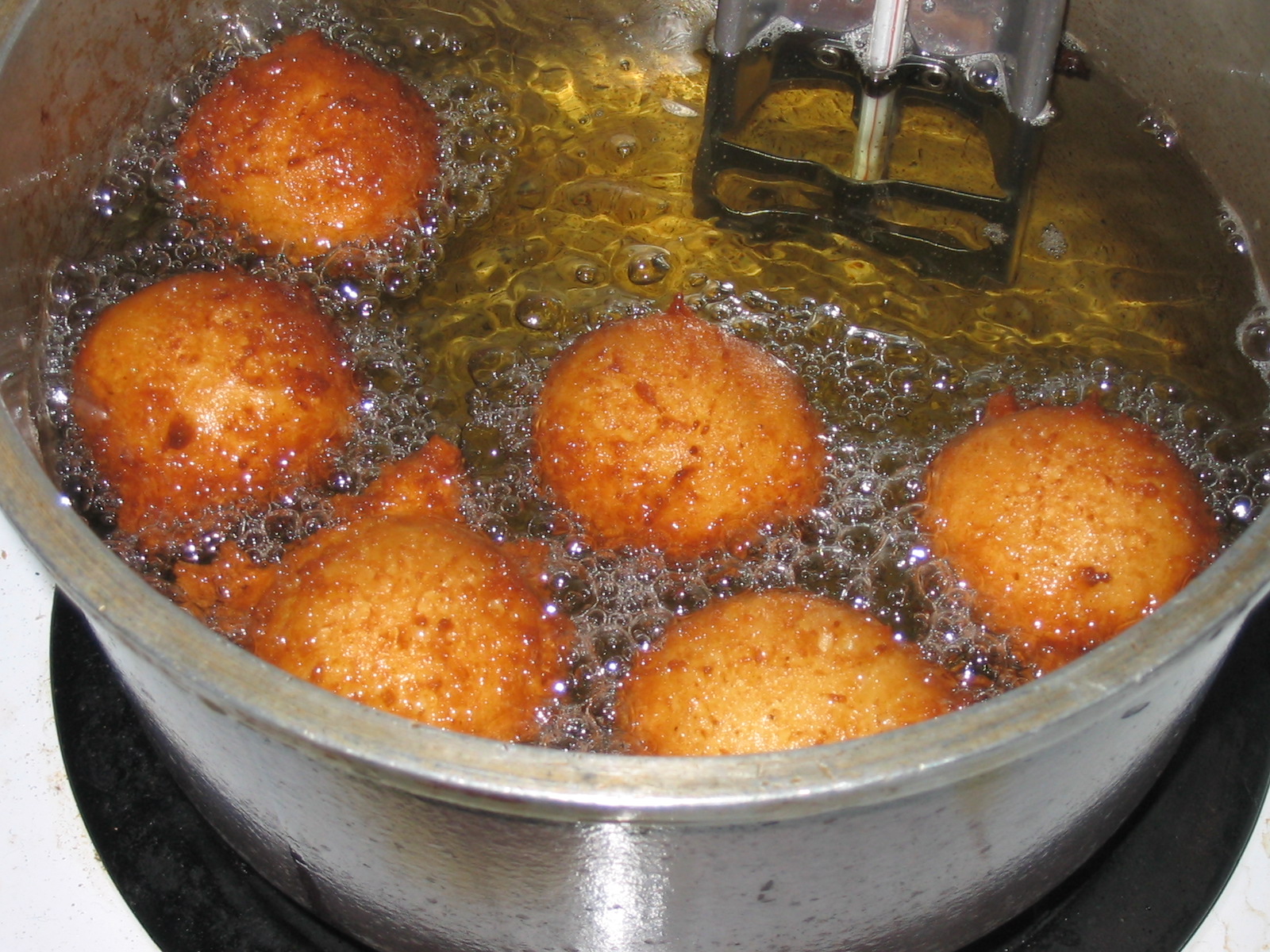
Heat oil in deep fryer or in small deep pan on stove to 375 degrees. Whisk together all the dry ingredients. Gently beat egg, then whisk together with milk and melted butter. Combine all ingredients well, ending with a very thick and sticky dough.  When oil has reached temperature, using a 1 tablespoon scoop or a spoon and a tablespoon measure, drop scoops of dough into the hot oil, about 6 at a time. Fry until a nice deep golden brown all over, turning the balls as needed. They should be done in 3 to 5 minutes. Drain on paper towel, and serve sprinkled with confectioners sugar if desired. Best served warm.

Here is what they should like look when about done:

Dabo Kolo

The boys and I are members of a homeschooling co-operative group in the area.  I peel the baby off of my leg, then teach a baking class to the teens, and assist in an “American Political System” class.  The boys take World Geography, Physical Education, Hands-on Science, International Cooking and Exploring the World through Art.


They’re always excited to tell me what they’ve learned in their classes when we meet up again at the end of the day.  They’ve been especially proud of sharing their recipes with me from the international cooking class.  The teacher in there told me that Ty actually ate coconut, grapes and strawberries.  Oh heck yes!  I don’t care who gets my son to eat fruit.  I’ll take it.  Thank you Ms. Kathy!


This week, the boys brought me the recipe for what they made with Ms. Kathy along with a sample.  Dabo Kolo.  Have the rest of you tried this before?  Am I the only one who hadn’t eaten this Ethiopian specialty before today?  They’re crispy little fried bread snacks that have just enough spice to make them seriously addictive.  I glanced over the recipe and realized that not only was it delicious, but it was also incredibly easy.  We ran home to make a bigger batch.  Let’s be honest.  I’m good at sharing, but I wanted to eat a pile of Dabo Kolo by myself, so, comme d’habitude, we doubled the recipe. 


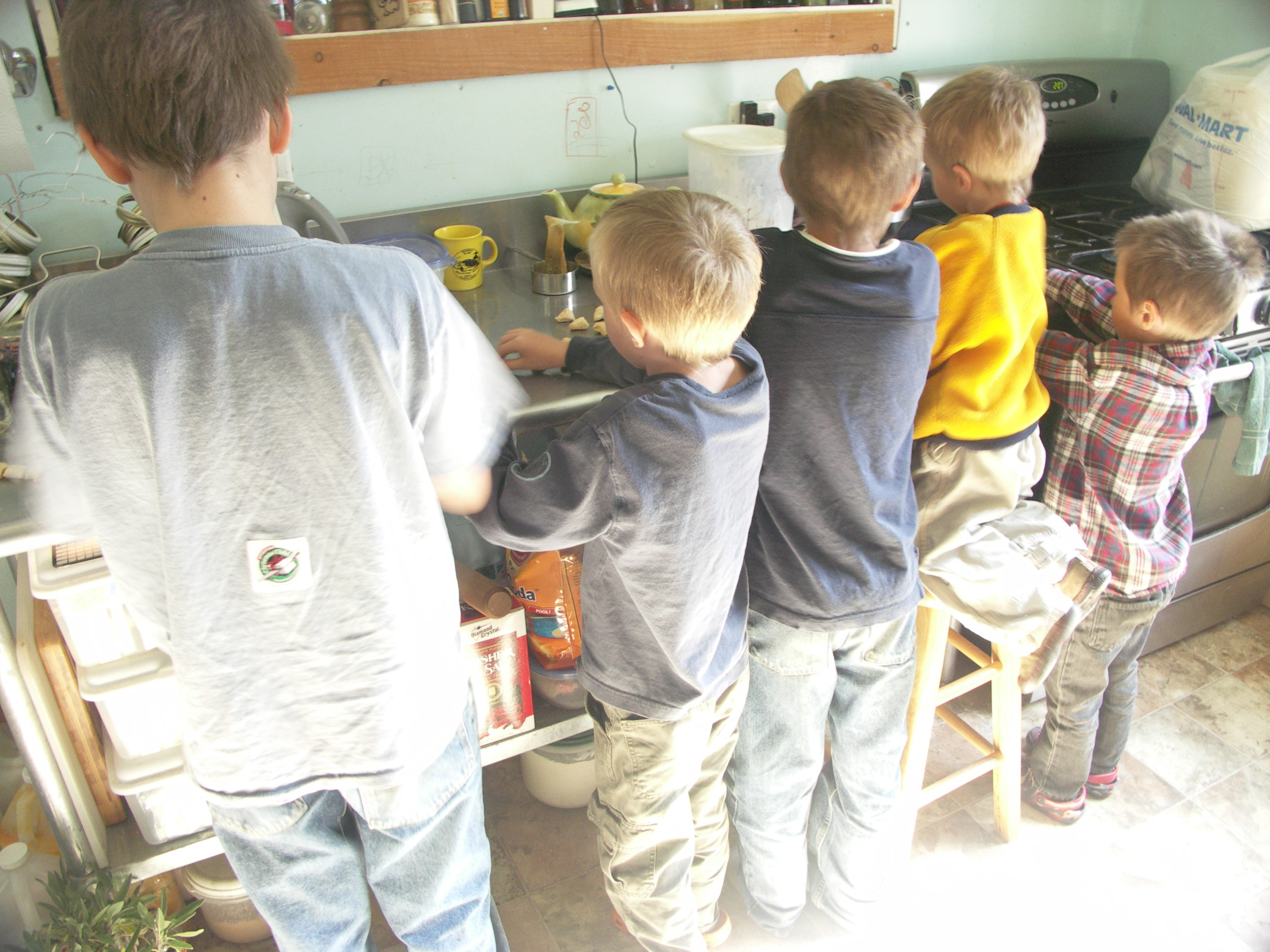
The boys set right to work showing me their impressive kitchen skills.  They scooped and levelled the flour, levelled the spoons of cayenne, salt and sugar and looked at the oil in the measuring cup at eye level.  They rolled out the dough and cut it themselves.


I hear someone out there saying “WHAT?  You let five boys ages 2-10 wield knives near each other?  What are you, nuts?”  Well, yes.  But they used butter knives and they didn’t -not even once- make an exploding sound, cross butter knives like swords, or yell ‘en guarde’.  The truth is that when you teach kids safety in the kitchen and you give them the responsibility (with proper supervision, duh!) they rise to it.  They were so proud to be creating food that they could share with me and as a result they took great care in the process. 


Care to hazard a guess as to how often they are all still enough to fit into that tight a space? 

Look at all those fuzzy heads.  I feel a noogie coming on…

Would you look at that?  I could hire these guys out…

Hands so fast they’re a blur…  They must be really hungry!

And this is the bowl of Dabo Kolo I siphoned away from the children just moments before I stuck my face in it and inhaled every last piece.


So what’s the skinny on these?  They’re incredibly, extremely addictive.  It occured to me as I ate a really huge amount of these that they would make a really nice finger food addition to buffets, tailgate parties, or gameday munchy spreads. In fact, as I type I’m trying to determine whether it would be indecent of me to whip up another batch of these.  There is a reason it is such a popular snack in Ethiopia.  I’d ten times rather eat a bowl of these than a bag of chips (and believe me that means something!) But leaving aside entirely the fact that I could eat five pounds of these in a sitting there is more to recommend them.  They’re really bloomin’ cheap AND fast to make.  Just please make them.  Really.  Now. 


Dabo Kolo

Ethiopian Little Fried Snacks


I’m giving you the single recipe but just double ‘em already.  They store well at room temp in a tightly covered container.  Or so I’ve heard.  Not like they’d last long enough around here to test storage.


And yes.  These are a bit spicy.  If you can’t do the cayenne I’ll look away while you omit or reduce it.  If you like spice, feel free to add more cayenne to the mix.  My boys did.  And they’re ages 3-10.  I’m just sayin’…


Ingredients:

  • 2 cups all purpose or wheat flour
  • 1/2 teaspoon kosher salt
  • 2 Tablespoons sugar
  • 1/2 teaspoon cayenne pepper
  • 1/4 cup canola or vegetable oil or melted butter
  • 1/2 cup water, more or less (You could need more or less depending on your flour and humidity)


Whisk together the flour, salt, sugar and cayenne pepper in a medium mixing bowl.  Add the oil or butter and stir together until evenly distributed.  Add water 1 Tablespoon at a time until you have a stiff dough that holds together well. 


Knead the dough until smooth, about 5 minutes. 


Preheat a griddle or heavy-bottomed frying pan over medium heat.


Divide dough into golf ball sized pieces and roll each piece into long rope-like pieces that are about a 1/2″ around.  Cut each dough rope into 1/2″ pieces.


Evenly space the dough pieces on the hot pan and turn occasionally -tongs make the job very easy- until lightly browned all over.


Allow the Dabo Kolo to cool completely, if you can, and store any you don’t eat at room temperature in an airtight container.

Time for a Cuppa?

We have had a couple of cold, sleety, rainy, dreary days here recently, and I know Rebecca’s working hard at getting the site in order and could probably use a little warm comfort herself, so I thought I’d throw in a good word for one of our favorite go-to’s at times like these–hot brewed black tea, with some sugar and cream, please! I also thought I would take this occasion to mention a couple of my favorite places–a place where I have purchased a good amount of tea and all the fun things that go with it, as well as a small pottery, both places in Pennsylvania where we lived before moving to Michigan.


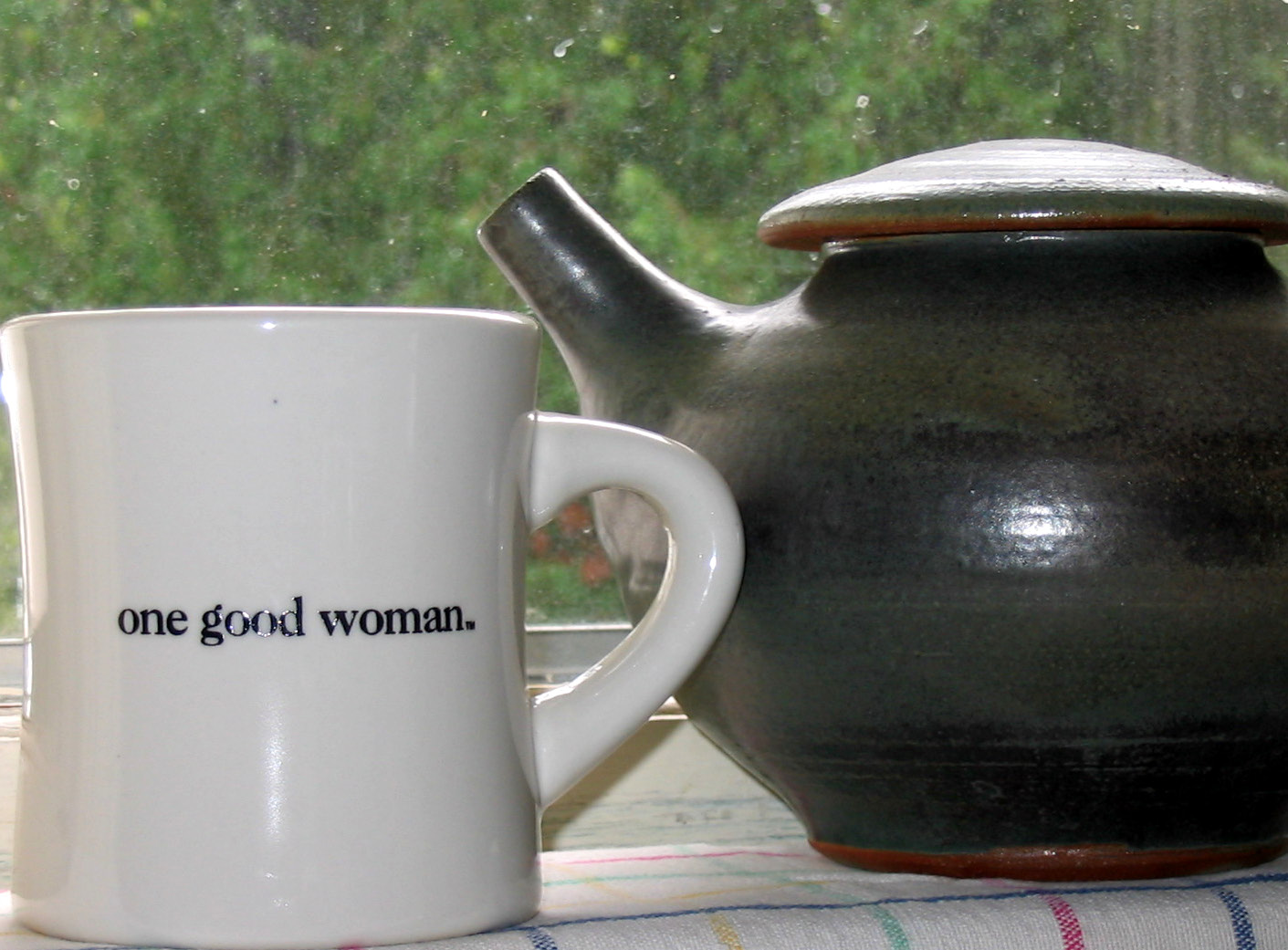
First, the tea–I’ve spent many happy hours at a small coffee and tea shop in Camp Hill PA, by the name of “One Good Woman.” Owned and operated by Holly O’Connor, this is a small business that started out very small, literally from the back of her Jeep, and has grown into a lovely shop that sells coffees, teas, gourmet food items, tea and coffee wares of various kinds, and now offers mail order service, which means I can still get my favorite teas even though we are 900 miles apart! Some favorites: I remember a plum tea I especially enjoyed, and a green tea with mango, tea with coconut, an herbal tea by the name of Once Upon a Tea–a wonderful combination of tea, chocolate, mint, orange and spice–to die for! English Breakfast, Irish Breakfast, and always, ALWAYS, my Earl Grey.


Just walking into Holly’s shop was a joy–the smell of the coffees and teas mixing and floating out to greet you was enough reason to stop by. But I never went in without coming back out with some new tea to try, a new mug, a teapot, or some lovely preserves to top my scones and biscuits. And the warmth of the welcome from Holly, her husband and her staff–well, words fail me. It always felt like coming home.


I guess that is one of the things that having that bit of time with a cup of tea means as well. It’s all tied in with that kind of cozy, warm, loved feeling you get when coming in from a cold, rainy or snowy day–while the water’s heating, you get out of your wet things, grab a sweater or a lap rug, pop a muffin on to toast and prepare to wallow in comfort (it’s even better if you have a nice fire going in the woodstove!).


My current favorite tea is Earl Grey (of course!), with some lavendar flowers thrown in to brew with the tea leaves (I think that makes it officially Lady Grey tea, but we won’t quibble here.) The smell of bergamot mixed with the lavendar makes for quite a heady scent, and I love it. A little vanilla sugar stirred in, a bit of cream, and I’m good to go.


One other thing that makes this time special is having a loved teapot in which to brew the tea, of course, and my teapot was made in another of my favorite Pennsylvania places, Penns Creek Pottery in Penns Creek, PA.  I was introduced to this business by my daughter, whose roommate for a while at college was the daughter of the owner. Bill Lynch heads up that concern, and again, it’s one of those special places. Housed in a restored mill on Penns Creek, he produces and oversees others in the production of beautiful handthrown pottery. I’ve picked up several items over the years, dishes that we use every day, and one of my favorite pieces is the teapot I picked up there several years ago. There is hardly a day when I don’t have something brewing in there, and it reminds me of the pleasure I’ve had in just wandering through the old mill, looking at the various pieces, all really unique works of art, in that old rustic setting.


All good things to think about and remember as I sit sipping my tea…


If you would like to check out either of these places, here are the links:


One Good Woman


Penns Creek Pottery

Stick with us… We’re getting there…

Okie dokie.  Let’s call what’s up on the blog now a sneak preview.  Of what?  I couldn’t say exactly…  It sort of depends on how many brain cells I have left after banging my head against the wall for hours on end trying to learn this dratted code and css gobbledygook.  Bear with us.


Back to food tomorrow!

F.R.U.S.T.R.A.T.I.O.N. Technology style!

Okie dokie.  We have what you might call a bit of a problem.  A technological problem.  This blog ‘make-over’ is temporary only.  Hopefully we’ll have our little code issue resolved by tomorrow.  In the meantime, enjoy our new and transient zen look.


Rebecca and Val

We have a winner!

We didn’t quite make 100 comments.  In fact, we were shy of 50 unique commenters, but we decided to round up because we really like to give things away!  After factoring in the emails we got from folks who had trouble commenting and the kind folks who made mentions of us on our blog we entered our grand total in the random number generator and came up with “4″.  That means that Natalie at Hot Garlic is our winner!


Hot Garlic will win a $50 gift certificate to her choice of Amazon.com, Williams-Sonoma, King Arthur’s Baker’s Catalogue, or Cooking.com.  We aim to please!


On the plus side, we’ll be doing another gift card giveaway in the next week or so since we didn’t quite reach our goal.


Check back early and check back often!

According to Jim, it’s Pretty Good Soup

Now, admittedly, I do follow some recipes for a lot of dishes I prepare,  but soups and stews are very forgiving foods to make, very flexible and a great way to use up those bits and pieces that don’t seem to have anywhere else to go. And most of these creations are dubbed by Jim as being “Pretty Good Soup.” This is high praise indeed, and I always know there won’t be much leftover when I hear those words floating on the air.


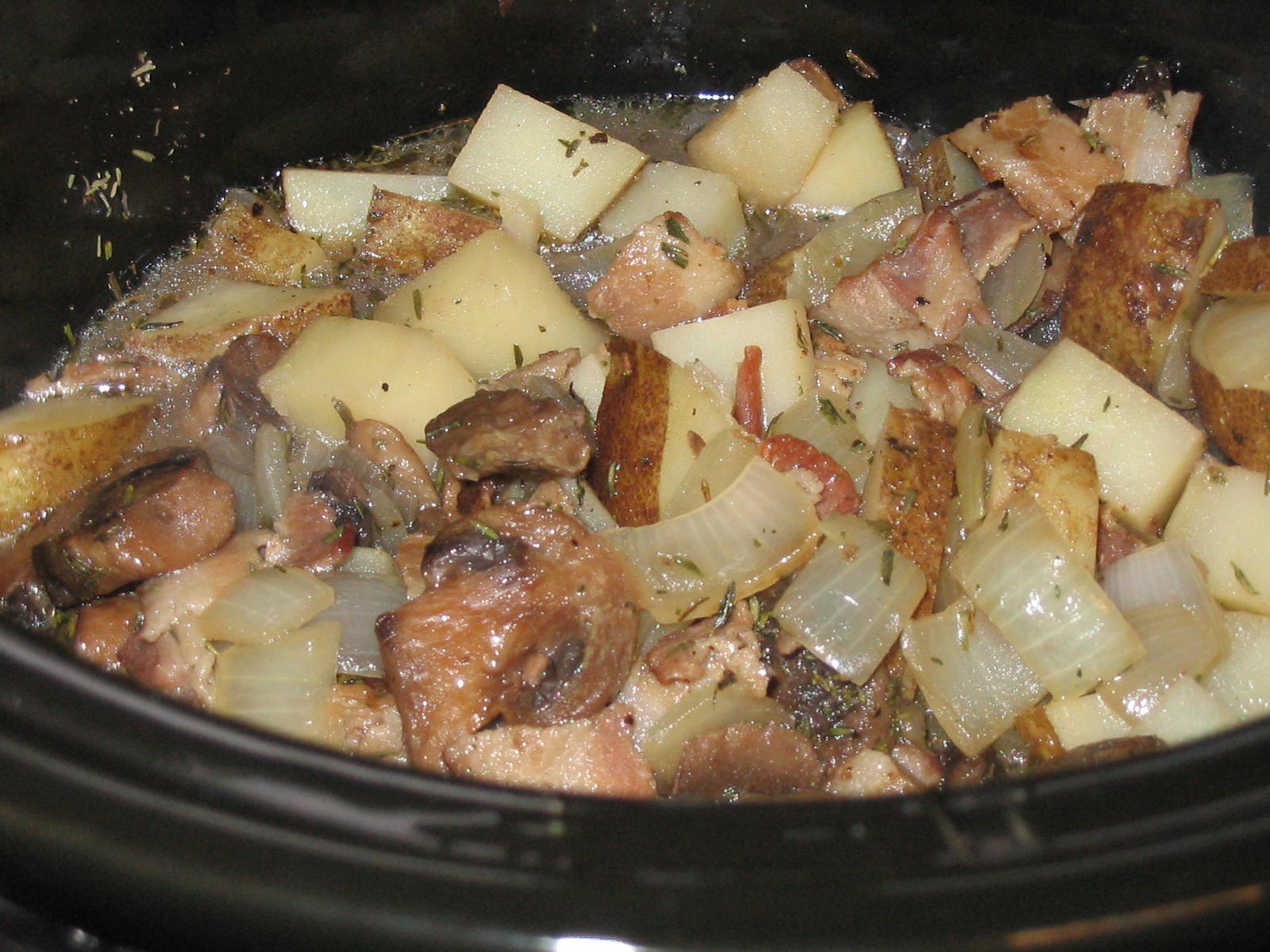
So, today’s venture:  Outside of a few minor chores, I spent much of today reading, but when this afternoon rolled around, I knew I wanted to come up with something warm and savory for supper, since Jim was spending a good deal of the day outside dealing with some hefty chores in the cold Northern Michigan air. (We are preparing for our first major snowfall that is expected tomorrow night, and he was ‘battening down the hatches.”)  When I checked the refrigerator looking for supper inspiration, I found a few slices of fairly lean bacon, some sliced mushrooms and a couple cups of leftover beef broth, and that was enough to get things going. I started by chopping the bacon into large pieces and threw them into a pot to brown and render their fat. While the bacon fried, I took a couple of minutes to roughly chop some onion and a handful of potatoes. Once the bacon was browned, I tossed in the onion for a few minutes, threw in the mushrooms for a bit longer, then tossed in the potatoes, letting it all cook together for a couple minutes more. Everything in the pan went into the crockpot, I deglazed the pan with the beef broth, pouring that over the ingredients in the pot, added a little more water, some pepper and a good amount of dried thyme leaf. Popping the lid on, I turned the pot on high and went back to my book.


Before…


About a half hour before dinner time, I added some bits of buerre manie (flour and butter creamed together) into the soup to thicken the broth a bit, wrapped a loaf of cheese bread in foild and tossed it in the oven to heat. Half an hour later, dinner is served! Bowls full of good hearty soup, warmed slices of bread, followed by a handful of cold, juicy green grapes.  Simple, warm, delicious and satisfying–Pretty Good Soup.


After…


Sorry, we gobbled it all up before we even thought about getting the camera out!!

Yooper Pasties

Update:  You’re in the right place to leave a comment to enter our $100 giveaway!  You have until 3:00p.m. EST on Friday, October 24th to leave a comment and to convince 75 of your closest friends to do the same.  Good golly!  Can’t we give away money?…  Good luck!


Okay.  Now those of my readers who are Yoopers (specifically) or Michiganders (generally)  will know exactly what I’m saying.  Those of you who don’t have kith or kin in either Michigan or Cornwall might need a little explanation.  The pasties of which I speak are pronounced ‘PASS- tees’.  The ones you’re probably thinking about are pronounced ‘PAY- steeze’.  My pasties are handheld meat pies and not little adhesive backed ‘modesty’ panels worn over, well, you know what.  So from now on, each time I type ‘pasties’, please think the correct pronunciation, k?  That way I don’t have to blush every time you read it.


And also for those of you not from Michigan, I should probably toss in a few other definitions:


  • Yooper:  A resident of the Upper Peninsula of Michigan.
  • U.P.:  A widely used acronym for the Upper Peninsula of Michigan.  Well, heck, you’d get tired of typing out Upper Peninsula of Michigan every time too, eh?
  • Big Mac:  A nickname for the Mackinac Bridge; the 5 mile long suspension bridge that links the U.P. to the lower Peninsula.
  • Trolls:  Residents of the Lower Peninsula of Michigan.  Get it?  They live under a bridge?
  • Summer:  Two months of bad snowshoeing.


I also have a big announcement.  This is Foodie With Family’s 100th post.  Please, please, please stop back tomorrow for a really great giveaway.  Trust me when I say you won’t want to miss this one!  We’re giving away a gift certificate for up to $100 to one of several merchants.  I say ‘up to’ because for each 25 commenters up to 100 we’ll add $25 to the gift certificate.  Tune in tomorrow for details.  Entry in the drawing will be as easy as leaving a comment!


But back to the food…


Pasties are a Yooper (and Cornish) specialty.  The Cornish miners that came over to the Upper Peninsula during the golden era of iron and copper mining brought the pasty with them as part of their homeland’s cuisine.  Owing partly to it’s convenient, hand-held-meal portability and mostly to the fact that it’s mouthwateringly delicious and warms you from the inside of your toes to the tips of your ears in cold U.P. weather, pasties were soon not just the fare of Finnish and Cornish miners, but were adopted as a favored food through the entire region.   More than just popular in the U.P., though, pasties make an appearance in troll restaurants under Big Mac, too. One of the best in the northern part of the lower peninsula is Cousin Jenny’s in Traverse City, Michigan.


A pasty is so representative of Yooper culture and food that those of us who are Yoopers-in-exile get wistful when we whip up a batch or talk to relatives who just picked up their pasty boxes at the local church’s fundraising drives.  I had actual hunger pangs when Val emailed me the ‘pasty order form’ from an insert in their church bulletin a few Sundays back.  I pictured a couple dozen Finnish grandmas up in Marquette whipping together hundreds of succulent pasties to sell to benefit the local community chest, booster club, or whatever worthy group they decided to support that year.


Then I did what I often have to do when I finish talking to Val.  I walked into my kitchen because I was starving.  All that pasty talk had left me with two options; feeling sorry for myself or making my own.  I decided to whip up a couple dozen pasties.


Perhaps ‘whip up’ is not the best description of the process involved in making pasties.  It’s a bit of a job, but if you have sisu*  you can manage.


*Sisu:  A Finnish term that translates roughly into English as having an inner strength of will, obstinacy or persistence to power on in the face of adversity regardless of the cost.


I heard someone describe pasties once as ‘hand held beef stew pies”. I think beef stew wishes it was a pasty. While there are variations in pasties based on what the cook can get -beef, venison, chicken, turkey, etc…- and the ratios of vegetables there are some things you’re likely to find in them all. Potatoes, onions, carrots and rutabaga are the traditional pasty veggies and I’m happy to stick with them because you don’t mess with perfection! You’re not likely to hear me saying that often in the kitchen, but we’re talking about food as tradition when it comes to pasties, people. I admit that I frequently make cheese pasties, and they’re divine, but that’s a completely different animal than a Yooper pasty. Truth be known, I don’t think of the cheese ones as pasties. I think of them as cheese pastries. Delicious, to be sure, but in a different food family altogether.


I’ll lay this out in a step-by-step fashion:  It’s easier if you can benefit from someone else’s experience when taking on a project like this for the first time.   I recommend you start this whole project at least three hours prior to when you’d like to eat the first time you make these.  If you’re feeding less than the full regiment that I victual at each meal, feel free to cut back on quantities.  Just keep in mind that pasties freeze and reheat beautifully.  Any cooled,  leftover pasties can be wrapped in a layer of heavy-duty foil and frozen for up to two months.  To reheat your frozen pasties, leave them in foil and put them on a cookie sheet in a preheated 350 °F oven for about 50 minutes or until heated through.  Then you can email me to thank me for sharing this recipe with you.


A fresh-from-the-oven pasty served with the traditional ketchup.  That’s right.  I said traditional ketchup.  If you insist you can eat it with gravy, but that’s Yoopers identify tourists.  Just sayin’…

For a printable version of this recipe, click here!

Yooper Pasties

This recipe yields about 16 plate-sized pasties.  Feel free to adjust amounts but you might want a few of these in your freezer.  They’re the ultimate winter meal-in-one.


Ingredients:

  • 1 large rutabaga and 1 small rutabaga, peeled and diced
  • 2 large carrots, peeled and diced
  • 2 medium onions, peeled and diced
  • 8 medium potatoes, preferably a waxy variety like Yukon golds or reds, peeled and diced
  • 4 pounds lean ground beef
  • enough sturdy pie dough for eight double crust pies (or eight boxes prepared refrigerated pie crusts)- I use the butter tart crust dough from the Fannie Farmer cookbook.  If you need the recipe, email me and I’ll happily pass it along!
  • salt and pepper to taste


Method:


First you are going to sharpen your knife so that if you slip and take off a finger while wrestling your rutabaga it’ll be easier to reattach.  I kid.  Sort of.  My point is this.  Exercise caution with the rutabaga because it does not go gently into that good night.

Rutabagas are hard little things to get into, but easy once you get it cracked open.  They store really well in cold weather root cellars which is one reason they’re so popular in the U.P.

The best way to prepare the recalcitrant little beast is to slice a sliver off one end of the rutabaga so that it stands sturdily on your cutting board.  Then use your biggest sharpest knife to lob it in half.  If it’s freaking you out too much to try to hold a slippery, wax covered, round and really hard vegetable while trying to cut it, feel free to whack it in half with a hatchet or an axe.  Just don’t do it on your kitchen counter!


Splitting the rutabaga is the toughest part of the whole operation.  Once you’re there you’re golden!


Once you have the brute opened, lay it on the flat side and dismantle it further so your original sphere is in quarters.  Take another little bit off the bottom so you can stand the quarters up on their ends and use another sharp knife to remove the peel from the insides.

Use a sharp knife.  Really. 


From this point on, cut the rutabaga into 1/4″ slices and stack them like a deck of cards.


See?  Rutabaga cards.  Delicious!

Now you’ll take your rutabaga cards and slice them into 1/4″ strips that will then be cut into 1/4″ cubes.  Isn’t that wonderfully symmetrical?

Now you’ll have your super adorable sous chef peel your carrots.

Combine all diced vegetables in a gigantic mixing bowl.


Break up ground beef over the top, add salt and pepper to taste, and mix up thoroughly.


Roll out a piece of pie crust to a diameter between 8″ and 10″.  Lay on a pie plate with the crust hanging over the lip of the plate by about 1/4″.  Use your hands or a large spoon to transfer as much filling onto the crust as you can, mounding and pressing down lightly with your hands, to fill the half of the crust that is hanging over the plate.


When in doubt, refer to the picture below.  This is by far the easiest way to form pasties.

Now fold the empty part of the pie crust over the filling, pinch the seams together, transfer to your countertop and crimp the edges with a fork.

Using yet another sharp knife, slice three little vents into the top of the pasty and transfer it to a baking dish or parchment lined baking pan.

You might find it helpful to use a benchknife to help move the pasty from counter to pan.

Now slide those pans into a preheated 375°F oven and bake for 45 minutes to an hour.  Since pasties don’t traditionally get an egg glaze, they won’t be a shiny brown when done, but a deep crispy looking golden brown.  Oh I’m getting so hungry talking about these.

Serve hot, cold, or anything in between.  My Dad used to heat his pasties up on the steam-pipe at the factory where he worked or on the manifold of the log skidder he operated.  I meant it when I said they were portable!

To eat in true Yooper fashion, smother with good ketchup.  If you have an aversion to ketchup you can serve with whatever gravy you prefer.  Either way they’re soooooo good.