Bread: Fully Loaded! And a book review.

Yesterday was B.U.S.Y!  Aside from the normal frenetic pace of life that goes hand in glove with having five sons ages 10 and under we had other pressing matters.  I am milking goats for friends up the road while they visit family, planning for a wedding rehearsal dinner I’m catering in August, helping put up firewood for the winter, and picking up more household chores and yard work while my husband tries to put batten up every night after work.  To top it all off I discovered yesterday morning that our garden had produced-seemingly overnight- mammoth pickling cucumbers. (My tried and tested pickle recipe will be in my next post.)  Because fresher cucumbers equal crunchier pickles I knew I was going to be pickling last night after making dinner, but before milking goats.  Phew!


Dinner was going to have to be fast and easy. 


I recently procured a copy of “Artisan Bread in Five Minutes a Day” by Jeff Hertzberg and Zoë Franςois.  Before reading the book I had regarded it with more than just a touch of suspicion.  I am a long time sourdough, poolish, and pâte fermenté baker and I didn’t think anything could come close to the time-honored methods. 


The premise of the book is that you mix up master bread doughs and store them in your fridge, taking a portion from the dough mass each day to bake.  I was interested, but still skeptical.  I mixed up one of the basic boule dough from the book.  Jeff Hertzberg, in the book, says:


“Amaze your friends with the “6-3-3-13″ rule:  If you want to store enough for eight one-pound loaves, here’s a simple mnemonic for the recipe:  6,3,3, and 13.  It’s 6 cups water, 3 tablespoons salt, 3 tablespoons yeast, and then add 13 cups of flour.  Store in a 10-quart lidded container.  That’s it.  It will amaze your friends when you do this in their homes without a recipe- but tell them to buy this book anyway!”


The day after mixing this up, I made naan from it.  It was outrageously delicious and tasted *gasp* authentic.  Yesterday was the perfect time to put the “6, 3, 3, 13 dough” through some more paces.

*And I interrupt myself to say just how wonderful it was to have that dough in the fridge for just such a crazy day. 

I busted out *cough, cough* 2 pounds of bacon.  Don’t judge.  I’m feeding a lot of people.  After slicing it into lardons, I par cooked it 3/4 of the way to where I like bacon;  just shy of charcoal- super crispy, please!  Next came an indecent quantity of thinly sliced onions sauteed in bacon fat with a small amount of white wine and a large amount of cracked black pepper.


 I cooked the onions in bacon fat and some bacon was left in it. I loved life at that moment.

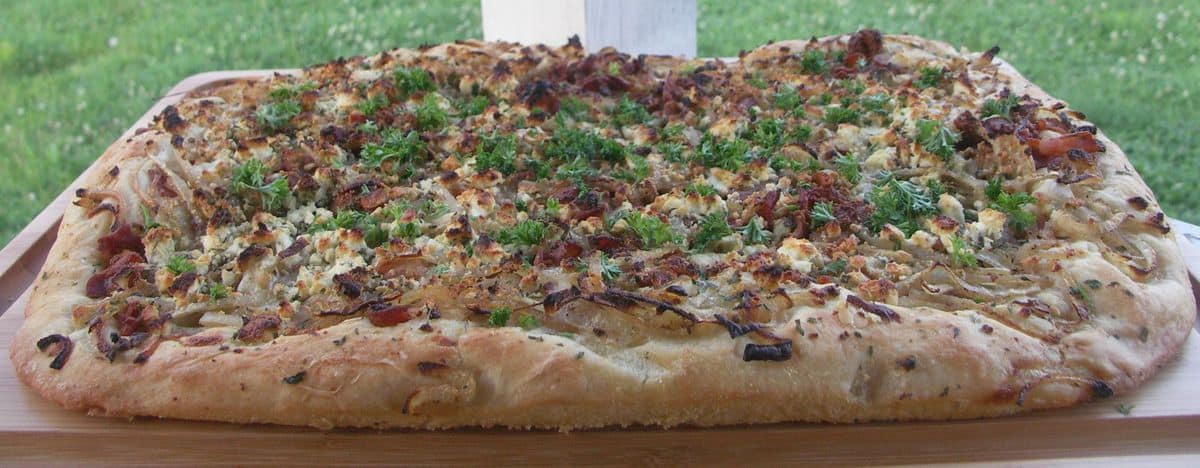
Next on deck: Dracula-repelling piles of minced garlic, a hint of gorgonzola, a large amount of garlic and herbed chevre, some minced fresh rosemary and parsley and healthy drizzles olive oil, all strewn over some of the “6, 3, 3, 13 dough” that had been stretched to cover a half sheet pan.


It baked in the oven for 35 minutes.  That gave me ample time to load my jars for the pickles I was making and snap this picture.  Aren’t kids great? 


How did it turn out?  Ohmyohmyohmy.  It was so good.  The crust had just the right amount of crispiness on the bottom and chewiness in the center.  It had a wonderful wheaty smell while baking and browned to a luscious shade on the few spots I left clear on my crazy topping binge.  I mean, really, look at this!


So, I’m left with two things to review… The book and the recipe (see end of post for recipe.)


The Book

The book gets 2 thumbs up out of 2 for usefulness.  The recipes in it are easy and the science is good.  I expect to get a great deal of use out of this book.  I’d recommend it for anyone who loves good, bakery style loaves.   I have a feeling this would also be a great book for folks who are intimidated by baking.  It is laid out clearly, it is encouraging, and it is simple. 


I highly recommend purchasing or borrowing this book from the library because the technique is somewhat unusual.  It’s not difficult at all. It’s just a departure from normal bread techniques and you need to consult the book to really get the desired result.


It also gets 14 thumbs up out of 14 for the recipes we’ve tried.  The master dough is versatile, delicious and simple to put together and store.  By my math that’s better than a hat trick. 

The Recipe

No question.  This got 14 thumbs up out of a possible 14.  It was outstanding and will be repeated orphan  frequently.  (That is your free Gilbert and Sullivan joke for the day.)  The aroma of this baking was enough to make me want to chew my own leg off.  So exercise caution…


Bread: Fully Loaded!

(Again, in this recipe I’m halving what I make for us, so you’ll note that while I used 2 pounds of bacon I’m giving you a recipe that calls for 1 pound.  I made two half sheet pans of this bread last night.  If ya’ll can eat 2 pans worth of this, by all means, double my quantities given below!)

Ingredients:

  • 1 1/2 lbs master bread dough from Artisan Bread in Five Minutes a Day
  • 4 Tablespoons olive oil, preferably extra virgin olive oil
  • 2 Tablespoons semolina flour or cornmeal, for sprinkling over pan
  • 1 lb bacon, sliced into lardons
  • 4 medium yellow cooking onions
  • 2 cloves garlic, peeled and sliced thin
  • 1 teaspoon fresh cracked black pepper
  • 1/4 cup white wine (I used Pinot Grigio)
  • 1/4 cup crumbled Gorgonzola cheese
  • 4-5 ounces crumbled herbed garlic chevre (for recipe, click here)
  • 2 sprigs fresh rosemary, finely minced
  • 1 handful fresh parsley, minced


Drizzle 2 tablespoons of olive oil over the bottom of a rimmed half sheet pan or large rimmed cookie sheet.  Sprinkle the semolina or cornmeal evenly over the oil and pan.  Set aside.


In a large, heavy bottomed skillet, cook bacon lardons over medium heat until bacon is cooked to about 3/4 of the state you usually cook it.  Line a bowl of plate with a double thickness of paper towels.  Remove the pan from the heat and use a slotted spoon to transfer the cooked bacon to the paper towels.  Carefully pour the bacon grease into a bowl to cool. (And use for home fries later.  Yeah!  Home fries in bacon fat rule!)  Do not wipe out the pan under any circumstances.  You’ll use the fat that remains to help cook your onions.


Add the onions to the bacony good pan and return the pan to the burner.  Pour the white wine in the pan and use a spoon to scrape up the browned bits that are stuck to the pan:  That’s the best part!  Add the cracked pepper and a pinch of Kosher salt and lower the heat to medium low.  The goal is to soften these onions, not to brown them.  If you brown them they’ll blacken in the oven.  Let them cook gently while you turn your attention to the dough.


On a lightly floured surface, use your hands and a rolling pin to work the dough out to approximately the size of your pan.  Gently move the dough to the prepared pan.  If the dough shrinks or changes shape in transit, stretch the dough into the corners and against the sides.  Set aside and preheat oven to 425°F.


By the time your dough is done, your onions should be softened to the point where they’ll flop when you pick one up, but it’ll still have a little toothsomeness in the center when you bite into one.  That’s the way you want them so kill the heat. 


Scatter the following ingredients evenly over the dough in this order: bacon, gorgonzola, onions, chevre, and rosemary.  Drizzle the whole thing with the remaining 2 tablespoons of olive oil.  Pop the pan into your preheated oven and bake for 30-35 minutes or until it reaches the degree of golden brown deliciousness you want.


Remove the bread from the oven, sprinkle with the minced parsley and let sit for 5 minutes prior to slicing.  This was amazingly good with a glass of Pinot Grigio.  Oh yes!


This is a slice of heavenly Bread: Fully Loaded!  Look at the irregular holes in the crumb.
  That is the mark of success.

Roasted Beet Salad with Herbed Goat Cheese

It is official.  I am addicted to food blogger events.  When I saw that Holler from Tinned Tomatoes was hosting her No Croutons Required event for July and that the category was vegetarian soups and/or salads showcasing herbs I was thrilled.  I lovey love love fresh herbs.  Since I have parsley and chives growing in abundance the question was not which herbs I would use, but how I would show them off to their best advantage. 


Enter my dairy goat farming friend from up the road.  I occasionally get wonderful goat milk from her.  Some of the best cheeses I’ve made have been from her goats’ milk.  Happily, she brought me about a gallon late last week and also happily, I had chevre culture in my freezer.  I immediately set about making the chevre.  The plan was to stir in finely minced garlic, chives and parsley from my garden.  If you have never made chevre, or any cheese for that matter, don’t be impressed.  It’s so deadly easy that you really have a difficult time paying the gobs of money they charge for it in the store once you’ve made it.    


There are several ways to make chevre.  I think the easiest way is simply to use direct set chevre culture.  It’s available from many mail order sources under many names, but I’ve been pleased with the quality of the culture I get in five-packs from New England Cheesemaking Supply Co.  (click here for product unformation and current pricing) Once you see how easy it is to make you’ll be glad to have made the $6.00 investments to keep a couple packets handy in the freezer.  (You can also purchase butter muslin through New England Cheesemaking.)


The recipe is as simple as can be.  I follow the directions printed on the culture package:


“Directions:  Heat 1 gal. pasteurized milk to 86F, add &mix in 1 packet, let set at room temperature undisturbed for 12 hrs. or until thickened (as in yogurt).  Ladle curd gently into a butter muslin lined colander, hang & drain 6-12 hours.  Refrigerate & Enjoy!”


I can add a couple observations that are based on a few years of home cheesemaking.  When setting out your milk after mixing in the culture, make sure you cover it to keep the fruit flies and other winged buggies away from the party.  Your room should be at least 72F.  This temperature is also ideal for proper draining when you hang the cheese in the butter muslin.   


To make the herbed chevre as I did:  (Please note [in the upper right hand corner of the picture] the mighty hunter, Diggedy, cunningly stalking the wild chevre and praying fervently that I need to run back into the house for a spare camera battery or to pull the boys out of the toilet or some other well timed interruption…)

1 batch freshly drained chevre (approx. 1 1/4 lbs)

1/2 cup finely minced fresh herbs (any combination of chives, parsley, chervil, etc…)

1-2 cloves garlic, finely minced (according to taste)

1/2-1 teaspoon cracked black pepper (according to taste)

1-2 teaspoons kosher salt- or any other non-iodized salt (according to taste)


Add all ingredients to a medium mixing bowl and mash together with a wooden spoon until evenly combined.  Transfer and pack into molds or form into a log on a piece of parchment paper (roll up in parchment paper for storage).  Place in fridge and eat within two weeks.  This cheese does not freeze particularly well.


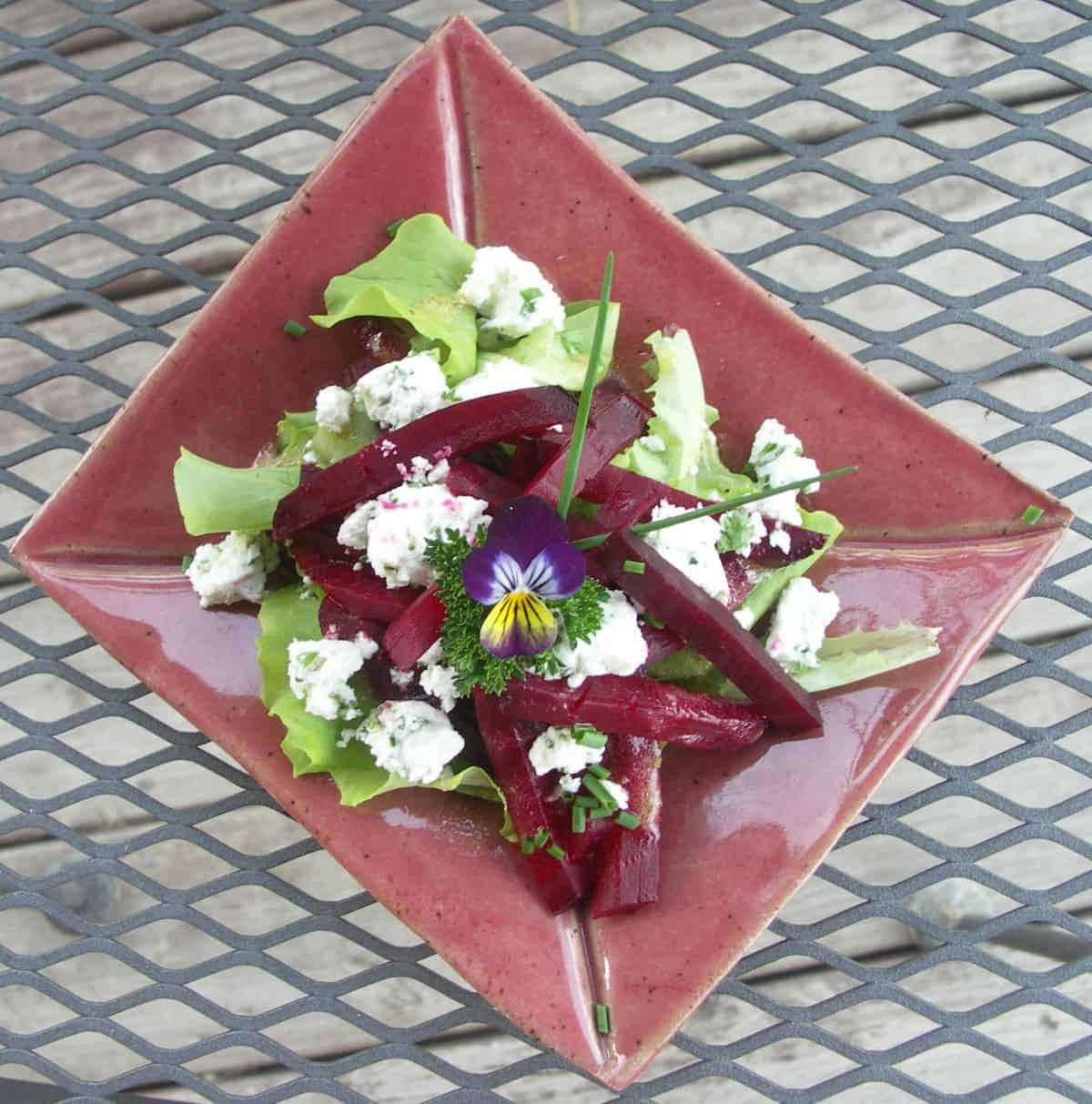
To make the salad as pictured above…


Herbed Goat Cheese and Roasted Beet Salad


To Roast the Beets


3 large beets, scrubbed and trimmed of greens

2 Tablespoons olive oil


Preheat oven to 400F.  Lay the beets in a large sheet of heavy duty foil, raise the edges of the foil around the beets to form a bowl and drizzle with the olive oil.  Cinch the foil up the rest of the way to form a closed packet around the beets.  Place on a rimmed baking dish and roast for 20-45 minutes (depending on the size of the beets) or until the beets are easily pierced to the center with a sharp knife. 


Remove from oven and cool until you can handle them.  Use your hands or an old towel to slough off the beet skins and slice into batons for your salad.  Set aside.


For the Vinaigrette

1 Tablespoon coarse dijon mustard

1/4 cup red wine vinegar

1 Tablespoon water

1/2 cup extra virgin olive oil (or canola oil)

1/4 teaspoon cracked black pepper

pinch kosher salt


Add all vinaigrette ingredients to a mason jar with a tight fitting lid and shake until emulsified.  Set aside.


To assemble the salad

Leaf Lettuce (fresh from the garden if you have it!)

Roasted Beets

Herbed Chevre

Dijon Vinaigrette

Additional chives, parsley, whatever fresh green herbs you can rustle up

Edible Flowers


Pile greens on a plate and top with the roasted beet batons, drizzle lightly with the dijon vinaigrette.  Crumble chevre over the beets and top with additional minced chives, parsley and edible flowers.


This salad was sooooo delicious that my husband and I are going to sow more rows of beets so we can eat it more often. 


This recipe definitely gets 4 enthusiastic thumbs up (my husband and I)   and 10 non-committal thumbs pointed any direction that didn’t require them to hold their forks. The idea of the beets and goat cheese didn’t really ding the boys’ chimes so they opted for plain greens dressed with ranch.  Ah well.  Can’t win ‘em all.  (The only time I got the boys to eat beets was the time I told them that if they ate the entire pan full of beets they’d pee pink.  The trick has not been repeatable.)