Thai Sweet and Hot Garlic Dipping Sauce

…Does writing two posts in a row with a sweet and spicy theme say something about me?

In actuality, I do believe I can blame this one on you all, you sweet and spicy wildcats.  I did, after all, put it up for a vote on the Foodie With Family Facebook fan phage. (Yes, I know it should be page, but I got carried away with alliterative abandon.) The voting results were narrowly skewed in favor of this addictive Thai Sweet and Hot Garlic Dipping Sauce.  Never fear, my salsa fanatics! We’ll be back on the salsa train tomorrow.  In the meantime, if you’re looking for my first salsa recipe in my week long salsa recipe series, you’ll want to click on over to my Record-Eagle column. While you’re at it, have a gander at my Peaches and Cream Time Saver Muffin recipe.  You’ll be so glad you did!

I have a confession to make.  My husband and I have allowed all of our children to learn and adopt our own long-standing addiction.  We didn’t just let it happen, we encouraged it.  In fact, we bought the strong stuff for them.  I mean heavy-duty.  The dangerous stuff that reduces strong men to weeping babies.  The truth is that growing up in our family it was all but inevitable.

All five of our sons are hot sauce addicts.

I do mean they are fully addicted to hot sauce.  For Christmas last year, my ten-year-old and eight-year-old chucked aside their main gifts in order to crack open the miniature bottles of Frank’s Extra-Hot Sauce that we had tucked into their stockings.  Did they shake it on their eggs?  Drizzle it over their breakfast sausage?  Eat it straight on chips?  No.  Any of those would’ve been reasonable, but no.  My children shook the bottles straight into their mouths.  On purpose.  And then repeated it until each of them had consumed about two tablespoons of it straight from the bottle.  Then -and then, only- they ate a couple pieces of candy.  And then went back to the hot sauce.

My baby.  My little, sweet, cuddly four-year-old baby likes copious amounts of Sriracha on his turkey sandwiches, in his congee and on his tacos.  My twelve- and six-year olds profess not to like hot sauce as much as their brothers, but that’s only because they’re choosy.  They don’t like Frank’s, Tabasco or Sriracha, but they both like -nay, adore!- Melinda’s Original Habanero XXXXtra Reserve Sauce.  Dare I confess that we buy it by the gallon?

Considering that I do often share ‘spicy’ recipes here on Foodie With Family, and that I often get questions regarding just how hot a recipe I just offered actually is, I thought it was about time for me to create a heat-rating system; one that gives you a good idea of just how hot something actually is.  A system that was more specific and universally understandable than my usual, “Well, my four-year-old eats it…” because the truth is, my four-year-old stuffs his face full of wasabi peas, cries, knocks his head against my thigh waiting for the wasabi burn to die down then begs me for more.  And so, I present to you…

The Foodie With Family “Spicy Foods” Equivalency Rating System

  1. Eh, at least it has flavor.
  2. Not bad.  This would be good for small children and it’s pretty tasty stuff.
  3. I like it. It’s a good all-purpose kind of heat without being at all overwhelming.
  4. Tingly, definitely packs a little punch.
  5. Hot, but full of great flavor.
  6. Oooh, the roof of my mouth is sweating.  More please.
  7. My tongue is on fire and I like it.
  8. I’m sorry.  Did you ask me something?  I can’t hear you over the freight train running through my ears and I’m pretty sure my face has melted off of my head.
  9. Where did everyone go?  I think I’ve gone blind.

If I were to put this in terms of widely available and well-known foods, it might look a little like this…

  1. A little freshly ground black pepper.
  2. Frank’s Red Hot Sauce
  3. Tabasco Sauce
  4. A generous shake of crushed red pepper flakes on a piece of pizza.
  5. Melinda’s Original Habanero XXXXtra Reserve Sauce
  6. Sriracha
  7. A bite of a fresh, ripe habanero pepper.  If you eat enough you will most definitely experience the ‘hot sauce hangover’.*
  8. …Crazy off-brand hot sauces that hardly anyone recognizes because they hurt and they’re expensive.  Most people don’t pay for that honest to goodness pain.
  9. Dave’s Insanity Sauce.  There’s a reason some states require you to sign a health-waiver when you purchase this stuff. And for the record, this stuff is off-the-charts for us.  With two notable (and historical) exceptions, we do not eat this.**

*The Hot Sauce Hangover is a phrase coined by The Evil Genius to describe the phenomenon whereby the hot sauce makes its presence known  on you causing your posterior to hang over the toilet for roughly the same amount of time it took you to eat it in the first place.

**These exceptions are stories for another day and another cuppa tea.  I’ll just say the first occasion was a pride-fueled attempt to impress someone by putting  Dave’s Insanity Sauce on my burger like ketchup. The second event was my husband trying to eat it because he didn’t believe I could’ve possibly experienced that much pain from hot sauce when I recounted the story to him. I won that time.

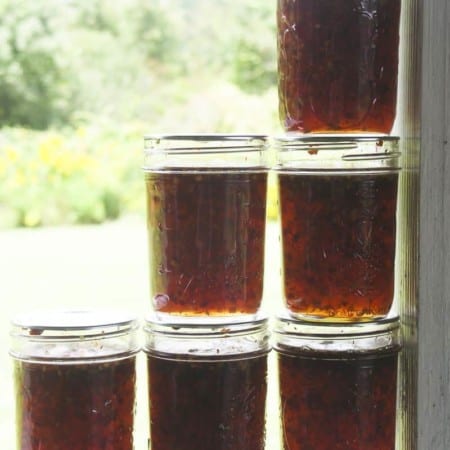
Now that we’re all on the same page, let’s talk Thai Sweet and Hot Garlic Dipping Sauce.  I’m going to say that it falls somewhere between a four and a five in terms of heat and it gets full-marks on flavor.  If your heat-preferences run lower than ours, you can certainly reduce the crushed red pepper flakes called for in the recipe.  In terms of commercial comparisons, it is similar in flavor to Mae Ploy sauce but as with most homemade sauces, it’s just so much better.  There isn’t much that tastes better with lumpia, summer rolls or fried spring rolls, egg rolls or chicken balls.  Use to glaze or brush on grilled meats or whisk a little together with grated fresh ginger, soy sauce, and sesame oil for the best dressing ever to adorn an Asian chicken salad. Just look at how gorgeous it is.  Don’t you want to drink a tall glass of it?

No?  I’m alone on this?  No one else wants a glass?  Alright, but seriously, make this.  It is one of the easiest canning projects you can try because it doesn’t require any exotic ingredients or specialty equipment aside from the canning jars themselves.  And believe me, it is worth the effort. For the sauce to reach its full flavor potential, it has to sit on the shelves at room temperature for at least three weeks.  This isn’t a moment where you can mix up the sauce and shove it in the back of the refrigerator.  It just won’t develop the same roundness and body. Veteran canners can skim through and get the information they need, but I’m going to talk this through step-by-step for the newbie canners out there.  You can do this! Yes, you CAN.  Oh man, I crack me up.

In order to complete the project, you need to be able to lay your hands on the following items:

  • Between nine and twelve half-pint (8 ounce) canning jars with new two-piece lids.  If you’re unfamiliar with two-piece lids, just buy a box of new canning jars from your local hardware store or Walmart.  They come -quite conveniently- with new two-piece lids!
  • A large stockpot or pasta pot with a tight fitting lid.
  • A rack that fits on the bottom of the pan to prevent jars from sitting directly on the pan’s surface. If you don’t have that, rings from ‘regular mouth’ canning jars can be placed facing downward sides touching to create a space between the bottom of the jars and the pan.
  • A waterproof oven mitt or canning tongs.
  • A ladle.
  • Paper towels or clean tea towels.
  • A timer or a clock.

For a printer-friendly, photo-free version of this recipe, click here!

Thai Sweet and Hot Garlic Dipping Sauce

Adapted from The Ball Complete Book of Home Preserving

Yield: About 9 half- pints as written

Ingredients:

  • 1/2 cup finely minced fresh garlic (Peel and mince your own garlic, please. Pre-minced garlic in jars just isn’t good enough for this recipe.)
  • 1 Tablespoon Kosher salt
  • 6 cups cider vinegar
  • 6 cups granulated white sugar
  • 3/4 cup (less if your heat tolerance is lower) crushed red pepper flakes

Prepare the jars and rings by washing on the hot cycle of your dishwasher.  Wash the lids in hot soapy water and rinse well.  Place in a bowl covered by two or three inches of very hot tap water.  Set aside.

Prepare your canner (or stockpot) by putting a rack in the bottom to hold the jars away from the base of the pan.  If you do not have a rack, use a fully opened vegetable steamer basket or extra rings from ‘regular-mouth’ or ‘narrow-mouth’ canning jars placed facing down with the sides touching.  Set aside.

Sprinkle salt over the minced garlic in a metal or glass bowl (don’t use plastic here unless you want a perma-garlic bowl!)  Stir together, cover tightly with plastic wrap and let it mellow at room temperature for an hour.  The salt will help pull some of the moisture from the garlic, so don’t skip this step!

In a saucepan, bring the vinegar to a rolling boil.  Add the sugar all at once and stir well until the sugar is dissolved.  Return to a full boil.  Lower heat just slightly so that it boils steadily but not really hard.  Boil steadily, uncovered,  for 10 minutes.  Remove the pan from the hot burner, stir in the garlic mixture and the crushed red pepper flakes.  Take care not to hold your face directly over the pan when adding in the pepper flakes as that can trigger some serious coughing and eye-watering, depending on the strength of the pepper flakes.

Ladle the hot sauce into the hot jars.  You want to leave 1/2″ of space between the top lip of the jar and the top level of the dipping sauce.  Use a ruler outside the jar to check whether you have the right amount of open space.  If you need to, use a spoon to remove some sauce or add sauce to maintain that 1/2″ of headspace.  Use a paper towel (or clean tea towel) dipped in pure cider vinegar to wipe the rims of the jars even if it doesn’t look like anything is on it.

Use your clean hands to grab a lid from the hot tap water.  Position it, rubber seal side down, directly over the center of the jar.  Place the metal ring over the jar and gently screw it into place until you meet resistance. When you meet resistance, tighten the jar until it is finger-tip tight.  (In other words, tighten until it is the tightness that you can achieve with your finger-tips, not with vice-grips.) The jars are going to be hot because you poured nearly boiling liquid into them.  I find it helpful to wear an oven mitt on the hand that is holding the jar steady.

When all of your jars are ready, set the prepared canner on your burner.  Position the jars (using an oven mitt to keep from burning your fingers or palms) over the rack (or steamer basket or upside-down canning lids) so that the jars are steady and in an upright position.  Cover the jars completely by at least one inch with hot tap water. Place a lid on your canner (or stockpot) and turn the heat on your burner to high.  When the water reaches a full, rolling boil (one that could not be stirred down), set your timer for 15 minutes.  When the 15 minutes have elapsed, remove the lid to your canner and shut off the heat.  Leave the jars in the hot water for 5 minutes.

After 5 minutes, transfer the jars (using a waterproof oven mitt or canning tongs) to a towel lined counter or a cooling rack with a towel under it. You should start to hear the “POP” of the lids as they form vacuums and seal.  This is a very good thing!  Leave your jars to rest, undisturbed, overnight.  In the morning, test the jars by pressing gently on the center of each lid.  If it does not give under gentle pressure or pop back up, your seal is good.  Remove the rings for storage*, wipe gently with a damp cloth or paper towel, label and store in a cool, dark place for 3 weeks prior to using.  Unopened, sealed jars of this sauce can be stored for a year.

*Storing your jars without the rings is a little bit of insurance.  When food spoils in a closed environment, the gasses produced by bacterial growth create upward pressure in the air pocket left by the headspace you so carefully measured in the jar.  If you remove the ring, any gasses produced by spoilage will push upward on the lid loosening the seal.  When you open a jar, if the seal is weak or there is no “schllllllooop” from a vacuum seal being broken, discard the contents immediately.  On the flip side, if you hear that lovely “schllllllllooop” and the lid is difficult to pry from the jar, you’ve done the job right!  You can eat your home-canned goodies, content in your foodstuffs’ safety.

Before opening a jar of Thai Sweet and Hot Garlic Dipping Sauce, be sure to give it a good shake.  There will be a natural settling of the product in storage and shaking is a simple way to distribute all that gorgeous garlic and pepper flake-age.

Candied Jalapenos


This last week, my baby brother Luke told me admiringly that I had finally done it.

“To which it do you refer?” I inquired.

“IT!” said Luke.

Luke was referring to this.

This sandwich blew my mind. It was the perfect sandwich. I do not use the phrase ‘perfect sandwich’ lightly. It is a very serious appellation to give a sandwich*. This one earned it.

*Could I possibly use the word ‘sandwich’ any more? There just doesn’t seem to be any way around it. And so I’d like every single English and composition teacher reading this to take a muscle relaxant right now to help them get through the rest of this post without cringing themselves into spasms.

Let me tell you what makes this bad boy so very bad*. The sandwich is built of naan brushed with ghee, tandoori style grilled chicken, cucumber and yogurt salsa, crunchy pickled onion rings and candied jalapenos. Un-bloody-believably delicious. The Evil Genius declared it to be ‘A Second-to-Naanwich’.

*Bad in a good way. As in phat. Not fat. It’s totally fly. I should probably stop now. Fo shizzle.

Every single component of this sandwich was made from scratch. Okay, so I didn’t grow the lettuce greens, spices or the chicken, but shy of that, all homemade. And over the next few posts, I will give you the recipes to make each component needed to reproduce this amazing sandwich in your own kitchen.

Even though this sandwich alone is worth the work of making each of these building blocks, you’re not just canning, yogurt, bread, and grilling for one purpose. Each of the ingredients can be used for multiple recipes. This is a springboard recipe. Once you’ve mastered each component, the world is your oyster. Are you ready for the first part? Here we go!

We’re starting with Candied Jalapenos for a very good reason. After being made, they need to sit for at least two weeks before you crack open the jar to start eating them. And by need, I mean it’s strictly optional, but you’ll be glad that you did. The flavors need time to meld and marry.

Candied Jalapenos. Ah. There’s a story here. A couple months ago, my friend Katie casually mentioned eating a sandwich made with candied jalapenos. She was singing the praises of what she described as an addictive jar of goodies. Then she said the magic words, “I wish I could figure out how to make these at home.” By this point, you know me enough to know what affect that statement has on me, right?  I quizzed her on the texture, flavor, and appearance of the jalapeno rings. I begged for photographs. I had her send me a picture of the ingredient list on the label. I asked her to describe the flavor to the very best of her food blogging abilities. She was game. She provided all the information and even sent a link to a recipe that she thought looked like it would come close to the benchmark for her.

After carefully examining close to thirty recipes on candied jalapenos (who KNEW there were so many people candying jalapenos?) I called my local Cooperative Extension office to pick the brain of their home food preservation specialists. Since jalapenos are a low-acid food, some precautions need to be taken when canning them. You have two choices for safely canning peppers of any kind; you can pressure can them or you can acidify (i.e. add vinegar, lemon juice, etc…) the liquid in which you pack the peck of pickled peppers.

I opted for acidifying the pepper liquid because I wanted to maintain some of the texture of the peppers through the process.  Pressure canning these would turn them to flavorful mush.  The result was gobsmackingly, head-spinningly, brain-addlingly delicious.  Sweet, spicy and savory, candied jalapeno rings are way too easy to eat on just about everything.  I’ve stashed them in sandwiches, chopped them up on baked beans, tucked them into tacos, used the syrup to brush meat on the grill, perched a couple rings on top of a cream cheese laden cracker and all sorts of other evil things.

For such a simple thing to can, these pack tons of flavor.  You’re going to want to make as many of these as you possibly can simultaneously, because once that first jar is cracked open you’re not going to be able to stop eating them.  And I mean it.

Hey!  Don’t forget to come back over the next few days to get the other components to my Second-to-Naanwich.  You will love me.  That’s a promise.

Candied Jalapenos

Scroll to the bottom for an easy-print version of this recipe!

Yield: About 9 half-pint jars of Candied Jalapenos plus additional jalapeno syrup.

Ingredients:

  • 3 pounds fresh, firm, jalapeno peppers, washed
  • 2 cups cider vinegar
  • 6 cups white granulated sugar
  • 1/2 teaspoon turmeric
  • 1/2 teaspoon celery seed
  • 3 teaspoons granulated garlic
  • 1 teaspoon ground cayenne pepper

Wearing gloves, remove the stems from all of the jalapeno peppers.  The easiest way to do this is to slice a small disc off of the stem-end along with the stem.  Discard the stems.

Slice the peppers into uniform 1/8-1/4 inch rounds.  Set aside.

In a large pot, bring cider vinegar, white sugar, turmeric, celery seed, granulated garlic and cayenne pepper to a boil.  Reduce heat and simmer for 5 minutes.  Add the pepper slices and simmer for exactly 4 minutes.  Use a slotted spoon to transfer the peppers, loading into clean, sterile canning jars to within 1/4 inch of the upper rim of the jar.

Turn heat up under the pot with the syrup and bring to a full rolling boil.  Boil hard for 6 minutes.

Use a ladle to pour the boiling syrup into the jars over the jalapeno slices to within 1/4-inch of the rim.  Insert a cooking chopstick to the bottom of the jar two or three times to release any trapped pockets of air.  Adjust the level of the syrup if necessary.  Wipe the rims of the jars with a clean, damp paper towel and fix on new, two-piece lids to finger-tip tightness.

*If you have leftover syrup, and it is likely that you will, you may can it in half-pint or pint jars, too.  It’s wonderful brushed on meat on the grill or added to potato salad or, or, or…  In short, don’t toss it out!

Place jars in a canner, cover with water by 2-inches.  Bring the water to a full rolling boil.  When it reaches a full rolling boil, set the timer for 10 minutes for half-pints or 15 minutes for pints.  When timer goes off, use canning tongs to transfer the jars to a cooling rack.  Leave them to cool, undisturbed, for 24 hours.  When fully cooled, wipe them with a clean, damp washcloth then label.

Allow to mellow for at least two weeks, but preferably a month before eating. Or don’t.  I won’t tell!


4.9 from 19 reviews

Candied Jalapenos
Author: 
Recipe type: Canning, Condiment, Ingredient
Prep time: 
Cook time: 
Total time: 

Serves: 32
 

There aren’t words that exist to describe how addictive these little savoury, sweet, spicy, crunchy, garlicky pickled jalapeno rounds are. Put them on sandwiches, tacos, rice or bake them into cornbread. You’ll need more and more!
Ingredients
  • 3 pounds fresh, firm, jalapeno peppers, washed
  • 2 cups cider vinegar
  • 6 cups white granulated sugar
  • ½ teaspoon turmeric
  • ½ teaspoon celery seed
  • 3 teaspoons granulated garlic
  • 1 teaspoon ground cayenne pepper

Instructions
  1. Wearing gloves, remove the stems from all of the jalapeno peppers. The easiest way to do this is to slice a small disc off of the stem-end along with the stem. Discard the stems.
  2. Slice the peppers into uniform ⅛-1/4 inch rounds. Set aside.
  3. In a large pot, bring cider vinegar, white sugar, turmeric, celery seed, granulated garlic and cayenne pepper to a boil. Reduce heat and simmer for 5 minutes. Add the pepper slices and simmer for exactly 4 minutes. Use a slotted spoon to transfer the peppers, loading into clean, sterile canning jars to within ¼ inch of the upper rim of the jar. Turn heat up under the pot with the syrup and bring to a full rolling boil. Boil hard for 6 minutes.
  4. Use a ladle to pour the boiling syrup into the jars over the jalapeno slices. Insert a cooking chopstick to the bottom of the jar two or three times to release any trapped pockets of air. Adjust the level of the syrup if necessary. Wipe the rims of the jars with a clean, damp paper towel and fix on new, two-piece lids to finger-tip tightness.
  5. *If you have leftover syrup, and it is likely that you will, you may can it in half-pint or pint jars, too. It’s wonderful brushed on meat on the grill or added to potato salad or, or, or… In short, don’t toss it out!
  6. Place jars in a canner, cover with water by 2-inches. Bring the water to a full rolling boil. When it reaches a full rolling boil, set the timer for 10 minutes for half-pints or 15 minutes for pints. When timer goes off, use canning tongs to transfer the jars to a cooling rack. Leave them to cool, undisturbed, for 24 hours. When fully cooled, wipe them with a clean, damp washcloth then label.
  7. Allow to mellow for at least two weeks, but preferably a month before eating. Or don’t. I won’t tell!

Notes
I know this sounds crazy, but double this recipe. People will beg you for jars of this and get surly if you say no. Just. Trust. Me.