

Roasted Mushrooms with Thyme | Make Ahead Mondays

Roasted Mushrooms with Thyme from Foodie with Family

Last week, I posted a picture on Instagram of fifty two ounces of sliced mushrooms and asked, “Does this make anyone else weak in the knees?” Aside from one or two folks who replied that it made them weak in the stomach, most of you appear to be as devoted to mushrooms as I am.

If I see a bowl full of perfectly cooked mushrooms I am quite likely to make a very embarrassing and purposeful face plant into it. I cannot resist them. They’re so savoury, so meaty, so earthy, so nutty, so… so… mushroomy.

I feel no need to curb my enthusiasm for mushrooms since they’re wonderful for your health. Pound for pound, you can hardly find something low-calorie that is more packed with Vitamin D, B vitamins, selenium, ergothioneine (an anti-oxidant that helps protect your cells), potassium, copper, beta-glucans, magnesium and phosphorous. To cap it off (mushroom pun alert), these little fungi help you feel fuller longer. In other words, they can help you control your weight, too!

As if the umami and nutrition power packing of mushrooms wasn’t enough to recommend them, they are so easy to cook that it feels like cheating. They don’t require much in the way of fuss or technique; a knife that’s sharp enough to lob them into a couple of thick slices is all it takes. Since they’re so easy to prepare at the last minute, you might wonder why they’d be a good candidate for Make Ahead Mondays. The reason is twofold:

  1. When they go on sale, you can stock up, roast your mushrooms and freeze them for times they’re more expensive.
  2. It eliminates one step in dishes where you’d like to use a smaller amount of roasted mushrooms. (i.e. Soup, Pizza, Sandwiches, etc…)

Yes, I have shared a recipe here for preparing a large amount of mushrooms before, but this one is different and a gal can’t have too many ways to prepare mushrooms! What distinguishes this recipe from the other one is both that this one is far easier and that it requires fewer ingredients but still delivers massive mushroom goodness. In fact, I’d go so far as to say this is my preferred method of mushroom cookery now. Don’t get me wrong, seared mushrooms are fabulous, but you have to watch them and cook them in batches. With Roasted Mushrooms, you toss everything together, whack the tray in the oven and stir once -halfway through- before they reach perfection.

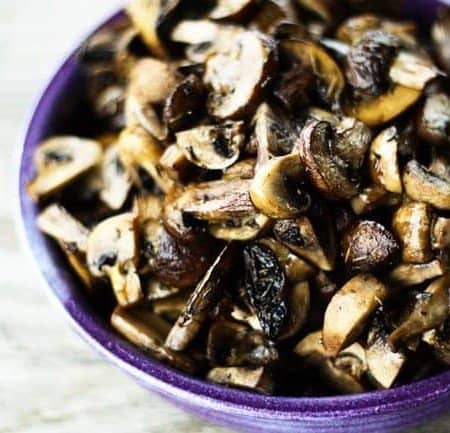
Why is it so great? Just look at them. These are perfectly roasted mushrooms -just a kiss of browning around the edges- substantial, meaty, and juicy, with a hint of thyme and nutmeg to amplify the natural flavour of the mushrooms. This is a lesson I learned from my bonus mom, Valerie, many years ago. Thyme goes with meat therefore it goes with mushrooms. Nutmeg goes with, well, EVERYTHING. No really, nutmeg is described as being aromatic, earthy, and nutty which makes it the perfect companion for mushrooms. I do highly recommend using freshly grated nutmeg from whole nutmegs in this dish. It’s worth seeking them out. I also recommend getting a decent amount of them when you do buy them. Whole nutmegs will last almost indefinitely -unlike purchased ground nutmeg- when stored in an airtight container in a dark cupboard. (See this affiliate link for an example:)

While cute nutmeg graters are available, please remember that you don’t REALLY need a special tool to grate them. The same side on a box grater that you would use for hard cheeses like Parmesan or Romano will do just fine. I use my fine Microplane for the job and it works perfectly.

When I have a stockpile of Roasted Mushrooms in the freezer, I toss them in beef and barley soup and risottos, on pizzas, stuff them in grilled cheese sandwiches, and pile them on top of steaks, chicken, and burgers. On busy, busy, busy nights, I simply serve the mushrooms over polenta or rice with a shower of grated Parmesan or Romano cheese on top. It keeps the crew full and Mama happy. So very happy. Where would you use wealth of Roasted Mushrooms with Thyme?

Roasted Mushrooms with Thyme | Make Ahead Mondays

Roasted Mushrooms with Thyme | Make Ahead Mondays

These are perfectly roasted mushrooms -just a kiss of browning around the edges- substantial, meaty, and juicy, with a hint of thyme and nutmeg to amplify the natural flavour of the mushrooms.

When I have a stockpile of Roasted Mushrooms in the freezer, I toss them in beef and barley soup and risottos, on pizzas, stuff them in grilled cheese sandwiches, and pile them on top of steaks, chicken, and burgers. On busy, busy, busy nights, I simply serve the mushrooms over polenta or rice with a shower of grated Parmesan or Romano cheese on top. It keeps the crew full and Mama happy!

Ingredients

  • 52 ounces of assorted fresh mushrooms (*See Notes)
  • 4 tablespoons extra virgin olive oil
  • 1 tablespoon coarsely chopped fresh thyme or 1 teaspoon dried thyme leaves
  • 3/4 teaspoon kosher salt
  • 1/4 teaspoon freshly grated nutmeg
  • ground black pepper to taste (preferably freshly ground or crushed)

Instructions

Preheat oven to 375°F.

Thickly slice or quarter the mushrooms. Arrange them on 2 11-inch by 17-inch rimmed baking sheets in a single layer. Drizzle half of the olive oil over each pan, followed by roughly half of the thyme, salt, and nutmeg over each pan. Generously sprinkle the black pepper over the mushrooms. Stir with a spoon to evenly distribute everything.

Roast the mushrooms, stirring halfway through, for 20 to 25 minutes, or until they are hot through and beginning to brown around the edges. Eat immediately or divide into meal sized portions and freeze for up to 3 months.

Notes

*I prefer to use mostly baby bella mushrooms with a few white button mushrooms thrown in for variety. You can use whichever mushrooms you like best, but I do recommend using baby bellas or white button mushrooms for the bulk of the mushrooms.

http://www.foodiewithfamily.com/2013/02/18/roasted-mushrooms-with-thyme-make-ahead-mondays/

P.S. As crazy as it is, the response to my Crunchy Beauty Tip was so positive that I’m planning another one. I can’t even believe I’m saying it, but I’ll be posting the next one later this week so stay tuned for more natural or low-fuss beauty tips! xo Rebecca

Bulk Italian Sausage and Broccoli Sausage Pasta | Make Ahead Mondays


Homemade Bulk Italian Sausage in Sausage and Broccoli Pasta from Foodie with Family 3

Have you ever been so intimidated to try making a certain thing in the kitchen that you put it off forever and a day. Then you finally work up the courage to try making it and are stunned to find it ridiculously easy? Such was the story with me and sausage a few years ago. I had made all sorts of food that makes people pause -cheesecakes, bread, homemade thises and thats- but I had always been just a bit scared of making sausage. I chalk this up to the time I spent in my teen and early adult years as a vegetarian. I had this little inferiority complex about my meat cooking skills.

Then one day, we came into a windfall of pork shoulder and decided I didn’t have much to lose since I had so very much pork lying around. I ground a couple of pounds of pork, added what I figured I liked best in sausage -fennel, garlic, crushed red pepper, salt, and black pepper- mixed it up with my hands, rolled it into little meatballs and fried them in a pan before building a marinara sauce around them. Holy wah.

To say that all my sausage making fears were wiped away with one succulent little pan full of saucy, moist, garlicky, spicy, browned-to-perfection-then-simmered meatballs is putting it mildly. The homemade sausage was superior in every single way from texture to flavour. It was perfect. In fact, I was so bucked up by my success that I made fresh sausage and meals from said sausage five nights in a row.

Then, although I was not nearly tired of the sausage, I was definitely tired of washing the grinder and all its little parts, and thus had an epiphany. They call it bulk sausage for a reason; I will make much and freeze some.

Bulk Italian Sausage with seasonings from Foodie with Family

And the freezing? I had a trick there, too… I weighed two and a half pounds of sausage into gallon freezer bags, squeezed out as much air as I possibly could and gently pressed the sausage so that it filled the bag all the way to the corners while flattening it. Then I pressed the handle of a long wooden spoon down the center of the bag and twice more perpendicular to that first impression.

Bulk Italian Sausage ready for the freezer from Foodie with Family

The reason I did this was two-fold. First, it would freeze faster and neater; flat bags stack up more efficiently in the freezer than wadded up bulky ones. Second, I could easily break off a square or two of the sausage without using the entire two and a half pounds. Two squares would give me between one and one and a half pounds of sausage which was just perfect for browning and scattering over pizzas or adding to pasta sauce. SCORE! (Ahem. Get it?)

Those first sausage experiments led me to many more. (See here and here for examples that I’ve posted before!) but nothing has matched the versatility and sheer usefulness of having a freezer full of bulk Italian sausage. So. Darned. Good.

Whaddya do with a freezer full beyond adding to pasta sauce or putting on pizza? Well, how about one of our favourite fast weeknight meals? Broccoli Sausage Pasta. This is one that pleases my crowd (even though I admit I have to pull some of the browned sausage from the pan before adding the broccoli to keep the No-Green-Things Contingent from revolting and BEING revolting at the table.) and feeds them for a song. You can use either fresh or frozen broccoli crowns in the dish, whichever you can procure most easily and the hearty dish is done in a flash.

Now here’s the thing. Where I live, pork shoulder is far cheaper per pound than purchased Italian sausage and it is marginally cheaper per pound than pre-ground pork. Since I prefer to grind my own, I stick with the pork shoulders. If you don’t have a grinder or food processor, you can definitely still make this using pre-ground pork. You’ll still be blown away by how wonderful it tastes!

I re-upped my Italian sausage stores this weekend while my kids were out enjoying all the snow that fell. I know it has nothing to do with food, but you have to see what my thirteen year old guy did with his time. Methinks he has had cabin fever…

Foodie with Family snowman army

When all the chilled and pink-cheeked boys came barreling in the door, I had a pan full of Broccoli Sausage Pasta ready to go. There were happy faces and full bellies that evening.

What would YOU do with a freezer full of Italian sausage?

Bulk Italian Sausage and Broccoli Sausage Pasta | Make Ahead Mondays

Rating: 51

Bulk Italian Sausage and Broccoli Sausage Pasta | Make Ahead Mondays

Homemade Bulk Italian Sausage is so simple and so much better than store-bought. Keep a stash of it in the freezer at all times so you can whip up this fast, fabulous weeknight favourite- Broccoli Sausage Pasta. You'll love this hearty, crowd-pleasing dish of garlicky, spicy, crisped Italian sausage, crisp-tender broccoli and rotini with a generous handful of grated Romano or Parmesan cheese.

Ingredients

    To Make the Bulk Italian Sausage:
  • 8 pounds freshly ground pork shoulder {*See Notes} or purchased ground pork.
  • 18-26 peeled garlic cloves (depending on how garlicky you like your sausage.)
  • 8 tablespoons fennel seeds
  • 2-5 tablespoons crushed red pepper flakes (depending on how spicy you like your sausage.)
  • 6 tablespoons kosher salt (you can adjust upward, but this is the minimum amount you should use.)
  • To Make the Broccoli Sausage Pasta:
  • 1 pound Bulk Italian Sausage
  • 1 pound rotini or other shaped pasta
  • 12 ounces to 1 pound fresh or frozen broccoli florets (The pictured dish used 12 ounces of frozen baby broccoli florets.)
  • 1/3 cup chicken stock (preferably) or water
  • grated Romano or Parmesan cheese to taste

Instructions

http://www.foodiewithfamily.com/wp-content/uploads/2013/02/Bulk-Italian-Sausage-ready-for-the-freezer-from-Foodie-with-Family.jpgAdd the pork to a large mixing bowl. Add the garlic cloves, fennel seeds, crushed red pepper flakes and salt to the bowl of a food processor (or pile it together on a large cutting board.) Process until the garlic is broken down very finely and is almost paste-like. If you are using a cutting board, chop them all together until the garlic is almost paste-like.

Scrape the mixture over the pork and use your hands to blend well. Test the sausage spice mixture by forming a quarter sized patty and frying it in a pan. Taste the test sausage. If you need to, adjust the spices and salt.

Divide the sausage into 4 gallon sized freezer bags. Squeeze out as much air as you can before mostly sealing the bag (leaving just a corner open to allow air to move out.) Gently push the sausage flat and fill the entire bag. Once the bag is filled to the corners, seal the little bit of the bag that you left open. Use the long handle of a wooden spoon to press a line down the middle of the bag from top to bottom, leaving a ridge in the sausage. Turn the spoon handle perpendicular to that line and press down about 1/3 of the way from the bottom of the bag and again at about 1/3 of the way from the top of the bag. This will leave 6 "rectangles" of sausage.

Lay the bag on a flat baking sheet, repeat with the remaining freezer bags of sausage and put the pan in the freezer. This will store well for up to six months before beginning to lose flavour.

You can open the bag and break off as many rectangles of frozen sausage as you need.

To Make the Broccoli Sausage Pasta:

Bring a large pot of water to a boil over high heat.

In a heavy-bottomed, large skillet, break up and cook the Italian sausage over medium high heat until it is crispy and browned but still moist. If it is excessively oily, feel free to drain some of the fat, but do leave some in to help coat the pasta. The flavour is wonderful!

Add the broccoli florets and the chicken stock or water, scrape up the lovely brown sausagey bits from the pan, cover and steam until the broccoli is crisp tender. While the broccoli is steaming, cook pasta according to package directions.

Strain the pasta and add it to the pan with the broccoli and sausage. Toss to distribute evenly and serve immediately generously doused with grated Romano or Parmesan cheese.

Notes

You can use a food processor or meat grinder to grind your own pork for this project if you wish. I prefer to buy bone-in pork shoulder and remove the bone myself. This cut is perfect just as it is, and aside from taking out that bone, needs no further prep work other than cutting it to fit into the grinder or food processor. It is the perfect sausage-cut because of its natural marbling.

http://www.foodiewithfamily.com/2013/02/11/bulk-italian-sausage-and-broccoli-sausage-pasta-make-ahead-mondays/


Homemade Feta Cheese | Make Ahead Mondays

Perfect Homemade Feta Cheese

I have been promising to bring you my homemade feta cheese recipe for a while (Ahem, probably a couple of years. Eek.) Today is finally the day. You may be wondering why I bother making feta cheese from scratch. The answer-as is often the case-  is that homemade tastes great and because I can. I am, after all, the daughter of a man who feels driven to walk laps around the house outside in blizzards when authorities warn that you shouldn’t go out unless you have to do so.

There’s an enormous satisfaction in doing something that seems just undo-able, isn’t there? Not only does homemade feta taste incredible, but it delivers a pioneer, up-by-my-bootstraps joy that a store-bought version just can’t give no matter how wonderful it is.

…But there’s another reason to take the plunge and it’s a doozy. For the cost of three gallons of milk (it can be pasteurized/homogenized or raw, cow or goat milk) and about a dollars worth of other stuff, you get a massive amount of feta cheese. As in a gallon jar of brined feta cheese. If you’re fearful of trying your hand at cheese making, just think of it this way; the risk is about twelve dollars worth of materials (depending on milk cost near you) versus a potential payoff of about forty dollars worth of cheese and an enormous ego boost. If it -bumbum BUM!!!!!- goes wrong, you can feed the errant cheese to dogs, cats, pigs, etc… They’ll be happy.

I’m going to get right into it because even if I’m being succinct, this post is going to be long on account of the how-to photos… There’s no getting around it. Some important notes:

  • Stay calm! Cheesemaking is not supposed to be stressful. It may seem complicated, but it isn’t. Just go one step at a time and you’ll get there.
  • Don’t get freaked out by the length of time it takes to make this. Much of the time is hands-off time. Another warning for those who haven’t made cheese or fermented something before; it gets a little, um, pungent smelling at times. Keep a-going. Don’t worry! Remember that cheese making is essentially controlling how fast and in what way milk ‘goes bad’. If it goes bad the right way it’s delicious!
  • The only special equipment you really need to pull this off is a large stainless steel or other non-reactive pot, a heat source, a long knife or off-set spatula, a colander, something from whence to hang the cheese and butter muslin (extra, super, mega fine cheesecloth.)  Do not confuse this with the “fine” cheesecloth you get in the grocery store or hardware store. It’s confusing terminology, but that stuff is so not fine. Just look for something called butter muslin and you’ll be fine. Finer than cheesecloth. Sorry. You can get it here. (Note: This is an affiliate link.)


  • You can opt to use raw OR pasteurized/homogenized milk. It can be cow milk or goat milk. Any of those choices will be delicious.
  • Goat milk is naturally more tangy, so if you use cow milk, you may want to consider adding a bit of lipase powder. Lipase is an enzyme that naturally occurs in higher amounts in goat milk. If you want cow milk feta to have that bite that is found in feta, lipase powder is your answer. You can get it via my beloved Amazon.com should you wish to. (Note: This is an affiliate link.)

  • As far as specialty ingredients go, the lipase is optional, but rennet and mesophilic culture are not optional. Again? You can turn to Amazon.com (Affiliate Links.)


Whatever you do, don’t think Junket Rennet will do the job. It simply won’t. That’s for custard making. My preferred cheesemaking rennet is made from animal sources:

But there is a perfectly acceptable and delicious vegetarian option…

  • Finally, I suggest you start the process around lunch time. This gives you the time needed to do the Day One portion of the recipe before too late in the day.

homemade feta 7


Just think what you’d do with a gallon jar full of fabulous feta cheese. You can go nuts with feta! On pizzas, spanakopita, this tempting salad from my friend, a baked potato, in soup, in omelets, with olives and bread, IN bread, and in just about any recipe that calls for cheese. Where would you use your wealth of feta?

Homemade Feta Cheese | Make Ahead Mondays

Homemade Feta Cheese | Make Ahead Mondays

What do you get when you combine three gallons of milk, a little know-how and some time? A big batch of homemade feta cheese that tastes incredible and gives you major bragging rights. Don't fear the cheesemaking!

Method gently adapted from and with thanks to Fias Co Farm Please visit her site for great feta cheese trouble shooting and other pointers.

Ingredients

    For the Cheese:
  • 3 gallons fresh raw or pasteurized and homogenized goat or cow milk
  • 1/4 teaspoon Mesophilic culture (see link in post for source)
  • 1/4 teaspoon lipase powder if using cow milk (Omit for vegetarian cheese. Lipase is animal derived.)
  • 1 teaspoon single-strength liquid rennet (or 1/2 teaspoon double strength liquid OR 3/4 of a vegetarian rennet tablet crushed) dissolved in 1/2 cup of cool, UNCHLORINATED water.
  • kosher salt (no substitute)
  • For the Brine:
  • 1/2 cup kosher salt (no substitute)
  • 1 gallon cool, UNCHLORINATED water

Instructions

To Make the Cheese:

Sterilize all of your equipment with boiling water before beginning (including the cheesecloth.)

In a very large, non-reactive pot, bring all of the milk up to 86°F.-88°F. Add the mesophilic culture and the lipase powder, if you are using it. Stir well with an up and down motion, cover the pot and let rest for one hour. Try to maintain the 86°F temperature. If you have trouble with that, you can set your large pot inside a larger pot with an inch of hot water in the bottom of it. This should help regulate the temperature more gently than firing up a burner directly beneath the milk. The goal is to avoid rapid temperature changes.*See notes.

After 1 hour, add the dissolved rennet to the milk and stir vigorously for 15-20 seconds. Remove the spoon from the pot, cover it, and let it stand undisturbed for 30-40 minutes or until the curd 'breaks' cleanly when you insert the tip of a knife and lift as shown below.

Cut a 1/2-inch grid pattern into the curd. Don't get perfectionist here, you'll get frustrated. The curd likes to move while you try to cut it, so just do your best.

After you have the grid pattern, hold the knife at a 45° angle and retrace the cuts you've already made. This is going to make MOST of the curd in the pot into roughly 1/2-inch pieces.

The ones that didn't get cut that small will break up later in the process. DO NOT STIR THE CURD YET.

Let the curd rest undisturbed for 10 minutes.

After 10 minutes, stir gently, breaking up any larger pieces you missed with the knife. Again, don't sweat this too much... Just try to have most pieces in the neighborhood of 1/2 an inch.

Keep the curd at 86°F to 88°F for 45 minutes, stirring from time to time to keep the curd from sticking to itself. You'll notice the curd getting slightly firmer and smaller. This is because as you stir it and hold it at this temperature it releases more whey.

Dampen your butter muslin/cheesecloth and use it to line a large colander. I usually position the colander over another large stockpot because I like to save the whey for baking.

Carefully and gently ladle the curds and whey into the lined colander.

When all the curds are in the colander, draw all 4 corners of the cheesecloth together to form a bag and tie in a sturdy knot. Hang the bag over the sink or a bowl or pot so it can drain freely.

Let the cheese drain at room temperature for 3-4 hours, carefully lower the bag into the colander and untie the bag. At this point, the cheese will be smooth on the bottom and spiky on top.

Flip the curd over so the spikes are at the bottom, retie and rehang the bag. Let it drain for 24 hours.

Here is where you're going to notice a certain stank coming from the vicinity of your cheese. That's okay. It means you're on the right track. Don't back down!

After 24 hours, lower the cheese, untie the bag and put the curd onto a sterilized cutting board. Cut it into blocks. I usually aim for pieces that are about the size of a deck of cards but about 2 inches thick.

Generously sprinkle all of the surfaces of the cut cheese with kosher salt then load the cheese into a sterilized, large, food-safe container with a tightly fitting lid.

Let the cheese rest at room temperature (DO NOT REFRIGERATE even though it is counterintuitive.) for 2 to 3 days so that it can continue releasing whey and hardening up. This will help it store longer.

To Prepare the Brine and Store the Cheese:

Pour the whey the cheese has released into a sterilized large, food-safe container with a tightly fitting lid. Arrange the cheese blocks in it.

Add the gallon of water and 1/2 cup of kosher salt to a non-reactive pot. Stir well over medium heat until the salt is completely dissolved. Let the brine come to room temperature before pouring it over the cheese. Put the lid in place tightly on the container and store the cheese in the refrigerator.

Let the cheese age at least two weeks before eating. It is good for up to a year as long as it is kept submerged in the brine and refrigerated. It will continue to get stronger in taste as it ages.

Notes

*If your room temperature is too cool and you are having trouble maintaining the temperature of the milk, you can either set the pot inside a larger pot with an inch or two of hot water in the bottom. When the temperature of the milk starts dropping, you can turn the burner on under the larger pot and the hot water will help gently raise the temperature of the milk in the inside pot. The goal is to avoid rapid temperature changes with can affect the culture at work in the milk as well as risk scorching. Scorched cheese is blechy.

Another option -and my preferred one- is to set the pot on top of a warm but not hot heating pad. This is my go-to procedure during cooler months when I have to wear a sweat-a to make feta.

http://www.foodiewithfamily.com/2013/01/07/homemade-feta-cheese-make-ahead-mondays/


Whiskey Vanilla Extract | Make Ahead Mondays


I am obsessed with vanilla extract. Since I started making my own extract several years ago, I haven’t bought vanilla extract (either faux or pure) once. Once you’ve made your own and tasted just how much better it is (and realized just how easy the entire process is) it’s hard -if not impossible- to go  back.

Why bother when you can get pure vanilla extract relatively cheap? First, the homemade stuff is customizable. You can make it as strong or as weak as you’d like it. Normally, the method involves splitting beans, pouring a neutral high-alcohol spirit such as vodka over it, capping it, shaking it and letting it age until you can’t really taste an alcohol burn from it. The idea is that the alcohol becomes a vessel for mega vanilla flavour delivery. I told you it was easy, didn’t I? That’s wonderful, isn’t it? It’s fabulous. I have a giant jug of the stuff in my cabinet… but…

Yes, there’s a but…

Sometimes I WANT a little burn to help cut some sweetness: I want that presence of alcohol WITH the vanilla. And in those cases, I reach for this stuff; Whiskey Vanilla Extract. The process is every bit as easy. I split vanilla beans lengthwise and stuff them into an empty bottle. The prettier the bottle the better. It’s not like it effects the overall outcome, but life is hard enough: Let’s try to get some beauty in there where we can.

I pour something drinkable but not expensive* (ask the clerk at your local liquor store for a good, inexpensive but sippable whiskey or bourbon.) over the top, cap it, shake it and let it go for a week.

*I did NOT use Templeton Rye Whiskey for my extract, merely the empty bottle.

A bottle of that on your pantry shelf invites you to use it, and since we’re not going with a neutral alcohol here but highlighting the richly flavoured, slightly smokey whiskey taste, you can start using it about a week or two after starting it. It will mellow with age, so if you find it’s a little too brassy and bright at the beginning, just stash it in a dark corner and retrieve/retry it later.

I love to use this in place of the ‘regular’ vanilla extract in whipped cream, pecan pies, fruit crisps, and hot fudge sauce. What would you make with Whiskey Vanilla Extract?

A Note on Making This for Gifts:

You can use canning jars to prepare this if you’d like, but I find using an actual liquor bottle makes it easier to use the finished vanilla extract without spilling it. If you don’t have access to empty liquor bottles or want to prepare it in smaller containers for gifts, dollar stores and big box stores usually have a nice selection of small decorative bottles with corks or twist caps. Just be sure the caps fit snugly to prevent spilling when you shake them.

A Note on Finding Inexpensive Vanilla Beans (because it CAN be done!)

You can use whatever vanilla beans you prefer, Madagascar, Tahitian, Bourbon (Hey! Bourbon Bourbon Extract!). I don’t actually have one that I love better than others, I love ‘em all! I buy my vanilla beans in bulk through one of two places. Here they are in order of preference.

  1. My beloved Amazon.com has them When you consider that the best price I have found in grocery stores is about $10 per package of 2 beans, and that there are about 50 beans in a half pound, that’s akin to saving $223. Trust me. My math is good, I’m  a homeschooling mom. And better yet, when the beans are properly stored (at a steady room temperature out of direct light) they last for at least a year.
  2. eBay. Seriously! I have bought pounds of vanilla beans via eBay over the years. Sometimes you can get a better deal on eBay, sometimes Amazon has the better price. Keep your eyes peeled and get bargain happy!

Whiskey Vanilla Extract | Make Ahead Mondays

Whiskey Vanilla Extract | Make Ahead Mondays

With its smokey, richly flavoured, high alcohol content, whiskey makes the perfect vehicle for homemade vanilla extract. There's nothing neutral about this vanilla extract, so use it where you'd love a little bite: in whipped cream, pecan pie, fruit crisps, and the like. This makes a wonderful and unique hostess gift for the holidays.

Ingredients

  • 1 clean and empty 750 ml liquor bottle with a tight fitting lid (or a glass container that can hold about 3 cups of liquid with a tight fitting lid.)
  • 5-20 whole vanilla beans, depending on how strong you'd like the vanilla flavour
  • about 3 cups whiskey, depending on the container you use

Instructions

Split the vanilla beans lengthwise then in half. Slide them into the empty liquor bottle. The fewer the beans you use, the weaker the vanilla presence will be. I like a LOT of vanilla and stuff as many into the bottle as I can while still leaving enough room for the beans to be covered by liquid and the lid to be added when I'm done.

Insert a funnel into the top of the bottle and pour in as much whiskey as you can, being sure to cover the beans completely. Add the lid, shake vigorously for about 2 minutes, then place in a dark, cool place for at least one week, shaking the bottle daily, before using. The longer the extract ages, the more mellow the whiskey and the more pronounced the vanilla will be.

http://www.foodiewithfamily.com/2012/11/26/whiskey-vanilla-extract-make-ahead-mondays/

Refrigerator Pickled Salad (Bread and Butter Style) | Make Ahead Mondays


I have this friend, Meseidy, who has a fabulous blog; The Noshery. Meseidy can do it all. She is a chef, a decorator, a great conversationalist and an extremely talented folder of sheets.

[youtube]http://www.youtube.com/watch?v=iP66IMO_fJ0[/youtube]

I am not kidding you when I tell you that I never successfully folded a fitted sheet before Meseidy taught me to do it. It’s not my mom’s or dad’s fault… They can fold like a pro. I seem to have some double recessive incompetent-at-housekeeping-tasks gene. Ah well, better late than never, eh?

I did mention she’s a chef, right? She’s not just a chef. Girl can COOK, people. I’ve had the privilege of having her cook for me a few times and every single time I’m wowed by the food. She made these almond crisps with boozy cherries and vanilla ice cream when we were all out at The Pioneer Woman’s. Oh heavens, I could eat my weight in that.

But that is NOT what I’m talking about today. I may be dreaming about it, but I’m not talking about it. Today, I want to tell you about her Refrigerated Pickled Salad. The second she posted it, I knew it would be made. And soon.

It is best described as a bread and butter pickle salad. Crazy sounding? Maybe, but think about it. You have oodles of thinly sliced cucumbers, multi-coloured bell peppers, red onion, and garlic marinating in a sweet and sour brine of vinegar, sugar, water, and -in my case- crushed red pepper flakes. How inviting does this look?

Let me tell you, this is not to be missed.

I messed with the recipe just a wee bit (on accident, but more on that in a moment and liked the results so much that I did it again. On purpose. The first time I prepared the pickles, I doubled it. What can I say, I was confident that she wouldn’t steer me wrong. When I doubled the recipe, I doubled everything BUT the ice. Whoopsie. I stuck my finger in the brine to see if it was too punchy with the extra vinegar and loved it so much, I left it that way.

Per instructions, we let the pickles happily soak in that delicious brine for THREE. WHOLE. DAYS. When I say we, I mean my sister, her husband, my dad and stepmom, my uncle and aunt, The Evil Genius, the kids and me. After three days, all bets were off. We had the pickles on carnitas tacos, grilled white hots, cottage cheese, and with cream cheese in tortilla wraps. We stuck our fingers in the jars and snacked on them all by themselves. This was the jar when we started.

Within five days, that gallon jar was empty. Oy. We are clearly a pickle dependent family. They were so good, though! Sweet and sour like a classic bread and butter pickle, but with lovely thin strips of pickled vegetables and a little kick of spice, they were simply wonderful. Being the waste-not-want-not sort of gal that I am, I re-used the flavourful brine from the first batch for my second batch. I sliced my veggies and tossed them in the mixing bowl like before, but then poured the leftover brine in and stirred to distribute the mustard seeds. I then used tongs to transfer the veggies to the jar and poured the brine back in over everything. Hubba hubba.

Batch two is well on its way to disappearing as quickly as the first did. Thank you mille fois, Meseidy… or should I say gracias?

Refrigerator Pickled Salad (Bread and Butter Style)

Refrigerator Pickled Salad (Bread and Butter Style)

Sweet and sour like a classic bread and butter pickle, but with lovely thin strips of pickled vegetables and a little kick of spice, these are simply wonderful. Bonus: no canning required and they're ready to eat in 3 days!

Serve this simple pickled salad with grilled meats, on sandwiches, on tacos, with cream cheese in tortilla wraps, over cottage cheese for an afternoon pick-me-up, or just on their own.

Recipe very gently adapted from and used with the permission of the wonderful Meseidy of The Noshery.

Ingredients

  • 2 seedless English cucumbers (also known as English Cucumbers)
  • 1 large red onion
  • 2 pounds baby multi-colour sweet bell peppers (or the equivalent poundage of red, yellow and orange bell peppers.)
  • 8 large (or 10 medium) cloves of garlic
  • 3 cups cider vinegar
  • 1 1/3 cups raw or granulated sugar
  • 2 tablespoons salt
  • 2 cups water
  • 1 cup ice cubes
  • 2 ounces (1/3 cup by volume) whole yellow mustard seeds

Instructions

Combine the vinegar, sugar, salt and water in a saucepan and bring to a boil over high heat. Stir until the sugar and salt are fully dissolved, remove the pan from the burner and set aside to cool while you prepare your vegetables.

Cut the English cucumbers into three pieces each, then cut each piece in half. Thinly slice each of those halves. Transfer the sliced cucumbers to a large mixing bowl.

Cut the blossom and stem end off of the red onion, peel it and cut in half. Slice each of those halves paper thin. Add the onions to the cucumbers in the mixing bowl.

Remove the stem and seeds from the bell peppers and thinly slice them lengthwise and transfer to the mixing bowl.

Peel and slice the garlic cloves as thinly as possible. Add those into the mixing bowl along with the mustard seeds and toss to distribute everything evenly. Pack into a glass gallon jar (or into 3-4 glass quart jars.)

Add the ice cubes to the partially cooled brine, stir until the ice is melted, then pour the brine over the vegetables in the jar(s). Tightly lid the jars and store in the refrigerator for at least 3 days before eating. Lasts for at least a month when refrigerated.

*Notes:

You can reuse the brine for a second batch of pickled salad by pouring the leftover brine over a freshly sliced batch of veggies in the mixing bowl, toss to distribute the mustard seeds, then use tongs to transfer the veggies to clean jars and pour the remaining brine over them. Again, refrigerate for 3 days before eating.

http://www.foodiewithfamily.com/2012/08/13/refrigerator-pickled-salad-bread-and-butter-style/

Dijon Cheddar Scallion Puffs (Gougères) | Make Ahead Mondays

Nicolas Sarkozy has banned cheese from the Elysée Palace? Woah.

That, my friends, is trés, trés scandalous. The French meal -such as is my experience with it- revolves around the cheese course. Jean Anthelme Brillat-Savarin -the French gastronome extraordinaire- is widely quoted as saying, “A dessert without cheese is like a beautiful woman who is missing an eye!” To put it in other words, France runs on cheese.

All politics aside, the man is off his nut.

In a nation so brimming with luscious and unique cheeses, how could he possibly eschew such glory? Such possibilities. Oh, Nicolas, tsk… tsk…

…Because if he has pronounced, “Pas de frommage!” he has tossed out not only cheese plates, but also a list of delights longer than my arms and legs put together: tartiflette, quiche, fondue, tartine, soufflé, and gougères, just to name a few. And it’s that last one that we’re going to talk about today because- Qu’est-ce un miracle!- gougères are perfectly suited to Make Ahead Mondays.

One day last week, my friend, Pamela, sent me the following text:

“I think you should do gougères for a Make Ahead Monday. Freezable comfort food? Yes, please.”

I know a good idea when I hear one, friends. I was on it. What could possibly be better than crispy, airy, chewy, cheesy, versatile gougères within minutes? Nothing, I tell you! Nothing could be better! (Except maybe for eating them while actually sitting -oh, say- IN FRANCE. But I digress.)

Here’s the thing… if you’ve never had a gougère or perhaps never heard of them, I should tell you why you’re going to want these so badly. It’s like a cross between a hand-held souffle but far less delicate, far less difficult to mess up, far more versatile as an accompaniment, and far more fun to say. Try it. Gougère (GOO-zhair!) vs. Soufflé (SOO-flay!) Alright. They’re both fun, but the edge goes to gougére for that fun zhhhhhhh sound in the middle. It just feels so Frahnsh to say it. N’est-ce pas?

It’s time for a little food nerd interlude. Don’t worry! It all applies to the end deliciousness…

Gougères are made from that ubiquitous French building block pâte à choux, or for ease’s sake, Choux pastry. It is a simple concoction to whip together, but somehow manages to pull off as versatile a collection as eclairs, cream puffs, gougères, Paris-Brests, croquembouches, profiteroles, and more… Holy. I’m telling you, if you master choux pastry, the culinary world is yours. A plain choux pastry, unadorned, piped onto parchment and baked can be used filled with ice cream or crab salad. As if that isn’t enough, the choux pastry itself can be dolled up, studded with all manner of sweet or savoury add-ins. Today’s choux pastry adventure is the savoury puff known as (duh) gougères but with a TWEEST. I’ve replaced the the traditional Swiss or Emmental cheese with a good, hearty American extra-sharp Cheddar (yes, I know Cheddar is originally English, but people, we make good Cheddar these days!), some of the water with a pungent Dijon mustard and tossed in a few finely minced scallions for good measure.

While choux pastry must be piped or scooped out immediately after being made, it can be frozen in that form and then transferred to zipper top bags or tightly sealed containers for up to three months before baking. That’s right. Cheesey, pouffy, scallion-studded, crisp-exteriored, crackly, golden brown, moist-in-the-center French comfort food baked straight from the freezer. Can I get an amen?

Is anyone out there wondering what to serve alongside these little beauties? (Because these do rather steal the show…) Any good brothy soup or stew would love to play second fiddle to a plate of fresh, hot gougères. Serve alongside roasts, braises, or a simple salad. Give your kids the best after-school snack of their lives. Serve with a cup of tea for a quick breakfast. But for the non plus ultra, serve with cocktails or a glass of wine: something you know that deep in his French heart, Nicolas Sarkozy desperately wants.

I’ve heard it said that nothing tastes as good as skinny feels, but I disagree violently. Skinny doesn’t taste as good as cheese. C’est vrai. C’est carrément vrai!

Pauvre Président Sarkozy, (Sad violins) we shall have to eat his share. (Insert Gallic laugh here.)

Dijon Cheddar Scallion Puffs (Gougères) | Make Ahead Mondays

Rating: 51

Prep Time: 30 minutes

Cook Time: 25 minutes

Yield: about 72 puffs

Dijon Cheddar Scallion Puffs (Gougères) | Make Ahead Mondays

These cheesy, pouffy, scallion-studded, crisp-exteriored, crackly, golden brown, moist-in-the-center puffs are French comfort food baked straight from the freezer. Serve with soups, salads, roasts, braises, for snacks or for breakfasts with a cup of tea. These also make the perfect accompaniment to the cocktail hour or a glass of wine.

Ingredients

  • 1/2 cup milk
  • 1 stick unsalted butter (8 tablespoons), cut into pieces
  • 5 tablespoons water
  • 1/2 teaspoon salt
  • 3 tablespoons strong Dijon mustard
  • 1 cup all-purpose flour
  • 5 large eggs, at room temperature (you can hasten this by putting chilled eggs into warm -not hot- tap water for 10 minutes.)
  • 1 1/2 cups coarsely grated sharp or extra-sharp Cheddar cheese
  • 4 scallions, dark and light green sections only, thinly sliced (put the white parts- about 2-inches worth, root end down, in a glass of water. The greens will re-grow!)

Instructions

To Make and Freeze:

Line two baking sheets with parchment or silpats. Set aside.

In a heavy-bottomed saucepan, bring the milk, butter, water and salt to a full rolling boil. Add the Dijon mustard and return to a boil, remove the pan from the heat and add the flour- all at once. Stir vigorously with a sturdy spoon until all is combined then return the pan to medium-low heat, stirring vigorously still, until the dough comes together- balling up slightly around the spoon, and a thin film forms on the bottom of the pan. Stir hard for 1 minute. The dough should seem cohesive, but still soft enough to break apart with the spoon. Remove the pan from the heat and let the dough sit for 10 minutes, undisturbed. After 10 minutes, you should be able to stick your finger -up to the first knuckle- into the dough and hold it there for several seconds before it becomes uncomfortable. In other words, it should be hot, but not blisteringly so.

Transfer the dough to the bowl of a stand mixer (or a large bowl in which you can use a hand mixer or a sturdy spoon and some serious effort). Add the eggs, one at a time, and beat well after each addition. After the last egg is added, beat the dough for 2 minutes before beating in the grated cheese and scallions.

You can use spoons, dishers or a pastry bag to portion out the pastry, but it must be done immediately! I prefer to use a disher (cookie scoop) or pastry bag to pipe out mounds that are about 1-1/2 tablespoons in size. Leave enough room between the mounds so that they are not touching. Immediately put the pan into the freezer and freeze until firm, about 6 hours. When they are hard to the touch, you will use a spatula or your hands to transfer all of the mounds to a re-sealable plastic freezer bag or container with a tight fitting lid. Keep frozen for up to 3 months, baking as many gougères as you need at a time.

To Bake from Frozen:

Preheat oven to 425°F. Line a baking sheet with parchment or a silpat and arrange desired number of frozen gougères so that there is at least 2 inches of space around each one to allow for expansion in the oven. Bake for 12 minutes, lower the oven heat to 375°F, rotate the pan(s) and bake for another 12-15 minutes, or until the gougères are puffed, firm, and deep golden brown. Serve warm for most pronounced flavour, or at room temperature.

To Prepare to Bake Immediately:

Preheat oven to 425°F. Line two baking sheets with parchment or silpats. Set aside.

In a heavy-bottomed saucepan, bring the milk, butter, water and salt to a full rolling boil. Add the Dijon mustard and return to a boil, remove the pan from the heat and add the flour- all at once. Stir vigorously with a sturdy spoon until all is combined then return the pan to medium-low heat, stirring vigorously still, until the dough comes together- balling up slightly around the spoon, and a thin film forms on the bottom of the pan. Stir hard for 1 minute. The dough should seem cohesive, but still soft enough to break apart with the spoon. Remove the pan from the heat and let the dough sit for 10 minutes, undisturbed. After 10 minutes, you should be able to stick your finger -up to the first knuckle- into the dough and hold it there for several seconds before it becomes uncomfortable. In other words, it should be hot, but not blisteringly so.

Transfer the dough to the bowl of a stand mixer (or a large bowl in which you can use a hand mixer or a sturdy spoon and some serious effort). Add the eggs, one at a time, and beat well after each addition. After the last egg is added, beat the dough for 2 minutes before beating in the grated cheese and scallions.

You can use spoons, dishers or a pastry bag to portion out the pastry, but it must be done immediately! I prefer to use a disher (cookie scoop) or pastry bag to pipe out mounds that are about 1-1/2 tablespoons in size. Leave 2 inches of space around each mound to allow them to expand in the oven.

Bake for 12 minutes, then lower the heat to 375°F, rotate the pans from top to bottom and front to back, and bake another 12 minutes, or until they are puffy, firm, and golden brown. Serve warm for most pronounced flavour, or at room temperature.

http://www.foodiewithfamily.com/2012/04/09/dijon-cheddar-scallion-puffs-gougeres-make-ahead-mondays/

“The pleasure of the table belongs to all ages, to all conditions, to all countries, and to all eras; it mingles with all other pleasures, and remains at last to console us for their departure.”

Jean Anthelme Brillat-Savarin

Roasted Red Pepper Spread | Gardener’s Delight Eggs

And POOF! Just like that, summer was gone. I am fully aware that it is still technically summer but the tell tale signs are all around us: breath is foggy in the morning, cozy socks are back at the front of the sock drawer, scarves and jackets are shaken out of storage, and the produce at the farmers’ markets is taking a definite pumpkin-y turn. This, my friends, is fall.

That giant cosmic yawp you just heard came from my ever-optimistic beloved husband who views the turning of the leaves as a personal metaphor for mortality. This is the same man who spends the first official day of summer in mourning because it means that the days will grow shorter until the year ends. Poor guy. Don’t feel too badly for him, though. He lives with a compulsive baker and we all know that bread makes everything better.

Some of us, though, are not-so-secretly rejoicing. I’ve rustled up my fingerless gloves and my woolen caps for my morning strolls. I’m thrilled that I’m no longer sweating buckets near (not over, perish the uncouth thought) my canning pots. In fact, I’m upping the canning program in order to help keep warm until my husband finally acknowledges that summer has flown the coop and fires up the wood stove*.

*Firing up the wood stove is like my husband throwing the white flag of surrender and admitting that one more summer is behind him.

In the meantime, I will keep filling jars with little tastes of summer for my soon-to-be hibernating husband to put on his fresh bread. Jams and jellies are wonderful, but nothing beats cracking open a vibrant, ruby-hued jar of savoury garden goodness when the brisk wind is blowing and the sky is gun-metal grey.

Roasted Red Pepper Spread is just the thing to banish chills to the body or soul. You can’t help but smile when you see the bright red jars with flecks of basil peeking out at you. And when you open it? It’s everything wonderful about summer encapsulated in one little jar. The silky smooth, thick red pepper spread with the full taste -courtesy of tomatoes, garlic, onion, and red wine vinegar- is at home dolloped on fried eggs, spread on toast, as a pizza sauce, or as a dip (either alone or stirred into mayonnaise or softened cream cheese.)

While my poor husband may never recover from the suggestion that winter is soon to follow, I would be remiss if I didn’t offer the following tip; if you tie a simple gold, silver or raffia ribbon and gift tag around the top of the jar, it makes a beautiful and tasty (and perfectly colored) Christmas gift. Red and green and good taste. What could possibly be better?

The recipe yields around five eight-ounce jars, but can easily be doubled or tripled. I recommend an automatic doubling of this recipe if you intend to give it as gifts, because once you taste it you won’t want to part with it. That is as incontrovertible a fact as the passing of the seasons.

Roasted Red Pepper Spread

Rating: 51

Yield: About 5 eight-ounce jars

Roasted Red Pepper Spread is just the thing to banish chills to the body or soul. It’s everything wonderful about summer encapsulated in one little jar. The silky smooth, thick red pepper spread with the full taste -courtesy of tomatoes, garlic, onion, and red wine vinegar- is at home dolloped on fried eggs, spread on toast, as a pizza sauce, or as a dip (either alone or stirred into mayonnaise or softened cream cheese.)

Adapted from The Ball Complete Book of Home Preserving

Ingredients

  • 5 ¾ pounds sweet red bell peppers
  • ¼ pound fresh cayenne peppers (or other red-hued hot peppers) (If you don’t like heat, use an additional ½ pound of sweet red bell peppers.)
  • 1 pound plum tomatoes
  • 1 small onion, unpeeled and uncut
  • 3 large cloves garlic, unpeeled and uncut
  • ½ cup red wine vinegar
  • 2 tablespoons, packed, thinly sliced (chiffonade) of fresh basil
  • 2 teaspoons sugar (I prefer raw)
  • 1 teaspoon salt

Instructions

Preheat the broiler in your oven. Spread the peppers, tomatoes, onion, and garlic cloves in a single layer on a rimmed baking sheet. Roast under the broiler, turning frequently, until the peppers are softened and blackened all the way around, and the tomatoes, onion and garlic have some black spots on them. The more thoroughly blackened the peppers are, the easier they are to peel. Transfer the peppers and tomatoes to a paper bag, fold the top down three or four times to seal it, then let cool about 15 minutes, or until the produce is cool enough to handle. Set the onion and garlic on a cutting board to cool as well.

When the peppers and tomatoes have cooled, use your hands to rub the skins off as well as you can. Don’t panic if a bit of the skin remains. Cut the peppers open in order to remove their stems and seeds. Rip the peppers into strips and put into a blender or food processor (in batches if necessary) and process until smooth. Pour into a stainless steel stockpot and repeat the process with the tomatoes.

Peel the onions and garlic then finely chop both. Add this and the remaining ingredients to the purees in the stockpot and stir to combine. Bring to a boil over medium high heat, stirring frequently to prevent scorching. Lower the heat to medium low and continue a gentle boil, stirring often, for about 20 minutes, or until the spread can be mounded on a spoon.

You may either refrigerate the red pepper spread at this point, or freeze it in single serving sizes, or can it to make it shelf stable.

To can the spread for long-term storage:

Ladle the hot spread into prepared 8-ounce jars leaving ½-inch of headspace. (For information on how to do this, click here ) Use a stainless steel chopstick or butterknife to remove any air bubbles. If the level of the spread lowers after air bubbles are removed, you can add more hot spread.

Wipe the rims of the jars with a damp cloth, put the lid in place, and screw on the rings until fingertip tight. Place on a rack in a canner, cover with hot water, and bring to a boil with the lid on the canner. Once the water reaches a full rolling boil, begin a 10-minute timer (15 minutes for pints). When the timer is done, remove the lid from the canner, turn off the heat and let it stand for 5 minutes before carefully transferring the jars to a towel or rack on the counter to cool, undisturbed.

When the jars are completely cool, remove the rings for storage, wipe the jars clean and label. Store in a cool, dry place for up to a year.

http://www.foodiewithfamily.com/2011/09/22/roasted-red-pepper-spread-gardeners-delight-eggs/

Would you like another good reason to have this on your shelves? I gotcha covered! This is my current favourite breakfast.

Gardener's Delight Eggs

This almost instant breakfast delivers a hugely satisfying punch of flavour courtesy of big, bold, smooth, garden-fresh Roasted Red Pepper Spread dolloped on fried eggs with pan-fried tortilla rounds. This breakfast will keep you going for hours.

Ingredients

  • 1 egg
  • 1 tablespoon butter
  • 1 flour tortilla, cut into quarters or rounds (with a biscuit or cookie cutter)
  • 2 tablespoons Roasted Red Pepper Spread (see recipe above)
  • salt and pepper to taste
  • Optional: Fresh basil, thinly sliced (chiffonaded)

Instructions

Melt the butter in a heavy-bottomed skillet. Crack the egg and slide it onto the skillet near one edge. Place the tortilla rounds or wedges along the other side of the skillet. Flip the tortilla rounds when they begin to lightly brown. Toast the other side and transfer to a serving plate.

Cook the egg, flipping once if desired, to your preferred doneness. Use a spatula to place the fried egg on top of the toasted tortillas. Top the egg with the Roasted Red Pepper Spread. Sprinkle with fresh basil, if desired.

http://www.foodiewithfamily.com/2011/09/22/roasted-red-pepper-spread-gardeners-delight-eggs/

Strawberry Balsamic Thyme Freezer Jam

When I was small, my mom made strawberry freezer jam every year during Michigan’s brief and glorious strawberry season.

It was my mom’s thing: her annual food preservation pièce de résistance. She scattered packets and boxes of pectin thither and yon, she mashed berries with the bottoms of drinking glasses, her potato masher, and anything else she could fit into her bowl.  Her blonde hair had strawberry streaks, her hands were fuchsia , and she smelled like a strawberry patch for days on end. True to her style, she never measured (measuring was a creativity killer and the man’s way of keeping her down*) but somehow it always turned out to be the best thing we had eaten all year.

*Power to the people! Or Up with the People! Oh, geez. I can never get that right. I’m sorry, Mom.

I played around with cooked jam over the years, but it never drew close to the juicy, soft-set, fresh-from-the-field taste of strawberry freezer jam. Is it because of my formative years and my mom’s painting the kitchen with strawberries? Oh, probably…

I want my kids to have that same memory when they’re adults. The full sensory memory of watching their mom make jam: smelling, tasting, feeling the ripe strawberries… The anticipation of the flavour when a jar is fetched from the freezer and twisted open… I want them to have a vision of me with strawberry streaks on my cheeks (since my hair is not light enough to show it), fuchsia hands and smelling like a strawberry patch. Of course, their Mama measures obsessively, but every childhood is a little different, isn’t it? At least I got the important stuff in there.

…And my jam, well, now it has two crucial ingredients that my Mom didn’t put in hers. Balsamic vinegar and fresh thyme.

I know it might sound bizarre, but this is the most strawberry-y jam ever. If you can imagine the most fresh, juicy, flavour-packed strawberry you’ve ever had that is multiplied by about fifteen, you have an idea of what this tastes like.

You may already know that adding balsamic vinegar to strawberries boosts the flavour, but did you know that infusing it with thyme has a similar effect? And when you add balsamic AND thyme, you get knock-you-flat strawberryness. Whizz-bang, ka-pow, shammalammadingdong strawberry power is what Strawberry Balsamic Thyme Freezer Jam is.

I was already a big fan of the strawberry/thyme combination thanks to my good buddy, Krysta over at Evil Chef Mom and the strawberry/balsamic combination thanks to, um, I don’t know what. I first read about combining all of them in jam form, though, over on Serious Eats when Lucy Baker made a batch that sounded tantalizing.

When I read Lucy’s post, I knew that was going to happen as soon as the sleepy New York strawberries finally burst onto the scene.

A friend brought a whole flat of strawberries my way two days ago and thankfully, I remembered my previous plans. Mercifully. Appreciatively. I am so grateful that I remembered those plans because this is the best strawberry jam I’ve ever shoveled shamelessly into my mouth by the spoonful.

Best. Strawberry. Jam. Ever.

(…except for my Mom’s…)

A Note About the Pectin I Use:

Pomona’s Universal Pectin is well worth any trouble you have finding it. You can double, triple or quadruple recipes (or more if you have appropriately sized vessels for preparing massive batches of jam) with no ill-effects, unlike most “normal” pectins. It has no funky preservatives, additives, and allows you to make the best jam you’ve ever eaten with much less sugar than your average pectin (even the low-sugar varieties) or no sugar at all.  I’m getting nothing out of this, the Pomona’s people don’t even know I exist *sniffsniff*. I seriously believe their product is the best and have years worth of experience to back up my claims.

Yes, it looks expensive. I mean honestly, $4-$6 per box? Yipes! But if you break it down, you’ll realize that each box has enough pectin powder to make 2-4 batches of jam. That works out to about $3.00 per batch (calculating for liberal use) which is equal to or  better than the most common commercial pectins. When you add the convenience of larger batches to the equal or better price per batch, I think the comparative value makes Pomona’s the much better bet.

You can use a standard commercial pectin to make Strawberry Balsamic Thyme Freezer Jam (see recipe notes) if necessary, but I stand by Pomona’s!

5.0 from 1 reviews

Strawberry Balsamic Thyme Freezer Jam
Author: 
Recipe type: Condiment
Prep time: 
Cook time: 
Total time: 

Serves: 48
 

Don’t let the complicated name fool you. This freezer jam is pure strawberry. While the balsamic vinegar and thyme may sound wacky, they both simply enhance the explosive natural freshness of strawberries.
Ingredients
  • 4 cups mashed, hulled strawberries
  • 2 tablespoons balsamic vinegar
  • 2 tablespoons fresh lemon juice
  • ¾-2 cups granulated sugar
  • 1 tablespoon Pomona’s Universal Pectin Powder(*See notes) + ¼ cup Pomona’s Calcium Water (or more, if necessary.)
  • 1 cup water
  • 3 sprigs fresh thyme

Instructions
  1. Prepare freezer-safe jars or containers with airtight lids that can hold up to 6 cups of jam. (**See Notes)
  2. Stir together sugar, crushed berries, balsamic vinegar and lemon juice in a large mixing bowl.
  3. Add sprigs of thyme to water and bring to a boil.
  4. Strain and measure ¾ cup into a blender carafe.
  5. Sprinkle the pectin powder over the boiling water in the blender and add the lid.
  6. Open the vent on the blender lid, cover with a doubled dish towel or wash cloth, and blend on high for 1-2 minutes or until the pectin powder is completely dissolved.
  7. Scrape into the berry mixture and stir well.
  8. Pour the pectin water into the berry mixture and stir very well to combine. It should start to gel visibly. If it does not gel (although the gel will be much more soft-set than cooked jam), add 1 teaspoon of calcium water and blend well, repeating if necessary.
  9. Ladle into prepared containers to within ½” of the rims, fix the lids on tightly and freeze immediately.

Notes
*If you can’t or don’t want to find Pomona’s Pectin, you can make your normal freezer jam (following the directions for the pectin you use) but adding 1 tablespoon each of balsamic vinegar and lemon juice per 2 cups of crushed berries along with the amount of sugar specified in the pectin’s recipe.. To infuse the jam with thyme flavour, simmer the fresh thyme sprigs with the water and pectin. **You can use Gladware or Rubbermaid containers or canning jars. I prefer to use canning jars with two piece lids.