Homemade Hummus

I spent nearly seven years as a vegetarian; those years were spent subsisting mainly on hummus, cheese and big green salads. I long ago enthusiastically re-entered the omnivore world* but still spend a great deal of time conveying hummus to my mouth on various crudites and pita chips.

Hummus is the first rite of spring that I observe every year and it’s on nearly every family-get-together-buffet. When the weather warms up my brain starts nagging me, “Hummus. You want hummus. You need some hummus. Make some hummus.” And like all good voices in the head, it only goes away when it’s obeyed. But I jest. I don’t have voices in my head nagging me about hummus; they nag me to eat chocolate. But that’s another cuppa tea…

The point is this. When I posted about the dreadfully addictive Mediterranean Hummus Pizza I mentioned that I was willing to share my hummus recipe if anyone wanted it.  I assumed everyone had their own hummus recipe and that everyone had spent years as a vegetarian living mainly on hummus.  That’s the way my thought process works, you see… “If I have done it, everyone has done it, too.” Let’s just say this; apparently not everyone went through a seven-year vegetarian phase the way I did.  And equally apparently, not everyone has made a cubic ton of hummus over their lifetime.  I see this now.  I understand.  And I’m going to show you the way.

Extraordinary hummus is so easy to make at home that you’ll never pay for deli-case hummus again.  Unless, of course, you’re away from your home and food processor and are struck with a sudden, unabating craving for hummus and there is a tub of Tribe of Umpteen Sheiks staring you in the face.  In that case, I fully stand behind spending way too much money on a snack.  It could be worse, after all; you could be spending it on Ho-Ho’s. *

*Note to self: Put Ho-Ho’s on grocery list in code so the kids don’t see it.  Hide the Ho-Ho’s in apron pocket, hide in closet and apply directly to mouth when needed (i.e. when kids are fighting, arguing, breathing, etc…)

There are a couple of camps in the hummus loving crowd; the smooth hummus lovers and the rustic hummus aficianados.  The rustic-hummus crowd is a good one to which to belong if you don’t own a food processor.  It is full of coarse pieces of garbanzo beans and bits of minced garlic. It is easily accomplished by mooshing all the hummus ingredients together with a potato masher or -in a gadgetless kitchen- with the clean bottom of a heavy can.

I am an unapologetic, card-carrying member of the smooth hummus contingent.  I like a super-smooth, chunk-free hummus that can be spread as easily inside a pita pocket as it is dipped onto a carrot stick or tortilla chip.  And since I’m making it, I’m in control here. (This, quite honestly, is probably one of the main reasons I love cooking so much.  Control.  For more musings on control as a common trait among obsessive cooks -and a killer coffee cake recipe-, see this hilarious post from my ‘Evil’ friend.)

When you make your hummus, you’ll be the one in control.  If you want it more coarse, just stop processing it earlier or use something less efficient than a food processor to do your squishing work for you.

Having a container of hummus in the refrigerator is like having one of those Jetson’s food synthesizing devices in your kitchen.  Stuff a pita pocket with a layer of hummus, some thinly sliced vegetables and a handful of sprouts and you have a filling, light, healthy lunch in less than five minutes.  Feeling peckish?  Scoop some hummus into a bowl and serve with a fistful of carrot and celery sticks or tortilla chips.

*Well, like a Jetson’s Food-A-Rac-A-Cycle minus Rosie the Robot Maid and the button that makes food materialize.  But you catch my drift, right?

For a photo-free, Chatty-Cathy-free, printer-friendly version of this recipe, click here!

Homemade Hummus

Basic Ingredients:

  • 1-4 peeled garlic cloves, minced or pressed
  • 3 cups cooked chickpeas (or 2 [15.5 ounce] cans, drained with liquid reserved) + 1/2 cup of the cooking liquid
  • 6 Tablespoons tahini
  • 6 Tablespoons lemon juice
  • up to 2 Tablespoons of extra virgin olive oil
  • 1/4 cup fresh parsley leaves, curly or flat, rinsed and drained
  • 1/2 to 1-1/2 teaspoons salt, to taste
  • 1/8 to 3/4 teaspoons cayenne pepper (or other ground hot chile pepper), to taste
  • fresh ground black pepper, to taste

Optional, but delicious possible additions:

  • Minced green onions, cumin, roasted red peppers, roasted garlic, curry powder, fresh cilantro leaves, and garlic scapes.  But probably not all at once, eh?

Add garlic cloves, chickpeas, tahini, and lemon juice to the bowl of a food processor fitted with a blade.  After putting the lid tightly in place, process until a thick, coarse paste is formed, about 1 to 2 minutes.  Check the consistency of the hummus.  If you’re happy with the texture of the hummus, add the salt, parsley, black pepper and cayenne pepper, and any optional add-ins, and pulse until evenly combined.

If you would like it to be thinner and/or smoother, add the olive oil and process for an additional minute.  If you would like it thinner yet, add some of the cooking liquid from the chickpeas along with the parsley, salt, black pepper and cayenne pepper, and any optional add-ins and process for an additional 3 to 4 minutes.

Serve plain as pictured below, or with a sprinkling of minced parsley as pictured above.  Either way it’s magnificent!

Don’t forget the goodies for dipping!

Spicy Saucy Black Beans

I know I promised the Spicy Saucy Black Bean recipe would be up in the wee hours last night.  I did not get to it. When The Evil Genius got back to our lair we talked, laughed, tucked kids in, and ate our way through an indecent quantity of homemade mint ice cream with deadly chocolate syrup.  And the black beans went and slipped my mind.  But here I am, beans in hand, and I think you’ll find they were worth the wait.

This black bean recipe is the third installment (see one and two) of our bean series encouraging you to eat more of the musical fruit with every meal.  Outside of ‘refried beans’, black beans are probably the most picky-eater friendly. They cook quickly since they are so small and they are wonderful in soups, dips, stews, and on their own.  As with most beans, they freeze well for about a month or two when packaged properly.  You can even prepare this entire dish and freeze it in individual serving portions.  Reheat each portion in the microwave or in a covered saucepan over low heat with a tablespoon or two full of water.  It’s fantastic for you and it’s delicious.  That’s fast food that makes your heart swell with happiness, not clogged arteries.  And it’s vegetarian friendly for the friendly vegetarians in your life.  Hey!  Whaddya know?  I can cook something without bacon fat.  (But I’d be lyin’ if I said I never make this with bacon fat in place of the olive oil.  I am fallible…)

I make it using beans that have been rehydrated and cooked because, well, they taste better and they’re better for you. You can certainly use canned black beans in this recipe, but you will definitely want to cut way back on the salt.  Canned beans come pre-salted, so just adjust salt to taste at the end of the cooking time.

Normally, I’d make these with petite diced tomatoes, but the vehicles are both out of commission.  And as I mentioned before, Hambone, while huge, is not big enough to saddle up and ride into town.  Time to improvise.  Tomato paste mixed with water stands in beautifully here.  If you want to prepare the beans with diced tomatoes, go for it… but don’t make a special trip to the store just for the maters if you have tomato paste in the pantry.

Please make this.  I am not above begging.  Once you’ve tried it you’ll find yourself wondering how something so simple can be so delicious and packed with flavor.  You’ll be serving this over rice by itself, with fried chicken, on tacos, in burritos, on nachos, and on a spoon in the middle of the night.  Beans.  What can’t they do?

I just lurve these beans.

I just lurve these beans.

For a printer-friendly, photo-free version of this recipe, click here!

Spicy Saucy Black Beans

Ingredients:

  • 4 cups cooked black beans
  • 1 (14-18 ounce) can petite diced tomatoes ~or~ 6 ounces tomato paste whisked together with 1 1/4 cups cold water
  • 1 yellow onion
  • 2 Tablespoons olive oil
  • 1 Tablespoon minced, fresh garlic or garlic paste
  • 1 teaspoon kosher salt
  • 1 teaspoon ground cumin
  • 1/2 teaspoon crushed red pepper flakes
  • 1/8-1/4 teaspoon ground cayenne pepper
  • optional, fresh cilantro for garnish

Dice your onion.

Take the tip of the onion off so it will stand still on your cutting board.

Take the tip of the onion off so it will stand still on your cutting board.

Love that flat spot now, no? Slice through the center of the root down through the onion.

Love that flat spot now, no? Slice through the center of the root down through the onion.

Peel away the outside layer leaving the rest of the onion intact.

Peel away the outside layer leaving the rest of the onion intact.

Slice from within 1/4" of the root to the tip from one side of the onion to the other.  Keeping the root end intact helps make the cuts to come easier...

Slice from within 1/4" of the root to the tip from one side of the onion to the other. Keeping the root end intact helps make the cuts to come easier...

Turn the onion 90 degrees and slice down across the slices you've already made for the perfect dice.  And for the love of all that's holy don't throw away that root end of the onion.  Keep it in a bag devoted to the purpose in your freezer.  That has a ton of flavor.  Toss it in when you're cooking dried beans and you'll never go back.

Turn the onion 90 degrees and slice down across the slices you've already made for the perfect dice. And for the love of all that's holy don't throw away that root end of the onion. Keep it in a bag devoted to the purpose in your freezer. That has a ton of flavor. Toss it in when you're cooking dried beans and you'll never go back.

Drizzle the olive oil into a medium, heavy bottomed saucepan.

spicyblackbeans8

Warm the oil over medium-high heat.  When oil is hot, add the onions and sprinkle with the salt and crushed red pepper flakes.

spicyblackbeans9

spicyblackbeans-10

Stir to distribute the salt evenly and cook gently.

spicyblackbeans-11

If onions begin to brown lower heat and continue cooking until the onions are mostly translucent and soft, about 5-7 minutes.  Add remaining ingredients -except the cilantro, if using- and stir well.

spicyblackbeans-12

Like I said... You can use the tomato paste mixed with water OR the can of diced tomatoes.  Both delicious, if different, in the final analysis.

Like I said... You can use the tomato paste mixed with water OR the can of diced tomatoes. Both delicious, if different, in the final analysis.

Gaaaaaahlic.  Mmmm.

Gaaaaaahlic. Mmmm.

spicyblackbeans-15

You can stop the cooking process as soon as it's the thickness you desire.  I like mine mighty thick... so I bubbled it away for another few minutes after this picture.

You can stop the cooking process as soon as it's the thickness you desire. I like mine mighty thick... so I bubbled it away for another few minutes after this picture.

Cook the beans over medium heat until bubbly and thickened, about 10 minutes, stirring frequently to prevent sticking.  Serve the beans, garnished with cilantro if desired, hot, warm, or cold.

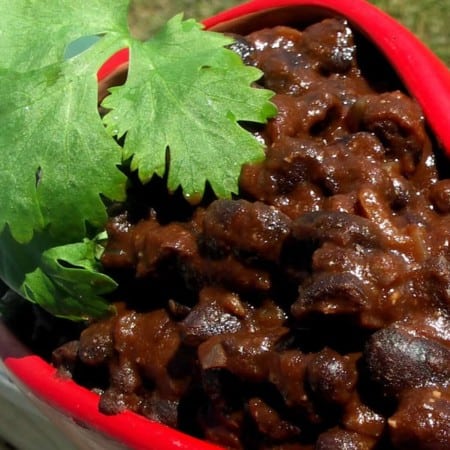
Spicy Saucy Black Beans.  Who doesn't love saucy beans?

Spicy Saucy Black Beans. Who doesn't love saucy beans?

spicyblackbeans2

It is finally Spring, both officially and otherwise. I sat on my porch with my bowl of beans and my feet up and ate the whole blasted thing. I think I may regret that later.

A Tutorial on Using Dried Beans

Ah wonderful beans.  We all love them for their taste.  I love them for their nutrition.  My boys love them for their, er, musical properties.

Ah wonderful beans. We all love them for their taste. I love them for their nutrition. My boys love them for their, er, musical properties.

UPDATE (12/10) :Since first writing this post almost two years ago, I have been experimenting with different ways to cook beans.  While I still use the crockpot method most often, I have changed on something.  I use salt at the beginning of the cooking time.  Really!  It doesn’t slow down the cooking of the beans a bit and leaves them much more flavorful than if you add salt at the end of cooking.  I stand (or rather, I sit, at this very moment) corrected.  Salt away!

Beans.  They are the perfect budget food.  They’re chock full of dietary fiber and nutrients, simple to store and able to leap tall buildings with a single bound. And they’re cheap! They’re so cheap (“How cheap ARE they?” screamed the crowd.  “So cheap they’re on the dollar menu!”) that there is no excuse to be without them.  Even if you’re so poor you can’t afford to pay attention, beans are still in your ballpark.   But -keeping it real here- unless you’ve grown up eating them or have been making them for years they can be a little intimidating to prepare and use.  And various well-meaning and well-researched cookbooks have you jumping through a billion hoops just to make a simple pot of unadulterated beans.  Not so beginner-friendly.

Why bother with dried beans and the extra work when you can buy canned beans super cheap?  Dried beans last close to forever when kept in a cool, dry cabinet.  They’re less expensive per pound and taste better than canned beans.  And -perhaps most importantly- they’re better for you than canned beans. When you reconstitute dried beans you control the amount of sodium in them and ultimately in the finished recipe.  When you start with canned beans you’re already starting at a super high sodium level (which can be a major health concern for many people.)  There is more, but I think you get the idea.  If you’ve never made dried beans before just do me a favor and try it at least once.  I am pretty convinced I can convert you…

Here’s my plan.  For the next few weeks, I’ll share a bean recipe with you on Thursday or Friday.  That will give you all weekend to try out your beanerific recipes.  This week, though, I’m going to start you out with a tutorial on how to get the dried little beasties to the point where you can use them in recipes…  And I warn you: My method is so easy that you may not want to prepare them any other way.   You’ll need a slow cooker, but if you don’t have one, you can snap up a basic model for $15 at le Walmart, le Target or le Blue-Light-Special.  Don’t let anyone tell you you need bells and whistles on a slow cooker.  All you really need are a ”HIGH” and a “LOW” setting.  Unless you’re cooking for one, get the largest of the basic slow cookers that you can afford.  I always cook more beans than we can eat in one meal.  You can portion them into individual servings and freeze them to add into soups and stews or make dips or refried beans with later.  We loves the bean dip around here!

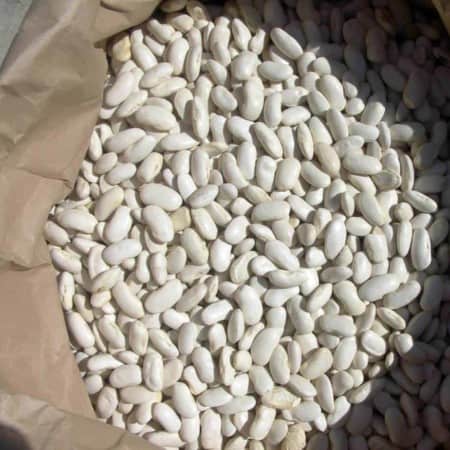
Because it’s what I’m going to be using in tomorrow’s bean recipe, we’ll start out with cannellini (white kidney beans) today, but feel free to kick it off your bean adventure with any dried variety that floats your boat; pinto, chili, black, lima, garbanzo…  If you follow the method, you can make any kind of bean you want!

For a printer-friendly, photo-free version of this tutorial, click here!

Dried Beans: A Tutorial

Necessary equipment:

  • a slow cooker
  • a saucepan to boil water

Ingredients:

  • 1 lb dried beans, (in this case, cannellini), or about 2 cups dried beans
  • 2 bay leaves
  • 2-3 frozen onion tops or 1 cooking onion, peeled and cut in half from root to end
  • 2 quarts boiling water
  • salt to taste


Pour your dried beans into a colander.

Yes.  I sit outside on my porch steps while picking through beans.  It's the hillbilly in me.

Yes. I sit outside on my porch steps while picking through beans. It's the hillbilly in me.

Pick through to find grossly misshapen, discolored or otherwise nasty looking beans or small stones.

It feels nice to run your hands through dried beans.  There's something therapeutic about it.

It feels nice to run your hands through dried beans. There's something therapeutic about it.

These are what Leif calls "Yuck beans."  This is what you want to remove.

These are what Leif calls "Yuck beans." This is what you want to remove.

Because dried beans are about the size and color of some pebbles, it’s not completely bizarro to find little rocks, clumps of dirt or other natural bits and pieces occasionally tucked into the bags.  After you’ve picked through and removed any undesirables, give the beans a good hearty rinse under cold water, rubbing them around in the colander as they’re being cleaned.   This ensures that you remove any dirt your eagle eyes may have missed.  This also gives you a chance to look the beans over one more time.

beantutorial7

Add the beans to the crock of the slow cooker.  Place the bay leaves and onion tops (or onion) on the beans. Sprinkle about a teaspoon of salt, give or take according to taste, over the top.

I told you to hang onto those onion tops.  I may be cheap, but these things add a lot of flavor!

I told you to hang onto those onion tops. I may be cheap, but these things add a lot of flavor!

Pour in the boiling water. (It really does need to be boiling.  That is key!)

Pretty please make sure your water is boiling.  It is superdy duper important.  Just take my word for it.

Pretty please make sure your water is boiling. It is superdy duper important. Just take my word for it.

See?  Two inches of water over the beans.  This is perfect!

See? Two inches of water over the beans. This is perfect!

Quickly put the lid on the slow cooker, turn the cooker to “HIGH” and assess the situation.  If your beans are covered by at least 2 inches of water you’re doing fine.  If they’re covered by less than that, you’ll want to put some more water on the boil to add as soon as possible.  Set your timer for 3 hours and go do a crossword puzzle or play a board game with the family.

When three hours are up, you’re going to do a test.  Use a spoon to reach into the cooker and quickly extract a couple beans, replacing the lid immediately.  Hold them a few inches from your face and blow on them gently.  If the skins curl up off the beans, they’re most likely done.  Carefully take a bite through the center of one of the beans.  If it’s tender, you’re all set.  When you cook black beans or pinto beans, it’s not unusual for them to be done that quickly, especially if they’re relatively new beans.  If they are done, you can use them immediately, divide them into containers for the freezer or stick straight into the fridge -tightly covered- in their own liquid for use within four or five days.

If you’re cooking a larger (or harder) bean -such as cannellini, garbanzo, butter bean, etc…- you’ll likely find that the beans are not yet tender in the center.  Turn the slow cooker to the “LOW” setting, add additional boiling water (if needed) to cover the beans, and allow to continue cooking for about four hours before checking again.  Repeat the test; extracting a couple beans quickly and replacing the lid, blowing on the beans and biting them. If they’re tender, pull them from the heat and use immediately or store for later.  If they’re still tough, give them a couple more hours -making sure they have water to cover- and repeat the test. Do this until they test done.  The batch of cannellini beans I cooked in the photos for this tutorial simmered overnight on “LOW” before they were done.

Done!  Not looking gorgeous, but tasting fi-ine!  Pop a lid on this, stash in the fridge and come back tomorrow to make bean dip with me!

Done! Not looking gorgeous, but tasting fi-ine! Pop a lid on this, stash in the fridge and come back tomorrow to make bean dip with me!

In my own experience, garbanzo beans (the stuff of my hummus dreams) have taken the longest time to cook by far.  Just be prepared to let them cook away.  And, for pete’s sake, don’t sweat testing it if you have to let it cook overnight.  Beans are pretty resilient as long as you’re cooking them in enough water.  And if you overcook them there’s always bean dip!

If you choose to freeze the beans for later use, divide the beans into one or two cup servings between containers.  Be sure to leave enough room to ladle cooking liquid over them so they don’t dry out and to account for expansion of the liquid as it freezes.  Make sure the lid of the container fits tightly and stash in the freezer for later use.  (Alternately, you can carefully scoop the beans and their liquid into zipper-top freezer bags taking care to seal them completely.  The bonus of this method is they lay flat to freeze and thus take up less room.)  Frozen beans will keep well for about two to three months in the deep chill.  After that they begin to deteriorate a bit in texture and in taste.  Not the end of the world, but after that point they’re only good for bean dip.  (All roads lead to bean dip in this house.)

Tomorrow:  Come back for a wonderful *gasp* bean dip that can be served hot or cold.  Get those pita chips or veggie sticks ready!