

Corn Stock plus Roasted Corn and Potato Chowder | Make Ahead Mondays

Soup and sweater weather…

There simply isn’t any weather I like better than those first days of fall -REAL FALL- where the skies are gunmetal grey and leaves are just starting to turn. It’s a mighty wind, and it’s brisk, and it wants to blow right through you. It makes you understand why those leaves finally give up and flutter around. We, thankfully, have sweaters and comfy socks.

And soup.

First, you may have been around here long enough to know I’m a huge fan of movies. My most favourite movies are usually absurd comedies. Squarely in that category falls the movie  ‘Best In Show’ by Christopher Guest and Eugene Levy. It’s a mockumentary where a bizarre group of characters competes to win a national dog show. The entire movie is weird, wonderful and hysterical from start to finish, but there is one exchange that has always stuck with my husband and I.

Jennifer Coolidge’s gold-digging, much younger trophy wife character, Sherri Ann Cabot, is talking about how very in love she is with her MUCH older, senile, immobile, uncommunicative, wealthy husband.

[youtube]http://www.youtube.com/watch?v=T9jxSOxtYHs[/youtube]

“We have so much in common, we both love soup and snow peas, we love the outdoors, and talking and not talking. We could not talk or talk forever and still find things to not talk about.”

In short, since seeing that movie, my husband and I quote that one passage every. single. time. we have soup. Given that we also love soup, that quote gets pretty solid play in our house. And I’ll tell you this, unlike Leslie Ward Cabot, it hasn’t gotten old yet.

Let’s make like Sherri Ann and Leslie and talk about soup for a moment, shall we?

This chowder is not for the low-fat crowd. Not only does it use bacon -and a lot of it!-, not only does it have butter, not only does it have cream cheese, but it has all three in abundance. Glory hallelujah! Don’t spend your days waiting for Guffman, it’s time to bust out the comfort food.

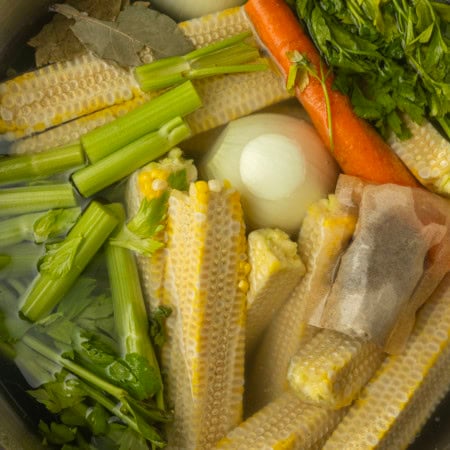
While you can certainly make this chowder with a store-bought chicken or vegetable stock, it really sings up a storm when made with the simplest stock you can ever make; Corn Stock. If you’ve been with me long enough to know I’m a movie nut, you’ll also know that I’m firmly in the waste not/want not camp as well. Corn Stock is what I like to call a three-fer.

  1. You prepare the corn the way you  normally would (I vastly prefer roasting it because it’s easier to do large amounts than boiling.) Cut the corn from the cob and freeze it or use it immediately.
  2. Boil the cobs for stock.
  3. Give the boiled cobs to the chickens who will get whatever is left that is edible and use it as energy to make eggs.

If that isn’t a frugal gal’s dream, I don’t know what is. Most importantly, though, the corn stock gives your chowder something that no other stock can. It gives it an essence of summer sweet corn that simply is not available in any other way mid-autumn or winter. If that doesn’t send a shiver of anticipation up your spine (unlike a spinal tap), then you’ve never lived in the snow belt.

Just imagine a bowl of rich chowder resplendent with roasted corn (that which you cut from the cob and froze, you frugal cook you!), cubes of potato with a hint of red skin still on, and hints of orange carrot in a fragrant broth that smells just like fresh sweet corn and is made thicker and velvety with the addition of cream cheese. Does that warm you up yet?

Don’t just talk about it: slurp that soup like Leslie!


Corn Stock plus Roasted Corn and Potato Chowder | Make Ahead Mondays

Corn Stock plus Roasted Corn and Potato Chowder | Make Ahead Mondays

Make as much of the Corn Stock as you can while corn is still in season. You'll be so glad to have the essence of summery corn available to you in the winter. Use in stews, risottos, and soups.

This luscious, hearty, rich chowder is resplendent with roasted corn (that which you cut from the cob and froze, you frugal cook you!), cubes of potato with a hint of red skin still on, and hints of orange carrot in a fragrant broth that smells just like fresh sweet corn and is made thicker and velvety with the addition of cream cheese.

Ingredients

    For the Corn Stock:
  • 2 dozen ears of corn, roasted and shucked (preferably) or shucked and boiled
  • 2 cooking onions
  • 1 tablespoon black peppercorns
  • 1 handful fresh or frozen parsley stems
  • 2 bay leaves
  • 2 sprigs fresh time or 2 teaspoons of dried thyme leaves
  • 2 gallons fresh cold water
  • For the Roasted Corn and Potato Chowder:
  • 1 pound of bacon (Omit the bacon and add another 4 tablespoons of butter for a vegetarian version.)
  • 2 tablespoons of butter
  • 2 medium sized cooking onions, peeled and cut into small cubes
  • 1 tablespoon minced or pressed garlic
  • 5 tablespoons all-purpose flour
  • 8 cups corn stock (or chicken stock)
  • 6 medium sized red potatoes, scrubbed and cut into small cubes
  • 1 carrot, peeled and cut into small cubes
  • 4 cups frozen or fresh roasted corn, cut from the cob
  • 8 ounces cream cheese, softened to room temperature
  • salt and pepper to taste
  • sliced green onions and minced fresh parsley, if desired, for serving

Instructions

To Make the Corn Stock:

Stand an ear of corn up on its flat end on a cutting board. Using a gentle sawing motion with a very sharp knife, cut down the ears, removing the kernels from the cobs as you go. Transfer the corn kernels to a parchment lined, rimmed baking sheet and stick in the freezer until solid. Transfer those corn kernels to zipper top freezer bags and store for use in soups or salads.

Put the cleaned cobs along with the remaining stock ingredients into a large stockpot or electric countertop roaster oven. Cover the pot and bring up to a boil. Drop the heat and let it cook at a low simmer for 1-4 hours. Use tongs to remove the boiled cobs from the stock. (I give those to my chickens after they've cooled.) Pour the remaining liquid through a fine mesh sieve over a pitcher or other deep pot. You can use the stock immediately,

~or you can pressure can it (leaving 1-inch of headspace) at 15 pounds of pressure for 75 minutes. The jars can be stored on the shelf for up to two years.

~or you can cool the stock and pour it into zipper top freezer bags in single use portions then freeze it for up to 6 months.

~or you can refrigerate it and use it within 2 weeks.

To Make the Roasted Corn and Potato Chowder:

Cut across the slices of bacon to make 1/2-inch strips. In a soup pot over medium heat, cook the bacon, stirring frequently, until it is crisp. Use a slotted spoon to transfer the crispy bacon to a paper towel lined plate. Set it aside -no snitching!- until the soup is almost done.

Drain all but 1/4 cup of the bacon grease. You can eyeball it: you don't need to be precise. Add the butter to the bacon grease and place the pan over medium low heat. Add the onions and a pinch of salt and cook, stirring frequently, until the onions are translucent. Add the garlic in and stir, cooking for an additional minute.

Sprinkle the flour over the onion/garlic/butter mixture and whisk it in thoroughly. Raise the heat to medium and cook for 2 minutse, stirring often. It should be bubbly. Add the corn stock, whisking to combine, then the potatoes and carrots. Bring to a boil, then lower the heat to a simmer and cook until the potatoes and carrots are super tender.

In a heat-proof bowl, lightly smash the softened cream cheese with a fork. Using a ladle, add a little of the hot corn stock to the cream cheese, working it in with a fork or a whisk until smooth. After you've added enough hot stock to it to create a thick but pourable liquid, add it back into the pan of soup, stirring to combine. Add the corn in and stir, cooking only until the corn is heated all the way through. Taste the broth and adjust the seasoning with salt and pepper to taste.

Serve with a handful of sliced green onions and chopped fresh parsley, if desired. Don't forget a big chunk of bread to sop up the irresistible broth!

http://www.foodiewithfamily.com/2012/09/10/corn-stock-plus-roasted-corn-and-potato-chowder-make-ahead-mondays/

Roasted Red Pepper Spread | Gardener’s Delight Eggs

And POOF! Just like that, summer was gone. I am fully aware that it is still technically summer but the tell tale signs are all around us: breath is foggy in the morning, cozy socks are back at the front of the sock drawer, scarves and jackets are shaken out of storage, and the produce at the farmers’ markets is taking a definite pumpkin-y turn. This, my friends, is fall.

That giant cosmic yawp you just heard came from my ever-optimistic beloved husband who views the turning of the leaves as a personal metaphor for mortality. This is the same man who spends the first official day of summer in mourning because it means that the days will grow shorter until the year ends. Poor guy. Don’t feel too badly for him, though. He lives with a compulsive baker and we all know that bread makes everything better.

Some of us, though, are not-so-secretly rejoicing. I’ve rustled up my fingerless gloves and my woolen caps for my morning strolls. I’m thrilled that I’m no longer sweating buckets near (not over, perish the uncouth thought) my canning pots. In fact, I’m upping the canning program in order to help keep warm until my husband finally acknowledges that summer has flown the coop and fires up the wood stove*.

*Firing up the wood stove is like my husband throwing the white flag of surrender and admitting that one more summer is behind him.

In the meantime, I will keep filling jars with little tastes of summer for my soon-to-be hibernating husband to put on his fresh bread. Jams and jellies are wonderful, but nothing beats cracking open a vibrant, ruby-hued jar of savoury garden goodness when the brisk wind is blowing and the sky is gun-metal grey.

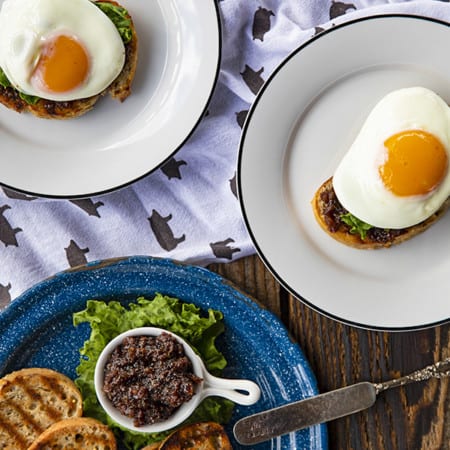
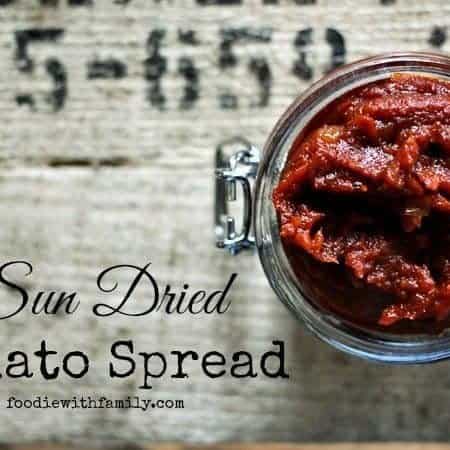
Roasted Red Pepper Spread is just the thing to banish chills to the body or soul. You can’t help but smile when you see the bright red jars with flecks of basil peeking out at you. And when you open it? It’s everything wonderful about summer encapsulated in one little jar. The silky smooth, thick red pepper spread with the full taste -courtesy of tomatoes, garlic, onion, and red wine vinegar- is at home dolloped on fried eggs, spread on toast, as a pizza sauce, or as a dip (either alone or stirred into mayonnaise or softened cream cheese.)

While my poor husband may never recover from the suggestion that winter is soon to follow, I would be remiss if I didn’t offer the following tip; if you tie a simple gold, silver or raffia ribbon and gift tag around the top of the jar, it makes a beautiful and tasty (and perfectly colored) Christmas gift. Red and green and good taste. What could possibly be better?

The recipe yields around five eight-ounce jars, but can easily be doubled or tripled. I recommend an automatic doubling of this recipe if you intend to give it as gifts, because once you taste it you won’t want to part with it. That is as incontrovertible a fact as the passing of the seasons.

Roasted Red Pepper Spread

Rating: 51

Yield: About 5 eight-ounce jars

Roasted Red Pepper Spread is just the thing to banish chills to the body or soul. It’s everything wonderful about summer encapsulated in one little jar. The silky smooth, thick red pepper spread with the full taste -courtesy of tomatoes, garlic, onion, and red wine vinegar- is at home dolloped on fried eggs, spread on toast, as a pizza sauce, or as a dip (either alone or stirred into mayonnaise or softened cream cheese.)

Adapted from The Ball Complete Book of Home Preserving

Ingredients

  • 5 ¾ pounds sweet red bell peppers
  • ¼ pound fresh cayenne peppers (or other red-hued hot peppers) (If you don’t like heat, use an additional ½ pound of sweet red bell peppers.)
  • 1 pound plum tomatoes
  • 1 small onion, unpeeled and uncut
  • 3 large cloves garlic, unpeeled and uncut
  • ½ cup red wine vinegar
  • 2 tablespoons, packed, thinly sliced (chiffonade) of fresh basil
  • 2 teaspoons sugar (I prefer raw)
  • 1 teaspoon salt

Instructions

Preheat the broiler in your oven. Spread the peppers, tomatoes, onion, and garlic cloves in a single layer on a rimmed baking sheet. Roast under the broiler, turning frequently, until the peppers are softened and blackened all the way around, and the tomatoes, onion and garlic have some black spots on them. The more thoroughly blackened the peppers are, the easier they are to peel. Transfer the peppers and tomatoes to a paper bag, fold the top down three or four times to seal it, then let cool about 15 minutes, or until the produce is cool enough to handle. Set the onion and garlic on a cutting board to cool as well.

When the peppers and tomatoes have cooled, use your hands to rub the skins off as well as you can. Don’t panic if a bit of the skin remains. Cut the peppers open in order to remove their stems and seeds. Rip the peppers into strips and put into a blender or food processor (in batches if necessary) and process until smooth. Pour into a stainless steel stockpot and repeat the process with the tomatoes.

Peel the onions and garlic then finely chop both. Add this and the remaining ingredients to the purees in the stockpot and stir to combine. Bring to a boil over medium high heat, stirring frequently to prevent scorching. Lower the heat to medium low and continue a gentle boil, stirring often, for about 20 minutes, or until the spread can be mounded on a spoon.

You may either refrigerate the red pepper spread at this point, or freeze it in single serving sizes, or can it to make it shelf stable.

To can the spread for long-term storage:

Ladle the hot spread into prepared 8-ounce jars leaving ½-inch of headspace. (For information on how to do this, click here ) Use a stainless steel chopstick or butterknife to remove any air bubbles. If the level of the spread lowers after air bubbles are removed, you can add more hot spread.

Wipe the rims of the jars with a damp cloth, put the lid in place, and screw on the rings until fingertip tight. Place on a rack in a canner, cover with hot water, and bring to a boil with the lid on the canner. Once the water reaches a full rolling boil, begin a 10-minute timer (15 minutes for pints). When the timer is done, remove the lid from the canner, turn off the heat and let it stand for 5 minutes before carefully transferring the jars to a towel or rack on the counter to cool, undisturbed.

When the jars are completely cool, remove the rings for storage, wipe the jars clean and label. Store in a cool, dry place for up to a year.

http://www.foodiewithfamily.com/2011/09/22/roasted-red-pepper-spread-gardeners-delight-eggs/

Would you like another good reason to have this on your shelves? I gotcha covered! This is my current favourite breakfast.

Gardener's Delight Eggs

This almost instant breakfast delivers a hugely satisfying punch of flavour courtesy of big, bold, smooth, garden-fresh Roasted Red Pepper Spread dolloped on fried eggs with pan-fried tortilla rounds. This breakfast will keep you going for hours.

Ingredients

  • 1 egg
  • 1 tablespoon butter
  • 1 flour tortilla, cut into quarters or rounds (with a biscuit or cookie cutter)
  • 2 tablespoons Roasted Red Pepper Spread (see recipe above)
  • salt and pepper to taste
  • Optional: Fresh basil, thinly sliced (chiffonaded)

Instructions

Melt the butter in a heavy-bottomed skillet. Crack the egg and slide it onto the skillet near one edge. Place the tortilla rounds or wedges along the other side of the skillet. Flip the tortilla rounds when they begin to lightly brown. Toast the other side and transfer to a serving plate.

Cook the egg, flipping once if desired, to your preferred doneness. Use a spatula to place the fried egg on top of the toasted tortillas. Top the egg with the Roasted Red Pepper Spread. Sprinkle with fresh basil, if desired.

http://www.foodiewithfamily.com/2011/09/22/roasted-red-pepper-spread-gardeners-delight-eggs/

Thai Sweet and Hot Garlic Dipping Sauce

…Does writing two posts in a row with a sweet and spicy theme say something about me?

In actuality, I do believe I can blame this one on you all, you sweet and spicy wildcats.  I did, after all, put it up for a vote on the Foodie With Family Facebook fan phage. (Yes, I know it should be page, but I got carried away with alliterative abandon.) The voting results were narrowly skewed in favor of this addictive Thai Sweet and Hot Garlic Dipping Sauce.  Never fear, my salsa fanatics! We’ll be back on the salsa train tomorrow.  In the meantime, if you’re looking for my first salsa recipe in my week long salsa recipe series, you’ll want to click on over to my Record-Eagle column. While you’re at it, have a gander at my Peaches and Cream Time Saver Muffin recipe.  You’ll be so glad you did!

I have a confession to make.  My husband and I have allowed all of our children to learn and adopt our own long-standing addiction.  We didn’t just let it happen, we encouraged it.  In fact, we bought the strong stuff for them.  I mean heavy-duty.  The dangerous stuff that reduces strong men to weeping babies.  The truth is that growing up in our family it was all but inevitable.

All five of our sons are hot sauce addicts.

I do mean they are fully addicted to hot sauce.  For Christmas last year, my ten-year-old and eight-year-old chucked aside their main gifts in order to crack open the miniature bottles of Frank’s Extra-Hot Sauce that we had tucked into their stockings.  Did they shake it on their eggs?  Drizzle it over their breakfast sausage?  Eat it straight on chips?  No.  Any of those would’ve been reasonable, but no.  My children shook the bottles straight into their mouths.  On purpose.  And then repeated it until each of them had consumed about two tablespoons of it straight from the bottle.  Then -and then, only- they ate a couple pieces of candy.  And then went back to the hot sauce.

My baby.  My little, sweet, cuddly four-year-old baby likes copious amounts of Sriracha on his turkey sandwiches, in his congee and on his tacos.  My twelve- and six-year olds profess not to like hot sauce as much as their brothers, but that’s only because they’re choosy.  They don’t like Frank’s, Tabasco or Sriracha, but they both like -nay, adore!- Melinda’s Original Habanero XXXXtra Reserve Sauce.  Dare I confess that we buy it by the gallon?

Considering that I do often share ‘spicy’ recipes here on Foodie With Family, and that I often get questions regarding just how hot a recipe I just offered actually is, I thought it was about time for me to create a heat-rating system; one that gives you a good idea of just how hot something actually is.  A system that was more specific and universally understandable than my usual, “Well, my four-year-old eats it…” because the truth is, my four-year-old stuffs his face full of wasabi peas, cries, knocks his head against my thigh waiting for the wasabi burn to die down then begs me for more.  And so, I present to you…

The Foodie With Family “Spicy Foods” Equivalency Rating System

  1. Eh, at least it has flavor.
  2. Not bad.  This would be good for small children and it’s pretty tasty stuff.
  3. I like it. It’s a good all-purpose kind of heat without being at all overwhelming.
  4. Tingly, definitely packs a little punch.
  5. Hot, but full of great flavor.
  6. Oooh, the roof of my mouth is sweating.  More please.
  7. My tongue is on fire and I like it.
  8. I’m sorry.  Did you ask me something?  I can’t hear you over the freight train running through my ears and I’m pretty sure my face has melted off of my head.
  9. Where did everyone go?  I think I’ve gone blind.

If I were to put this in terms of widely available and well-known foods, it might look a little like this…

  1. A little freshly ground black pepper.
  2. Frank’s Red Hot Sauce
  3. Tabasco Sauce
  4. A generous shake of crushed red pepper flakes on a piece of pizza.
  5. Melinda’s Original Habanero XXXXtra Reserve Sauce
  6. Sriracha
  7. A bite of a fresh, ripe habanero pepper.  If you eat enough you will most definitely experience the ‘hot sauce hangover’.*
  8. …Crazy off-brand hot sauces that hardly anyone recognizes because they hurt and they’re expensive.  Most people don’t pay for that honest to goodness pain.
  9. Dave’s Insanity Sauce.  There’s a reason some states require you to sign a health-waiver when you purchase this stuff. And for the record, this stuff is off-the-charts for us.  With two notable (and historical) exceptions, we do not eat this.**

*The Hot Sauce Hangover is a phrase coined by The Evil Genius to describe the phenomenon whereby the hot sauce makes its presence known  on you causing your posterior to hang over the toilet for roughly the same amount of time it took you to eat it in the first place.

**These exceptions are stories for another day and another cuppa tea.  I’ll just say the first occasion was a pride-fueled attempt to impress someone by putting  Dave’s Insanity Sauce on my burger like ketchup. The second event was my husband trying to eat it because he didn’t believe I could’ve possibly experienced that much pain from hot sauce when I recounted the story to him. I won that time.

Now that we’re all on the same page, let’s talk Thai Sweet and Hot Garlic Dipping Sauce.  I’m going to say that it falls somewhere between a four and a five in terms of heat and it gets full-marks on flavor.  If your heat-preferences run lower than ours, you can certainly reduce the crushed red pepper flakes called for in the recipe.  In terms of commercial comparisons, it is similar in flavor to Mae Ploy sauce but as with most homemade sauces, it’s just so much better.  There isn’t much that tastes better with lumpia, summer rolls or fried spring rolls, egg rolls or chicken balls.  Use to glaze or brush on grilled meats or whisk a little together with grated fresh ginger, soy sauce, and sesame oil for the best dressing ever to adorn an Asian chicken salad. Just look at how gorgeous it is.  Don’t you want to drink a tall glass of it?

No?  I’m alone on this?  No one else wants a glass?  Alright, but seriously, make this.  It is one of the easiest canning projects you can try because it doesn’t require any exotic ingredients or specialty equipment aside from the canning jars themselves.  And believe me, it is worth the effort. For the sauce to reach its full flavor potential, it has to sit on the shelves at room temperature for at least three weeks.  This isn’t a moment where you can mix up the sauce and shove it in the back of the refrigerator.  It just won’t develop the same roundness and body. Veteran canners can skim through and get the information they need, but I’m going to talk this through step-by-step for the newbie canners out there.  You can do this! Yes, you CAN.  Oh man, I crack me up.

In order to complete the project, you need to be able to lay your hands on the following items:

  • Between nine and twelve half-pint (8 ounce) canning jars with new two-piece lids.  If you’re unfamiliar with two-piece lids, just buy a box of new canning jars from your local hardware store or Walmart.  They come -quite conveniently- with new two-piece lids!
  • A large stockpot or pasta pot with a tight fitting lid.
  • A rack that fits on the bottom of the pan to prevent jars from sitting directly on the pan’s surface. If you don’t have that, rings from ‘regular mouth’ canning jars can be placed facing downward sides touching to create a space between the bottom of the jars and the pan.
  • A waterproof oven mitt or canning tongs.
  • A ladle.
  • Paper towels or clean tea towels.
  • A timer or a clock.

For a printer-friendly, photo-free version of this recipe, click here!

Thai Sweet and Hot Garlic Dipping Sauce

Adapted from The Ball Complete Book of Home Preserving

Yield: About 9 half- pints as written

Ingredients:

  • 1/2 cup finely minced fresh garlic (Peel and mince your own garlic, please. Pre-minced garlic in jars just isn’t good enough for this recipe.)
  • 1 Tablespoon Kosher salt
  • 6 cups cider vinegar
  • 6 cups granulated white sugar
  • 3/4 cup (less if your heat tolerance is lower) crushed red pepper flakes

Prepare the jars and rings by washing on the hot cycle of your dishwasher.  Wash the lids in hot soapy water and rinse well.  Place in a bowl covered by two or three inches of very hot tap water.  Set aside.

Prepare your canner (or stockpot) by putting a rack in the bottom to hold the jars away from the base of the pan.  If you do not have a rack, use a fully opened vegetable steamer basket or extra rings from ‘regular-mouth’ or ‘narrow-mouth’ canning jars placed facing down with the sides touching.  Set aside.

Sprinkle salt over the minced garlic in a metal or glass bowl (don’t use plastic here unless you want a perma-garlic bowl!)  Stir together, cover tightly with plastic wrap and let it mellow at room temperature for an hour.  The salt will help pull some of the moisture from the garlic, so don’t skip this step!

In a saucepan, bring the vinegar to a rolling boil.  Add the sugar all at once and stir well until the sugar is dissolved.  Return to a full boil.  Lower heat just slightly so that it boils steadily but not really hard.  Boil steadily, uncovered,  for 10 minutes.  Remove the pan from the hot burner, stir in the garlic mixture and the crushed red pepper flakes.  Take care not to hold your face directly over the pan when adding in the pepper flakes as that can trigger some serious coughing and eye-watering, depending on the strength of the pepper flakes.

Ladle the hot sauce into the hot jars.  You want to leave 1/2″ of space between the top lip of the jar and the top level of the dipping sauce.  Use a ruler outside the jar to check whether you have the right amount of open space.  If you need to, use a spoon to remove some sauce or add sauce to maintain that 1/2″ of headspace.  Use a paper towel (or clean tea towel) dipped in pure cider vinegar to wipe the rims of the jars even if it doesn’t look like anything is on it.

Use your clean hands to grab a lid from the hot tap water.  Position it, rubber seal side down, directly over the center of the jar.  Place the metal ring over the jar and gently screw it into place until you meet resistance. When you meet resistance, tighten the jar until it is finger-tip tight.  (In other words, tighten until it is the tightness that you can achieve with your finger-tips, not with vice-grips.) The jars are going to be hot because you poured nearly boiling liquid into them.  I find it helpful to wear an oven mitt on the hand that is holding the jar steady.

When all of your jars are ready, set the prepared canner on your burner.  Position the jars (using an oven mitt to keep from burning your fingers or palms) over the rack (or steamer basket or upside-down canning lids) so that the jars are steady and in an upright position.  Cover the jars completely by at least one inch with hot tap water. Place a lid on your canner (or stockpot) and turn the heat on your burner to high.  When the water reaches a full, rolling boil (one that could not be stirred down), set your timer for 15 minutes.  When the 15 minutes have elapsed, remove the lid to your canner and shut off the heat.  Leave the jars in the hot water for 5 minutes.

After 5 minutes, transfer the jars (using a waterproof oven mitt or canning tongs) to a towel lined counter or a cooling rack with a towel under it. You should start to hear the “POP” of the lids as they form vacuums and seal.  This is a very good thing!  Leave your jars to rest, undisturbed, overnight.  In the morning, test the jars by pressing gently on the center of each lid.  If it does not give under gentle pressure or pop back up, your seal is good.  Remove the rings for storage*, wipe gently with a damp cloth or paper towel, label and store in a cool, dark place for 3 weeks prior to using.  Unopened, sealed jars of this sauce can be stored for a year.

*Storing your jars without the rings is a little bit of insurance.  When food spoils in a closed environment, the gasses produced by bacterial growth create upward pressure in the air pocket left by the headspace you so carefully measured in the jar.  If you remove the ring, any gasses produced by spoilage will push upward on the lid loosening the seal.  When you open a jar, if the seal is weak or there is no “schllllllooop” from a vacuum seal being broken, discard the contents immediately.  On the flip side, if you hear that lovely “schllllllllooop” and the lid is difficult to pry from the jar, you’ve done the job right!  You can eat your home-canned goodies, content in your foodstuffs’ safety.

Before opening a jar of Thai Sweet and Hot Garlic Dipping Sauce, be sure to give it a good shake.  There will be a natural settling of the product in storage and shaking is a simple way to distribute all that gorgeous garlic and pepper flake-age.

Sweet Black Cherry Pie Filling

I used to think I despised cherries.

This was some high-heresy for a girl raised awfully close to ‘The Cherry Capital of the World’.*  Why I thought cherries were gross I can attribute to two reasons: A) I didn’t like the whole spit-the-pit thing.  I was a tidy child. B) The only way to eat cherries sans pits, as far as I knew, was maraschino cherries and I still maintain that those are disgusting.

*Nothing like some trivia to de-cobweb the old gray matter. Does anyone out there know which area I mean?

I realized the error of my ways long after moving out of state*.  I was at a friend’s house when she insisted I try a beautiful red cherry she had picked earlier that day.  I was blown away by the intense, tart, sweet flavor.  And I didn’t even mind spitting the pit. My devotion was deep and instant. But DANG they were expensive. On sale, loss-leader sale even, I couldn’t find pre-picked cherries for anything less than $2.99 per pound.  I lived much too far from any cherry orchards to make it cost-effective to drive to one to pick my own. Then we moved again.

*I have a  major food regret from my childhood. I wish I hadn’t been such an anti-cherry and anti-morel mushroom picky-pants.  I had both overflowing in my backyard free for the taking.

I am now fortunate enough to live in Amish country where the bulk-food buying and canning mindsets of my ‘Dutch’ neighbors combine to provide me with ample and affordable supplies of pre-picked fruits and vegetables at prices that would make grocery store managers reach for the antacids. This year, I pitted sixty pounds of sweet black cherries and I’m still canning my way through thirty pounds of pre-pitted sour cherries. The black sweet cherries rang in at $0.70 per pound and the pre-pitted sour cherries came in at a slightly pricier (but still bargain-basement price of) $1.26 per pound.  You already know about the Rum-Soaked Preserved Cherries and the Boozy Cherry Molasses, and I’ve been promising my Sweet Black Cherry Pie Filling recipe for an (indecently) awful long time.  How many of you are waiting out there languishing with a whipped ganache filled tart in hand just hanging on for a pie filling that doesn’t taste and look like glorified maraschino cherries and doesn’t plop out of a pull-tab can?  I am so sorry.  I blame my children.*

*Because I can. Yes, I can. A little laughter please? Can’t a girl get a little giggle for politico-culinary humour?

Why make your own instead of buying the cheap stuff? For the usual reasons; flavor and health. Store-bought canned pie filling can’t hold a candle to homemade in terms of flavor.  But just as compelling is the long list of nasty additives and artificial flavors present in the storebought stuff.  There are five -count ‘em- FIVE ingredients in homemade Sweet Black Cherry Pie Filling, all of which are readily available and pronounceable.

Ah, Sweet Black Cherry Pie Filling. What can’t you do? Sure, you can make a good old-fashioned cherry pie with it, but you can also top cheesecakes with it, layer it with brownies and whipped cream in a mean trifle, pour it on top of softened cream cheese to serve with graham crackers or make a deadly no-bake Black Forest Truffle Tart.  You want some of this on your pantry shelves. Seriously.

For a printer-friendly, photo-free version of this recipe, click here!

Sweet Black Cherry Pie Filling: Printer Friendly Version

From The Ball Complete Book of Home Preserving (see here for book details!)

Yield: about 8 pint (500 mL) or 4 quart (1 L) jars

Ingredients:

  • 10 pounds frozen sweet black cherries, thawed in the refrigerator for 24 hours.
  • 2 1/2 cups granulated sugar
  • 1 cup ClearJel (Or Thermaflo or Permaflo)
  • 1/2 teaspoon ground cinnamon
  • 1/3 cup lemon juice

Position a colander over a large bowl. Pour partially thawed cherries into the colander, cover lightly with plastic wrap and leave on the counter top, stirring occasionally, until you have collected 7 cups of juice in the bowl.  Set aside the juice and the cherries.

Prepare the canner, jars and lids. For more information, see our basic canning how-to’s.

In a large stainless steel or enameled stockpot, whisk together the sugar, ClearJel and cinnamon. When it is evenly combined, whisk in 4 cups of the cherry juice*.  Place stockpot over medium-high heat and bring to a boil, stirring constantly to prevent scorching. Continue boiling until thickened. Whisk in the lemon juice and return to a boil, stirring constantly. Continue stirring and allow the mixture to boil hard for 1 minute. Add the reserved cherries all at once, stir in gently, and continue stirring constantly while returning to a boil. Remove the pan from the heat.

*You can freeze or can the remaining juice or turn it into Boozy Cherry Molasses. The basic instructions remain the same, just add half as much sugar (by volume) and go forth with the directions from there.

Scoop the hot pie filling into the hot jars allowing 1-inch of headspace to remain between the pie filling and the rim of the jar.  Remove air bubbles from the filling by inserting a long, flexible spatula or chopstick into the jars. Wipe the jar rims and position the lids in place.  Screw the rings onto the jars to fingertip tight.

Place jars in a canner, cover with hot tap water by at least 1-inch, cover, and place covered canner over high-heat to bring the water to a boil.  Once the water is boiling hard, you can begin timing; both pints and quarts must be processed for 35 minutes.  After 35 minutes, turn off the heat, remove the lid and let the jars remain in the water for an additional 5 minutes.  Remove to a cooling rack or towel lined counter and allow to cool, undisturbed, for 24 hours before removing rings, wiping jars clean and labeling. Processed and sealed pie filling can be stored in a cool, dark place for a year or so.

~~~~

Before I leave you to whipping up your own batch of Sweet Black Cherry Pie Filling I want to let you in on a dirty little secret. I have a treat that I allow myself that I refer to as Mommy’s Little Helper. It’s the thing that stands between sanity and selling my children to the nearest traveling circus and it is as simple as it is delicious. Just dip a spoon into your resident jar of Nutella (you DO have one, don’t you?) and top with a dollop of Sweet Black Cherry Pie Filling.  Open mouth. Insert. Oh sure, you could  class it up a little and serve it on graham crackers or chocolate wafer cookies, but then it’s not so naughty -and therefore- not so much fun. Danger. It’s my middle name.

Rum Soaked Preserved Cherries and Boozy Cherry Molasses

Cherry season usually gets away from me.  It seems like I find out cherries are on about twelve hours before the end of the (what feels like a twenty four hour) season.  I usually manage to get one or two glorious pounds.  We dispatch of those quickly with a manic eating and pit spitting binge that ends not with the jars and jars of pie filling and preserved cherries that I wanted but with pink stained lips and teeth and hands.  Then I sigh, promise myself I’ll get the jump on it next year and wait semi-patiently for blueberry season where I compensate by picking about a hundred pounds of blueberries.*

*Would that I were joking.  I put up in the neighborhood of 100 hand-picked pounds of blueberries every year. We were talking cherries, though, weren’t we?

But not this year.  Oh no.  Not this year.  This year, thanks to my good friend Lisa, I heard about an almost unbelievable deal from one of our local Amish bulk stores.  They were putting together a group order of cherries; sweet dark cherries, freshly picked, for $0.95 per pound.  And what’s more, they would be getting sour cherries, already pitted, in a couple weeks time for $1.26 per pound. I ordered thirty pounds of sweet darks and thirty pounds of sours.  I didn’t just get a jump on it.  I bungeed. Off a cliff.

The results of my cherry preserving bender are nothing short of lip-smacking and I’ll be sharing all of the recipes over the next couple weeks.  Some of the recipes require fresh cherries, some require frozen and some can take advantage of fresh, frozen or canned cherries; I’ll start with the ones that use the fresh cherries first.  Aren’t I logical?

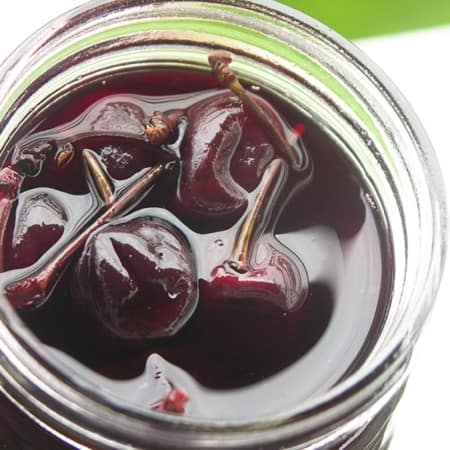
First up is a two-fer; Rum Soaked Preserved Cherries and Boozy Cherry Molasses.  Rum Soaked Preserved Cherries are exactly what they sound like.  They are cherries soaked in a rum-heavy sweetened syrup.  And they are heavenly.  These tipsy little beauties can be eaten straight from the jar, added to baked goods, used to garnish drinks (think Maraschino cherries, but delicious and all natural), or perched on top of a scoop of ice cream that has been drizzled with the happy side-product of their creation; Boozy Cherry Molasses (a jewel-toned rum and Kirsch fortified, thick, sweet, intensely cherry syrup boiled down after making Rum Soaked Preserved Cherries.) What do you do with the Cherry Molasses?  It’s a chameleon, I tell you.  Pour it over ice cream, brush it on grilled pork or venison, eat it from a spoon.

You have some decisions to make when you start with these; stems or no stems and pits or no pits.  I prefer to leave mine with stems and pits intact. I think it makes for a prettier finished product but I’m not all flash and no substance; leaving the pits intact imparts a gentle almond flavor and leaving the stems on gives each cherry a built-in handle for removal from the jar.  If you want to remove the stems and pits, go for it! I’ve included the different quantities needed for both versions.

For a printer-friendly, photo free version of this recipe, click away!

Rum Soaked Preserved Cherries

Adapted from the Ball Complete Book of Home Preserving (See here to learn more about the book.)

Yield: about 4 (8 ounce) jars.

Ingredients:

  • 1 cup granulated sugar
  • 2 cups water
  • 6 1/2 cups cherries with pits and stems intact (5 cups of cherries if you remove stems but leave pits intact, 7 1/2 cups of unpitted cherries if you wish to pit and stem them before preserving)

Per Jar:

  • 1 1/2 Tablespoons Golden Rum

Prepare your jars and lids. If you wish to make the cherries shelf-stable, please also prepare your canner.

Place a stainless steel or non-reactive stock pot over medium-high heat; add the sugar and water to the pot and stir to dissolve the sugar.  Bring the syrup to a boil and add all of the cherries immediately.  Return to a boil while stirring constantly.  Reduce the heat and allow to remain at a gentle boil for 5 minutes. Turn off the heat.

Using a slotted spoon and a wide-mouthed funnel, transfer the hot cherries from the hot syrup into the jars, leaving 1/2 of an inch of head space (the space between the rim of the jar and the food).  Add 1 1/2 Tablespoons of Golden Rum to each jar, then spoon or ladle the hot cherry syrup into the jar, maintaining the 1/2 of an inch of head space.

Insert a chopstick or skewer down the insides of the jar to remove air bubbles.  If necessary, add more cherry syrup to keep that 1/2 of an inch of head space.*  Wipe the rims of the jars, center the lids on the jars and screw down the rings until finger-tip tight.

*Hang on to that leftover hot syrup and leave it in the pan; that’s the most important part of the Boozy Cherry Molasses!  You can either make the Boozy Cherry Molasses right away, or pop the pan into the refrigerator to complete later.

You can either refrigerate the cherries in the syrup for up to a month or you can process them in a boiling water canner to make them shelf stable for a year.  I prefer to can them.

To process them, place the jars in a stockpot or canner, covering them by 1-2 inches of warm tap water.  Cover the pot and bring to a boil.  When the water is at a rolling boil (a boil that cannot be stirred down), begin timing and allow to process for 10 minutes. After 10 minutes, remove the lid to the pot, turn off the heat, wait 5 minutes and then lift the jars straight from the water and place them carefully on a cooling rack positioned over a towel.  Do not tilt the jars (it interferes with the natural formation of a vacuum which is one of the things that keeps the food safe and shelf-stable!)

Cool, undisturbed, for 24 hours.  As the jars cool, you will hear a popping sound.  That is the sound of the lids sealing.  That is what you want to hear.  Check the jars after 24 hours.  If any of them have not sealed, simply store in the refrigerator.  Wipe the jars clean and label them before storing in a cool, dry place (like a cupboard.)

Boozy Cherry Molasses

Yield: Between 1 1/2 and 2 (8 ounce) jars

Ingredients:

  • Remaining hot cherry syrup from making Rum-Soaked Preserved Cherries

Per Jar:

  • 1 1/2 Tablespoons Golden Rum
  • 1 teaspoon Kirsh (or other cherry liqueur)

Place the remaining cherry syrup back over the burner over medium-high heat and return to a boil.  Lower the heat to medium-low and maintain a gentle boil until syrup is reduced by half (or more, depending on how thick and concentrated you want the syrup.)  The syrup should fall slowly from the spoon when thickened and leave a clear trail when you draw your finger across a spoon that was dipped into it. But do be careful.  Hot sugary syrups are, well, HOT!  Be patient.  Wait  before testing! When the syrup is thickened to your liking remove from heat.

Prepare your jars and lids. If you wish to make the syrup shelf-stable, please also prepare your canner.

Add the Golden Rum and Kirsh to your jars and ladle the thickened syrup into the jars to within 1/2 an inch of the rims.  Wipe the rims, center the lids on the jars and screw the rings on until fingertip tight.  I usually process this in a boiling water bath along with the Rum Soaked Preserved Cherries, but if you opted to save the hot cherry syrup and complete the task later, boiling water processing is optional.  As with the preserved cherries, you can store the Boozy Cherry Molasses in the refrigerator or process them for one year’s worth of shelf stability.  If you opt to can them, the directions are as follows.

To process them, place the jars in a stockpot or canner, covering them by 1-2 inches of warm tap water.  Cover the pot and bring to a boil.  When the water is at a rolling boil (a boil that cannot be stirred down), begin timing and allow to process for 10 minutes. After 10 minutes, remove the lid to the pot, turn off the heat, wait 5 minutes and then lift the jars straight from the water and place them carefully on a cooling rack positioned over a towel.  Do not tilt the jars (it interferes with the natural formation of a vacuum which is one of the things that keeps the food safe and shelf-stable!)

Cool, undisturbed, for 24 hours.  As the jars cool, you will hear a popping sound.  That is the sound of the lids sealing.  That is what you want to hear.  Check the jars after 24 hours.  If any of them have not sealed, simply store in the refrigerator.  Wipe the jars clean and label them before storing in a cool, dry place (like a cupboard.)

Just look at this elixir poured over chocolate ice cream.

And ooh boy, how about doing this?

Go on.  You know you want some…

Oh.  I’m sorry.  You can’t taste it through the computer?  I guess you’ll just have to make some.  You’ll be happy you did.  Now pardon me, please.  I have to finish off this bowl of ice cream before it melts or I do.

Candied Jalapenos


This last week, my baby brother Luke told me admiringly that I had finally done it.

“To which it do you refer?” I inquired.

“IT!” said Luke.

Luke was referring to this.

This sandwich blew my mind. It was the perfect sandwich. I do not use the phrase ‘perfect sandwich’ lightly. It is a very serious appellation to give a sandwich*. This one earned it.

*Could I possibly use the word ‘sandwich’ any more? There just doesn’t seem to be any way around it. And so I’d like every single English and composition teacher reading this to take a muscle relaxant right now to help them get through the rest of this post without cringing themselves into spasms.

Let me tell you what makes this bad boy so very bad*. The sandwich is built of naan brushed with ghee, tandoori style grilled chicken, cucumber and yogurt salsa, crunchy pickled onion rings and candied jalapenos. Un-bloody-believably delicious. The Evil Genius declared it to be ‘A Second-to-Naanwich’.

*Bad in a good way. As in phat. Not fat. It’s totally fly. I should probably stop now. Fo shizzle.

Every single component of this sandwich was made from scratch. Okay, so I didn’t grow the lettuce greens, spices or the chicken, but shy of that, all homemade. And over the next few posts, I will give you the recipes to make each component needed to reproduce this amazing sandwich in your own kitchen.

Even though this sandwich alone is worth the work of making each of these building blocks, you’re not just canning, yogurt, bread, and grilling for one purpose. Each of the ingredients can be used for multiple recipes. This is a springboard recipe. Once you’ve mastered each component, the world is your oyster. Are you ready for the first part? Here we go!

We’re starting with Candied Jalapenos for a very good reason. After being made, they need to sit for at least two weeks before you crack open the jar to start eating them. And by need, I mean it’s strictly optional, but you’ll be glad that you did. The flavors need time to meld and marry.

Candied Jalapenos. Ah. There’s a story here. A couple months ago, my friend Katie casually mentioned eating a sandwich made with candied jalapenos. She was singing the praises of what she described as an addictive jar of goodies. Then she said the magic words, “I wish I could figure out how to make these at home.” By this point, you know me enough to know what affect that statement has on me, right?  I quizzed her on the texture, flavor, and appearance of the jalapeno rings. I begged for photographs. I had her send me a picture of the ingredient list on the label. I asked her to describe the flavor to the very best of her food blogging abilities. She was game. She provided all the information and even sent a link to a recipe that she thought looked like it would come close to the benchmark for her.

After carefully examining close to thirty recipes on candied jalapenos (who KNEW there were so many people candying jalapenos?) I called my local Cooperative Extension office to pick the brain of their home food preservation specialists. Since jalapenos are a low-acid food, some precautions need to be taken when canning them. You have two choices for safely canning peppers of any kind; you can pressure can them or you can acidify (i.e. add vinegar, lemon juice, etc…) the liquid in which you pack the peck of pickled peppers.

I opted for acidifying the pepper liquid because I wanted to maintain some of the texture of the peppers through the process.  Pressure canning these would turn them to flavorful mush.  The result was gobsmackingly, head-spinningly, brain-addlingly delicious.  Sweet, spicy and savory, candied jalapeno rings are way too easy to eat on just about everything.  I’ve stashed them in sandwiches, chopped them up on baked beans, tucked them into tacos, used the syrup to brush meat on the grill, perched a couple rings on top of a cream cheese laden cracker and all sorts of other evil things.

For such a simple thing to can, these pack tons of flavor.  You’re going to want to make as many of these as you possibly can simultaneously, because once that first jar is cracked open you’re not going to be able to stop eating them.  And I mean it.

Hey!  Don’t forget to come back over the next few days to get the other components to my Second-to-Naanwich.  You will love me.  That’s a promise.

Candied Jalapenos

Scroll to the bottom for an easy-print version of this recipe!

Yield: About 9 half-pint jars of Candied Jalapenos plus additional jalapeno syrup.

Ingredients:

  • 3 pounds fresh, firm, jalapeno peppers, washed
  • 2 cups cider vinegar
  • 6 cups white granulated sugar
  • 1/2 teaspoon turmeric
  • 1/2 teaspoon celery seed
  • 3 teaspoons granulated garlic
  • 1 teaspoon ground cayenne pepper

Wearing gloves, remove the stems from all of the jalapeno peppers.  The easiest way to do this is to slice a small disc off of the stem-end along with the stem.  Discard the stems.

Slice the peppers into uniform 1/8-1/4 inch rounds.  Set aside.

In a large pot, bring cider vinegar, white sugar, turmeric, celery seed, granulated garlic and cayenne pepper to a boil.  Reduce heat and simmer for 5 minutes.  Add the pepper slices and simmer for exactly 4 minutes.  Use a slotted spoon to transfer the peppers, loading into clean, sterile canning jars to within 1/4 inch of the upper rim of the jar.

Turn heat up under the pot with the syrup and bring to a full rolling boil.  Boil hard for 6 minutes.

Use a ladle to pour the boiling syrup into the jars over the jalapeno slices to within 1/4-inch of the rim.  Insert a cooking chopstick to the bottom of the jar two or three times to release any trapped pockets of air.  Adjust the level of the syrup if necessary.  Wipe the rims of the jars with a clean, damp paper towel and fix on new, two-piece lids to finger-tip tightness.

*If you have leftover syrup, and it is likely that you will, you may can it in half-pint or pint jars, too.  It’s wonderful brushed on meat on the grill or added to potato salad or, or, or…  In short, don’t toss it out!

Place jars in a canner, cover with water by 2-inches.  Bring the water to a full rolling boil.  When it reaches a full rolling boil, set the timer for 10 minutes for half-pints or 15 minutes for pints.  When timer goes off, use canning tongs to transfer the jars to a cooling rack.  Leave them to cool, undisturbed, for 24 hours.  When fully cooled, wipe them with a clean, damp washcloth then label.

Allow to mellow for at least two weeks, but preferably a month before eating. Or don’t.  I won’t tell!


4.9 from 19 reviews

Candied Jalapenos
Author: 
Recipe type: Canning, Condiment, Ingredient
Prep time: 
Cook time: 
Total time: 

Serves: 32
 

There aren’t words that exist to describe how addictive these little savoury, sweet, spicy, crunchy, garlicky pickled jalapeno rounds are. Put them on sandwiches, tacos, rice or bake them into cornbread. You’ll need more and more!
Ingredients
  • 3 pounds fresh, firm, jalapeno peppers, washed
  • 2 cups cider vinegar
  • 6 cups white granulated sugar
  • ½ teaspoon turmeric
  • ½ teaspoon celery seed
  • 3 teaspoons granulated garlic
  • 1 teaspoon ground cayenne pepper

Instructions
  1. Wearing gloves, remove the stems from all of the jalapeno peppers. The easiest way to do this is to slice a small disc off of the stem-end along with the stem. Discard the stems.
  2. Slice the peppers into uniform ⅛-1/4 inch rounds. Set aside.
  3. In a large pot, bring cider vinegar, white sugar, turmeric, celery seed, granulated garlic and cayenne pepper to a boil. Reduce heat and simmer for 5 minutes. Add the pepper slices and simmer for exactly 4 minutes. Use a slotted spoon to transfer the peppers, loading into clean, sterile canning jars to within ¼ inch of the upper rim of the jar. Turn heat up under the pot with the syrup and bring to a full rolling boil. Boil hard for 6 minutes.
  4. Use a ladle to pour the boiling syrup into the jars over the jalapeno slices. Insert a cooking chopstick to the bottom of the jar two or three times to release any trapped pockets of air. Adjust the level of the syrup if necessary. Wipe the rims of the jars with a clean, damp paper towel and fix on new, two-piece lids to finger-tip tightness.
  5. *If you have leftover syrup, and it is likely that you will, you may can it in half-pint or pint jars, too. It’s wonderful brushed on meat on the grill or added to potato salad or, or, or… In short, don’t toss it out!
  6. Place jars in a canner, cover with water by 2-inches. Bring the water to a full rolling boil. When it reaches a full rolling boil, set the timer for 10 minutes for half-pints or 15 minutes for pints. When timer goes off, use canning tongs to transfer the jars to a cooling rack. Leave them to cool, undisturbed, for 24 hours. When fully cooled, wipe them with a clean, damp washcloth then label.
  7. Allow to mellow for at least two weeks, but preferably a month before eating. Or don’t. I won’t tell!

Notes
I know this sounds crazy, but double this recipe. People will beg you for jars of this and get surly if you say no. Just. Trust. Me.


Homemade V-7 (not 8) Garden Vegetable Juice Blend

A few weeks ago, my mom made the trek out to Michigan to visit her sisters (my aunties) and my Grandma.

One night while Mom and my baby sister were out there, the Shaffer girls (because that’s what they become when they’re all together again) and Grandma gathered around the kitchen table to talk food and enjoy one another’s company.  That’s when Grandma brought out the game.  Boggle.  My grandmother looks sweet and kind and delicate because she normally is.  My beloved late grandfather was a pastor and Grandma fed every stray person and dog that Grandpa brought home; and that was many, many mouths.  She is kindness personified and I have never once heard her say a bad word or gossip about anyone she knows.  She doesn’t drink, she doesn’t swear, and she takes care of everyone who crosses her path.  But you put Boggle in front of her and she morphs into a killer.  Grandma has handily defeated engineers, teachers, doctors of theology, English majors, physicians, and housewives and has -so far as I know- an undefeated Boggle record in her 83 years of life.  Grandma is a walking thesaurus.  Grandma is a a word creating machine.  And don’t let her sweetness fool you.  You don’t want to write down a word incorrectly or make one up.  She’ll lower the boom; then offer you a bite to eat because you look famished.

Here’s a fact; playing Boggle is the only time my Grandma talks smack.  She challenged my mom and aunties by saying, “Come on.  I’ll wallop the dang out of you!”  Seriously.

I learned to can at the collective elbow of these women.  I don’t even have to close my eyes to picture all five of them sitting around my grandmother’s table or on her porch peeling peaches, snapping green beans, peeling and packing tomatoes,  brining pickles or playing Boggle to unwind after a marathon canning session.  If I put the tiniest effort into the thought I can even feel the steam in the kitchen from the rocking canner on the stovetop.  They would sit and talk and laugh and eat while helping put up the massive amounts of produce from Grandma’s gardens for the winter.  Nothing was wasted.  If it couldn’t be eaten right away it was frozen or canned or fed to the wildlife surrounding their home that we had named ‘Grandpa’s Mountain’.  All creatures great and small eat well when my grandma is around!

I am blessed that all of these wonderful women are still canning up a storm and ever present in my life.  We regularly call (or email, these days.  And yes, my Grandma emails.  She’s a techno-Grandma!) to share our canning tallies. And honestly?  It’s absolutely wonderful to pop down the basement stairs and struggle back up lugging those luscious jars of summery tomatoes and whatnot to make dinner on a dreary winter’s day; But sharing what you’ve made is a  more than half the fun.

My sister and I are carrying on the tradition.  We make staples like tomatoes, salsa, pickles, jam and more, but also consult each other and try to make something new each year so we have something to swap that the other doesn’t have. And we try to figure out a way to get stuff out to our Michigan family every year.

Just this past summer I knew I wouldn’t get a chance to get up north in the mitt to see Grandma and the aunties.  I got to see Aunt Sarah briefly and sent a heavy box of pickles and jam along with her to distribute amongst Grandma, Aunt Molly, Aunt Vicki and the cousins during one visit.  (Don’t worry.  I didn’t burden some poor old thing with a massive box-o-jars.  My Aunt Sarah is only a handful of years older than me and she agreed because I added an extra jar of pickles to pay her back for lugging them around.  Well, she might’ve also agreed because she loves me.  The next time I talk to her I’ll ask if it was for love or pickles.)

I wish I had laid my hands on tomatoes before our visit because I would have loved to send a jar full of one of our more recent favorites along with her: V-7 Juice.  This is definitely a canning recipe that reminds me of my grandma. This seven veggie juice blend  uses up the odds and ends from a well stocked garden.  No garden?  No problem!  You can throw this together easily with vegetables that can be found at almost any grocery store or farmer’s market.  Why not rustle up an additional ingredient to make it homemade V-8? Between my husband and kids and I we have seven people in our family, and I become symbolic-slash-nostalgic at odd moments.   V-7 it remains.  Strange that may make me.  Talking like Yoda am I.  A V-7 I need. *

*Promise to stop talking like Yoda do I.  Hard to quit it is…

This juice is a bit of a project.  It’s not hard, but it is time-consuming.  You’ll want to block off about five hours total from start to finish.  It can be divided up over a couple days, so those five hours don’t have to be consecutive.  And the surpassingly fresh flavor is so worth the effort.  It is infinitely better tasting and better for you than the stuff in cans at the store.  It smokes it.  Dare I say it wallops the dang out of storebought vegetable juice blends?

Viking7juice1

For a printer friendly, photo-free version of this recipe, scroll to the bottom of the post!

V-7 Garden Vegetable Juice Blend

Ingredients:

  • 24 pounds tomatoes
  • 1 pound carrots, scrubbed and diced
  • 1 head celery, scrubbed and diced
  • 1 cup diced onions
  • 1 large bunch parsley, washed (This can be found bundled at the store if it is not in your garden.  If you grow it, firmly pack a measuring cup with washed parsley still on its stems.)
  • 1 Tablespoon Kosher or sea salt, optional
  • Bottled lemon juice (use the best stuff you can afford here.)

Wash the tomatoes.

Viking7juice3

Slice a shallow wedge out of the top, stem-end of the tomato to remove the core.

Viking7juice7

Viking7juice8

Viking7juice9

If they are small or average size tomatoes, cut into quarters.

Viking7juice 12

If they are large, cut into eighths.  Add a couple cups of the chopped tomatoes at a time to a large, non-reactive (glass, enamel, and stainless steel are all good choices) stockpot over medium-low heat.  Lightly break it up with a large spoon or potato masher.

Viking7juice 13

Continue adding tomatoes and breaking them up after each addition until all the tomatoes are in the pot.  Add the carrots, celery, parsley, and onion to the pot and stir to combine. No onion pics today, though.  Those were some powerful onions and I was crying too hard to take a picture.

Viking7juice 16Viking7juice 14Viking7juice 15Viking7juice 17

Viking7juice2

Raise heat to medium high and bring to a boil, stirring frequently to prevent scorching and sticking.  Lower heat and simmer for about 35 minutes, or until carrots and celery are mostly tender.

Viking7juice 18

Position a strainer over a large bowl or another large, non-reactive stockpot.

Viking7juice5

Ladle the vegetables and their juice into the strainer.

Viking7juice6

Once everything has been strained,   return the liquid you’ve collected to the (rinsed) stockpot.  Juice the remaining vegetables (or process until smooth in a food processor or food mill.)  Strain over the stockpot to remove seeds and peels.  If using salt, stir it in now.

Heat juice to 190°F.  DO NOT ALLOW TO BOIL!  If you don’t have a thermometer,190°F looks like a great deal of steam coming from the surface of the juice with no bubbles breaking the surface.  Hold at this temperature for 5 minutes.

Viking7juice 19

Prepare jars.*

Viking7juice 20

Add 1 Tablespoon of bottled lemon juice to each sterile* pint jar and 2 Tablespoons of bottled lemon juice to each sterile* quart jar you will fill.  Ladle the hot juice into the jars leaving 1/4″ of headspace. Wipe the rims of the jars and add the lids, then tighten the rings just until resistance is met.

*If you need help learning what this means or how to sterilize your jars, click here!

Fill your canner about halfway full of tepid water. Arrange the jars around the base of the canner and add water, if needed, to cover the jars by 2 inches.  Cover and bring to a full, rolling boil.  Start timing at that point.  Process quarts for 40 minutes and pints for 35 minutes.  Carefully transfer finished jars to a cooling rack or a towel on the countertop.  Allow to cool overnight without disturbing the jars.

Viking7juice 21

If the jars have sealed, the center of the lids will be tight when pressed gently.  If the seal has failed, it will pop down and then back up when pressed.  Any jars with failed seals should be stored in the fridge until used.  The rest of the jars can be stored in a cool place such as a cupboard or basement for up to a year.

Homemade V-7 (not 8) Garden Vegetable Juice Blend

Make your own garden vegetable juice that wallops the dang out of storebought. This is so easy to make even if it is a little time consuming. Since you control the sodium in the juice, it's a far healthier option than the one on store shelves!

Ingredients

  • 24 pounds tomatoes
  • 1 pound carrots, scrubbed and diced
  • 1 head celery, scrubbed and diced
  • 1 cup diced onions
  • 1 large bunch parsley, washed (This can be found bundled at the store if it is not in your garden. If you grow it, firmly pack a measuring cup with washed parsley still on its stems.)
  • 1 Tablespoon Kosher or sea salt, optional
  • Bottled lemon juice (use the best stuff you can afford here.)

Instructions

Wash the tomatoes and slice a shallow wedge out of the top, stem-end of the tomato to remove the core. If they are small or average size tomatoes, cut into quarters. If they are large, cut into eighths. Add a couple cups of the chopped tomatoes at a time to a large, non-reactive (glass, enamel, and stainless steel are all good choices) stockpot over medium-low heat. Lightly break it up with a large spoon or potato masher. Continue adding tomatoes and breaking them up after each addition until all the tomatoes are in the pot. Add the carrots, celery, onion and parsley to the pot and stir to combine. Raise heat to medium high and bring to a boil, stirring frequently to prevent scorching and sticking. Lower heat and simmer for about 35 minutes, or until carrots and celery are mostly tender.

Position a strainer over a large bowl or another large, non-reactive stockpot. Ladle the vegetables and their juice into the strainer. Once everything has been strained, return the liquid you’ve collected to the (rinsed) stockpot. Juice the remaining vegetables (or process until smooth in a food processor or food mill.) Strain over the stockpot to remove seeds and peels. If using salt, stir it in now.

Heat juice to 190°F. DO NOT ALLOW TO BOIL! If you don’t have a thermometer,190°F looks like a great deal of steam coming from the surface of the juice with no bubbles breaking the surface. Hold at this temperature for 5 minutes.

Add 1 Tablespoon of bottled lemon juice to each sterile* pint jar and 2 Tablespoons of bottled lemon juice to each sterile* quart jar you will fill. Ladle the hot juice into the jars leaving 1/4? of headspace. Wipe the rims of the jars and add the lids, then tighten the rings just until resistence is met.

*If you need help learning what this means or how to sterilize your jars, click here!

Fill your canner about halfway full of tepid water. Arrange the jars around the base of the canner and add water, if needed, to cover the jars by 2 inches. Cover and bring to a full, rolling boil. Start timing at that point. Process quarts for 40 minutes and pints for 35 minutes. Carefully transfer finished jars to a cooling rack or a towel on the countertop. Allow to cool overnight without disturbing the jars.

If the jars have sealed, the center of the lids will be tight when pressed gently. If the seal has failed, it will pop down and then back up when pressed. Any jars with failed seals should be stored in the fridge until used. The rest of the jars can be stored in a cool place such as a cupboard or basement for up to a year.

http://www.foodiewithfamily.com/2009/09/21/homemade-v-7-not-8-garden-vegetable-juice-blend-wallops-the-dang-out-of-storebought/

Pickled Green Cherry Tomatoes

Beautiful little green ‘yellow pear’ cherry tomatoes waiting to be pickled…

Because there really is no such thing as a garlic clove that is too big.


When I got home from our vacation I didn’t toddle over to our garden immediately.  I started doing laundry furiously.  I don’t mean to say that I was doing it quickly.  I mean to say that I was furious that I had to do more laundry.  I know I’ve said it before, but it bears repeating.  I tried to clear out the wrappers and crumbs and sand that had invaded the van.  I scratched the dogs behind their ears, made a few meals, sat and finished “The Hound of the Baskervilles”, listened to my kids’ talk about how their second-cousin informed them there was a new generation of Bionicles being released just in time for Christmas, checked my email and did other various and sundry things before remembering that I had some plants that probably needed my attention.  I pulled on my barn boots and ambled out to the garden.


HOLY WUH!  In one week it seemed the entire garden had been taken over by monster heirloom cherry tomato plants.  I did some quick mental calculations and realized that there was no possible way we could manage to eat all the cherry tomatoes that were coming on.  A little more silent math and it was also plain that even freezing the excess ripe fruit for use in soups and stews would leave us with more tomatoes than my non-wasteful heart could bear to ignore.  What to do with all those gorgeous heirloom cherry tomatoes?  Pickling to the rescue!


A quick scan of the pantry revealed that I had everything else necessary for pickling some green cherry tomatoes; white wine vinegar, garlic, dill seed and weed, bay leaves and non-iodized salt.  Score!


Since dill pickled cherry tomatoes are one of the easiest things to pickle, I managed to pack my jars, make my brine and turn out dinner at the same time.  All you have to do in order to prep for this is to carefully wash and stem each cherry tomato, boil your brine, peel one clove of garlic for each pint of tomatoes, and sterilize your jars and rings.  With a dishwasher in the house, the sterilizing of the jars is the easiest part of the whole proposition.


With that gorgeous color, crispy and juicy texture and vibrant flavor dill pickled green tomatoes are a little burst of summer when added to a mid-winter salad.  But dill pickled green cherry tomatoes are even better.  They’re everything that is good about a pickled green tomato in a super cute bite-sized package.  In addition to being delicious on salads, they stand alone as appetizers that manage to be simultaneously elegant, flavorful, simple and adorable.


If you’re overrun with cherry tomatoes that you don’t want to kill off with that looming first hard frost, give these a try.  I think you’ll thank me!


White Wine Vinegar Pickled Heirloom Green Cherry Tomatoes


Feel free to play with the flavors in this recipe.  You could substitute tarragon for the dill and have a very French pickle.  You could toss in some dried or fresh habaneros with the dill and have Green Cherry Bombs.  Get creative!  As usual, I’m giving you this recipe in a per-jar scalable format.  Make as many or as few jars as you wish.  I recommend making at least as much brine as the recipe gives below and possibly more.  Extra brine keeps well in the fridge.  It’s very frustrating to have to prepare and boil another batch of brine for the sake of 1/4 cup shortage.  You can always make more later or use the extra brine to brine meats or in salad dressings.


Before starting your brine, have your jars and lids prepared.  For an easy explanation on how to sterilize and prepare your jars, lids and rings, click here.


Ingredients


For the Brine:

  • 3 1/2 cups white wine vinegar
  • 3 1/2 cups water
  • 1/4 cup pickling salt (Any non-iodized salt will work well here.  If your salt is superfine, reduce amount by 1 Tablespoon.)


For each pint jar:

  • 1 large clove garlic, peeled
  • 1 bay leaf
  • 2 teaspoons dried dill seed
  • 1 1/2 teaspoons dried dill weed
  • Small, firm green cherry tomatoes, carefully washed and stemmed (You can use small, firm green standard-sized tomatoes that are halved or quartered if you cannot lay your hands on the cherry tomatoes.)


In a medium sized, non-reactive saucepan combine all brine ingredients over high heat.  While waiting for brine to boil, fill your jars


In each jar, place a garlic clove, bay leaf, dill seed and dill weed.  Pack the jar tightly to within 1/2″ of the top with the green cherry tomatoes.  Pour boiling brine over the tops of the tomatoes to within 1/2″ of the rim of the jar.  Wipe rims, position lid over the top and screw rings on just until they hold but do not wrench them on too tightly.  (For more information on why this important click here!)


Place jars in the canner and fill with water to cover jars by at least an inch.  Cover canner and place pan over high heat.  Allow water to come to a rolling boil, leave lid on and boil hard for 15 minutes.  When the 15 minutes are up, shut off heat, remove lid and allow the jars to sit in the hot water for an additional 5 minutes.  Remove jars to a cooling rack and allow to cool, undisturbed overnight.


When jars and their contents are completely cooled, wipe down with a clean, damp cloth, remove rings and store in a cool, dry place for up to 3 years.  The pickled cherry tomatoes will be ready to eat in 6 weeks.   Bon Appetit!