Individual Garlic Bread Braids

Bread makes me happy. Garlic bread makes me happier. Individual garlic bread makes me even happier than that, but individual garlic bread that is braided makes me happiest of all. They hit all of the food points that make me nearly weepy*. You have a.) bread, b.) extra tasty bread, c.) cute bread, and d.) cute bread to the fiftieth power.

*I cannot be the only person who starts feeling a little teary over food they love. Come on. Somebody say it’s not just me…

Everyone loves individual servings. It’s like when you were a kid and you scraped together enough money to buy your own comic book or candy bar when your mom was grocery shopping. Remember how excited you got when the clerk put it in a bag by itself and handed it to you*? It was better than playing grown-up. You had arrived.

*Again, this isn’t just me, right?

Now, when I’m given an single serving size anything -bread, custard, cake (ooooh, cute little cake- not to be confused with cupcake), cornish game hen, or whatnot- I feel like I’m a kid again. So what is about individual servings that does it?

Theorizing about marginally useless stuff is one of my specialties, so I’ve given this some thought. It’s about feeling like someone took trouble to please you. When you get that perfectly-sized-for-one item, you feel like one of a kind. It seems like it was made just for you: like someone wants to make you  happy. It feels like love.

There’s nothing wrong with buffet or family style meals; they’re what we serve here every night. But this is the little touch that says to each child, “I love you. This is for you and you alone. You are special.” That is always a good thing.

Do you want to make someone feel loved tonight? Put one of these tender, golden-brown, garlic and herb brushed braids next to their plate and watch their face light up. The day’s burdens ease a bit, the tension melts away like warm butter on hot bread, and the conversation flows just a bit more easily.

Individual Garlic Braids

Rating: 51

Yield: 6 servings

Serving Size: 1 braid

Put one of these tender, golden-brown, garlic and herb brushed braids next to dinner plates and watch faces light up. The day's burdens ease a bit, the tension melts away like warm butter on hot bread, and the conversation flows just a bit more easily.

Ingredients

  • 4 cups (1 pound, 1 ounce, by weight) all-purpose flour
  • 2 cups (11 1/2 ounces, by weight) semolina flour
  • 3 teaspoons SAF or instant yeast
  • 3 teaspoons kosher salt
  • 4 tablespoons sugar or non-diastatic malt powder
  • 4 tablespoons extra virgin olive oil
  • 2 cups (16 ounces, by weight or volume) lukewarm water
  • 1/3 cup extra virgin olive oil
  • 3/4 teaspoon granulated garlic (or 1 clove fresh garlic, minced)
  • 1 teaspoon dried Italian seasonings

Instructions

To Mix Dough By Hand:

Add all ingredients except oil, garlic, and seasonings to a large mixing bowl and stir together with a sturdy wooden spoon until you form a shaggy but cohesive dough. Let the dough rest for 30 minutes, covered with a clean towel. Turn out onto a lightly floured counter top and knead until smooth and elastic, about 10 minutes. Transfer dough to a clean bowl, cover with a damp towel and let rise in a warm, draft-free place until doubled in size, about 2 hours.

To Mix Dough By Stand Mixer:

Add all ingredients except the oil, garlic and seasonings to the work bowl of your stand mixer fitted with the dough hook. Turn mixer onto the lowest setting and mix until a shiny, elastic dough forms. Remove the bowl from the mixer, cover the bowl with a damp towel and let rise in a warm, draft-free place until doubled in size, about 2 hours.

To Mix Dough By Bread Machine:

Add all ingredients except the oil, garlic and seasonings to the pan of your bread machine that has been fitted with the dough paddle(s). Set the bread machine on the dough setting and press start. When the cycle is completed, proceed with shaping…

To Shape the Dough:

Turn the dough out onto a clean surface and form into a neat mass. Divide into 3 equally sized pieces. Divide each of those pieces in half. This will give you 6 pieces all together. Cover all but one piece with a tea towel.

Divide that one piece into 3 equally sized pieces.

Roll each piece lightly with the hands to form a rope between 10 and 12 inches long. Repeat with the other two pieces so that you have 3 ropes of roughly equal length. Line them up in parallel with the ends facing you.

Gently grasp the end of the rope on the far left. Lift it to about the center, leaving the far end on the counter, cross it over the rope nearest to it and lay it down. Now grasp the end of the piece on the far right and lift it to about the center, leaving its far end on the counter, cross it over the (now) center rope (which is the first one you moved) and lay it down. This is the manoeuver you will repeat – far left over center, far right over center, and so on- until you have ends too short to continue. At that point, pinch the ends together and tuck under the braid. Now go back to the center of the loaf and finish braiding the loaf toward the top. When you reach the ends, pinch together and tuck under. Transfer the braid to a parchment lined baking sheet and repeat with the remaining pieces of dough. (For a photographic how-to on braiding bread, visit this post .) Let rise in a warm place until puffy in appearance and about doubled in size.

While dough is rising, stir together the olive oil, garlic and Italian seasonings and preheat the oven to 400°F.

When the braids are puffy, brush generously with the olive oil mixture then bake on the center rack of the oven until deep golden brown, about 18-20 minutes.

Brush the finished bread again with the remaining olive oil mixture and let cool at least 10 minutes before eating.

http://www.foodiewithfamily.com/2011/09/26/individual-garlic-bread-braids/

Roasted Red Pepper Spread | Gardener’s Delight Eggs

And POOF! Just like that, summer was gone. I am fully aware that it is still technically summer but the tell tale signs are all around us: breath is foggy in the morning, cozy socks are back at the front of the sock drawer, scarves and jackets are shaken out of storage, and the produce at the farmers’ markets is taking a definite pumpkin-y turn. This, my friends, is fall.

That giant cosmic yawp you just heard came from my ever-optimistic beloved husband who views the turning of the leaves as a personal metaphor for mortality. This is the same man who spends the first official day of summer in mourning because it means that the days will grow shorter until the year ends. Poor guy. Don’t feel too badly for him, though. He lives with a compulsive baker and we all know that bread makes everything better.

Some of us, though, are not-so-secretly rejoicing. I’ve rustled up my fingerless gloves and my woolen caps for my morning strolls. I’m thrilled that I’m no longer sweating buckets near (not over, perish the uncouth thought) my canning pots. In fact, I’m upping the canning program in order to help keep warm until my husband finally acknowledges that summer has flown the coop and fires up the wood stove*.

*Firing up the wood stove is like my husband throwing the white flag of surrender and admitting that one more summer is behind him.

In the meantime, I will keep filling jars with little tastes of summer for my soon-to-be hibernating husband to put on his fresh bread. Jams and jellies are wonderful, but nothing beats cracking open a vibrant, ruby-hued jar of savoury garden goodness when the brisk wind is blowing and the sky is gun-metal grey.

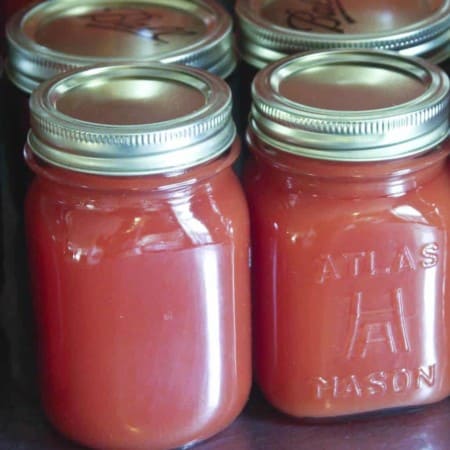
Roasted Red Pepper Spread is just the thing to banish chills to the body or soul. You can’t help but smile when you see the bright red jars with flecks of basil peeking out at you. And when you open it? It’s everything wonderful about summer encapsulated in one little jar. The silky smooth, thick red pepper spread with the full taste -courtesy of tomatoes, garlic, onion, and red wine vinegar- is at home dolloped on fried eggs, spread on toast, as a pizza sauce, or as a dip (either alone or stirred into mayonnaise or softened cream cheese.)

While my poor husband may never recover from the suggestion that winter is soon to follow, I would be remiss if I didn’t offer the following tip; if you tie a simple gold, silver or raffia ribbon and gift tag around the top of the jar, it makes a beautiful and tasty (and perfectly colored) Christmas gift. Red and green and good taste. What could possibly be better?

The recipe yields around five eight-ounce jars, but can easily be doubled or tripled. I recommend an automatic doubling of this recipe if you intend to give it as gifts, because once you taste it you won’t want to part with it. That is as incontrovertible a fact as the passing of the seasons.

Roasted Red Pepper Spread

Rating: 51

Yield: About 5 eight-ounce jars

Roasted Red Pepper Spread is just the thing to banish chills to the body or soul. It’s everything wonderful about summer encapsulated in one little jar. The silky smooth, thick red pepper spread with the full taste -courtesy of tomatoes, garlic, onion, and red wine vinegar- is at home dolloped on fried eggs, spread on toast, as a pizza sauce, or as a dip (either alone or stirred into mayonnaise or softened cream cheese.)

Adapted from The Ball Complete Book of Home Preserving

Ingredients

  • 5 ¾ pounds sweet red bell peppers
  • ¼ pound fresh cayenne peppers (or other red-hued hot peppers) (If you don’t like heat, use an additional ½ pound of sweet red bell peppers.)
  • 1 pound plum tomatoes
  • 1 small onion, unpeeled and uncut
  • 3 large cloves garlic, unpeeled and uncut
  • ½ cup red wine vinegar
  • 2 tablespoons, packed, thinly sliced (chiffonade) of fresh basil
  • 2 teaspoons sugar (I prefer raw)
  • 1 teaspoon salt

Instructions

Preheat the broiler in your oven. Spread the peppers, tomatoes, onion, and garlic cloves in a single layer on a rimmed baking sheet. Roast under the broiler, turning frequently, until the peppers are softened and blackened all the way around, and the tomatoes, onion and garlic have some black spots on them. The more thoroughly blackened the peppers are, the easier they are to peel. Transfer the peppers and tomatoes to a paper bag, fold the top down three or four times to seal it, then let cool about 15 minutes, or until the produce is cool enough to handle. Set the onion and garlic on a cutting board to cool as well.

When the peppers and tomatoes have cooled, use your hands to rub the skins off as well as you can. Don’t panic if a bit of the skin remains. Cut the peppers open in order to remove their stems and seeds. Rip the peppers into strips and put into a blender or food processor (in batches if necessary) and process until smooth. Pour into a stainless steel stockpot and repeat the process with the tomatoes.

Peel the onions and garlic then finely chop both. Add this and the remaining ingredients to the purees in the stockpot and stir to combine. Bring to a boil over medium high heat, stirring frequently to prevent scorching. Lower the heat to medium low and continue a gentle boil, stirring often, for about 20 minutes, or until the spread can be mounded on a spoon.

You may either refrigerate the red pepper spread at this point, or freeze it in single serving sizes, or can it to make it shelf stable.

To can the spread for long-term storage:

Ladle the hot spread into prepared 8-ounce jars leaving ½-inch of headspace. (For information on how to do this, click here ) Use a stainless steel chopstick or butterknife to remove any air bubbles. If the level of the spread lowers after air bubbles are removed, you can add more hot spread.

Wipe the rims of the jars with a damp cloth, put the lid in place, and screw on the rings until fingertip tight. Place on a rack in a canner, cover with hot water, and bring to a boil with the lid on the canner. Once the water reaches a full rolling boil, begin a 10-minute timer (15 minutes for pints). When the timer is done, remove the lid from the canner, turn off the heat and let it stand for 5 minutes before carefully transferring the jars to a towel or rack on the counter to cool, undisturbed.

When the jars are completely cool, remove the rings for storage, wipe the jars clean and label. Store in a cool, dry place for up to a year.

http://www.foodiewithfamily.com/2011/09/22/roasted-red-pepper-spread-gardeners-delight-eggs/

Would you like another good reason to have this on your shelves? I gotcha covered! This is my current favourite breakfast.

Gardener's Delight Eggs

This almost instant breakfast delivers a hugely satisfying punch of flavour courtesy of big, bold, smooth, garden-fresh Roasted Red Pepper Spread dolloped on fried eggs with pan-fried tortilla rounds. This breakfast will keep you going for hours.

Ingredients

  • 1 egg
  • 1 tablespoon butter
  • 1 flour tortilla, cut into quarters or rounds (with a biscuit or cookie cutter)
  • 2 tablespoons Roasted Red Pepper Spread (see recipe above)
  • salt and pepper to taste
  • Optional: Fresh basil, thinly sliced (chiffonaded)

Instructions

Melt the butter in a heavy-bottomed skillet. Crack the egg and slide it onto the skillet near one edge. Place the tortilla rounds or wedges along the other side of the skillet. Flip the tortilla rounds when they begin to lightly brown. Toast the other side and transfer to a serving plate.

Cook the egg, flipping once if desired, to your preferred doneness. Use a spatula to place the fried egg on top of the toasted tortillas. Top the egg with the Roasted Red Pepper Spread. Sprinkle with fresh basil, if desired.

http://www.foodiewithfamily.com/2011/09/22/roasted-red-pepper-spread-gardeners-delight-eggs/

Smoky Roasted Tomatillo and Tomato Salsa


Are you ready for some salsa? It’s a salsa time of year, after all. Now is the time for all good tomatoes to come to the aid of the salsa. Salsasalsasalsasalsasalsasalsasalsasalsa!

Clapclap. Clap. Clap. Clap. Clapclap. Clap. Clap. Clap*

*Ahem. That’s a salsa beat. Trust me.

It’s not that I get carried away over salsa in general, but I do over this particular salsa. Aside from fresh salsa (pico de gallo, or whathaveyou) this is what every single little salsa wants to be when it grows up. It’s smoky, thick, brick-red, and vibrant with guajillo and chipotle chiles, roasted tomatoes and tomatillos, and garlic that you forget you’re eating a jarred salsa. This is the salsa that makes people stop and say, “WOW!” and “Where’d you get this?” That, my friends, is no time for humility. Show them the rows of this on your shelves and puff your chest out a bit and say, “I made it.” I’d advise you fix a dollar amount in your head before serving to company, though, because you will inevitably be asked by reasonable people how much you would charge for a jar*.

*Unreasonable people, or younger siblings, however, will ask, beg and plead for you to give them a jar for free and remind you of the fact that they never told mom that you made them wear your fluffy pink nightgown in exchange for playing Hot Wheels and Matchbox cars with them even though they still don’t know you would’ve played it anyway because you liked them better than Barbies anyway.

It is best to be prepared is my point.

Back to the salsa. There are a few key points that differentiate this salsa from your average chunky jarred stuff.

  • It uses dried, reconstituted chiles instead of fresh ones. For some reason this just feels so much easier. Am I crazy? Maybe. But this is what my brain says and I’m listening.
  • It is made from roasted tomatoes rather than blanched, peeled, seeded, chopped tomatoes. (Read: two-step tomatoes rather than four-step tomatoes.) This makes peeling easier because you roast the tomatoes, put them in a paper bag, crimp the top and wait a few minutes, then the skin just sloughs right off. I’m sorry about using slough while talking about food. I know it’s not appetizing, but I couldn’t think of another word that fit just right.
  • It is a “ground” salsa. Instead of uniformly (and angrily, depending on how much salsa you’re making and how many times you’re interrupted by the people who will eventually eat this salsa) hand chopping all the prepared ingredients, you toss them into the food processor and pulse until all the contents have been chopped to the point where they’re pretty derned little. Almost (but not quite) smooth. Why? Well, because I can. And because it tastes great. And because my kids like it better that way. And because it makes this end product more versatile. You can dump a jar on a pork or beef roast or a whole chicken, marinate it overnight, then drop it in the crockpot the next day on low. After several hours, shred everything together for the ultimate in simple main dishes. Eat the meat on sandwiches, on barbecue pizzas, in quesadillas, in this glorious dish, or on tacos. I guarantee you’ll come up with many more ways to use meat cooked in this salsa.
  • It just plain tastes better. I realize that’s not scientific or terribly persuasive, but there you have it. This is the best salsa in the world.

I have one final piece of advice about this salsa. Double the recipe. You really should just trust me on this or one of two things will happen to you. You will find yourself crying over your last jar of salsa between bites ~OR~ you will be reduced to guarding your stash jealously, suspiciously staring down anyone walking past your pantry or basement stairs and menacingly slapping a wooden spoon against your palm to show them you mean business. It will be easier on your mind in the long run if you just go ahead and double it. You’ve been warned.

Smoky Roasted Tomatillo and Tomato Salsa

Smoky Roasted Tomatillo and Tomato Salsa

It's smoky, thick, brick-red, and vibrant with guajillo and chipotle chiles, roasted tomatoes and tomatillos, and garlic that you forget you're eating a jarred salsa. This is the salsa that makes people stop and say, "WOW!" and "Where'd you get this?" Be sure to double the recipe because it will be one of the most popular things you ever can.

Recipe from the canning bible: The Ball Complete Book of Home Preserving.

Ingredients

  • 12 dried chipotle chile peppers, stemmed
  • 12 dried guajillo (cascabel) chile peppers, stemmed
  • 2 cups boiling water
  • 2 pounds tomatillos, husks removed
  • 2 pounds plum tomatoes, cored
  • 1 large onion
  • 1 head garlic, broken into cloves with excess paper brushed away
  • 1 cup cider vinegar
  • 2 teaspoons sugar (raw or granulated)
  • 1 teaspoon salt (non-iodized)

Instructions

Place a large, dry, heavy skillet over medium heat.

Toast the chipotle and guajillo peppers on both sides (this may take more than one go-round as the size of the skillet determines how many peppers you can fit in at a time without overcrowding), about 30 seconds to a side, until they are pliable and fragrant. Transfer the toasted chiles to a stainless steel or glass bowl and pour the 2 cups of boiling water over the peppers. Weight the peppers down with a bowl or plate to keep them submerged and cover the whole bowl with plastic wrap or a tight cover for 15-30 minutes or until the peppers are softened.

Transfer the contents (water and peppers both) to a blender or food processor fitted with a metal blade and process until smooth. Set aside.

Put cored plum tomatoes, tomatillos, onion, and garlic in a single layer into a rimmed baking pan. Put them under a broiler set on high until tomatillos and tomatoes are blistered, blackened and softened and onions and garlic have black spots on them. Put tomatillos and tomatoes into a paper bag and cinch the top closed. Set aside until cool enough to handle, about 15 minutes.

Pull the tomatoes out one at a time, rub them to remove the skins, depositing the peeled tomatoes directly into the food processor bowl that is fitted with a metal blade. When the processor is full, pulse until smooth. Pour the smooth processed tomatoes into a large, stainless steel stockpot. Repeat with the remaining tomatoes and tomatillos.

Peel the onions and garlic and pulse in the food processor until finely chopped. Add those to the tomatoes and tomatillos in the stockpot.

Add the reserved pureed chiles and remaining ingredients to the stockpot and stir until evenly distributed.

Prepare canner, jars and lids. (For more information on how to do this, see this link. )

Bring the tomato mixture to a boil over medium-high heat, stirring constantly. Reduce the heat to a simmer, stirring frequently, and continue simmering until it thickens slightly. This should take about 15 minutes or so.

Ladle the hot salsa into the prepared jars, leaving 1/2-inch (1 cm) of headspace.

Use a stainless steel chopstick or butterknife to remove any air bubbles. If you need to add more salsa to maintain the headspace, do so.

Use a clean towel dampened with vinegar to wipe the rims of the jars.

Center the lid on the jar then screw on the band until fingertip-tight. Don't overtighten but don't leave loose!

Place jars into a canner, cover with water by an inch, and bring to a boil with the lid on the canner. Once the water reaches a rolling boil, begin a 15 minute timer. When the timer expires, turn off the heat, remove the lid to your canner and let the jars rest in the water for 5 minutes.

After five minutes, carefully transfer the jars to a towel or cooling rack on your counter and let stand, undisturbed, for 24 hours. Any jars that did not seal should be stored in the refrigerator.

After 24 hours, remove the rings for the sealed jars, wipe the jars clean and label them for storage. Store with the rings off (and in a single layer.) This is a little insurance policy. If there is bacterial growth in the jars, the bacteria will produce gas which will loosen and push up on the lid. This is an indicator that the jar has gone bad. If you have the rings in place, the lids cannot loosen and pop up to tell you something is wrong.

Store in a cool dry place for up to a year.

http://www.foodiewithfamily.com/2011/09/14/smoky-roasted-tomatillo-and-tomato-salsa/


Boiled Cider (Apple Molasses)

I am a magician.

You see that wine bottle? I fit two whole gallons of apple cider into it.

Really.

Okay, I boiled the cider down until it fit, and I didn’t have to work hard to do it. Yes, it took nearly six hours, but I didn’t stir it and wasn’t even in the same room (or same floor of the house for that matter) for more time than it took to pop in and confirm that, yeah, it was still boiling, and mmm-hmmm, it was still shrinking in volume.

So what’s the point behind this exercise?  I am about to let you in on an almost-forgotten little piece of America’s food history. This thing goes all the way back to the sixteen-hundreds, the introduction of apples as a crop and the European settlers. I’m talking about Boiled Cider.

Oh, I know. The name? Boring. Totally. Sometimes it has been referred to as apple molasses which ,while a little more jazzed up comparatively speaking, still sounds pretty meh. Believe me, though, there is nothing bland, boring, or unexciting about Boiled Cider.

You know when you get a really good glass of fresh, icey cold apple cider straight from the mill; The way your tastebuds perk up and your mouth actually waters from the tart sweet cider? Imagine that times seven*. Add to that a hint of caramelization, and a thick, pancake syrupy consistency and you have Boiled Cider. It is beautiful in its simplicity. It is just cider. No sugar, no flavourings, no preservatives, no fancy canning. It is only cider boiled down into a thick, shelf-stable syrup that makes just about everything better by its mere presence. There is no added sugar, it is the natural sweetness of the apples that makes this so good.

*Seven is not an arbitrary choice for this comparison. When boiling cider down for this project you want to reduce it to one seventh of its original volume.

Boiled Cider started as a way the settlers devised to preserve cider long past when even hard cider would be drinkable and would pass into irretrievably vinegar territory. Kept in a bottle on the pantry shelf, this stuff lasted through the winter and into the next apple season for them and it will do the same for you.

What do you do with Boiled Cider? Let me get you started, but once you have this handy, you’ll be off and running.

  • Drizzle over vanilla ice cream.
  • Use to baste pork roasts or chops, ham, chicken or glaze other meats.
  • Stir a little into hot tea.
  • Pour some into a mug, add a shot of whiskey or brandy, and top off with hot water.
  • Toss a tablespoon or two to the sliced apples for a pie or apple crisp. You will be blown away by how much more appley it tastes. (I know many professional bakers add this to their pies and crisps as their secret ingredient!)
  • Whisk into cream cheese icing for a pumpkin spice cake and be prepared for the compliments.
  • …Our personal favourite: Pour a tablespoon over ice, fill the rest of the glass with seltzer water, and give a quick stir. Voila! Healthy apple cider soda!

Lipsmacking just doesn’t cover it. This is… It’s… Could words be failing me? It’s like everything wonderful about fall condensed into one syrup. It’s pure, distilled essence of apple. It’s completely and utterly wonderful. And you get all this just by boiling a pot of cider.

Don’t wait. Make some of this for yourself as soon as possible. Have it on your shelf. Then, in December, January, February -whenever you need a boost- pull out your bottle of this opaque, deep reddish brown elixir and pour out a little measure of happiness. You’ll be so glad you did.

Boiled Cider (Apple Molasses)

Boiled Cider is everything wonderful about fall condensed into one syrup. It's pure, distilled essence of apple. It's completely and utterly wonderful. And you get all this just by boiling a pot of cider.

Ingredients

  • 2 gallons apple cider (or less, but remember you will be reducing this to 1/7th of it's original volume.)

Instructions

Pour apple cider into a very large, non-reactive stockpot (stainless steel, copper, or glass, but NOT aluminum unless it's coated.)

Use a clean ruler or wooden stick that you can mark with the starting level of the cider.

Turn heat to high, cover the pot with a splatter screen (to prevent flies or other insects from dropping into the pot) and bring to a boil.

Boil the cider hard until it has reduced to 1/7th of its original volume. Watch more carefully toward the end because it may creep up higher in the pan as it becomes thicker and bubbles stack up on each other. Turn off the heat and let the bubbles die down to check the depth of the liquid with your ruler or dipstick. You should end up with approximately the volume that it takes to fill a clean, empty 750ml wine bottle.

Pour into a clean, sterile jar (for long term storage) or a clean, empty wine bottle (for short term, refrigerated storage). Cover tightly and store in a cool, dark place.

http://www.foodiewithfamily.com/2011/09/08/boiled-cider-apple-molasses/

Homemade Hot Italian Sausage Links


There is a lot of pretty food in the world; Much of it provokes your salivary glands into action when you look at it. But if you lay out a bunch of pictures of beautifully photographed food side by side, the one that’s going to fire me up the most is going to be a perfectly cooked sausage. There is no food that makes me hungrier just to think about it.The snap of biting into it (because a great sausage link always, always, ALWAYS has a snappy casing), the perfectly moist interior, the balance of spices and herbs and the fat.

There’s no getting around it. A sausage needs fat. No fat/low fat sausages = not sausage. It’s true. If there is no or low fat it is simply spiced up ground meat stuffed into a casing. That’s not to say it’s going to be bad, but it is what it is and what it isn’t is a sausage.

For many moons, I’ve made my own bulk sausages (in other words, not in casings) but I’ve had a hankering to stuff sausages for quite some time. This urge, desire, obsession, whatever-you-call it, is the fault of Bell’s Meat Market in Kane, Pennsylvania. When my dad was working at a camp down in the Harrisburg area, Kane was directly on the path between our two homes. En route to or from my house, my dad and stepmom had discovered this little place in this little town that made what had to be the best hand made sausages any of us had ever eaten. Since the drive was well outside of the “I’d drive that far for a craving” range, the idea of making exquisite sausages (not to be confused with the a-okay for every day but not earth-rockingly wondrous variety available at local grocers) firmly rooted itself in my mind.

When Dad and Val moved back to the Upper Peninsula, Kane was no longer on the way to or from and the situation became culinarily urgent.

Then came Charcutepalooza. This “Year of Meat” project brought people from all walks of life together to get all meaty together.  Cooking from scratch? You bet. Canning? Oh sure, everyone has dabbled in that, but preserving your own meat? That was hardcore. And I was all over it. I bought the “manual” for our collective project, “Charcuterie: The Craft of Salting, Smoking and Curing” by Michael Ruhlman and Brian Polcyn. Reading that book made me feel like the heavens had opened and the angels were singing. There was the answer to my sausage conundrum. I had the method, I had the basics, and I was ready.

I recruited my nine year old minion because he is currently infatuated with the Two Fat Ladies and is willing to do anything and everything remotely connected to Jennifer and Clarissa (and he had watched an episode where they made Bangers and Mash the night before our grand project.) With Ty turning the handle on our old school meat grinder/sausage stuffer and me feeding meat into the hopper and then manning the casings (an admittedly off-putting and slightly blush-inducing job),  we managed to turn out a glorious string of Hot Italian Sausage Links.  To say we were proud would be an understatement. We shuffled around like the Tim-Conway-as-the-old-guy-on-Carol-Burnett saying, “Would you like some huh-weenies?”

Those sausages were not going to be admired for long. We popped half of them in the freezer (for later minestrone or Sunday sauce or some other such project) and put the other half straight into a pot to simmer in beer before their ultimate destination… The grill.

We cut peppers and onions into strips to fry up with olive oil and garlic.

Let’s have a word about properly grilling sausages, shall we? If you throw them on a hot grill and ignore them you’re going to, in all likelihood, have three tragic things happen.

  1. You will have unevenly cooked sausages.
  2. Your sausage casings will explode which will cause tragic thing #3.
  3. You will have dry little sausage jerkies because all the juices and fat will leak out on account of the breached casings.

There is no drama like sausage drama, so let’s discuss how to do it the right way, shall we? This applies to all “raw” sausages, not just homemade ones.

  1. Gently par-boil your sausages in something yummy. Beer, apple cider, wine? All good choices. If you want to know what is best to use, consider whether what you’re using for simmering would be tasty served alongside the finished sausage. If the answer is yes, then use it! The goal here is to get heat moving into the sausage, not to cook it completely.
  2. When you move on to grilling, put the sausages over moderate direct heat to start with so you get nice browning on the outside.
  3. When you have some nifty grill marks and tantalizing browning started, move the sausages to indirect heat (in other words, not directly over the flames/coals/what have you, until it is done through. For these sausages, that is 150°F.

When the sausages look like this, make haste in getting them off the grill!

These were crackling crisp on the outside and juicy on the inside. This is a good reminder of why you want the casings to pop open only when you bite them. All that lovely fat and those intense juices from the meat were contained in the casing.  If you do it right, you get to eat all that good stuff. If you do it wrong, it sizzles out onto the grill and is wasted forever and ever amen. Not to put too fine a point on it or anything, but a dry sausage is a sad sausage.

This is not a sad sausage.

Neither were the other two that I ate. I’m just being honest.

Homemade Hot Italian Sausage Links

Prep Time: 1 hour

Heavily seasoned with garlic, Italian herbs and spiced up with crushed red pepper flakes and cayenne, this succulent Hot Italian Sausage is worth every effort involved in making it. You can stuff it into casings to make links, or leave it in the bulk form for browning and adding to sauces. Either way, you won't want to go back to store bought after eating this!

Ingredients gently adapted from Michael Ruhlman and Brian Polcyn, but the method is theirs.

Ingredients

  • 4 1/2 pounds boneless pork shoulder butt, trimmed of sinew (but not fat) and cut into 1 1/2" cubes
  • 8 ounces pork back fat, partially frozen and diced into 1/2" cubes
  • 3 tablespoons kosher salt
  • 2 tablespoons white or raw sugar
  • 3 tablespoons fennel seeds, toasted or not
  • 1 teaspoon ground coriander (or 1 tablespoon coriander seeds)
  • 3 tablespoons sweet paprika (not hot)
  • 1/2-1 teaspoon cayenne pepper (depending on how hot you like it)
  • 4 tablespoons fresh oregano leaves (or 1 1/4 teaspoons dried)
  • 4 tablespoons minced fresh basil leaves (or 1 1/4 teaspoons dried)
  • 1 tablespoon minced fresh parsley (or 1/2 teaspoon dried)
  • 2 tablespoons crushed red pepper flakes
  • 2 teaspoons freshly ground black pepper
  • 3/4 cup ice cold water
  • 1/4 cup red wine vinegar, well chilled
  • If you want link sausage you will also need 10 feet natural casings soaked in room temperature water for 30 minutes then rinsed.

Instructions

Combine the pork and the rest of the ingredients (minus the vinegar and water) and toss to evenly distribute the seasonings. Cover tightly with plastic wrap and refrigerate for 1-12 hours before proceeding.

Using a small die or disc on your meat grinder, grind the meat/spice mixture.

Transfer the meat into the work bowl of your stand mixer (or into a very large mixing bowl) and mix the vinegar and water in with the paddle attachment (or a hefty, sturdy spoon) until the liquids are all fully incorporated and the meat is sticky and uniform in appearance. This should take about 1 minute on medium speed.

Pinch off a quarter-sized amount of the sausage and pan fry it to check for seasonings. Adjust if necessary before proceeding.

Thread the casings onto your sausage stuffer and fill, taking care not to overfill but also not to leave air pockets, and twist it into links of your desired size.

Cook immediately with desired method or store tightly wrapped in the freezer.

http://www.foodiewithfamily.com/2011/09/06/homemade-hot-italian-sausage-links/


Foodie With Family's Favourite Grilled Italian Sausage with Peppers and Onions

There is nothing quite like a grilled Italian sausage with a hearty dose of yellow mustard and garlicky peppers and onions to make you feel like all is well in the world. I heartily recommend you try our favourite version of this classic!

Ingredients

  • 6 raw hot Italian sausage links
  • 1 can (12 ounces) drinkable quality beer (lager or ale is a good choice here)
  • 1 tablespoon extra virgin olive oil
  • 1 large onion, sliced into half and then into thin strips
  • 2 large bell peppers, green, red, orange or yellow or a blend, sliced into thin strips
  • 2 cloves garlic, peeled and roughly chopped
  • 1/2 teaspoon kosher salt
  • 6 hearty sausage rolls or Homemade Hot Dog Rolls
  • Lots of yellow mustard!

Instructions

Preheat half of your grill to high (or build a bed of moderately hot coals on one half of the grill.

Place the sausage links in a single layer in a heavy-bottomed skillet and pour the beer over the top. Put the lid on the pan and bring up to a boil, covered tightly, over medium high heat. As soon as it boils, remove the lid, drop the heat to low and simmer for 1 minute only.

Transfer the sausages to the hottest part of the grill. Cook them, turning often, until they start to become golden brown.

Immediately move them to the coolest part of the grill and let them cook , turning frequently, until they are very hot all the way through (150°F on an instant read thermometer).

Move the sausages to a platter and tent loosely with foil while working on the peppers and onions.

Heat the olive oil in a heavy-bottomed skillet over medium high heat. Add the sliced peppers, onions, and garlic, sprinkle with salt, and stir to coat. Continue cooking, stirring frequently, until the peppers and onions are tender with just a little bite in the center. Transfer to a bowl.

Serve each sausage on a bun, smeared with yellow mustard and piled with sauteed peppers and onions!

http://www.foodiewithfamily.com/2011/09/06/homemade-hot-italian-sausage-links/

Snickerdoodle Cake with Brown Sugar Cinnamon Buttercream

Here is the cake that upended my tidy little world. This is a Snickerdoodle Cake with Brown Sugar Cinnamon Buttercream.

I’ve mentioned before that I’m not fond of cake or frosting. (Here and here, for starters…) As a little girl, I watched “Pollyanna” over and over. I’m talking about the original nineteen-sixty Disney film. It was one of the twenty five movies available for rental in the small movie  section of the Glen’s Market in Gaylord, Michigan where we shopped.  Despite my dislike for cake, I dreamed of the giant slab of cake she scored at the fair. That towering layer cake called to me like no other cake could. And for the most  of my life, I resigned myself to the fact that while that Pollyanna cake looked so good, no cake measured up to the promise it offered.  That is still true except. for. this. cake.  And who do I blame thank for this earth shaker? My friend, Krysta. She, without a word, sent me this link. No word of warning, no heads-up. No. Just a link. She knows my feelings on snickerdoodles so she sent it my way. She didn’t know it, but she delivered my Pollyanna cake to me.

All of a sudden, in my brain at least, I was Hayley Mills wandering around a small town fair with the world’s largest slice of layer cake and a sunny disposition. I might’ve even belted out the National Anthem and poked at the little prism dangling in my kitchen window. It was as good as I thought it would be.

The cake itself is a cinnamon vanilla butter cake. (I died a little bit just typing that…) It is moist, it is cinnamon-y. I’ve never had a cake like that. It is layered around and slathered with the only buttercream I have ever craved in my life; brown sugar cinnamon butter cream. (A little more dead now…) It is smooth yet still crunchy with sugar. It has little bursts of brown sugar and cinnamon and it is smoothed out with half and oh-my-goodness half. People. The buttercream. It must be stopped.

Who’s in?

Here are some tried and true cake baking and decorating tips to help you get the most polished finished product before you polish off your finished product.

  • To butter two pans easily, smear the pans with the butter wrappers you used for the cake itself (use more soft butter if necessary.) *If you choose to use parchment, too, butter under AND over the parchment for easiest release.
  • To flour those pans neatly, toss 1/4 cup of all-purpose flour into one pan, swirl it around over the second pan then tap the excess into the second pan. Repeat the process with the second pan, then tap the excess into the garbage.
  • When dividing cake batter between pans, use a scale to get them as close to even as possible. No scale? Scoop it in with a measuring cup.
  • Smooth the top of the cake batter into the pan and tap firmly on the counter several times before baking to settle the batter evenly.
  • Rotate pans front to back and side to side mid way through baking.
  • Cool the cakes COMPLETELY before slicing into layers. Do not hurry this or you will regret it immensely while you cry over your broken cake.
  • Before slicing your cooled cakes into layers, use a large serrated knife to even up the top of the cake. (In other words, to slice off any dome that formed while baking.)
  • Before you move your cake to the plate you’ll use to frost and serve it, lay four strips of parchment or waxed paper around the edges. Center the cake on the parchment strips. This will help you frost the cake rather than the plate. When you’re done frosting, pull the strips straight away from the cake. Ta da! Professionally done. Go you!
  • Make sure each  layer of frosting/cake is level before adding another level. It is much easier to adjust as you go along than to try to fix everything with frosting.
  • When the cake is assembled, refrigerate for at least an hour (preferably more) before attempting to slice into wedges. If you skip this step, the cake is likely to shift around on the frosting and look like it was thrown together by drunken monkeys.
  • If you forget all of these steps it really won’t matter because you’ll still have this cake. Pour yourself a nice hot cup of coffee or tea and enjoy it anyway!

Before you rub your eyes and question me, that is not a typo. Yes, there really ARE 4 1/2 sticks of butter in the buttercream. I told you it must be stopped.

Snickerdoodle Cake with Brown Sugar Cinnamon Buttercream

Prep Time: 25 minutes

Cook Time: 35 minutes

Total Time: 1 hour

Snickerdoodle Cake with Brown Sugar Cinnamon Buttercream

The name says it all: Snickerdoodle Cake with Brown Sugar Cinnamon Buttercream. This is the well-loved snickerdoodle cookie rewritten as a moist cinnamon vanilla butter cake layered and surrounded with a smooth, decadent buttercream laced with sweet ground cinnamon and brown sugar.

Gently adapted from Always With Butter

Ingredients

    For the Cake:
  • 1 1/2 cups all-purpose flour
  • 1 1/2 cups cake flour
  • 1 tablespoon baking powder
  • 1/2 teaspoon salt
  • 1 tablespoon ground cinnamon
  • 2 sticks butter (8 ounces by weight), softened to room temperature
  • 1 3/4 cups fine or superfine sugar
  • 4 large eggs, room temperature
  • 1 tablespoon vanilla extract
  • 1 1/4 cups whole milk, warmed to room temperature
  • For the Buttercream:
  • 4 and 1/2 sticks butter (or 1 pound, 2 ounces by weight), softened to room temperature
  • 1 cup light brown sugar, packed
  • 2 teaspoons ground cinnamon
  • 8-9 cups confectioner's (powdered) sugar
  • 1 teaspoon vanilla extract
  • 1/2 cup of half and half, plus more if needed
  • Optional:
  • Whole cinnamon sticks for garnish

Instructions

To Bake the Cake:

Preheat oven to 325°F.

Butter and flour two 8- or 9-inch round cake pans.

In a mixing bowl, whisk together the flours, baking powder, salt and cinnamon. Set aside.

Cream together the butter and sugar until fluffy and pale in colour.

Beat the eggs in one at a time, fully incorporating each egg and scraping down the bowl between each addition. Beat in the vanilla.

Add about 1/3 of the milk, beat to incorporate, then 1/3 of the flour, again beating to incorporate.

Repeat this process, scraping down the bowl as necessary, until all of the milk and flour are added and mixed in evenly.

Divide the batter evenly between the two pans and bake, rotating midway through, for about 35 minutes or until the cake tests done.

Let the cakes cool in the pan on a rack for 5 minutes before turning out onto the racks to finish cooling.

To Make the Buttercream:

Beat together the butter, brown sugar and cinnamon until fluffy and pale in colour.

Add 6 cups of the confectioner's sugar and the vanilla extract and beat, starting on low and moving up to high, until it is fully incorporated.

Scrape down the bowl and add the half and half. Beat to incorporate again.

Add another 2 cups of the confectioner's sugar and beat, starting on low and moving up to high, until fully incorporated. Check the consistency of the buttercream. If it needs to be thicker, add the remaining confectioner's sugar. If it is too thick, add more half and half a teaspoon at a time, beating after each addition, until it reaches the consistency you like.

To Assemble and Frost the Cake:

Level out your cooled cakes and cut each into two even layers.

Place one layer on a cake plate then add a layer of buttercream, spreading to the edges and evening out as you go. Repeat with the remaining layers.

Frost the top and sides of the cake with the remaining buttercream.

If desired, garnish the top of the cake with whole cinnamon sticks.

Cover and refrigerate for at least an hour before slicing.

Store leftovers tightly covered in the refrigerator.

http://www.foodiewithfamily.com/2011/08/26/snickerdoodle-cake-with-brown-sugar-cinnamon-buttercream/

Homemade Chocolate Syrup


It is no secret that I am a big proponent of making things that many folks buy at the store. From the common (potato chips, bread, ice cream, laundry detergent) to the hard-or-impossible-to-find (furikake, candied jalapenos, game stock), home kitchen alchemy can do it if it’s worth having or doing. Sometimes my efforts earn me admiration, but just as often it gets me a resounding, “Why would you bother when you can easily buy this fill-in-the-blank at the store?” My motivation for this DIY spirit tends to vary with the project, but here, in no particular order, are a few reasons that pop up frequently.

  • To save money: I’ve said it before and I’ll say it again. I’m cheap. I want to stretch every household dollar as far as it can reasonably go without breaking. Starting with basic ingredients prepared at home is almost assuredly gentler on your wallet than pre-fab food.
  • To make it taste better: I honestly believe that the best food is never, ever going to come from a box mix or a shelf-stable pre-made package. This is not to say I’m a food snob; I’ll eat just about anything you put in front of me. Food should sustain your body, yes, but it should also nourish your soul, so if I’m the one slinging grub, I’m going to make it the best grub I can possibly sling.
  • To make it better for you: Soup made at home is, unless you’re very heavy handed, certain to contain less sodium than the canned or frozen variety. You can opt to make foods with healthier ingredients (for example olive oil vs. vegetable oil, butter vs. shortening, etc…)
  • To avoid certain ingredients: Thankfully, my husband, children and self are free of food allergies, but there are still certain preservatives and ingredients that I choose not to serve to us. Making our own food from scratch is a much easier way to accomplish that than obsessively reading labels.
  • To know the source of the item: This is not a star-bellied sneetch issue; I don’t care whether something has stars on thars. The problem is that there have been some real problems in the recent past with food, household, or health and beauty items that did not meet safety standards. Besides, why pay for something to come from overseas when I can make it here at home, saving goodness-knows-how-much fuel and/or energy for better purposes?
  • To prove that I can do it: It’s that pioneer spirit, that sisu, that I-don’t-know-what. It’s the same reason my dad put on his winter kit and walked around the house three times after the meteorologist said that the weather was too bad for anyone to be outside. We do this because we are capable and we are not intimidated. If a machine can make it, I darned well better be able to make it, too. (This is where we pound our chests and do warrior cries, folks.)

Chocolate syrup is a big deal around here. Chocolate syrup is stirred into cold milk for chocolate milk, hot milk for hot chocolate, blended into smoothies, squirted on ice cream, peanut butter and banana sandwiches, pound cake,  and –when I’m not looking- directly into mouths. We consume it in vast quantities. A couple years back, I got tired of actively ignoring the ingredient lists (the major brands all have high fructose corn syrup, artificial flavouring, food dyes, and other things on my no-no- list) and paying through the nose for the privilege. A little experimentation yielded a vastly superior in taste, higher quality, far less expensive chocolate syrup that was simple to make and required nothing more exotic than Dutch-processed cocoa powder.

I played around with the classic Alton Brown cocoa syrup recipe and found that our crew greatly preferred it made with raw sugar because of the light caramel undertones it delivers and the added richness. Honestly. How could rich + chocolate go wrong? I make at least one batch (sometimes more if the hot chocolate consumption is especially high around these parts) of this good stuff a month.

Bonuses: If you are looking for fat-free, this recipe is for you! If you’re not looking for fat-free, I suggest making it anyway. This chocolate syrup is mighty good. This syrup can be made with honey if you have corn allergies or aversions chez you.  Try finding a chocolate syrup at the store that is corn syrup free for this price!

Homemade Chocolate Syrup

Prep Time: 5 minutes

Cook Time: 15 minutes

Total Time: 20 minutes

This simple homemade DIY chocolate syrup delivers a mega punch of deep, dark, and chocolatey flavour for drizzling on ice cream, stirring into milk, blending into Coffee Milkshakes , or whatever else your chocolate-loving heart desires.

Ingredients

  • 1 ½ cups water
  • 3 cups raw sugar
  • 1 ½ cups Dutch-processed cocoa powder
  • 1 ½ tablespoons vanilla extract (preferably homemade)
  • ¼ teaspoon kosher or sea salt
  • 2 tablespoons light corn syrup or mild honey

Instructions

Bring water and sugar to a boil in a medium-to-large saucepan (this will expand as it boils in later stages of the recipe), stirring until sugar is dissolved.

Whisk in the remaining ingredients until the cocoa powder is also dissolved. Return to a boil, then lower the heat and simmer until slightly thickened, about 5-8 minutes. You do not want to boil it until it is very thick, as it will become even more viscous as it cools.

Pour the hot syrup through a fine mesh strainer and let cool to room temperature before transferring into squeeze bottles.

Notes: Dutch-processed cocoa powder is used here because it dissolves more easily in liquids than common (a.k.a. natural) cocoa powder; No matter what its other benefits, a homemade chocolate syrup that is gritty isn’t what we want. Dutch-processed cocoa powder is generally easy to find in grocery stores with well-stocked baking sections and in bulk food stores. I use raw sugar in this recipe because I like the added depth of flavour and touch of caramel it contributes. If you cannot find it easily (it is also sold under the names turbinado, sugar-in-the-raw, and demerara) you can substitute white granulated sugar for it. You can get squeeze bottles at big box stores or in the kitchen notions sections of grocery stores. If you use an opaque ketchup or mustard bottle to store your syrup, remember to label it so you don’t forget what’s in there at an inopportune moment. While chocolate syrup is good on many things, hot dogs and hamburgers are not among them.
http://www.foodiewithfamily.com/2011/08/25/chocolate-syrup/

Grandma Val’s Hot Fudge Sauce

First of all, you know this is going to be good; it’s hot fudge sauce. What you may not know, though, is just how good this particular hot fudge sauce is. It is, in fact, the best hot fudge sauce ever of all time Amen pass the beer nuts. This hot fudge sauce is not just the ne plus ultra of hot fudge sauces, it is a thing of power. Let me tell you a story.

My relationship with my stepmom did not begin smoothly because I was, to put it succinctly, a surly nincompoop. There was no nincompoopitude from Val, who assured me kindly that she did not intend to try to take the place of my mother. It was all me people. I had that arena sewn right up.

And Val?

Val never tried to talk me out of  anything. Each time I visited, she smiled, talked books and movies, and fed me. Val turned out amazing food every time I was anywhere near her and it was not long before I removed my foot from my mouth to make room for dinner, and uncrossed my arms so I could hold a fork.

Then one day, Val served me a bowl of ice cream with a generous amount of this hot fudge sauce on it and I was smitten with both the sauce and Val.

I am fortunate enough to know now that my stepmom is one of my best friends AND I have her glorious hot fudge sauce. There isn’t enough time in the world for me to tell you all the things that make Val so wonderful, but I can spell out what makes this hot fudge sauce so special.

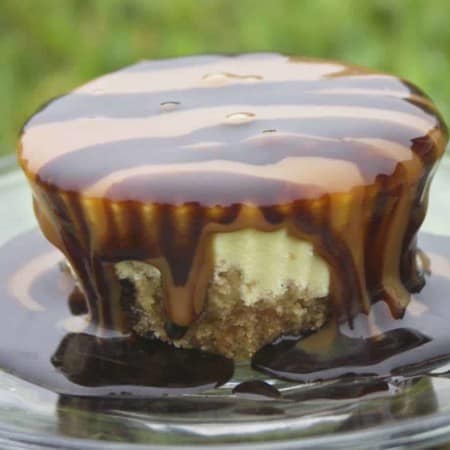
  • This is the best kind of hot fudge sauce. It drizzles onto your sundae and then partially firms up to a stretchy, chewy, caramel-like hot fudgy chocolate crown. Tell me you don’t want to eat that right now.
  • It takes 10 minutes to make and 8 of those minutes you are not to stir anything under penalty of sad sauce.
  • The ingredients are not at all exotic: unsweetened chocolate, butter, sugar, light corn syrup, a pinch of salt and vanilla extract. Hey ho, hot fudge!
  • A spoonful of this, straight from the jar in the refrigerator, is enough to turn a bad day good very, very quickly. I’ll direct your attention to the ingredient list. See? You’re smiling already!
  • This recipe comes from a woman who is arguably one of the most patient, loving, lovely, brilliant, forbearing, forgiving, well-read, witty, insightful people I’ve ever met. You can’t argue with hot fudge that comes from someone like that.

Go make yourself (or someone who you want to make a friend) a batch of this hot fudge sauce. I’ll wait. It’s worth it. In the meantime, I’m going to lick my jar…

4.0 from 1 reviews

Grandma Val’s Hot Fudge Sauce
Author: 
Recipe type: Dessert, Condiment
Prep time: 
Cook time: 
Total time: 

Serves: 8
 

Seriously fudgy hot fudge sauce that firms up ever so slightly when poured over ice cream to form caramel-like ribbons of chocolatey goodness. Oh yes. It does.
Ingredients
  • 6 tablespoons unsalted butter
  • 6 ounces unsweetened chocolate
  • 2 cups granulated sugar
  • ½ cup light corn syrup
  • ¾ cup boiling water
  • 1½ teaspoons vanilla extract
  • pinch of salt

Instructions
  1. Melt the butter and unsweetened chocolate together in a large, heavy-bottomed saucepan over low heat, stirring occasionally.
  2. Stir in sugar, corn syrup, and boiling water.
  3. Increase heat to medium and stir mixture until it reaches boiling.
  4. Boil without stirring for 8 minutes. Really. Do not stir that stuff.
  5. Remove from heat and stir in the vanilla extract and salt. It will bubble up violently, so be careful.
  6. Let rest for 5 minutes before pouring into a heat-proof container with a tight fitting lid. (A canning jar works perfectly for this situation.) Be certain the container you use is small enough to fit into the microwave for reheating purposes.
  7. Leftovers can be stored in the refrigerator.
To Reheat:
  1. Remove lid from the jar and microwave for about 30 seconds.
  2. Stir.
  3. Heat in additional 10 second bursts until the hot fudge flows freely when poured.