Grilled Summer Salad


There are few things I like better on a hot day than a cold salad. If it happens to be one that I was able to whip up when the day was still cool or -better yet- the day before, I’m even happier. When that salad takes advantage of the best parts of summer produce I’m ecstatic.

I am grateful to have something to love about all four seasons. My affection for summer is entirely wrapped up in the fresh vegetables. Well, alright. It is kind of nice not to trip over snow boots in the mudroom for a couple of months. But the produce. Oh, the produce!

While the variety available to us in stores is nothing short of remarkable, there simply is nothing that compares to produce grown nearby and eaten in season. Everyone knows a frozen ear of sweet corn from a grocery store just can’t hold a candle to an ear that was picked from the field earlier that day.

I used to be a corn boiler. Everyone I knew was a corn boiler. It was just how we did things. Then -nearly a decade ago- I picked up the Nero Wolfe detective books by Rex Stout. I identified with Nero’s obsession with food and when -in one book- he  frantically pursues the perfect sweet corn while the police inspector wants him to pursue a killer. I totally got it. I mean really. If you gave me the options of tracking down the perfect sweet corn vs. a cold blooded killer? I’d go with the corn every day. I’m a scaredy cat.

At one point, though, Nero Wolfe said something that made me question my lifelong corn boiling habits:

“Boiled in water, sweet corn is.. edible, and nutritious.  But roasted in an oven, at the hottest possible temperature for 40 minutes. Shucked at the table. Buttered. Salted. Nothing else! Ambrosia.”

Well, shoot. Ambrosia? I had to give that a whirl. The first time I made Nero Wolfe’s corn, I did indeed use my oven. And it was absolutely ambrosia, but the smell of burning husks in the house was less than wonderful and it was bloomin’ hot out to be firing up the oven to the hottest possible temperature. I moved my endeavours outside to the grill, adjusted the heat (because hottest possible temperatures in grills and home ovens are vastly different), and in the process learned what the entire southwest has known for I-don’t-know-how-long: fire roasted corn is incomparably delicious.


From that day on, there was simply no other way to cook corn (with one sad foray into cooler corn.)  I almost always deliberately cook more corn than we can possibly eat in one setting. Believe me, that takes work… we can eat a lot of corn.

One of our favourite ways to use the extra grilled corn (with its extra boost of concentrated corn flavour) is in a Grilled Summer Salad. We change the salad up, depending on what is most readily available from our garden or the local farmers’ market, but the backbone of the salad is always grilled corn and zucchini. Everything else is negotiable.

Grilled zucchini is in the same category as grilled corn. It is just plain better. There’s something about the time on that hot grill that turns a vegetable that has a reputation for insipidity into a flavour explosion. I prefer the texture of grilled zucchini, too. There’s nothing complicated about it. Slice the zucchini into half-inch slabs, brush with olive oil and sprinkle with salt and pepper or Montreal Steak Seasoning (my preference) then pop on a hot grill. When they’re marked by the grill, they’re done enough. How simple is that?

I usually fill out the salad with roasted red pepper, garden tomatoes, garlic, parsley and a little squeeze of lemon juice… not too much… just a bit. If I’m feeling particularly peckish, I’ll crumble a little feta cheese in there. With the feta, it’s a stand-alone vegetarian meal in a bowl, but it does do a marvelous job of accompanying grilled meats or fishes. I almost always make as large a batch of this as my refrigerator can accommodate. I have been known to walk past the refrigerator with a fork just to dip into a bowl of this. I suppose that’s not a bad thing. I could be snacking on much, much worse things. (Ahem. Frito habit.)

Get out there and make this while the getting’s still good. Fresh veggies won’t be around that much longer!

Grilled Summer Salad

Grilled Summer Salad

Summer vegetables take center stage in this seasonal salad that takes advantage of grilling sweet corn and zucchini to bring out the best of both. Serve this at your Labor Day festivities to guarantee praise!

A light lemon dressing and a little feta cheese (optional) round out this refreshing and healthy-habit forming dish that can be a stand-alone vegetarian meal or accompany grilled meats of fishes with equal aplomb.

Ingredients

  • 2 medium to large zucchinis
  • olive oil
  • Montreal Steak Seasoning or salt and pepper
  • 2 large beefsteak type tomatoes
  • 2 ears leftover grilled corn , cut from the cob.
  • 1 clove garlic, peeled and minced or pressed
  • 1/2 cup crumbled feta cheese
  • a fistful of fresh parsley, roughly chopped
  • 1 tablespoon lemon juice
  • salt and freshly ground pepper to taste

Instructions

Preheat a clean gas grill to HIGH (or build a hot bed of coals on a charcoal grill.)

Slice the zucchini into 1/2-inch thick slabs. Brush both sides of each slab with olive oil and sprinkle with Montreal Steak Seasoning or kosher salt and freshly ground black pepper. Place the zucchini directly on the grill. With the lid open on the grill, leave the zucchini slices in place until there are grill marks on the zucchini, carefully lifting the corner with tongs to check occasionally. This should not take more than 3 minutes. Flip the zucchini and cook until the other side has grill marks, about 2 minutes. Use tongs or a spatula to transfer the grilled zucchini to a rimmed pan.

Put the rimmed pan, uncovered, in the refrigerator until the zucchini is cool to the touch, about 30 minutes to an hour.

Dice the chilled, grilled zucchini and the tomatoes. Toss them together with the remaining ingredients in a large mixing bowl. Transfer to a container with an airtight lid and refrigerate for at least an hour before serving.

http://www.foodiewithfamily.com/2012/08/31/grilled-summer-salad/

Waffle Iron Hash Browns and Chorizo Hash

I absolutely, unequivocally, unabashedly, whole-heartedly, borderline-medicably love potatoes in just about every form they can possibly be served; Mashed, fried, baked, smashed, roasted, grilled, and most especially in grated hash brown form. Oh hash browns, you are so magical. The crunch to soft ratio is so perfect on you. Every bite is a beautiful thing.

I’m going to say something everyone knows is true, but it’s unpopular to point it out. Potatoes need fat. Oh, yes they do. I don’t do skinny potatoes. (Unless we’re talking about fingerlings doused in melted butter.) Potatoes cry out for fat. It’s practically the law. And hash browns are no exception to that rule. In fact, they require a little more fat than the average tater.

Given my love for the ever wondrous hash brown, it should come as no surprise that when I saw this pinned on Pinterest, I about broke my neck getting to my waffle iron. Waffles are already in the “How do I love thee, let me count the ways” category of foods for me because of the crispy little pockets of syrup-catchery. The idea of putting hash browns in the waffle iron to better catch sour cream, bacon jam, hot sauce, etc… made instant sense to me. I grabbed a bag of frozen hash browns (keep frozen hash browns in case of potato emergencies), generously buttered my waffle iron plopped a massive pile of shredded frozen potatoes in place, added a dollop of bacon fat (don’t look at me like that) and closed the waffle iron. Then I stood there and watched while tapping my foot. Then I clenched my fists. Then I bit the counter. If you can behave better than that while potatoes are cooking then you’re a stronger person than I am…

The wait was so worth it. It was like the offspring of a potato chip and a hash brown. Terminally crisp, fluffy in the center. Oh my word. That day, I topped it with bacon jam and it was a very good thing. I knew, however, that the potato-tential of the waffle ironed hash browns far exceeded that simple treatment (that was, I repeat, a very good thing.) I thought chili, but I didn’t have all the fixings. Then I thought chorizo.

Chorizo is the magic meat. Chorizo makes everything just that much tastier. One of the beautiful things about using chorizo in a meal is that it is a self-contained flavour explosion so you really don’t have to add much more in the way of garlic or onion. So into the skillet went a pound of chorizo until browned and crisped in spots, then came black beans, tomatoes with green chiles, and a handful of corn at the end. I simmered just until the corn was hot through then spooned it over my wickedly delicious waffle iron hash browns. Another hash brown went on top, then a dollop of sour cream, a little salsa and a couple slices of candied jalapenos.

Holy swoon.

I about fell off of my chair I was so happy. I didn’t think there was any way it could possibly get better.

My brother commented “Add a poached or sunny-side up egg.” Well, duh. Of course. Next time, friends. Next time.

Waffle Iron Hash Browns and Chorizo Hash

Waffle Iron Hash Browns and Chorizo Hash

Hash browns cooked in a waffle iron with plenty of butter or bacon fat topped with a spicy, flavourful chorizo, black bean and corn hash. Elevate it to the next level by topping with a sunny-side up egg or sour cream, salsa and a candied jalapeno slice or two.

Since chorizo is so full of spices and herbs, the simple hash comes together in mere moments without extra ingredients.

Ingredients

    For the Waffle Iron Hash Browns:
  • Frozen Hash Browns (or freshly shredded potatoes)
  • Butter (or a combination of butter and bacon fat)
  • For the Chorizo Hash:
  • 1 pound bulk Mexican style Chorizo
  • 2 cups cooked black beans (or 1 can black beans, drained and rinsed)
  • 1 standard sized can diced tomatoes with green chiles
  • 2 cups frozen or freshly cut sweet corn
  • Optional for serving:
  • Sour Cream
  • Salsa
  • Candied or Jarred Jalapeno Slices

Instructions

To Prepare Waffle Iron Hash Browns:

If you have a waffle iron that has different sections, put a 1/4-inch pat of butter in each section. If it is one big section, put about 3 pats of butter around the section. Pile about 2 to 3 inches of shredded potatoes on the base of the waffle iron, dot over each section as you did beneath the hash browns either with more butter or a dollop of bacon fat. Close the lid of the waffle iron and let it go to desired crispness. I like mine at about 8 minutes. Use tongs to remove to a pan and repeat until you have enough servings.

To Prepare the Hash:

In a heavy-bottomed skillet, break up the pound of chorizo. Cook, stirring frequently and breaking up chunks, until the chorizo is fully cooked and browned in places. If necessary, drain the chorizo after cooking then return it to the pan. If the chorizo is relatively lean, leave it in the pan.

Add the black beans and tomatoes with green chiles and stir. Bring to a simmer, add the corn and cook just until heated through.

To Serve:

Lay a piece of hash brown on a plate, top with a scoop of the chorizo hash, and another hash brown. If desired, top with a dollop of sour cream, a spoonful of salsa and a candied or jarred jalapeno slice.

...Or as my brother suggested, a poached or sunny-side up egg.

http://www.foodiewithfamily.com/2012/08/02/waffle-iron-hash-browns-and-chorizo-hash/


Slow-Cooker Red Beans and Rice and Creole Seasoning | Make Ahead Mondays

I’m going to go ahead and say right now that I have absolutely zero idea how authentically “Cajun” today’s recipe is, having never actually been to the great state of Louisana. All I know is that it is very possibly one of the tastiest things to come out of my kitchen in recent weeks.

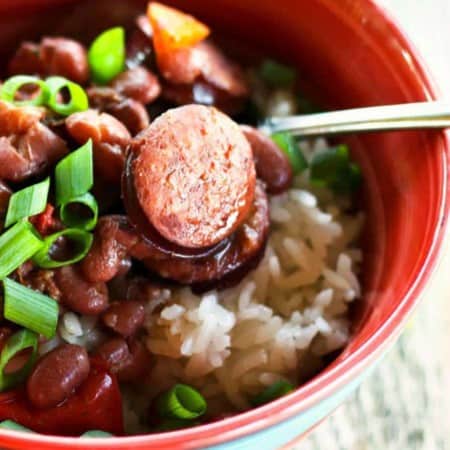
There are few things more satisfying than a big bowl of cooked rice topped with saucy, spicy, tender red beans and smoky sausage rounds then crowned with green onions and sour cream. Whether the weather be cold, or whether the weather be hot, as the saying goes, you can weather it better with a bowl of this under your belt. It is one of the few comfort foods that does hot or cold weather conditions equally well.

On a wild hare, I decided to throw my usual red beans and rice ingredients into my slow-cooker and see what happened. I figured that the worst case scenario would be a flavourful mush and the best case scenario would be the world’s easiest and wickedly economical dinner. I turned my best beloved slow-cooker to high, let ‘er rip, and walked away for six hours.

The next six hours were spent trying fervently not to eat everything in the pantry because it smelled so ever loving good in this house that I thought I might die. I repeatedly broke the cardinal rule of slow-cooking and crockpot-ery by lifting the lid and testing and re-testing beans to see if they were (oh please oh please oh please) done yet. After those agonizing six hours were up, I was rewarded with the easiest -and easily the best- red beans and rice I had ever made.

The facts that it didn’t heat up my kitchen and that the hardest part of the whole procedure was keeping myself from eating it before it was done were just gravy. My word, friends, it was so good.

So good, in fact, that I made a double batch again later that week and plan on making it for company when we receive a houseful of family for my brother’s wedding next month. It’ll be just thing; set it up and let it cook while running around for rehearsals, making the wedding cake, and trying to get five boys who’d rather not see the inside of a shower ready for their uncle’s wedding. Pray for me folks. It’s the getting the boys ready that’s giving me palpitations.

There is one grave danger attendant to making this recipe. It smells so good while cooking that there is a very real possibility that you will gnaw off your own leg of that of someone nearby.

I have just a couple of other thoughts to share about this recipe.The Creole Seasoning is wonderful to have on hand for recipes that call for it, to be sure, but we like to use it on other things, too. For instance, we love it on popcorn or homemade tortilla chips.

I like to make it really spicy and then mellow it out in my own bowl with a big dollop of sour cream. I think a fistful of grated Cheddar would do something similar if you’re so inclined. To do this, I tend to use the higher amount of cayenne pepper I specify in the recipe.

On the other hand, you could just keep the spice to a minimum in the first place. If you’d like to keep it on the milder side, cut back on or omit the additional cayenne pepper (above and beyond the small amount that is already in the Creole Seasoning) from the recipe.

I know andouille is the sausage darling of Cajun/Creole cooking, but it can be hard to find in these parts, so I most often make mine with smoked sausage. I absolutely love it this way, so do not feel like your ability to make this spicy, smoky classic hinges on the availability of andouille.

Slow-Cooker Red Beans and Rice and Creole Seasoning | Make Ahead Mondays

Slow-Cooker Red Beans and Rice and Creole Seasoning | Make Ahead Mondays

Whip up a batch of this handy Creole seasoning to add a little oomph to your every day dishes or reserve it for the most wonderfully tantalizing and simple red beans and rice you've ever had. The slow-cooker does the work so you can stay out of the kitchen on hot days. Be forewarned: this smells so good while it's cooking that you may feel ravenous by the time dinner rolls around.

Creole Seasoning adapted from Emeril Lagasse's recipe.

Ingredients

    For the Creole Seasoning:
  • 3 tablespoons paprika
  • 2 tablespoons kosher salt
  • 2 tablespoons garlic powder
  • 1 1/2 tablespoons dried thyme
  • 1 tablespoon onion powder
  • 1 tablespoon cayenne pepper
  • 1 tablespoon dried leaf oregano
  • 2 teaspoons black pepper
  • For the Slow-Cooker Red Beans and Rice:
  • 10 cups water
  • 3 cups small red chili beans (about 1 1/2 pounds), rinsed and picked over
  • 1 pound smoked sausage or andouille, sliced into 1/4 to 1/2-inch rounds
  • 1 red bell pepper, stemmed, seeded and cut into 1-inch pieces
  • 1 medium cooking onion (yellow or white), peeled, trimmed of root and blossom ends, and diced
  • 1 rib celery, cut into 1/2-inch pieces
  • 1 tablespoon Creole Seasoning
  • 1/2 teaspoon dried thyme
  • 1 bay leaf
  • 1/8-1/2 teaspoon ground cayenne pepper (according to heat preference)
  • For Serving: Hot cooked rice and green onions
  • Optional: Sour Cream

Instructions

To Make the Creole Seasoning:

Add all of the ingredients to a small mixing bowl bowl and toss together with a fork or a whisk. Store, tightly covered, in a jar or other airtight container in a cool, dry place. This is good for about a year after mixing.

To Make the Slow-Cooker Red Beans and Rice:

Add the water, beans, sausage, red bell pepper, celery, Creole seasoning, thyme, cayenne pepper, and bay leaf to the bowl of a slow-cooker. Add the lid and turn the heat to "HIGH'. Let it cook for 6 hours, stirring once or twice. After 6 hours, use a spoon to fish out a bean to test. If it is tender, turn off the heat. If it is still underdone, replace the lid and cook for another hour or until the beans are tender. Remove and discard the bay leaf.

Gently stir the contents of the slow-cooker before ladling over bowls of hot, cooked rice. Garnish with chopped green onions and -if desired- sour cream.

Store leftover beans tightly covered in the refrigerator for up to 4 days or freeze in individual portions for longer storage: up to 6 months.

http://www.foodiewithfamily.com/2012/07/16/slow-cooker-red-beans-and-rice-and-creole-seasoning-make-ahead-mondays/

Whole Cherry Clafoutis (Cherry Custard Tart) | Classic French Dessert

Plrb.

That’s the genteel version of ptooey. Which is what you’re inevitably going to have to do if you eat a clafoutis whilst in France. This brings me, rather quickly, to two very important points.

  1. Clafoutis -for the benefit of those who haven’t yet had it- is seriously good stuff. It’s a warm or room temperature custardy dessert that is usually studded with fresh fruit, usually cherries. It’s kind of a big deal in France.*
  2. In the aforementioned Belle France, cherry clafoutis are usually made with whole fruits. Translation: they leave les pits in les fruits.

*As in a really big deal. Clafoutis is to France as apple pie is to the U.S.A.

And this is why the spitting. As an American, born and raised, I was unaccustomed to cherry desserts avec pits. I was used to having the pits removed before they reached my plate and ploughing through cherry pies at lightning speed. Thankfully, a kind soul was aware that most Americans didn’t eat pit-intact cherry desserts and warned me, otherwise, I could’ve become intimately acquainted with the dental system in France. While I’m sure it’s a wonderful system, I’m really okay with not knowing it from the inside.

Why would you want to leave the pits in when you could remove them and be done with the whole thing? There are actually two very good reasons. (Today’s post brought to you by the number Two!)

  1. Leaving the pit in the cherries preserves the beautiful round shape of the cherries as they bake. It’s visually appealing.
  2. The cherry pit -believe it or not- brings a lot of flavour to the party. It contributes a subtle hint of almond. This is where the bells and chimes ring out. Yes. Cherry and almond. The pairing is not an accident! If you leave the pits in place, you don’t have to add almond for that classic flavour combination.

Negotiating the pits while eating dessert is not as disconcerting as you might think, speaking from personal experience. When the cherries cook in the custard-like batter, the pits free themselves from the fruit. As you bite down, the pits tend to slip right out of the cherries and you can tuck them into your cheek to be discreetly plrb-ed or ptooeyed (depending on the company) into a napkin or into the spoon and then deposited in a small bowl next to the dessert plate.

While cherries are still at their peak of availability, try a whole cherry clafoutis. Put a little Edith Piaf on the stereo. Throw in a Gallic laugh for good measure. And do summer like the French do: with style and great taste.

P.S. These are, like most custard-based tarts, at their very best when served fresh and at room temperature. They are quite good, though, cut into wedges when cold.


Whole Cherry Clafoutis (Cherry Custard Tart)

Whole Cherry Clafoutis (Cherry Custard Tart)

A simple, creamy, custard-based classic French dessert made with fresh cherries. Enjoy with a generous dusting of powdered sugar.

Ingredients

  • 1 pound of fresh, sweet cherries
  • 3 large eggs, room temperature
  • 3/4 cup sugar
  • 1/8 teaspoon salt
  • 1 1/2 teaspoons real vanilla extract
  • 1/2 cup all-purpose flour
  • 3/4 cup whole milk (DO NOT SKIMP ON THE FAT. You will regret it bitterly.)
  • 1/4 cup heavy cream
  • soft butter
  • powdered sugar, for serving

Instructions

Preheat your oven to 350°F.

Remove the stems from your cherries, but leave the pits intact. Generously butter the sides and bottom of a deep pie plate. Scatter the cherries as evenly as possible over the bottom of the pie plate. Set aside.

Vigorously whisk the eggs until they are frothy.

Add the sugar, salt and vanilla and beat well again with a whisk until the sugar is incorporated. Whisk in the milk and cream. Sprinkle the flour over the surface and -once again- beat enthusiastically with the whisk until you have a perfectly smooth batter. Let the batter rest for 5 minutes at room temperature then pour over the cherries in the prepared pie plate.

Bake the clafoutis for 40-50 minutes, or until puffy and golden brown in the center (but still jiggly) and darker brown at the edges. A knife, when inserted in the center of the clafoutis, should come out clean. It may be damp, but it should not have uncooked egg clinging to it.

Let the clafoutis cool in the pan on a cooling rack until it is barely warm to the touch or room temperature. Dust the clafoutis generously with powdered sugar and serve in wedges with a small bowl or napkin for the pits.

Store tightly wrapped leftovers in the refrigerator for up to 3 days.

http://www.foodiewithfamily.com/2012/07/13/whole-cherry-clafoutis-cherry-custard-tart-classic-french-dessert/

Corn and Black Bean Salsa


I’m a Fritos kind of gal. It’s hard to go wrong with a salty, deep-fried corn chip, but there’s just something special about Fritos. I’ve loved them as long as I can remember. When I was younger, there was more than one time I polished off a whole bag of Fritos in one sitting. These days, though, aging dictates that I can no longer sit and plough through an entire bag unaccompanied. Something about heartburn, calories, moderation, setting a good example for my children, blah blah blah.

Now I use Fritos not as a stand-alone food group but rather a tasty, salty, crunchy eating implement. They hold up well to my favourite kind of dips; those full of vegetables, garlic, herbs and beans. This time of year, a vegetable/bean salsa is just about the perfect way to round out a meal. Heck, when it’s hot enough, a bowl of this IS a meal at our house. You don’t have to fire up the oven. It’s cool, flavourful, substantial but not heavy, and packed with nutrition. Don’t EVEN tell me the Fritos cancel that out because I will stick both fingers in my ears and ‘LAH-LAH-LAH’ until you get tired of trying to get past my incredible display of loyalty and stubborness regarding snack food.

I did tell you. I’m a Fritos girl.

But the dip -the salsa, if you will- is where it’s really at today. Sweet corn, black beans, crunchy red bell peppers, onions, garlic, lime, jalapeños and beaucoup cilantro are tossed together in a eye-catching salsa that can even stand alone as a salad. That’s right. I’m saying you can eat it *GASP* without the Fritos. It is that good. I still dip it up with chips, but I also serve with ribs (hint, hint… not so distant post), in tacos, over baked potatoes, or tossed in cooked and cooled grains for a nutritionally complete meal. Mix up a big batch of it on the weekend and eat from it over the next several days. Fritos are optional.

Maybe.

Corn and Black Bean Salsa

Corn and Black Bean Salsa

I love this Southwestern inspired, flavour-packed sweet corn and black bean salsa for dipping, certainly, but I also tuck it into tacos, on top of baked potatoes, use it as a stand alone salad with grilled meats, or toss it together with cooked and cooked quinoa or millet for a nutritionally complete summer meal.

Ingredients

  • 1 pound frozen sweet corn, thawed
  • 1 1/2 cups cooked black beans, drained and rinsed and drained again (or 1 can black beans, drained and rinsed and drained again.)
  • 1 red bell pepper, stemmed, seeded and diced
  • 1 half of a sweet onion, peeled and diced
  • 1 jalapeno, stemmed, seeded and minced
  • 1-2 cloves of garlic, peeled and minced or pressed, according to preference
  • the juice of two limes
  • a large fistful of fresh cilantro or parsley, chopped
  • salt and pepper to taste

Instructions

Toss all of the ingredients together and refrigerate for at least 30 minutes before serving. Store leftovers in a tightly covered container in the refrigerator for up to a week.

http://www.foodiewithfamily.com/2012/07/12/corn-and-black-bean-salsa/


Tocino (Filipino Cured Pork) | Make Ahead Mondays

UPDATE: The National Pork Board has generously extended the deadline for The Foodbank donation partnership with you all because you’ve been asking such great questions! In other words, every question you leave for pork producers in the comments on this post, the Foodie With Family facebook page, or on Twitter with the hashtag #sustainablepork will translate to 1 pound of pork being donated to The Foodbank of Ohio. No strings attached!

Pork.

It’s what’s for dinner in one form or another in our house most nights of the week. We are a porkcentric household. That has probably been pretty obvious here with all my use of bacon, chops, roasts, Cuban Pork, Cola Pulled Pork, Hot Tex Mess, and more (scroll down for porky goodness.) So when the National Pork Board contacted me to see if I wanted to take a tour of a sustainable pork farm, I replied with a pretty quick ‘yes’.  Then they contacted me again and made me an offer I couldn’t refuse.

They are going to donate one pound of pork to The Foodbank in Ohio for every question you all leave here for me to ask them when I go on the tour up to 1,000 pounds. Holy cow. Or should I say holy pig?

Just think of how many people we can feed if you all are curious enough!

Let’s talk for a moment about what I’ll be looking at when I head out to Dayton. According to the information sent to me by the National Pork Board, within a 50 year time frame, pig farmers have reduced their carbon footprint by 35%, reduced water usage by 41% and decreased the amount of land needed to grow feed by 78%. Additionally, we are getting more meat from fewer pigs – which helps reduce the use of natural resources to raise pigs.

 The Pork Checkoff has been honoring the sustainability efforts of pig farmers for 18 years with the Pork Industry Environmental Steward Award. The farm I will be visiting on July 24 was recently honored with this award.

So where do you come in on all of this? Just leave me a question in the comment area below (or on Twitter using the hashtag #SustainablePork ) between now and July 13th. All comments and tweets that have questions for me to ask the farmers and the National Pork Board representatives will count and one pound of pork will be donated per question or tweet.

~~

Now I figure you all know me well enough to realize that I couldn’t talk this much about pork without giving you a great recipe for it. That would just be unkind. Without further ado, I present to you one of my favourite freezer pleasers; Tocino. (Pronounced toe-see-no.)

Tocino is a Filipino dish that I have loved longer than I can remember. Starting with a humble and inexpensive pork shoulder (about $1.29/lb where I shop), a little slicing and a quick cure in some sugar and spice in a resealable zipper top bag, you end with a salty but sweet, crisped pork that tastes like super meaty bacon. It doesn’t take much work, and once you’ve tossed the pork with your sugar and spices, you can stash the bag in the freezer for up to six months before frying or grilling. Low investment, mega-payoff.

The sugary salty cure that enrobes the thin slices of pork keeps the mixture from freezing totally solid, so you can scoop out what you’d like to serve for dinner and leave the rest frozen for future meals. The traditional accompaniment for tocino is garlic fried rice and a fried egg for the classic Filipino breakfast called Tosilog. Doesn’t that sound like just about the best possible way to start a day? I speak from experience when I say it makes one heckuva lunch, dinner or snack, too.

Tocino is traditionally cured with red food colouring or other agents (like the pink salt, or saltpeter, used in curing other meats). I’m not super keen on food colouring, so I use beet powder as recommended by Jun-Belen. That man is a genius. The beet powder adds an appetizing red colour without adding any funky insect or chemical colouring. Lest you fear the beet, let me assure you it does not impart any beet-y flavour to the finished product.

Tocino (Filipino Cured Pork) | Make Ahead Mondays

Tocino (Filipino Cured Pork) | Make Ahead Mondays

Do you love meaty bacon? Give this traditional Filipino, quick-cured, pork a try. An inexpensive pork should gets a boost from the fast-curing sugar, salt and spice combination and yields salty, sweet perfection that is reminiscent of thick cut bacon. It stores beautifully in the freezer for whenever cravings strike.

Ingredients

  • 3 pounds pork shoulder, sliced into 1/8-inch thick pieces
  • 3/4 cup raw or granulated sugar
  • 3/4 cup brown sugar (light or dark)
  • 1 clove garlic, peeled and minced
  • 3 tablespoons kosher salt
  • 3 tablespoons beet powder (you can substitute about 15 drops of red food colouring if you prefer.)
  • 1 tablespoon light soy sauce
  • For Cooking:
  • Vegetable, peanut or canola oil for pan frying

Instructions

Combine both sugars, the garlic, salt, beet powder (or food colouring), and soy sauce in a very large resealable zipper top bag (2 gallons) or a stain-proof container with a tight fitting lid. Close the bag or container tightly and shake to combine ingredients evenly. Open the bag or container, drop the pork slices in and reseal. If using a bag, squeeze the bag to thoroughly coat all of the pork with the sugar and salt mixture. If using a container, use your hands to move the pork around to be sure it is thoroughly coated in the mixture then close the container tightly.

Put the bag or container in the refrigerator and let it cure for at least 2 days before using, but up to 4. Alternatively, you can put the container or bag directly into the freezer (letting it sit for at least a week before using) for up to 6 months.

To Cook the Tocino:

Whether using fresh from the refrigerator or directly from the freezer, remove the amount of tocino you want to cook and let it sit in a colander for several minutes to drain any excess liquid.

You may either grill the tocino over high, direct heat, or pan fry in batches. To pan fry, heat about 2 teaspoons of oil in a heavy-bottomed skillet over medium-high heat. Fry the pieces until cooked through and browned with little charred bits, about 2-3 minutes per side.

Serve, if desired, with garlic fried rice and a fried egg for a traditional Filipino breakfast.

http://www.foodiewithfamily.com/2012/07/09/tocino-filipino-cured-pork-make-ahead-mondays/

Don’t forget to leave your question for the pork farmers and National Pork Board below. Every question you leave will provide a hungry family with a pound of pork!

From July 23-24, I will be attending a tour of an Ohio family’s pig farm with the National Pork Board (NPB) focused on sustainability efforts in the pork industry. NPB will cover the costs of my trip, but all opinions expressed are my own.


Fabulous Homemade Ranch Dressing

This one’s for my friend, Peg. Peg bakes magnificent bread and sells it at our farmers’ market in Angelica, New York. Peg pointed a baguette at me last Saturday and said, “Rebecca. You need to do Ranch dressing. Soon.”  When someone brandishes bread at me, I listen.

It didn’t hurt that Peg was doing a little mind-reading. I had just been thinking that Foodie With Family was sorely lacking in the salad dressing category and it is BIG GREEN SALAD season and we all know how I feel about BIG GREEN SALADS (if not, click here.) It’s dunking season, too. Don’t forget all the summer snacking possiblities. Carrot and celery sticks, broccoli and cauliflower florets -oh heck- and breadsticks, and chicken wings, too. Just about everything is better with a little coating of Ranch dressing, isn’t it?

Remember that Ranch dressing doesn’t just come in packets. And good golly… that pre-made stuff in the bottle is horrific. Ranch dressing is -at the heart of things- a tangy buttermilk dressing loaded to the gills (were buttermilk to have gills, that is) with herbs. We all know fresh herbs taste better than dry ones, so why are we content to dress our salads with dry ones? This Independence Day, I call for a revolution. A Ranch revolution. A herby, garlicky, tangy, creamy, buttermilky dressing revolution.

Put pitchers of this out at your party! Put bowls of this out on your buffet for dipping! Celebrate your freedom from packets and bottled dressing!

Peg will lead the charge with a baguette.

Fabulous Homemade Ranch Dressing

Yield: 3 cups of dressing/dip

Fabulous Homemade Ranch Dressing

No need to buy packets of mix or bottles of the stuff, Fabulous Homemade Ranch Dressing is just minutes away. Tangy buttermilk thickened with sour cream and mayonnaise is the base for the classic herb dressing that kids of all ages love on salads or as dip. Once you try the homemade version, you may never go back!

Ingredients

  • 1 1/4 cups cultured buttermilk (homemade, or storebought)
  • 1 cup sour cream
  • 3/4 cup mayonnaise
  • 1/3 cup, packed, finely chopped dill
  • 1/4 cup finely chopped parsley (flat-leaf or curly)
  • 1/4 cup finely chopped chives or green parts only of scallions
  • 3/4 teaspoon finely chopped fresh oregano
  • 1 large clove garlic, peeled and finely minced or pressed (or 1/2 teaspoon granulated garlic)
  • 1 teaspoon salt (or more to taste)
  • freshly ground black pepper to taste

Instructions

In a mixing bowl, whisk together all ingredients until smooth. Pour into a canning jar or pitcher, cover tightly and refrigerate for up to 10 days.

http://www.foodiewithfamily.com/2012/07/03/fabulous-homemade-ranch-dressing/

One-Pot Bacon Pizza Pasta

The other night, a few of my teenager’s buddies came for a Minecraft party/eating festival. What that means, for those of you who aren’t don’t have teenagers or a gamer in the house, is that there were a fistful of teenage boys with laptops at my dining room table doing something on their computers that looked a whole lot like building Lego worlds full of zombies and pigs on their laptops.

The catch is that I didn’t know whether the plans were going to work until about a half an hour before they were set to arrive: right at dinner time. If that doesn’t strike fear deep into your heart, maybe this will; it was nearly 100°F out and these teenage boys that were arriving were coming straight from fencing lessons.

Let that sink in a bit.

A handful of hungry teenage boys straight from intense physical activity at my table.

The only possible answer was pasta and lots of it. Quickly.

I revamped my Bacon Cheeseburger Pasta for lack of hamburger and turned it into Bacon Pizza Pasta.  I was just stirring the last handful of cheese, pepperoni and crispy bacon into the pot when the doors opened and a bunch of young men with computers loped through. * We had a massive stockpot full of pasta that tasted for all the world like a pepperoni and bacon pizza had fallen into it; tender pasta in herby tomato sauce full of melted mozzarella cheese, pepperoni and crispy bacon.

*Can we just talk about this for a minute? First of all, I don’t even feel like an adult yet, let alone one with a teenager and CERTAINLY NOT one whose teenager and all of his friends are taller than her. I might need someone to hold my hand for a minute.

The pasta was as big a hit as I hoped it would be. The boys ate a lot. There were happy faces. And I only had one pot to clean even after feeding eight people for dinner. I washed my one pot, the boys brought their dishes for the dishwasher and I got to put my feet up. I’d call that an all around win, wouldn’t you?

The recipe as printed below yields a large pot of pasta. Not large enough to feed the crew I fed, but large nonetheless. It scales up beautifully -I made a triple batch for the wild men over here- and leftovers, should you have them, store and reheat nicely for up to four days.


Bacon Pizza Pasta

Bacon Pizza Pasta

This one pot wonder dinner is a crowd pleaser with tender pasta covered in a pizza flavoured, herb-laden tomato sauce full of melted mozzarella cheese, crispy bacon, and pepperoni slices.

Ingredients

  • 1/2 pound sliced bacon
  • 1 onion, peeled and very finely chopped
  • 1 garlic clove, peeled and pressed or finely minced
  • 1 can (6 ounces) tomato paste
  • 1 cup pizza sauce
  • 4 cups beef broth
  • 1 cup water
  • 2 teaspoons Italian seasonings
  • 1/4 teaspoon dried oregano
  • 1 teaspoon salt
  • 1 teaspoon onion powder (preferably granulated onion)
  • 3/4 teaspoon garlic powder (preferably granulated garlic)
  • 1/8 to 1/2 teaspoon crushed red pepper flakes (or more, to taste depending on heat tolerance and preference.)
  • 1 pound dry small shell, rotini, or elbow pasta
  • 2 cups grated mozzarella cheese
  • 15 slices of pepperoni, cut into quarters

Instructions

Stack the bacon strips and cut down through the stack at 1/4-inch intervals. When done, you should have a pile of thin bacon strips. Put these into a large stockpot over medium-low heat, stirring frequently. Add the onion and minced or pressed garlic when the bacon is about halfway cooked. Continue frying the bacon, onions and garlic until the bacon is crispy. Use a slotted spoon to transfer the crispy bacon with the onions and garlic to a paper towel lined plate to drain. Pour the remaining bacon grease out of the pan (and hopefully into a jar to use in tasty things later.)

In a large mixing bowl, whisk together the garlic, tomato paste, pizza sauce, beef broth, water, Italian seasonings, oregano, salt, and onion and garlic powders. Pour this into the pan from which you drained the bacon grease. Stir well, raise the heat to high and bring the mixture to a boil. When it is boiling, gently stir in the dry pasta, add a lid to the pan and drop the heat to low. Cook for 10 to 12 minutes, stirring every couple of minutes to prevent the pasta from sticking. When the pasta is tender, turn off the heat, add all of the grated cheese, the crispy bacon, and the chopped pepperoni and stir gently until the cheese is melted in completely and everything is evenly distributed. Serve hot with additional grated cheese if desired.

http://www.foodiewithfamily.com/2012/06/28/one-pot-bacon-pizza-pasta/