Homemade Furikake |Japanese Rice Seasoning

The first order of business on this post just plain has to be pronunciation. Foo-ree-kah-kay. My boys, however, prefer to call it furry khaki. Why? Well, I assume it has something to do with being very silly boys.

Now that we’re all on the same page, let’s talk about what it is… Furikake is like the salt and pepper of Japan. It goes on bowls of rice, gets mixed into onigiri, sprinkled over noodles, on porridge and just about anything else that holds still long enough to get hit with it. This wanton flinging of furikake happens for an excellent reason; because it tastes great and delivers an instant explosion of umami to anything it tops. I find myself looking for more foods to cover with this distinctive seasoning that is briny and earthy with just a touch of seafood essence. If you’ve had it before, you know that there’s nothing to compare to the complete flavour added to dishes where this is present.

I’ll be honest. I’m fixated on furikake. I love this so much that I almost always make more rice than we’ll need in a meal so I can form rice balls to sprinkle with furikake for late night snacks. Sometimes I just open the jar to sniff it a little bit. It’s a weakness.

So what is it exactly? In it’s basic form -the form I’m giving you today- it is toasted sesame seeds, sea salt, nori, bonito flakes** and an optional pinch of sugar*.

*Most commercially available furikakes contain added MSG and preservatives.

**Bonito flakes are dried, paper-thin shaved flakes of tuna. They add a rich seafood taste to the furikake. If you have trouble finding them, you can purchase them through this link . (Full disclosure: This link will take you to Amazon.com. If you purchase the bonito flakes, I will receive an itty bitty commission. )

There are many, many versions of it sold, and just as many, if not more, versions of it made in homes but what I’m giving you today is a good basic leaping off point for adding that little special something to your meals or snacks. We start with raw sesame seeds here, but if all you can find is toasted sesame seeds, simply skip the toasting step and proceed from that point forward.

Do make this, though. Just do. I can’t be the only one who obsesses over these things. I refuse to think that is possible. I need some company on my wacky little furikake island, people.

Homemade Furikake |Japanese Rice Seasoning

Prep Time: 10 minutes

Cook Time: 5 minutes

Yield: One generous cup of furikake.

Furikake: the salt and pepper of Japan. This crunchy, salty, nutty, earthy, briny topping that tastes slightly of seafood is a great all-purpose seasoning for rice, seafood, snacks, and more.

Ingredients

  • 1/2 cup raw sesame seeds
  • 1 teaspoon to 1 tablespoon sea salt, to taste
  • 3 sheets nori
  • 3 heaping tablespoons bonito flakes
  • 1/2 teaspoon sugar, optional

Instructions

Heat a dry, heavy-bottomed skillet over a medium high burner.

Pour in the sesame seeds and shake to distribute evenly over the surface of the skillet.

Toast, shaking occasionally, until the seeds are fragrant and begin making little popping sounds.

Immediately pour the seeds into a dry, clean bowl to cool and stir in the sea salt. Allow to cool completely before proceeding.

Use kitchen shears or clean, dry scissors to cut the nori into 1-inch strips. Stack the strips and cut cross-wise into very thin strips over the bowl of sesame seeds.

Use the kitchen shears again to roughly cut up the bonito flakes.

Add the sugar (if using) and stir all ingredients together, then transfer to a jar with a tight fitting lid.

This is ready to use immediately but can be stored in a cool, dry place out of direct sunlight for up to two months.

http://www.foodiewithfamily.com/2011/08/09/homemade-furikake-japanese-rice-seasoning/


General Tso’s Chicken

I love chicken. I love Chinese food. I love Chinese chicken dishes. I really, really do.

It’s a matter of garlic, ginger, soy sauce and sesame oil.  There’s just something about that combination that makes me weak. The heady, nutty scent of toasted sesame oil with the pungent garlic and spicy ginger and the umami of the soy sauce renders me powerless. When I smell that there’d better be food on the horizon. And quick.

When I first saw this over on Evil Chef Mom, I knew I had to have it that night. Sweet and hot, crispy and tender, garlicky, gingery General Tso’s chicken is a mainstay of Chinese buffets and restaurants, but I knew it would be infinitely better, fresher and healthier at home. Since my husband was at work in the big city,  I texted him saying, “Please pick up boneless, skinless chicken thighs and broccoli. Need them desperately. Love you!”

He came home with bone-in, skin-on drumsticks and peas. Sigh. He meant well. Needless to say, I didn’t get my General Tso’s chicken that night.

The next night, my darling brought me pork chops and salad.

The night after that? Beef to grind for hamburgers and potatoes. I worshipped the idea from afar and waited for the moment I would get to the store by myself.

The next two big shopping trips yielded *GASP* no boneless, skinless chicken thighs because there was an apparent run on them in Amish country. Go figure.

General Tso and I were becoming star-crossed lovers.

Finally, when I went shopping for my birthday meal last week, boneless, skinless chicken thighs were abundant on the shelves and I did a happy dance that resembled Chris Farley’s ‘Tommy Boy’ version of the Flashdance number near the butcher’s counter. He looked at me a little funny, but I didn’t care. General Tso was mine at last.

He was totally worth waiting for. Love always is.

Adapted ever so slightly from and with major thanks to Evil Chef Mom.


General Tso’s Chicken

Sweet and hot, crispy and tender, garlicky, gingery General Tso's chicken is a mainstay of Chinese buffets and restaurants, but you can make it better, fresher and healthier at home!

Ingredients

    For the chicken:
  • 1 1/2 teaspoons toasted sesame oil
  • 1 large egg white
  • 1 tablespoon soy sauce
  • 1/4 cup plus 2 tablespoons cornstarch
  • 1 pound boneless, skinless chicken thighs, trimmed of fat and cut into 1 1/2" pieces
  • canola, peanut or vegetable oil for frying
  • For the Sauce:
  • 2 tablespoons finely chopped fresh ginger root
  • 2 garlic cloves, peeled and minced
  • 1 cup chicken broth or stock
  • 1/4 cup soy sauce
  • 1 tablespoon cornstarch
  • 1 teaspoon Chinese chile-garlic sauce
  • 3 tablespoons raw sugar (a.k.a. Demerara or Turbinado)
  • 1 tablespoon peanut, canola or vegetable oil
  • For Serving:
  • 4 scallions, thinly sliced
  • Steamed broccoli
  • Fresh, hot cooked white rice

Instructions

Prep your chicken:

In a mixing bowl, stir together the sesame oil, soy sauce, egg white, and 1/4 cup plus 2 tablespoons of cornstarch until a thick slurry forms. It will look gummy but smooth.

Add the chicken pieces and stir until all are evenly coated. At first it may appear that it will not come together but it does!

Set aside, covered lightly with plastic wrap, at room temperature for 20 minutes, stirring occasionally.

Begin the sauce:

Add the tablespoon of oil to a large, heavy-bottomed saucepan over high heat.

Stir the garlic and ginger into the oil and cook, stirring constantly, until fragrant, about 1 minute.

In a separate bowl, whisk together the remaining sauce ingredients until smooth. Pour into the garlic and ginger, stirring, until thick and shiny. Keep over a low burner partially covered to stay warm.

To fry the chicken:

Heat 1/2-inch of oil in a heavy-bottomed, high-sided frying pan or skillet over high heat.

When the oil is shimmering, add one piece of chicken at a time, taking care not to crowd the pan.

Cook for 4 minutes on each side, or until deep golden brown and crisp on both sides**.

Transfer the chicken to a paper towel lined plate and repeat the process until you've cooked all the chicken.

Slide all the chicken into the prepared sauce and toss to coat. (If desired, add the steamed broccoli to coat with the sauce also.) Increase the heat to medium, stir and cook just until hot all the way through.

Sprinkle with sliced scallions and serve immediately over white rice.

**A note: Chicken is a safe food for me. I know that just about anything done to it is going to yield something that is, at the very least, edible. This is especially true of boneless skinless chicken thighs. It's really hard to mess those up! They stay tender and juicy and it's very hard indeed to cook them to the point of chicken jerky. Be sure to cook them through, you definitely want that crisp, deep-brown coating to hold up to the sauce!
http://www.foodiewithfamily.com/2011/08/03/general-tsos-chicken/

Cinnamon Swirl Bread

AH- HAHAHAHAHAHAAH!

Bwahaha-HA!

Ha-ha-ha-ha-ha.  HA-ha!

Evil laughs are so hard to put into words, but I really have to give it a shot here.

I have three reasons to guffaw as though I’m the baddie who conquered MetroCity.

  1. I’ve discovered (or rather I discovered that King Arthur Flour discovered) the secret to a super moist cinnamon swirl and it doesn’t require buying a special cinnamon spread in teeny-tiny jars.
  2. I fed raisins to two unsuspecting children who swear they hate them and they loved them.
  3. The first two reasons are related.

Please allow me, in the grand tradition of super villains, to fill in the back story a little bit.

First, a friend asked me whether I had a recipe for cinnamon schmear (what many commercial bakeries use to fill their cinnamon rolls and bread) a while back. She had a hankering for bakery-type cinnamon rolls with the distinctive, moist filling that they turn out. I did a little research but all of the recipes seemed to be missing something crucial. I wrote off the search for a while.

Second, I have two kids who just plain don’t like raisins. I can’t blame them, really, I’m not certain those little shriveled grapes are my favourite things in the world, but unlike them, I’ll eat ‘em. And when you stuff them in an oatmeal cookie, I’ll eat them quite happily. Those two, however, are the anti-raisin police. If raisins are suspected to be in the vicinity, these normally sanguine children clamp down, dig their feet in and steadfastly refuse to even try the item in question. What’s the big deal? Well, the fact that these same two children pretty much despise all fruit, for one. And raisin cinnamon bread, for another. The rest of the crew can’t get enough raisin cinnamon bread. Ever.

That puts me in a bind.

If I sally forth making raisin cinnamon bread, I have two little faces with big saucer eyes that stare at me sadly as if to accuse me of deliberately making something that looks delicious “except for those shrunken bits there.” I can almost hear them thinking, “Why don’t you just make a plain old cinnamon swirl bread, Mama?”

“Because of the moisture the raisins bring to the bread!” I cry back at them in my brain*.

*Aren’t you glad you’re not in my brain?

This internal debate intensified when one of the feed-me-no-raisins twosome specially requested cinnamon swirl bread.

And along rides valiant King Arthur to the rescue on his cookbook steed…

I thumbed through the index and saw a recipe for ‘Cinnamon Swirl Bread’. There was no mention of raisins anywhere so I figured it was a good bet. When I opened the page, I scanned the ingredient list and saw (you know what’s coming) raisins. Oh geez.  For some reason, I decided to read the blurb about the recipe anyway and boy am I ever glad I did.

This was the bit that got me:

“First, for a deep-dark, moist cinnamon swirl inside the bread, whirl sugar, cinnamon and raisins or currants together in a blender or food processor until smooth. The fruit adds moistness as well as subtle flavor to the filling.”

Well, hello. This seemed like it would solve all sorts of problems. With the raisins obliterated in the food processor, I would get the moisture I desired from them without setting off the no-raisin-radar. Smooth, moist, deep-dark cinnamon swirl? That sounded remarkably like the cinnamon schmear my friend was seeking.

I gave it a whirl and wow. (Cue evil laugh again.)

They didn’t just like it, they loved it. Luh-uh-uh-huhved it. I made a double batch and it was gone after breakfast. The raising hating duo couldn’t get enough of the bread. I pleased them all! I texted my friend and told her I’d found her holy grail of cinnamon swirliness. I was on a roll.

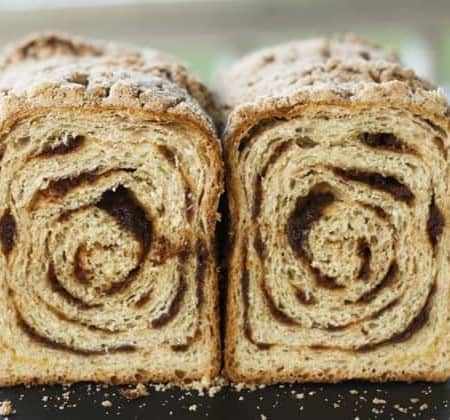
It’s not just cinnamon swirl bread.  It’s a soft, white bread with a hint of cinnamon kneaded into the dough that is rolled around the most deep, dark, moist cinnamon filling ever. It holds together beautifully when sliced thanks (again) to the King Arthur Flour Bakers Team’s genius idea to use an egg wash instead of brushing the dough with butter. If you are the sort who is inclined to dismantled your bread along swirl lines while eating it -as I am- you’ll find that the bread de-swirls beautifully with just a little encouragement from your fingers and teeth. There’s more though. Those clever Arthurians topped the bread with a streusel topping. Is that gilding the lily? Perhaps, but it’s really tasty gilding.

Cinnamon Swirl Bread. It’s what’s for breakfast.

Cinnamon Swirl Bread

Cinnamon Swirl Bread

Cinnamon Swirl Bread taken to another level: tender white bread topped with a cinnamon streusel crown and filled with the most deep, dark, moist cinnamon swirl imaginable. This makes the ultimate cinnamon toast.

Adapted gently from King Arthur Flour

Ingredients

    For the dough:
  • 3 cups (12 3/4 ounces) all-purpose flour
  • 1/3 cup (3/4 ounce) instant potato flakes or 1/4 cup (1 1/2 ounces) potato flour
  • 1/4 cup (1 1/4 ounces) nonfat dry milk
  • 1 1/4 teaspoons salt
  • 1/2 teaspoon cinnamon
  • 3 tablespoons (1 1/4 ounces) granulated sugar
  • 2 1/2 teaspoons instant yeast
  • 4 tablespoons (1/2 stick or 2 ounces) butter, softened to room temperature
  • 1 cup (8 ounces) water
  • For the Filling:
  • 1/4 cup (2 ounces) raw sugar
  • 2 1/2 teaspoons cinnamon, divided
  • 1/4 cup (1 1/2 ounces) raisins or currants
  • 2 teaspoons all-purpose flour
  • 2 tablespoons granulated sugar
  • 1 large egg, beaten with 1 tablespoon of water until smooth
  • For Topping:
  • 2 tablespoons (1 ounce) cold butter
  • 2 tablespoons (7/8 ounce) granulated sugar
  • 1/4 teaspoon cinnamon
  • 1/4 cup all-purpose flour

Instructions

For the Dough:

Combine all of the dough ingredients in a large mixing bowl (or the work bowl of a stand mixer), mixing until the dough comes away from the sides of the bowl.

Knead until the dough is smooth and satiny. By hand, this will take about 10 minutes. By mixer, it will take between 5 and 7 minutes.

Oil a large mixing bowl or proofing bucket and transfer the dough to it, covering lightly with plastic wrap.

Set aside in a warm, draft-free place to rise until puffy and nearly doubled in bulk.

For the Filling:

Pulse together the raisins, raw sugar, 1 1/2 teaspoons of the cinnamon, and all-purpose flour until the raisins have been obliterated and the sugar forms clumps. It will resemble this:

Stir together the remaining cinnamon and granulated sugar in a small bowl and set aside.

To Assemble:

Lightly oil your work surface and transfer the dough to it.

Gently roll the dough into a rectangle that is approximately 16" x 8".

Brush the dough with about 1/2 of the egg wash, scatter the raisin/cinnamon mixture evenly over the top, then sprinkle the cinnamon sugar evenly over everything else.

On the short end of the rectangle, begin rolling the dough up log-roll style. Keep it tight but don't be so heavy handed that you stretch the dough. Making a tight roll eliminates air pockets in the swirl.

Pinch the seams and ends closed.

Tuck the ends under and move the log into a greased 8 1/2" x 4 1/2" standard loaf pan.

Cover with lightly greased plastic wrap or parchment and let rise at room temperature for about an hour, or until the dough has risen just above the edge of the bread pan.

To Top and Bake:.

Preheat oven to 350°F.

Combine the butter, sugar, cinnamon and flour with a pastry blender (or in a food processor) until crumbly.

Brush the top of the risen loaf with the remaining egg wash and sprinkle all the topping over the egg wash. very gently press the topping into an even coating.

Bake the bread for about 45 minutes. If it begins browning too quickly you can tent it with foil in the last 15 minutes of baking.

Place bread pan on a cooling rack for five minutes, then run a butterknife around the edges of the loaf to loosen it.

Place the pan on its side and slide the loaf out (this should minimize the amount of streusel topping that falls off.) Turn the loaf upright and cool completely before slicing.

http://www.foodiewithfamily.com/2011/08/01/cinnamon-swirl-bread/