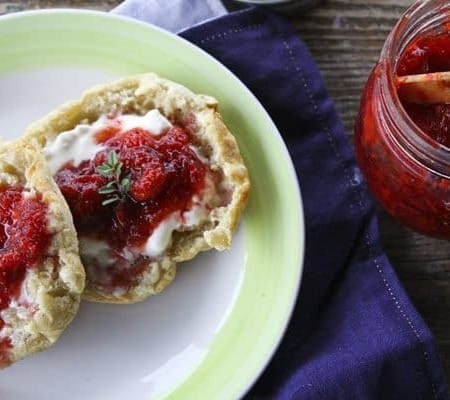


Strawberry Balsamic Thyme Freezer Jam

When I was small, my mom made strawberry freezer jam every year during Michigan’s brief and glorious strawberry season.

It was my mom’s thing: her annual food preservation pièce de résistance. She scattered packets and boxes of pectin thither and yon, she mashed berries with the bottoms of drinking glasses, her potato masher, and anything else she could fit into her bowl.  Her blonde hair had strawberry streaks, her hands were fuchsia , and she smelled like a strawberry patch for days on end. True to her style, she never measured (measuring was a creativity killer and the man’s way of keeping her down*) but somehow it always turned out to be the best thing we had eaten all year.

*Power to the people! Or Up with the People! Oh, geez. I can never get that right. I’m sorry, Mom.

I played around with cooked jam over the years, but it never drew close to the juicy, soft-set, fresh-from-the-field taste of strawberry freezer jam. Is it because of my formative years and my mom’s painting the kitchen with strawberries? Oh, probably…

I want my kids to have that same memory when they’re adults. The full sensory memory of watching their mom make jam: smelling, tasting, feeling the ripe strawberries… The anticipation of the flavour when a jar is fetched from the freezer and twisted open… I want them to have a vision of me with strawberry streaks on my cheeks (since my hair is not light enough to show it), fuchsia hands and smelling like a strawberry patch. Of course, their Mama measures obsessively, but every childhood is a little different, isn’t it? At least I got the important stuff in there.

…And my jam, well, now it has two crucial ingredients that my Mom didn’t put in hers. Balsamic vinegar and fresh thyme.

I know it might sound bizarre, but this is the most strawberry-y jam ever. If you can imagine the most fresh, juicy, flavour-packed strawberry you’ve ever had that is multiplied by about fifteen, you have an idea of what this tastes like.

You may already know that adding balsamic vinegar to strawberries boosts the flavour, but did you know that infusing it with thyme has a similar effect? And when you add balsamic AND thyme, you get knock-you-flat strawberryness. Whizz-bang, ka-pow, shammalammadingdong strawberry power is what Strawberry Balsamic Thyme Freezer Jam is.

I was already a big fan of the strawberry/thyme combination thanks to my good buddy, Krysta over at Evil Chef Mom and the strawberry/balsamic combination thanks to, um, I don’t know what. I first read about combining all of them in jam form, though, over on Serious Eats when Lucy Baker made a batch that sounded tantalizing.

When I read Lucy’s post, I knew that was going to happen as soon as the sleepy New York strawberries finally burst onto the scene.

A friend brought a whole flat of strawberries my way two days ago and thankfully, I remembered my previous plans. Mercifully. Appreciatively. I am so grateful that I remembered those plans because this is the best strawberry jam I’ve ever shoveled shamelessly into my mouth by the spoonful.

Best. Strawberry. Jam. Ever.

(…except for my Mom’s…)

A Note About the Pectin I Use:

Pomona’s Universal Pectin is well worth any trouble you have finding it. You can double, triple or quadruple recipes (or more if you have appropriately sized vessels for preparing massive batches of jam) with no ill-effects, unlike most “normal” pectins. It has no funky preservatives, additives, and allows you to make the best jam you’ve ever eaten with much less sugar than your average pectin (even the low-sugar varieties) or no sugar at all.  I’m getting nothing out of this, the Pomona’s people don’t even know I exist *sniffsniff*. I seriously believe their product is the best and have years worth of experience to back up my claims.

Yes, it looks expensive. I mean honestly, $4-$6 per box? Yipes! But if you break it down, you’ll realize that each box has enough pectin powder to make 2-4 batches of jam. That works out to about $3.00 per batch (calculating for liberal use) which is equal to or  better than the most common commercial pectins. When you add the convenience of larger batches to the equal or better price per batch, I think the comparative value makes Pomona’s the much better bet.

You can use a standard commercial pectin to make Strawberry Balsamic Thyme Freezer Jam (see recipe notes) if necessary, but I stand by Pomona’s!

5.0 from 1 reviews

Strawberry Balsamic Thyme Freezer Jam
Author: 
Recipe type: Condiment
Prep time: 
Cook time: 
Total time: 

Serves: 48
 

Don’t let the complicated name fool you. This freezer jam is pure strawberry. While the balsamic vinegar and thyme may sound wacky, they both simply enhance the explosive natural freshness of strawberries.
Ingredients
  • 4 cups mashed, hulled strawberries
  • 2 tablespoons balsamic vinegar
  • 2 tablespoons fresh lemon juice
  • ¾-2 cups granulated sugar
  • 1 tablespoon Pomona’s Universal Pectin Powder(*See notes) + ¼ cup Pomona’s Calcium Water (or more, if necessary.)
  • 1 cup water
  • 3 sprigs fresh thyme

Instructions
  1. Prepare freezer-safe jars or containers with airtight lids that can hold up to 6 cups of jam. (**See Notes)
  2. Stir together sugar, crushed berries, balsamic vinegar and lemon juice in a large mixing bowl.
  3. Add sprigs of thyme to water and bring to a boil.
  4. Strain and measure ¾ cup into a blender carafe.
  5. Sprinkle the pectin powder over the boiling water in the blender and add the lid.
  6. Open the vent on the blender lid, cover with a doubled dish towel or wash cloth, and blend on high for 1-2 minutes or until the pectin powder is completely dissolved.
  7. Scrape into the berry mixture and stir well.
  8. Pour the pectin water into the berry mixture and stir very well to combine. It should start to gel visibly. If it does not gel (although the gel will be much more soft-set than cooked jam), add 1 teaspoon of calcium water and blend well, repeating if necessary.
  9. Ladle into prepared containers to within ½” of the rims, fix the lids on tightly and freeze immediately.

Notes
*If you can’t or don’t want to find Pomona’s Pectin, you can make your normal freezer jam (following the directions for the pectin you use) but adding 1 tablespoon each of balsamic vinegar and lemon juice per 2 cups of crushed berries along with the amount of sugar specified in the pectin’s recipe.. To infuse the jam with thyme flavour, simmer the fresh thyme sprigs with the water and pectin. **You can use Gladware or Rubbermaid containers or canning jars. I prefer to use canning jars with two piece lids.


Pickled Ginger (Gari)

I love sushi. I love it so much. I love everything about it. The fish, the rice, the nori, the little wad of wasabi, but as much as I love all of that, I love the pickled ginger, or gari, even more.

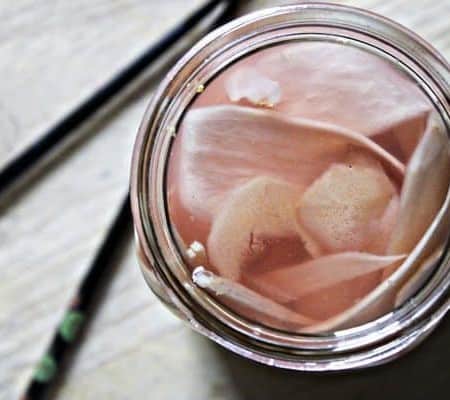
Oh, pickled ginger, how do I love thee? Let me count the ways. You’re sweet and sour, spicy, fresh, snappy and PINK!* You pack so much punch into such a little package.

*Pink. Sigh. I love pink.

On those rare occasions when my husband and I can actually go. out. of. the. house. without. children, we almost invariably head for sushi joints. Being creatures of habit and fond of our ruts, we’ve established a little routine. (If you’re a sushi purist you may want to look away.)

  1. We look over the menu and order far too much sushi with the justification that we can take leftovers home to the children.
  2. When the sushi arrives, we each take an identical roll.
  3. He pours soy sauce over the bottom of his plate, drops his portion of the roll into it, piles it with wasabi then manoeuvers the whole thing to his mouth adeptly with chopsticks.
  4. I eat a piece of pickled ginger, put a couple dots of wasabi on my roll, dunk a corner in soy sauce, and dive in.
  5. We then repeat until we have to call for more pickled ginger and wasabi and the waitress gives us the stink eye.
  6. We call for a small box to house the one lonely California roll we managed to save for the children and waddle out of the restaurant clutching our overfilled bellies.
  7. We take a nap in the car then drive home.

I know. The glamour and high-living we exhibit is stunning. It’s okay if you need a moment to process that.

The pickled ginger, though. Mmmm. During each of my pregnancies, I craved it like other people crave ice cream. I ate it on everything from rice bowls to sandwiches. I sent my husband over to the Asian foods market across the street from his office to grab a new jar for me almost weekly. Then one day I looked at the ingredient list and saw two things I didn’t like; aspartame and food dye.

I sent him back the next day to get me a different brand. He came home with a white pickled ginger. Still with the aspartame. Blech.

It curbed my enthusiasm for pickled ginger a little bit until I got to thinking about making my own. It was a duh-and-a-half moment. Me. The Kitchen DIY Queen. I hadn’t even considered making my own. *headsmacksdesk

A little searching on the internet yielded a plethora of pickled ginger recipes for experimentation and an interesting tidbit of information about the pink connection for pickled ginger. I learned that young ginger, the variety that yields the best pickled ginger, naturally turns a soft pink when pickled. Old ginger, on the other hand, may not. So I ask you, what gives on the food dye?

After playing around with several recipes, I realized that the best of the lot was also the simplest. I also learned a few helpful tips:

  • While young ginger yielded the best texture and flavour, old ginger that was pickled also had a certain charm to it.
  • Slice the ginger as thinly as is humanly possible. A mandolin or extra sharp knife and a dose of patience is your best bet.
  • Slice across the ginger instead of slicing lengthwise. This yields an easier-to-chew result.
  • To easily peel ginger, scrape the edge of a regular spoon over knobs of ginger. The skin should easily peel away. If it doesn’t, and you have to dig the skin away with the spoon, you have older ginger.

Don’t be alarmed by the quantity yielded by this recipe. It keeps nearly forever in the refrigerator and -if you have friends that are like me- it makes a thoughtful and unique food gift.

Pickled Ginger (Gari)
Author: 
Recipe type: Condiment, Side Dish
Prep time: 
Cook time: 
Total time: 

Serves: 16
 

Snappy, spicy, sweet and sour, pickled ginger is not just for sushi. Serve with rice bowls or as a palate cleanser with seafood dishes. You’ll be thrilled at how easy it is to make this classic Japanese condiment.
Ingredients
  • 1½ pounds young, fresh ginger (*see notes)
  • 2½ teaspoons sea salt or kosher salt
  • 3 cups unseasoned rice vinegar
  • 2 cups granulated sugar (**see notes)

Instructions
  1. Wash the ginger and use the edge of a spoon to gently scrape away the skin.
  2. Slice the ginger as thinly as you possibly can across the knob (not lengthwise!)
  3. Toss ginger slices with salt in a colander and leave over a bowl or the sink for one hour, tossing again occasionally.
  4. Lay the ginger slices out on a clean tea towel or paper towels to blot some of the excess moisture from them before putting them in a heat-proof jar or container that has a tight fitting lid.
  5. Bring the rice vinegar and sugar to a boil and pour immediately over the ginger.
  6. Put the lid on tightly and allow to cool completely at room temperature.
  7. Refrigerate for at least one week before serving.
  8. Stores indefinitely in the refrigerator.

Notes
*You can test the age of the ginger in your store several ways. In young ginger, the skin should look smooth and tight. It should feel heavy for its size when lifted. If you scrape your thumbnail over the skin gently, it should peel away with little effort. You can pickled older ginger, but it may be a little chewier. **Use granulated white sugar for the best looking pickled ginger. You can use raw sugar, but the pink colour will not be as pronounced and it may add a slight caramel flavour.


Strawberry Limeade

Happy First Day of Summer, everyone!

It’s sweaty, sticky, humid, sunburn season. It’s time for spreading a blanket under a tree and reclining with a great book. Prepare for baseball and swimming and frisbee and creek stomping. Make moments for hamburgers and hot dogs and steaks and shrimp on the grill, potato chips, popsicles, and ice cream cones. More than anything else, though, it is officially time for Strawberry Limeade.

This is directly inspired by my good friend Melissa. She hosted a birthday dinner party for herself a couple weeks ago. Unfortunately, I couldn’t be at her party (a whole dratted continent got in the way of me attending) but two dear mutual friends (I’m jealous of her and her) were able to represent for me. After the party, they regaled me with tales of the company, the chicken, and the white bean dip. Above all else, though, they talked about Melissa’s strawberry lemonade. And they talked. And some more. And they begged her for the recipe. And they wouldn’t. stop. talking. about. the. lemonade.*

*The Braggy Braggertons had fresh strawberries. (*Shakes fist toward California’s early produce.)

When our first New York strawberries made their appearance at our market last weekend I pounced. I leapt. I bounded. I vaulted over little old ladies and small children to get to them. The whole drive home was spent anticipating the strawberry lemonade which my friends had discussed at such length.

I got home, set up the blender, prepped the strawberries, measured sugar and water and found that I was approximately completely out of lemons and bottled lemon juice. GAH! Regroup! I had limes. Limes were good. It was going to be strawberry LIMEade. And wow.

Strawberry limeade is simply fresh, succulent strawberries blended with lime juice, sugar, and water and chilled. It doesn’t get much easier than that, but hoo boy, it is something else. Refreshing doesn’t quite cut it as an adjective. It’s strawberry writ large with a straw. We’re talking about drinkable lime-kissed strawberries. *SLURP*

I got the hype, even if I didn’t get the lemonade. So let me pull on you what my friends did on me. TRY THIS! Oh dear me, try it. Today. Make this while the strawberries are still so juicy that they burst when you put them between your teeth. Make it with lime or with lemon, but do make it.

Strawberry Limeade
Author: 
Recipe type: Beverage
Prep time: 
Total time: 

Serves: 6
 

Sweet strawberries pureed into homemade limeade and chilled make the ultimate refreshing summer beverage.
Ingredients
  • 1 pound ripe strawberries, washed, hulled and quartered
  • ½ cup granulated sugar
  • 1 cup fresh lime juice
  • up to 6 cups cold water
Optional garnish:
  • additional lime slices and strawberries

Instructions
  1. Add the strawberries, sugar and lime juice to the pitcher of your blender.
  2. Blend until completely smooth.
  3. Add 4 cups of cold water and pulse just 3 times to combine.
  4. Taste, add more water to adjust and pulse, if desired.
  5. Put the lid on the pitcher and put the pitcher into the refrigerator (or transfer into a jar with a tight fitting lid) for an hour before serving.
  6. Pour into tall glasses (*see notes), with or without ice, and garnish the rim of the glass with additional lime slices and strawberries, if desired.
  7. Serve with a straw.

Notes
*If you prefer a smooth, pulp-free limeade, you can pour it through a fine-mesh sieve or cheesecloth into a jar or pitcher with a tight fitting lid. I personally love pulp, so I leave it!


Salt Potatoes

Today, I am a mind reader.

I am going to predict the reaction of all readers outside the Western New York region (or those who have never lived or visited here.) “Wow. Boiled potatoes with butter. Big deal.” I must tell you gently that you’re wrong. Wrongity wrong wrong WRONG wrong. These are no mere boiled potatoes. These are salt potatoes.

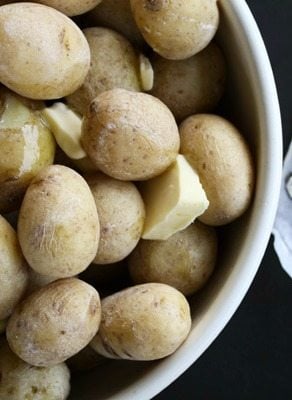
Look closely at the photo. Do you see that white dusty appearance to the potatoes? That is a super fine coating of salt left from boiling in heavily salted water, draining and air drying. Are you ready for another telepathic demonstration?

Many of you are now saying, “Oookay. Boiled potatoes in salty water. Whoopee.” Have a little faith, folks! I only share my favorite recipes with you. This is definitely one of them.

Salt potatoes are a fixture on the Upstate New York and Western New York summer barbecue/picnic/county fair/carnival circuit. Where there is a grill fired up, there is likely to be a pot of water on the boil for a big bowl of buttered salt potatoes. Around these parts, salt potatoes represent summer as much or more than potato salad. They are so popular, that they’re sold as “kits” (the kits are nothing more than perfect sized potatoes and a packet of salt) in even the smallest grocery stores. It was one the first things my husband requested for his Father’s Day cookout and I guarantee you these will be on the Fourth of July menu for three-quarters of the households in our region.

So, what’s the difference between a mere boiled potato and a salt potato? A boiled potato is dropped into plain or lightly salted water, boiled until tender and served, usually, with butter and chopped herbs. Salt potatoes, on the other hand, use a formula to determine how salty the water should be. Generally speaking, bring to a boil three quarts of water, stir in three-quarters of a pound of good old-fashioned table salt, then carefully lower in four and a quarter pounds of Size B new white boiling potatoes. When they’re tender,  drain in a colander and let air dry a bit to form that signature white dusting of salt. Top with butter and serve hot, warm, cold or anywhere in between. Then die of happiness when you take your first bite.

It is this method and formula that transforms a plain old boiled potato. Because of the quantity of salt in the water, it boils at a higher temperature, better cooking and developing the starches the potato contains. When this happens, you have a creamier potato. And whoah is it creamy. Tender, but not waterlogged; salty but not Dead-sea salty; salt potatoes are a revelation.

I have a third and final example of my powers of thought transference. Some are now asking what they would possibly do with four and a quarter pounds of cooked potatoes. Well, my first answer is “eat them!”, but I understand that not everyone is feeding a regiment with each meal like I am. There are some mind-bendingly delicious applications for leftover salt potatoes.

  • Home fries: Chop up leftover salt potatoes and fry in a heavy skillet with additional butter or bacon grease. You’ve never had better home fries in your entire life.
  • Crash Hot Potatoes: The Pioneer Woman’s fabulous Down-Under treatment for potatoes becomes that much easier with leftover salt potatoes. It probably goes without saying, but I’ll say it anyway, you can ramp back on the salt you sprinkle over the smooshed, olive oiled and rosemaried potatoes before baking. They are salt potatoes, after all.
  • Smashed Potatoes: Reheat your salt potatoes, smash lightly, add a splash of heavy cream, some garlic, black pepper and chopped herbs. Stir well with a wooden spoon, serve with a grilled steak or portabello mushroom and prepare to be very happy.
  • Potato Salad: Cut chilled leftover salt potatoes into bite sized pieces, toss with mayonnaise, chopped onions and celery, a squirt of yellow mustard, freshly ground black pepper and stir. Voila! Almost instant potato salad.
  • Cold Salt Potato Midnight Snack: Yes. You haven’t lived until you’ve hit the refrigerator after staying up too late to watch a movie, skewered a cold salt potato on a fork, and nibbled delicately until the potato has disappeared. Trust me.

There is one last item to cover in this salt potato discussion; that is the question of whether to toss with butter or let the butter melt and run down over the hot salt potatoes. I’m in the latter camp, because I like the slight salt crust to be accented by rivulets of melted butter.  I love dunking my salt potatoes in the butter that pools at the bottom of the bowl. In my opinion, tossing the hot potatoes with butter to cover them completely takes away a bit from the charm of salt potatoes. The melted butter obscures the salty outer dusting. However -and I speak the gospel truth here- they’re still delicious that way. They’re still distinctively not your average boiled potato. They’re still creamy and salty; they’re just covered with butter. That’s not a bad thing.

This recipe is a perfect illustration of how simplicity so often delivers the most refined, intense flavours. Eating salt potatoes -whether taking a bite from the end of the little gem and dragging it through the melted butter on the plate before biting again or licking the melted butter dripping down your fork and the side of your hand- is one summer’s purest joys.

Salt Potatoes

Rating: 51

Prep Time: 5 minutes

Cook Time: 25 minutes

Yield: 8-10 servings

Salt potatoes are a fixture of summertime picnics, feasts, barbecues and festivals in Western New York for great reason; they're creamy, tender, salty, buttery and vastly superior to the average boiled potato.

Ingredients

  • 3 quarts of water
  • 12 ounces (approximately 1 1/2 cups) fine salt
  • 4 1/4 pounds one-to-two bite sized new white boiling potatoes, washed (*see notes)
  • 1 stick cold butter (4 ounces), cut into 8 pieces
  • Optional:
  • Chopped parsley for garnish

Instructions

Bring water to a boil in a large stockpot or soup pot over high heat.

When water reaches the boil, stir in all of the salt.

Lower the potatoes into the water, one or two at a time, taking care not to splash yourself.

Return the water to a boil, lower heat to medium and simmer until the potatoes are tender, between 15 and 25 minutes, depending on the size of the potatoes. (**See notes for methods on testing the potatoes for doneness.)

Pour the water and potatoes into a colander in the sink and leave to air dry for 5-10 minutes.

Transfer the potatoes to a serving dish and dot with the pieces of butter.

Serve as is or garnish with chopped parsley.

To Store Leftovers:

Pour potatoes and butter from the bowl into a container with a tight fitting lid or a zipper top bag.

Notes

*Salt potato kits, sold all over Upstate New York, use a very specific size of potatoes; Size B, Grade US no. 2. While most grocery stores don't define their potatoes using this method, you can't go wrong buying small creamer potatoes that are one-or-two-biters. The shape of the potato doesn't matter at all.

**To test your potatoes, use tongs to lift a large potato from the boiling water. A skewer plunged into the potato should pass through the potato completely if it is done.

http://www.foodiewithfamily.com/2011/06/20/salt-potatoes/

Cold Tuna and Edamame Soba |Frugal Dinners

It’s been a long time since I’ve been grocery shopping. What with one thing and another, it’s been close to a month and a half since my last real shopping trip.* There have been quite a few creative food combinations happening and some of those creative combinations have been really happy accidents. For instance? This.

*What can I say? I’ve been busy. Thank heavens for a well-stocked pantry and freezer.

I grabbed a bag of what I thought were peas from the freezer and popped them into the refrigerator to thaw. The idea was to make an über-classy tuna casserole. When I opened the bag the next day, I stared blanky wondering who had swapped my peas for edamame. Derp.

When I realized what happened, I really didn’t want to put edamame anywhere near my tuna casserole. I am, as you might say, a tuna noodle casserole purist.*And so? We moved on to Plan B. Except that I didn’t really have a Plan B in place yet. So, really, we moved onto Plan Nebulous.

*It is written, in the book of me, that tuna noodle casserole should be a good white sauce, onions, tuna, peas, egg noodles and a crispy buttery crumb coating. No more. No less.

Plan Nebulous is a fun way to make a meal… Here’s how it works. Start with a loose category of the flavours you want: in this case, Asian inspired. Gather up any ingredients you have that might fit that category; I grabbed soba, chile garlic sauce, fish sauce, soy sauce, toasted sesame oil, pickled ginger, fried garlic bits, and some nice albacore tuna. That covers the basics of a main dish: Starch, vegetable, protein, and goodies. No need to complicate it… That’s all that’s necessary for a great dinner.

Next, contemplate the ingredients. What’s the best way to cook and combine them? Here, the edamame were already thawed and just needed a quick cook: one that could be accomplished by cooking it along with the noodles in the pot of boiling water. Whomp! Two birds with one stone.  The sauce ingredients were all whisked together, tossed with the drained and rinsed noodles, piled on a plate, topped with the rest of the ingredients and -quicker than you can dial for take out- dinner was served.

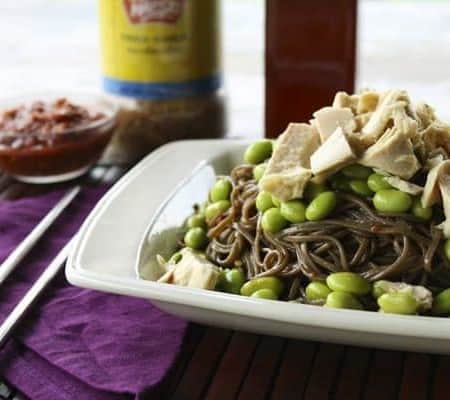
Lovely cold soba tossed lightly with a gently spicy sesame sauce, topped with edamame and flaked albacore tuna, and garnished with fried garlic; When served with additional chile garlic sauce, sesame oil, fried garlic and a bowl of pickled ginger we are talking about a serious treat.

I want to let you in on a little secret. I know soba can be a little tricky.

So often, they’re mushy, clumpy and gummy. This is because the package is lying to us. Lying like a dog. In fact, it sits on a throne of lies.

The back of my pack of noodles says, “Boil 6 minutes, stirring occasionally.” If I did that, I’d be left with a giant wad of glue noodles. That is not a good thing. Let me tell you how you really want to do this. Whether you’re serving them hot or cold, try this next time:

  • Boil for two minutes less than specified on the back of the package. Test a noodle. It should still have body. In other words, it shouldn’t be crunchy, but neither should it disintigrate. My noodles are perfect at two minutes under the suggested time. Experiment a bit with yours and find your perfect number.
  • Drain the noodles and immediately rinse them very well with cold water. The goal is to stop the cooking as fast as you possibly can. This is the most important bit. By rinse well, I mean pick up the noodles with your hands so the water can rinse and chill every single one.
  • If serving cold, toss with your dressing or sauce and let chill, covered, in the refrigerator before eating.
  • If serving hot, reheat by dropping into boiling water only until heated through. Toss with dressing or sauce or put into your soup bowl and serve immediately.


Cold Tuna and Edamame Soba |Frugal Dinners
Author: 
Recipe type: Main Dish, Side
Prep time: 
Cook time: 
Total time: 

Serves: 2-4
 

Lovely cold soba tossed lightly with a gently spicy sesame sauce, topped with edamame and flaked albacore tuna, and garnished with fried garlic; When served with additional chile garlic sauce, sesame oil, fried garlic and a bowl of pickled ginger we are talking about a serious treat. This takes under 10 minutes, making it a perfect heat-beating main dish!
Ingredients
  • 2 portions of dry soba (buckwheat noodles)
  • 1 pound of frozen shelled edamame, thawed
  • 3 tablespoons toasted sesame oil
  • 1½ tablespoons chile garlic sauce
  • 1 tablespoon soy sauce
  • a splash (about ½ teaspoons, more or less) fish sauce
  • 1 can albacore tuna, drained
Optional for serving:
  • fried garlic bits (*see notes)
  • pickled ginger
  • additional chile garlic sauce

Instructions
To Cook the Noodles and Edamame:
  1. Bring a gallon of water to a boil in a large pot over high heat.
  2. Add 2 teaspoons of salt and the edamame to the water.
  3. Boil for one minute before adding the soba.
  4. Stir frequently, boiling for 2 minutes less than specified on the package of noodles.
  5. Test a noodle. If it is cooked through with a little body left to it, drain right away.
  6. Immediately rinse the noodles and edamame well with cold water to stop the cooking. The edamame will mostly fall to the bottom of the colander.
  7. Let the noodles drain while you make the sauce.
To Make the Sauce and Dress the Noodles:
  1. Add the sesame oil, chile garlic sauce, soy sauce and fish sauce to a large mixing bowl. Whisk until smooth.
  2. Use your hands to lift the noodles into the mixing bowl, leaving most of the edamame in the colander.
  3. Toss the noodles in the sauce, using hands or tongs, to coat evenly.
  4. Transfer the noodles to your platter or bowl.
  5. Chill, covered, for at least 30 minutes.
To serve:
  1. Scatter the edamame and then the tuna over the noodles.
  2. Serve with bowls of fried garlic, pickled ginger and additional chile sauce as optional toppings.

Notes
*Fried Garlic is available at some grocery stores, most Asian food markets and via mail order. If you can’t find it, you can simply fry minced garlic in a little neutral oil, such as canola or peanut oil until golden brown and drain on paper towels before serving. This recipe scales up and down easily depending on how many you wish to serve. Just count on cooking one “bunch” of noodles (soba is usually sold with individual portions wrapped inside the main package) per adult or half a “bunch” per child. Likewise, count on using half of- or an entire five-ounce can of albacore tuna, drained, per adult and half a can per child, depending on appetite. Adjust the quantity of sauce accordingly.


Pin It

S’Mores Brownies and Homemade Marshmallow Fluff

Hot on the heels of my Deep-Frying Trilogy (Parts I, II, and III) I bring you yet another uber-healthy offering; S’Mores Brownies. I know. I hear you. Please don’t hate me. I’m sorry. Not.*

*I’m also a mature adult. Not.

Sweets are a requirement on all birthdays, but I believe that big birthdays require sugarbomb confections. Today is the thirtieth birthday of my baby brother Luke.  My now thirty-year old little brother. He is now officially thirty. Did I mention he is no longer in his twenties? Yes. The big three-oh. THIR-TEE. *

*Don’t worry. I’m sure he’s okay with that. Luke? Why are you huddling in the corner rocking like that?

Luke: the kid who repeatedly bounced basketballs off the wall behind my head and said, “I don’t have to stop. It’s not your wall.”; the high-school baseball player who was put into games because of his uncanny ability to get hit by any pitcher; the man who gave my five sons a REAL. LIVE. BLOWDART. GUN (with darts) when they were all under the age of nine; the man who is now expecting his first child to arrive any moment. To him, I dedicate these S’Mores Brownies. I have just one piece of advice for him on this auspicious occasion. Watch your back. I saved that blow dart gun and it’s going to be a special gift from Aunt Beccy to Baby Penny when she’s old enough to shoot it at the wall over your head.*

*I’m still being mature. Not.

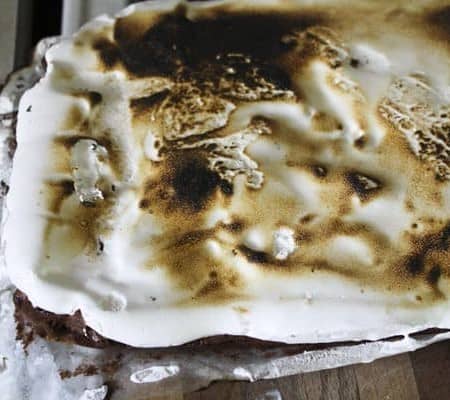
A little bit about these brownies. The pan is sprinkled with buttered graham cracker crumbs and sugar before being filled with brownie batter. They’re baked, cooled, topped with marshmallow fluff and then torched or broiled until the marshmallow is toasted. Isn’t that a kicker? This brownie is like every summer of my youth encapsulated in a sticky, chocolatey, chewy, buttery treat.

What’s even better is that they’re flex-ee-blay. I’ve made them with both homemade brownies and a brownie mix and they haven’t lasted long enough to compare either time. Either way, you want enough brownie batter to make a 9″x13″ pan. When I made it from scratch, I used King Arthur Flour’s gorgiferous recipe, the next time I used a Ghiradelli’s box mix.  I’m not telling you which one to use because both were really great. Do whatever floats your boat!

And a word about the marshmallow fluff. I used homemade because it is so much fun to make. (It doesn’t hurt that it ends up being about one-third of the cost of the storebought stuff and tastes ten times better…) You can opt to procure your fluff from a jar without hurting my feelings, but if you can, try making your own at least once. I think you’ll be impressed!

These may look like a mess (because they are) but have you ever seen a pretty s’more? I rest my case. Whip up a pan of these, park yourself out on a log in the yard, get your fingers and your face sticky eating one or two and then lay back for a nap in the grass before the sugar kicks in. It’s summer. Take a breath.

Happy Birthday, little brother. I feel a little guilty about teasing you over your birthday, so let me just remind you that no matter how old you get, I’ll always be older and I’ll always be there. In the corner. Having an aging crisis and hyperventilating into a paper bag as my baby siblings hit milestones.

I think I need a brownie.

5.0 from 1 reviews

S’Mores Brownies and Homemade Marshmallow Fluff
Author: 
Recipe type: Dessert, Condiment
Prep time: 
Cook time: 
Total time: 

Serves: 12
 

Chewy, chocolatey brownies baked over buttered graham cracker crumbs, topped with marshmallow fluff and torched or broiled until the marshmallows are as toasty as if they were cooked over a campfire. This screams summer camp!
Ingredients
Ingredients for Marshmallow Fluff:
  • 3 egg whites (*See Notes)
  • 2 cups light corn syrup or honey (**See Notes)
  • ½ teaspoon salt
  • 2 cups confectioner’s sugar
  • 1 tablespoon pure vanilla extract
For Brownies:
  • 1½ cups graham cracker crumbs (this is about 20-25 graham crackers, crushed)
  • 4 tablespoons butter, melted
  • 1 batch brownie batter (boxed or homemade, but enough for a 9″x13″ pan)
Also needed:
  • 1 sheet of parchment paper, cut to fit across the bottom and up the long sides of the 9″x13″ pan.
  • non-stick cooking spray

Instructions
To Make the Marshmallow Fluff:
  1. Combine the egg whites, corn syrup or honey and salt in a large mixing bowl or in the bowl of a stand mixer fitted with the whisk attachment.
  2. Mix on high speed until thick, about 10 minutes.
  3. Sift the confectioner’s sugar over the egg whites and mix on low speed until evenly combined.
  4. Pour in the vanilla extract and mix on low speed until evenly combined.
  5. Scrape into a container with a tight fitting lid and store in the refrigerator for up to two weeks. Freeze for up to one month. Stir before each use.
To Make the S’Mores Brownies:
  1. Preheat oven to the temperature specified by your brownie recipe or the directions on your boxed mix.
  2. Lightly spray a 9″x13″ pan with non-stick cooking spray and press the parchment paper into place.
  3. Spray the bottom of the parchment paper with non-stick cooking spray.
  4. Toss the graham crackers and melted butter together in a small bowl then sprinkle them evenly over the bottom of the parchment lined pan.
  5. Spoon the brownie batter over the buttered crumbs.
  6. Use a spoon or spatula to even out the batter over the bottom of the pan, trying not to lift the crumbs as you do so.
  7. Bake as directed by the mix or recipe.
  8. When the brownies test done (a skewer, toothpick or tester inserted into the center comes out clean) remove the pan to a cooling rack and let cool completely.
  9. Spread enough fluff over the brownies to cover them by at least ¼-inch.
  10. Lightly cover with plastic wrap and refrigerate for an hour before proceeding.
To Toast the Marshmallow Topping Using a Torch:
  1. Remove the plastic wrap and place pan on a heatproof surface.
  2. Ignite the torch and move steadily back and forth over the surface of the marshmallow topping until it is done to the degree that you like your toasted marshmallows to be done. I like a few charred bits and deep golden brown. If your parchment paper flames up, move the torch and blow out the fire.
To Toast the Marshmallow Using a Broiler:
  1. Put your broiler on high and place the pan at least 8-inches below it. Watch the marshmallow topping carefully as it will quickly go from nicely browned to completely charred in the blink of an eye.
To Serve:
  1. Let them rest for five minutes after torching or broiling before attempting to slice.
  2. Use the parchment paper like a sling and pull the brownies up out of the tray and onto a cutting board.
  3. Slice into desired portions and serve.
  4. Leftovers can be stored in a single layer in a tightly covered container in the refrigerator for several days.

Notes
*If you are concerned about using raw egg whites in a recipe, I recommend trying to locate pasteurized egg whites in the dairy section of your grocery store. They are often sold in cartons and specify how much to use to replace regular egg whites. **Using honey in place of corn syrup will give you a strongly honey flavoured fluff. Keep this in mind when deciding which to use.


Pin It

Sriracha Crab Rangoons or Crab Rangoon Dip

This is the last of my Rule of Three deep-frying posts. Look for more hat tricks of deep-fried recipes in the future!

Yes, I crabbed (heh) about these rangoons two posts ago, but I tell you this honestly and truly… Every single one of these was devoured. The children wanted more. The husband wanted more. I wanted more. The truth is, had I not doubled the recipe*, and had I not overfilled and then sealed them with a lick and a prayer**, I wouldn’t have had such issues with the popping and the exploding and the grease burns. All that being said, these Sriracha Crab Rangoons were worth every single grease burn I acquired in the making of them.

*It’s a compulsion. I’m working on it.

**I don’t mean I actually licked them to seal the wrappers. I mainly mean that I was distracted while sealing them and in a hurry. What? Who’s distracted? SQUIRREL!

Sriracha Crab Rangoons. Honestly. could something sound any better? First of all I need to make a confession. I adore Chinese Buffets. It’s indecent really. I’m not talking about authentically Chinese food*. I’m talking about thoroughly Americanized deep-fried, kind-of Hunan, sort-of Szechuan, not-really Cantonese steam tables loaded with Crab Rangoons, Sweet and Sour Chicken, General Tso’s Chicken, French fries, hot dogs and donuts that suspiciously resemble deep-fried canned biscuit dough dusted with cinnamon sugar. I know crab rangoons have about as much to do with authentic Chinese food as Boston Coolers have to do with Boston. It doesn’t matter. They’re so good.

*I have had real Chinese food. It’s amazing. My overwhelming love of what my friend calls “WPCF” does not at all detract from my adoration of the real-deal. By the same token, though, I pledge my troth to General Tso and his Happy Family forever and ever, Amen. If it tastes good I will eat it; authentic or not.

Honest-to-Pete, you do not want to sit, stand, or otherwise be in between me and the crab rangoon steam tray at a buffet. Crispy wrapper (we’ve talked about my crispy foods issue), creamy crab filling, green onions, etc… Come on. That’s the stuff of dreams. When you add Sriracha you have hit another level of crave-ability entirely. Rooster sauce + Crab Rangoons= Heaven.

It will probably not surprise you to know that there are no Chinese buffets near where I live (unless, that is,  you count a forty-five minute drive both ways as being near.) As much as I love this not-Chinese Chinese food, I’m far too lazy and far too cheap to drive that far for a craving. Farfarfarfarfar. Could I say that again?

The solution in these situations -because I often find myself craving things- is to make them myself. This is how I found myself manically and maniacally overstuffing wontons that I hastily sealed with hands shaking from hunger*.  This is also how I came to stuff a fresh-from-the-fryer rangoon straight into my mouth. I do not recommend this move. Patience isn’t just a virtue, it’s a saver of the roof of your mouth.

*PSA: Foodie With Family does not recommend approaching a deep frying project when you are shaky because all you have consumed are two pretzel sticks, a fistful of raisins and an ill-advised cup of coffee. We recommend you eat a hard-boiled egg, at the very least, and come back to the job in a half hour. Too long to wait for fried happiness? I understand. There’s always the make-someone-else-do-it approach. We endorse that.

Here’s the other thing to remember about this recipe. Halfway through, when I realized that the 72 crab rangoons that were the inevitable result of doubling the recipe would be excessive even for a family the size of mine, I abandoned stuffing wontons and decided on the filling-as-dip/Sesame Wonton Crisp approach. Those were fantastic, too. Approach this as the spirit moves you. Either way you do it, you’re going to be eating happy.

Because I am nearing the end of the school year with the kids and this is what homeschoolers do, let’s RECAP!:

  • Doubling this recipe? Bad idea unless you have a lot of time. This should’ve been evident from the “Yield: 36 wontons” statement in the book.
  • Overfilling or not sealing the wontons well? Bad idea #2. Don’t go there. Take your time and do the job right or you’ll have quite the clean up job and a couple lovely red grease burns to boot.
  • Eating these straight from the fryer? Also a bad idea unless you dislike the skin on the roof of your mouth.
  • Making these very soon? Great idea. You will NOT regret it.
  • Don’t feel like frying? Make the filling, call it dip and dunk Sesame Wonton Crisps in it with joy!


Sriracha Crab Rangoons or Crab Rangoon Dip
Author: 
Recipe type: Appetizer, Snack
Prep time: 
Cook time: 
Total time: 

Serves: 6-12
 

This spicy, garlicky, combination of crabmeat, cream cheese, garlic, green onions and Sriracha is great as a stand-alone dip or stuffed into wontons and deep fried.
Ingredients
  • 1 (8 ounce) brick cream cheese, brought to room temperature
  • 1 tablespoon Sriracha
  • 6 ounces drained, flaked crabmeat
  • 1 tablespoon soy sauce
  • 1 clove garlic, peeled and minced or pressed
  • 4 green onions, green part only, minced (*see notes for what to do with the white parts!)
  • 1 teaspoon toasted sesame oil
  • 36 wonton wrappers (**see notes)
  • 1 egg white, beaten until frothy
  • vegetable or peanut oil, for frying

Instructions
To Make the Dip:
  1. Use a wooden spoon or stand mixer to beat together the softened cream cheese and Sriracha until it is an even colour.
  2. Stir the crabmeat, soy sauce, garlic, green onions and sesame oil into the cream cheese mixture.
  3. Chill, tightly covered, and serve as dip. Or…
To Make the Sriracha Crab Rangoons:
  1. Preheat about two inches of vegetable or peanut oil in a high-sided frying pan or pot until it reaches 375°F.
  2. Line a pan or large platter with paper towels, set aside.
  3. Lay a single wonton wrapper in front of you oriented like a diamond.
  4. Brush all four outer edges of the wonton wrapper with the beaten egg white.
  5. Spoon about 1 teaspoon of the filling below the top point, but above the centerline.
  6. Fold the bottom corner up over the filling to match with the top corner and form a triangle.
  7. Carefully and firmly seal the outer edges completely by pressing the edges tightly.
  8. Fry the stuffed wontons in batches of 2-3, taking care not to overcrowd the pan, for 3-5 minutes, or until golden brown, delicious and crispy looking.
  9. Carefully transfer the rangoons (this is where they like to pop) using a skimmer or slotted spoon, preferably, or tongs to the towel lined platter.
  10. Repeat until all rangoons are fried.
  11. Let rest 2-3 minutes before eating, but serve while still hot!

Notes
*Don’t toss out those white root ends of the green onions! Put them, roots down, in a jar with water about halfway up the white portion and stick in a sunny window-sill. Change the water every two days and before you know it, you’ll have more green onion ends to use! **Most wonton wrappers are available in the frozen section of grocery stores. Be sure to thaw them completely before using or you’ll have to fight to separate them!


Cincinnati Chili Empanadas

This post makes two deep-frying posts in a row. Does this break some sort of variety rule? Does it count that one of the recipes is a mere snack? Here’s the thing. I didn’t stop at two. I had three days of deep-fried goodies in a row. Why, you ask?

Have you heard of the “Deep-Frying Rule of Three”*? It states that if you prepare one recipe that is deep-fried, you must plan two additional deep frying projects.  Why is this so important? Because you have all that oil that you’ve just broken in with one lovely deep-fried meal and it’s far too good to throw out just yet.  IT’S FRYING GOLD, PEOPLE! You wouldn’t throw away gold, would you?

*I thought up the rule. If you haven’t heard of it yet, the voices in my head are not loud enough, evidently.

And so we sally forth, deep-frying all foods that cross our paths. It’s just the way we roll.

But these. These are the these that rhyme with bees-knees. These bees-knees. The combination of two wildly different regional favorites: Cincinnati Chili and Empanadas. Cincinnati Chili being the specialty of Cincinnati (duh), Ohio and Empanadas being the regional specialty of Greater Not-Ohio. While explaining to a friend that I was on an empanada bender owing to the fact that I recently discovered the great joy that is frozen empanada dough discs (Hallelujah, Thank You, Goya!*), I half-joked that I was so obsessed with empanadas that I was likely to stuff a batch with my leftover Cincinnati Chili. Instead of laughing at me, she said, “DO IT!” Well, yes ma’am.

*Let me tell you about Goya Discos for a second, if I might. I refer to frozen packages of ten empanada dough discs at a price so low you have to do a double take. At any given moment, I have at least ten packages in the freezer. You can stuff them with all sorts of chopped leftover meats, chilis, stews, cheese, vegetables, and GLORY, pie filling or sweet stuff.  I may or may not have stuffed them with chopped dark chocolate. And if I did, it was really, really good.

I did.

And you should, too. It turns out that this is my favorite empanada yet.

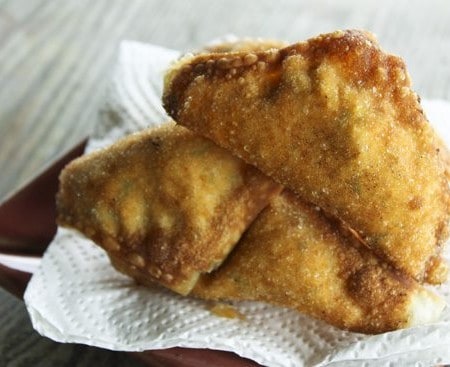
These bees-knees empanadas are mighty meaty and super saucy. They’re satisfying, spicy, lightning fast, and pleasing to all ages. My husband and I scarfed them down with a pile of guacamole perched precariously on top. The kids formed factions of those eating them ‘pure’ and those dunking into sour cream. Anyway you move them to your mouth, you’ll be happy.

Cincinnati Chili Empanadas

Flaky, crispy empanada dough wrapped around spicy, meaty, Cincinnati Chili. Served as a snack, appetizer or main dish, these are hard to beat.

Ingredients

  • 2 packages of ten frozen empanada dough rounds (or equivalent amount of homemade dough)
  • 5 cups leftover Cincinnati Chili
  • Canola or Vegetable Oil for deep frying (*see notes if you prefer not to deep fry)

Instructions

Roll out one empanada disc to a circle about 6-inches in diameter.

Scoop about 1/4 cup of chili into the center of the dough.

Fold dough in half over the chili to form a semi circle.

Crimp with a fork, then fold the dough up and pinch it to form a decorative edge.

Repeat until all dough discs have been filled and crimped.

Heat a large, heavy-bottomed, high-sided pan of oil to about 375°F.

Line a plate of pan with several layers of paper towels. Set aside.

Fry 3-4 empanadas at a time, taking care not to crowd the pan, for 4-6 minutes or until the dough is golden brown.

Use tongs or a skimmer to transfer the empanadas from the hot oil to the paper towel lined plate or tray.

Let rest 5 minutes before serving hot or let cool to room temperature before serving.

Store leftovers, carefully wrapped, in the refrigerator.

http://www.foodiewithfamily.com/2011/06/10/cincinnati-chili-empanadas/