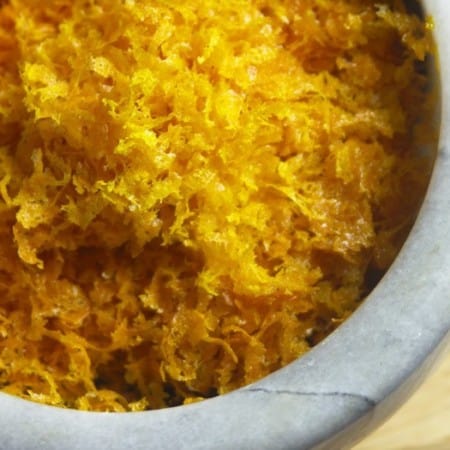


Homemade Grand Marnier Clone

Mmmmm. Oranges.  I love them.  Dearly.

I’ve even been known to eat the peels of oranges, candied or not; minus the pith, of course! Orange is one of my favorite flavors to add to baked goods, hot drinks, custards, and more.  Sometimes that’s easily accomplished by squeezing a little wedge of orange into or over a dish, but sometimes it requires a little more finesse.  Sometimes it requires Grand Marnier.

This classic liqueur is basically the essence of oranges blended with cognac (fancy-pants brandy).  There are times when that small addition of alcohol is necessary to release flavors that otherwise would remain sadly locked away in their little alcohol-soluble encapsulated molecules*.  And there is no substitute for a little nip of something potent at those times.

*Think tomatoes, peaches, strawberries, blueberries, etc…  All of those have flavors that cannot reach their full potential unless joined with alcohol.  I’m not saying you have to drown your food, I’m just saying a judicious glug added to a recipe can make the difference between ‘great’ and ‘spectacular’.

A couple weeks ago, I shared my recipe for Blueberry Tiramisu and a quick, informal poll showed that most of you wanted to know how to make a Homemade Grand Marnier Clone.  This means one of two things:

  1. You want to refill the bottle of the ‘real’ stuff you bottomed out when you generously made margaritas for your entire neighborhood. Or…
  2. You, like me, just want to prove that you can do it better than ‘the man’ does.  You know.  The ‘Grand Marnier’ man.  Sitting in his fancy chateau in Les Alpes, sipping his apéritif and laughing haughtily at all the hoi polloi paying big money through the nose for something that can be made so easily at home. *Insert snooty Gallic snicker here.

Well, one way or the other, I’m your gal.  There is one really difficult thing in this recipe, though; you’re going to have to wait 2-6 months after putting it together before you start sipping if you want it to taste like the real deal.  Of course, if you’re popping it in a blender with a bunch of ice, some sugar syrup, lime juice and tequila, you have my blessing to cheat on that time frame a bit.  I mean honestly. Is it REALLY going to make a difference how ’round’ a flavor you have if you’re going that direction?

But if you want to sip on this or use it in cheesecakes or dunk ladyfingers in it for tiramisu or add it to pastry cream or drizzle it over crêpes prior to flambéeing the tar out of them, you may want to go that extra mile.  Trust me.

Psst.  Hey.  Want to impress your favorite food or wine or cocktail aficionado? Decant the finished liqueur into a beautiful bottle with a cork or stopper, wrap with a lush (pun intended) ribbon and watch their jaws drop and eyes pop when you tell them what’s in it.  I tried this out on my favorite wine snob (her description, not mine) friend and asked her whether she thought it measured up to the real thing. Her response? “This is amazing!  This is BETTER than Grand Marnier! Grand Marnier WISHES it tasted like this.”

For a photo-free, printer-friendly version of this recipe with no blah-blah, click here!

Homemade Grand Marnier Clone

While this is a project that is simple, it is definitely one that requires forethought.  At a bare minimum, this liqueur takes 2 months to be ready.  And yes, it will be delicious at 2 months, but if you go all out, whole hog, pedal to the metal and give it the full six months to age you will be rewarded with an amazing depth of flavor and smoothness.  Of course, if your patience is anything like mine, you’ll want to try it sooner, so do what I do: divvy the batch into two containers, one for now and one for later.  ~or~ Double the batch!  You could quadruple it for the same price as a 750ml bottle of the real deal.  And I think you’ll find that this is not only just as good as the ‘benchmark’ but even better!

Ingredients:

  • The zest of 8 oranges (gently washed and toweled dry before hand).  Take care to get the zest only- no white pith!
  • 1 cup granulated white sugar
  • 4 cups brandy (Using a better quality brandy or cognac will result in a much smoother sipping finished product.)
  • optional, 1 teaspoon liquid vegetable glycerine (This creates a finished product with a more velvety mouth feel.)

Sprinkle about 1/4 cup of the sugar over the zest in a mid-sized bowl or mortar and squish together with a pestle or the back of a heavy spoon.

Continue smooshing and adding sugar 1/4 cup at a time until the sugar and orange zest are almost paste-like.

Transfer this mixture to a large, clean jar with a tight fitting lid.

Pour the brandy over the mixture and stir well.

~And here is where the photos stop.  Honestly, I’m all out of the aged stuff and I’m not willing to wait 6 months before I post this recipe for you.  Take my word for it.  It’s pretty and it’s delicious.  I’ve made it many times before. Remember my amazing yet ill-fated Blueberry Tiramisu? That *sob* work of art used the very last of my Homemade Grand Marnier Clone.  (Blasted dog!)  So if you make this now, we’ll have it available at just about the same time.  To your health!

Cap tightly and age 1-3 months, shaking weekly, in a cool, dark place. (Basements are usually perfect for this!)

After at least 4 weeks (the longer you let this age, the better it will be!) shake the jar well and pour the mixture through a fine mesh stainless-steel strainer into a bowl or large measuring cup with a spout.  Rinse the strainer and the jar that you used to age the liqueur.  Line the strainer with cheesecloth or a clean tea towel and pour the liqueur back into the aging jar.  If using the liquid glycerine, stir it in at this point.  Cap tightly again and continue aging for an additional 1-3 months.


Cream of Broccoli Soup and DIY Crème Fraîche

Did you know there’s a fan page for Foodie With Family on Facebook?  Do you have any idea how lame I feel saying that?  Seriously.  But one exists, and it’s *blush* pretty fun for me.  I love talking with all of you.  Thank you all for weighing in on the ‘what do I post next’ poll.  Taking into account the previous requests and promises, the winner is Homemade Grand Marnier, followed by Tres Leches Cake and Cream of Broccoli Soup. So what am I doing leading off with Cream of Broccoli Soup?  It’s raining here.  And when it rains I like to do three things; sit on the couch with a blanket and book, drink tea, and make soup.  Thus, soup wins.  Tres Leches and Grand Marnier will make their long promised appearances this week!

So you have a loaf of One-Hour Sandwich Bread in the oven…  What do you serve with it?  Candidate #1: Cream of Broccoli Soup.

Thick, smooth, and vibrant in both color and taste, this soup spotlights the bright flavor of fresh broccoli. And let me tell you something. I adore broccoli;  Always have and always will. I guarantee that this is the Cream of Broccoli soup for serious broccoli lovers.

My soup is a little different than most broccoli soups out there (similar to this soup made by my good friend, but different than most ‘cream of broccoli’ recipes.) Why?  Because I don’t put any cream or milk in it.  I usually stir a bit of ye olde crème fraîche* in at the end to provide just a little tang, but I find that adding milk or cream in the whole pot of soup ends up muting the broccoli too much for my taste. Isn’t the point of a ‘broccoli’ soup to taste the aforementioned broccoli?

*Nerd alert: Check out my Richard the Lionhearted moment; Old English + French.  Am I the only one laughing? Le sigh. But more practically, have you made your own crème fraîche yet?  This couldn’t be simpler!  Stir 2 Tablespoons of cultured buttermilk (NOT lemon or vinegar soured milk!) into 2 cups of heavy cream.  Cover and leave at room temperature for 24 hours before refrigerating.  Ta da!  You made crème fraîche!  And you didn’t pay an arm and a leg for it at the grocery store!  And I’m using a lot of exclamation marks!  It’s so exciting! I’ll stop now! I mean to say, “I’ll stop now.” Calmly.

There are a couple fringe benefits to preparing Cream of Broccoli soup this way (aside from the taste-bud tantalizing flavor.)

  1. It’s quicker! Chop, sweat, stir, simmer, blend, serve.  That’s it; no melting butter, stirring in flour, forming the roux, simmering, blending, returning to pot, adding dairy and re-heating.
  2. It’s cheaper! Heavy cream is pricey, folks!  By adding it as an accent rather than a major player, you cut down on the overall cost of the meal.  Every little penny helps, right?
  3. It’s healthier!  We thicken this pot of soup with a vitamin-rich, low-maintenance potato rather than a fussy, fatty roux and heavy cream. (Don’t get me wrong.  I love the fussy, fatty roux and heavy cream in other contexts, but this soup simply doesn’t need it for flavor or for texture!)  More details on the health properties of broccoli?  Why sure!  I thought you’d never ask.

Broccoli alone is considered a super-food.  It’s rich in vitamins C, K, A and dietary fiber.  As if that wasn’t good enough, it’s been linked to boosting immunities, preventing cancer and the slowing or halting the aggressive spread of cancer.  This is one recipe where eating healthily is no chore, it’s a delight.

For a printer-friendly, photo-free version of this recipe, minus the broccoli-prosthelytizing, click here!

Cream of Broccoli Soup

Ingredients:

  • 4 cups fresh or frozen cut-up broccoli (Use the stems as well as the florets! It tastes amazing and it’s economical!)
  • 4 cups stock (homemade chicken or vegetable, preferably) or water
  • 1 medium russet potato, peeled and diced
  • 1 small cooking onion, peeled and diced
  • 1 Tablespoon butter
  • salt and freshly ground white pepper to taste (You can use black pepper if white pepper is not available.)
  • Optional, crème fraîche for drizzling before serving (see below for instructions on making your own!)

Melt the butter in a stockpot or large soup pot over medium heat.  Add onions and lower heat to medium-low.  Sprinkle a pinch of salt over the onions and sweat, stirring occasionally, until onions are softened.  Lower the heat if necessary to avoid browning the onions.  This should take about 5 minutes.

Add the broccoli, stock, and potato to the soup pot and raise the heat to medium-high.  Bring the soup to a simmer.  Partially cover the pot and simmer for 25 minutes, or until all the vegetables are soft.

Remove the pot from the heat and allow to cool for 10 minutes.  Puree the soup, in batches, in a blender or food processor or use an immersion (stick) blender in the pot to puree the soup to your desired consistency.  Add the salt and pepper to taste.

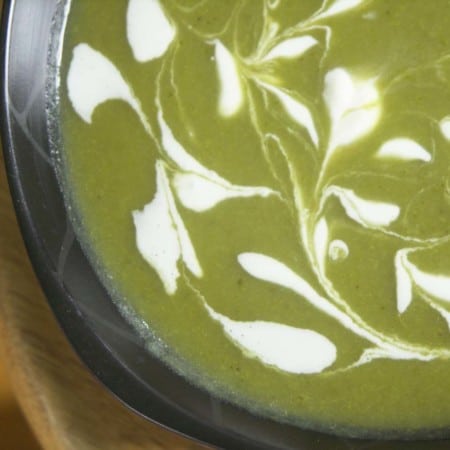
If garnishing first loosen the crème fraîche in a small bowl with a fork or whisk.  Use a spoon to drizzle or dollop the crème fraîche over the soup and then swirl with a toothpick to create pretty patterns throughout.

You can freeze the uneaten, un-garnished soup in tightly covered containers for up to three months.

DIY Crème Fraîche

Ingredients:

  • 2 Tablespoons cultured buttermilk (NOT lemon juice or vinegar soured milk)
  • 2 cups heavy cream (while it’s preferable to use cream that hasn’t been ULTRA-pasteurized, you can use the ULTRA-pasteurized versions, it just may take longer to thicken properly.)

Use a whisk to combine the buttermilk with heavy cream.  Cover lightly and leave at room temperature (between 65°F and 75°F) for 24 hours or until thickened (but no more than 48 hours.)  This is good for two weeks (but I’ve used it longer than that…) in the refrigerator. Chilling it prior to use will thicken it further.

One Hour Sandwich Bread

Can you think of any scent more bewitching than that of fresh bread baking in the oven?  It is nearly impossible to concentrate when I smell it. While the bread bakes my brain rummages through its box of all my favorite ways to eat a loaf hot from the oven; Should it be blueberry jam? Cold butter? Ginger marmalade? Or maybe a fried egg? A paper thin slice of salty ham? What sweet agony narrowing down those options.  And what a marvelous way to pass part of a Saturday morning; luxuriating in the brown yeasty aroma of dough transforming into the staff of life and contemplating that new loaf’s upcoming rapid demise.

If talk of bread fires up your salivary glands the way it does mine, you are in luck today, my friends.  I have a recipe for an astonishingly flavorful yeast bread that is ready to be loaded up with whatever makes your fancy take flight in one hour flat.

From start to finish, from its Alpha to its Omega, from the time you dip that first scoop of flour to the time it is removed from the oven you will have spent sixty minutes; and most of that will have been baking time.  There’s no crazy trick to it, it’s simply simple.

And this is a sandwich bread that is the stuff on which dreams are built; mouthwatering flavor, magnificently chewy crust, fine crumb interior, able to be sliced Texas toast thick or whisper thin and capable of holding anything you want to pile or slather on it.   Just take a look at it.

Want to look closer?

Well, sure! zoom on in…

If you have any fears about making yeast breads abandon them long enough to give this a try.  Kiss those yeast-bread bogey monsters goodbye, because this is the bread that will change your life.  You don’t need special equipment, or mad bread skills, or anything other than a big bowl and a spoon and a little counter space and the counter space is negotiable.  I’ll give instructions for preparing this with a stand mixer, food processor and by hand. And please note that it is just as easy as can be in all three methods.  I do believe it’s time to revamp that old cliché, “It’s as easy as pie.”  From now on I’m going to say, “It’s as easy as One Hour Sandwich Bread!”

Remember, too, that a last minute loaf of bread can make the meal.  It can be the difference between a lonely bowl of soup and a feast.  And more than that, this bread turns humble pantry staples into a reason to look forward to dinner.  And while the taste and ease are enough, there is also the low price tag to recommend it.  A few cups of flour, salt, sugar, yeast, water and it’s bread! And let me tell you something else, a loaf of this wrapped in a new tea towel makes a fantastic hostess gift.  Who doesn’t like a loaf of warm bread?

For a printer-friendly version of this recipe minus the photos and rhapsodic waxing about bread, click here!

One Hour Sandwich Bread

Adapted from ‘The Tightwad Gazette’.

Ingredients:

  • 6 cups all-purpose flour (1 pound, 9.5 ounces by weight)
  • 2 Tablespoons instant yeast (also known as Bread Machine Yeast)
  • 2 Tablespoons sugar
  • 1 Tablespoon Kosher salt (if using table salt, reduce to 1 ½ teaspoons)
  • 2 cups very warm water (about 120°F)
  • 2 Tablespoons extra virgin olive oil

Mixing the dough by Stand Mixer (my preferred method):

Combine flour, instant yeast, sugar, and salt in the bowl of the stand mixer that has been fitted with a dough hook.  Mix on low speed for 30 seconds.

With mixer running, slowly pour in the water and olive oil at the same time.  Continue mixing on low until the dough comes together and becomes smooth, about 4 minutes.  Remove bowl from the stand mixer, scraping any dough that remains on the dough hook into the bowl.  Pull dough from bowl with your hands and form a smooth dough ball.  Replace in bowl, cover with a clean tea towel and let rise in a warm place for 15 minutes.

Mixing the dough by Food Processor:

Combine flour, instant yeast, sugar and salt in the bowl of a food processor that has been fitted with a blade or dough blade.  Pulse 10 times.  With the food processer running, pour the water and olive oil into the feed chute.  Continue processing until the dough forms a cohesive ball.  Spin the dough ball 20 times and shut off the food processor.  Remove the dough, form a smooth dough ball and place in a lightly oiled mixing bowl.  Cover with a clean tea towel and let rise in a warm place for 15 minutes.

Mixing the dough by Hand:

Combine flour, instant yeast, sugar and salt with a whisk or fork in a large mixing bowl.  Pour the warm water and olive oil into the flour mixture and use a sturdy spoon to combine into a shaggy dough.  Use your hands to knead for 8 minutes*.  After kneading for 8 minutes, cover the bowl with a clean tea towel and let rise in a warm place for 15 minutes.

*If you find it difficult to knead in the bowl, you can turn the dough out onto a clean surface to knead it.  After kneading, just return the dough to the bowl and allow it to rise as instructed above.

Turn dough out onto a clean surface and divide in half.  Form each half into a ball and place 5-6 inches apart on a baking sheet that has been lined with parchment paper or a silpat, or has been lightly greased.  Use a sharp knife to slash the top of the loaf about ¼ of an inch deep.  This allows the steam to escape the baking loaf.

To bake the loaves:

Arrange the racks in your cold oven so that one rack is on the very bottom and one is positioned in the center of the oven.  Place the baking sheet with the loaves on the center rack and a bread or cake pan that is full of very hot tap water on the bottom rack.   Close the oven and turn your oven on to 400°F.  It is imperative that you start this in a cold oven!  Set your timer for 40 minutes.  That 40 minutes is all that stands between you and fresh bread.

The crust should be a deep brown and quite firm when you remove the loaves from the oven.  Transfer the loaves to a rack to cool completely if you wish to slice them, or you can do like I normally do and cool one loaf while tearing the second one into pieces and slathering with cold sweet cream butter.

Amish Cookies

This is the face of a monster.

Merciless.

This is a face that destroys on a whim.

Unyielding.

This is a face that -without pause- devastates the entire population…

Of cookie jars.

This is my cookie monster baby.

Allow me to illustrate.  The Evil Genius and I went to Houston before Christmas and the boys’ soon-to-be-nominated-for-sainthood Nana (a.k.a. My Mom) babysat the entire mini-horde.  My Mom is fun.  All kinds of fun.  Proof?  This is her just last month.

That’s right.  That’s MY mom, on the climbing wall of a playground, wearing a skirt and cotton shoes.  I told you she was all kinds of fun.

But I was telling you about the cookie monster.

Nana had plans for these boys.  They were going to sled, camp in the living room, hike through the snow, play board games, make glue and poster board collages, eat homemade pizza, go to her favorite coffee house,watch movies, make Christmas ornaments and decorate Christmas cookies while having a frosting war.* And they were going to accomplish this in three days.  Did I mention my mom is fun?

*A frosting war is a Christmas tradition started by my mom wherein she flings frosting at the children and they fling it back at her.  It involves a great amount of butter, laughter, sugar and paper towels.

The time came for the Christmas cookies.  According to reports, the boys all enthusiastically decorated a double batch of sugar cookies shaped like trees, bells, gingerbread men and whatnot.  When the job was done and the cookies were stacked to be nibbled after dinner, the whole company retired to the living room to fulfill the ‘watching movies’ portion of the programme.

Forty-five minutes into the movie, Liam asked, “Where’s Leif?”

Leif was discovered in the kitchen with a plate empty of cookies (save one), sticky fingers and a smile that stretched from the tip of one pink ear to the other.  And a fierce sugar buzz.  Leif killed the Christmas cookies.

Today’s cookie recipe is one that I watched my Grandma make hundreds of times at the camp where I lived as a child.* Hey.  My Grandma is fun, too.  (My Mom learned from the best, you know.) I ate my way through more of these cookies than I could ever count as a kid and I’m still in love with them.

*Lake Louise United Methodist Camp.  Shout out to Boyne Falls, Michigan!

I’m not sure why these were called Amish Cookies but I have a guess.  They make abundant use of humble ingredients to turn out a cookie that manages to be  delicately caramel flavored, crisp on the outside, chewy on the inside and surprisingly sturdy all at the same time..  These cookies don’t fall apart when you dunk them in a tall glass of cold milk.  And they hold together beautifully when crammed into my apron pockets for stolen bites when the kids aren’t looking.  I do believe these are the perfect cookies.

The recipe, as written by my Grandma, suggests chocolate chips, raisins, nuts, chopped dates, coconut and other goodies as stir-ins.  Around these parts, I split the cookie dough into two bowls and stir raisins into one half and chocolate chips into the other.  This makes everyone happy; including the cookie monster.

And if I find that I’ve let down my guard and left the room before securing the cookies I don’t panic.  If my little monster eats his way through a cooling rack of these, at least I’ll have snuck some fruit and oats into him.

For a printer-friendly, photo-free, just-the-facts version of this recipe, click here!

Amish Cookies

Adapted from my Grandma Shaffer’s Lake Louise Amish Cookies recipe.

Ingredients:

  • 3/4 cup softened butter (6 ounces)
  • 3/4 cup coconut oil or shortening (6 ounces)
  • 2 cups granulated sugar (14 ounces by weight)
  • 1 large egg
  • 1/3 cup molasses (3 1/2 ounces)
  • 2 teaspoons vanilla extract
  • 3- 1/2 cups all purpose flour (15 ounces by weight)
  • 1 teaspoon salt
  • 2 teaspoons ground cinnamon
  • 1 Tablespoon baking soda (not a misprint!)
  • 1 Tablespoon baking powder (also not a misprint!)
  • 3 cups old-fashioned rolled oats
  • 1/2 cup buttermilk (Don’t forget, you can make your own!)
  • Optional: 1 -1/2 cups of any of the following ingredients: chocolate chips, nuts, raisins, coconut, chopped dates, dried cherries, or chocolate chunks.

Preheat oven to  350°F.

In the bowl of a stand mixer or in a large mixing bowl with a hand mixer, cream together the butter, and coconut oil or shortening on low speed until they the sugar starts combining with the fat.  Turn the mixer to medium high speed and whip until the mixture is fluffy and the sugar is completely distributed.

Add the egg, molasses and vanilla extract to the butter and beat on medium speed until even.

In a separate bowl, use a whisk to combine the flour, salt, cinnamon, baking soda and powder, and the rolled oats.  Add this to the butter mixture along with the buttermilk and beat until thoroughly combined.  Stir in the optional goodies.

On a greased or parchment lined cookie sheet, drop generously rounded tablespoons of the cookie dough three inches apart. Form the cookie dough into balls.

Use a flat bottomed drinking glass dipped in sugar to gently flatten the cookie dough.

Bake for 10 minutes, or until the bottoms and edges of the cookies are lightly browned and the cookies are set. Allow cookies to rest on the cookie sheets for one minute before transferring to a cooling rack.  Store cooled cookies in an airtight container at room temperature.

…And for the love of all that’s holy, don’t leave this little guy in the room alone with a batch of these cookies…

Basic Chicken Stock and Asian Chicken Stock

Let’s talk chicken stock.

Do you keep it handy?  Having chicken stock around is like owning a black dress or a pair of red shoes; it’s just something you have to have to have and it makes you feel good.

The best chicken stock is made in  your own kitchen.  You can control the final product -the complexity, the flavor profiles, the intensity, the salt content- because you decide what goes into the pot.  But there’s more to it than the simple issue of control (What did I just say?  Something is more important than control?)  There’s the issue of texture.

I know that most of the time texture is not the first thing that pops into the noggin when contemplating chicken stock but let me explain why it should be. Sure, you can go buy a carton of stock off the shelf at your local grocery store, but it can’t hold a candle to the homemade stock. (For reasons other than the stock carton’s clear lack of opposable thumbs.)

Homemade stock, when done well, becomes thick and gelatinous when refrigerated.  This is because it contains all sorts of lovely dense, mega-nutrition in forms that the body can absorb easily; calcium, protein, gelatin, glucosamine, chondroitin, magnesium and phosphorous.  Store bought stock, even the fancy-schmancy brands, just can’t make this boast.  And why?  Because in homemade stock, you slow simmer the bones and trimmings -the throw away bits of meat*- until everything good that can be extracted from them is incorporated into that lovely elixir.

*I keep a little pail with a tight fitting cover in my freezer.  Into that pail go all the trimmings from every chicken I cook; the bones from chicken thighs,  the necks, (cleaned) feet and backs of chickens that I break down for various meals.  And let me tell you, you haven’t had an amazing stock until you’ve made one with chicken feet.  If you don’t have access to whole chickens with the feet and necks, check an ethnic market around you.  The Evil Genius frequents the Asian foods market near his office building.  He is able to grab two pounds of chicken feet for about $3.50 for me.  It’s slightly disconcerting to look into a simmering stockpot full of chicken feet.  Kind of a Lady MacBeth feeling, but boy howdy, it’s worth it.  It yields the most velvety, full-flavored chicken broth you’ve ever tasted because of all the gelatin from the connective tissue in the feet.  Blech.  I know.  But once you’ve tried the stock you’ll be convinced.

Made with or without chicken feet, amazing nutritional qualities are one of the many reasons that homemade stock has long been considered the food to feed to those who feel sick, weak, depressed or otherwise under the weather.  It’s nourishing.  It’s satisfying.  It’s simple.  It’s economical.  It’s what food should be.

My two favorite stock recipes are given here, but they’re just guidelines.  Put what you like in your stock; just remember that the flavors become concentrated.  And lay off on the salt while making stock.  Salt is for broth.  If you leave the salt out here, you can better control the final product when you cook with your stock.

And lest you be skeeved out by the idea of gelatinous chicken stock let me reassure you. (I understand!  I was a vegetarian for seven years.  It was baby steps back into the meat world [starting with a bacon bender- but that's another story] and the thought of gelatinous chicken stock would’ve done me in…)  It’s only when it’s cold that it’s thick like this. When you cook with it the gel-like texture disappears and results in a silky smooth liquid chicken stock.  Don’t just take my word for it though, give it a try!

For a photo-free, printer friendly, non-chatterbox version of these recipes, click here!

Basic Chicken Stock

This stock is the bees-knees for use in soups, risotto, plain rice, sauces and any other places you need a good, basic chicken stock.

Ingredients:

  • 2 pounds chicken trimmings (backs, necks, bones, fat, skin, and cleaned chicken feet, if available. Above all, make sure you have many uncooked bones in the mix.)
  • 2 large carrots, scrubbed and broken in half
  • 2 stalks of celery, scrubbed and broken in half
  • 1 large onion, halved and peeled
  • a handful of parsley stems (save the leaves for use in other dishes)
  • 10 black peppercorns
  • water

Add the chicken to the stockpot and cover with cold, fresh water by four inches.  Bring to a simmer -when an occasional bubble breaks the surface of the steaming liquid, but it is not boiling- and skim any foam or impurities that rise to the surface of the liquid.  After 30 minutes of skimming and simmering, add the remaining ingredients to the pot and cover partially.  Simmer for at least 4 hours but up to 10  hours, adding additional boiling water if the liquid drops below the level of the solids in the pot.  Remove from the heat and fish out as many solids as you can get with a pair of tongs, transferring them to a bowl.  Position a fine mesh strainer, or a colander lined with cheese cloth or a clean tea towel over a large bowl or another stockpot.  Pour the stock through the strainer.  Add the solids that you removed to the strainer and press with the back of a wooden spoon to squeeze out as much stock and flavor as you can.  Discard the remaining solids.

Cover the stock and chill until the fat rises to the surface.  Skim off the fat.  (You can store the chicken fat in the freezer to use to make the best roasted potatoes you’ll ever taste!)

You can store the stock in the refrigerator, tightly covered, for up to 5 days.  If you wish to store it longer, you can transfer to smaller containers and freeze for much longer.

If you, like me, are a canning maniac and want to go that extra step, reboil the stock, and pour the boiling stock into clean canning jars.  Screw on new two-piece lids and process in a pressure canner at 10 pounds of pressure for 25 minutes.  And if you want more details on just how to do that, let me know.  I’m happy to share!

Asian Chicken Stock

This stock is delicious in Asian-style noodle or dumpling soups or just sipped by itself.  And I can’t think of much that I enjoy more than a piping hot bowl of jook or congee made with this stock.

Ingredients:

  • 2 pounds of chicken trimmings (Preferably mostly feet and necks, but you can use any combination of bones, meat and skin that you can find.)
  • 1 head of garlic, intact, but rubbed to remove the papery exterior
  • 1 (2-inch) piece of fresh ginger
  • optional, 2 fresh chile peppers (jalapeno, habanero, Thai, etc…)
  • water

Add the chicken to the stockpot and cover with cold, fresh water by four inches.  Bring to a simmer (when an occasional bubble breaks the surface of the steaming liquid, but it is not boiling.) and skim any foam or impurities that rise to the surface of the liquid.  After 30 minutes of skimming and simmering, add the garlic, ginger and chile peppers (if using), partially cover the pot and simmer for at least four more hours, but up to 10 hours, adding additional boiling water if the liquid drops below the level of the solids in the pot.  Remove from the heat and fish out as many solids as you can get with a pair of tongs, transferring them to a bowl.  Position a fine mesh strainer, or a colander lined with cheese cloth or a clean tea towel over a large bowl or another stockpot.  Pour the stock through the strainer.  Add the solids that you removed to the strainer and press with the back of a wooden spoon to squeeze out as much stock and flavor as you can.  Discard the remaining solids.

Cover the stock and chill until the fat rises to the surface.  Skim off the fat.  (You can store the chicken fat in the freezer to use in fried rice or frying dumplings.)

You can store the stock in the refrigerator, tightly covered, for up to 5 days.  If you wish to store it longer, you can transfer to smaller containers and freeze for much longer.

If you’d like to can this stock, follow the directions given above in the Basic Chicken Stock recipe.

Homemade Mascarpone

A Tale of Two Mascarpones:

“It was the best of times, it was the worst of times, it was the age of wisdom, it was the age of foolishness, it was the epoch of belief, it was the season of Light, it was the season of Darkness, it was the spring of hope, it was the winter of despair, we had everything before us, we had nothing before us, we were all going direct to Heaven, we were all going direct the other way- in short, the period was so far like the present period, that some of its noisiest authorities insisted on its being received, for good or for evil, in the superlative degree of comparison only.”

Charles Dickens, ‘A Tale of Two Cities’


It was pretty clear from the response to the Blueberry Tiramisu post that you all are a bunch of fellow mascarpone lovers.  And I know how expensive it is as the stores, so I’m thrilled to pass along just how easy and inexpensive it can be to make at home.  Sounds like a great start, right?

But.

And it’s a big but.

Not to be confused with a big butt although that is a present and looming danger if you eat the entire batch of mascarpone at once.  Butt I digress.

I  sat down to write this post prepared to tow a line that makes me struggle.   I was going to give you a recipe for the most hyper-traditional mascarpone a body can make.  Because sometimes -if I’m being fully truthful- I think I should be fancier and more traditional than I actually am. I have to continually check myself (and my burgeoning ego) and remember that the point is not whether I did it like someone’s Nonna in Abruzzi; the point is that I made it.  Hello.

There are entirely too many times in life when we have to do things a certain way to avoid disaster, health crises, heartbreak, financial ruin, etc.  This is not one of them.

‘Authenticity’ is a term that is applied to food a little too strictly for my comfort.  According to the ‘noisiest authorities’, food can only be authentic if it is prepared in the most traditional way with the most traditional ingredients to meet a strict definition of what the food is or isn’t.  To wit, mascarpone.  Prepared in the most authentic way, mascarpone requires Tartaric Acid.  This stuff:

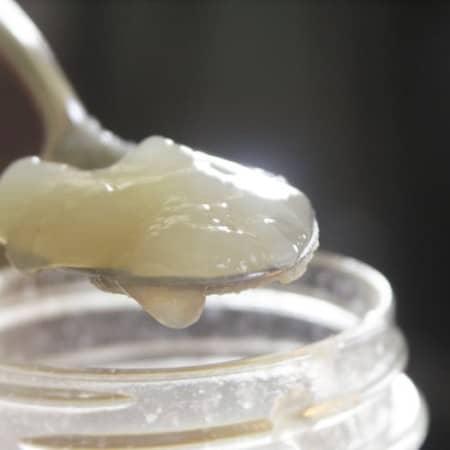
Tartaric Acid is derived from the skins of grapes.  It’s harmless; it’s used in winemaking (and mascarpone making) and has been for a very, very long time.  It’s pretty mild stuff, very inexpensive, keeps forever. Mucho authentic.  And a  large pain in the rear.

What?  Yes.  I think it is a major, massive, mond0, big, huge, giant pain in my tuckus. I have made mascarpone in the most traditional way at least 25 times over and it always requires more scraping of cheesecloth, more ‘hang time’, more fine tuning of the final product than I feel like giving it.

Authentic can blow it out it’s ear as far as I’m concerned.

I have a shortcut I like and I’m darned if I’m not going to share a shortcut with you just because it isn’t authentic.  Besides, my recipe is foolproof and every bit as delicious and creamy as authentically made mascarpone. And my way has an advantage; it has longer shelf-life in the refrigerator than traditionally made mascarpone because it’s cultured!  The cultures help preserve the cream so you can make a bigger batch at once; this translates to more mascarpone on hand.  How can that be a bad thing?

Either way you make it -Foolproof or Traditional- you’re going to yield about 2 pounds of mascarpone for less than $6.00.  So either way, you win.

For a printer-friendly, photo-and-culinary-angst-free version of these recipes, click here!

Foolproof Mascarpone

Yield: about 2 pounds of mascarpone

Ingredients:

  • 2 quarts Half and Half or Light Cream, pasteurized is preferred, but ultra-pasteurized will do, it just might take longer to do its thang.
  • 1 packet direct set Crème Fraîche culture (OR- 1/2 cup of room temperature buttermilk [less than a week old] mixed with 1/4 cup non-chlorinated room-temperature water and 1/8 teaspoon liquid vegetable rennet [or 1/8 of a tablet of vegetable rennet crushed and dissolved in the water].)

Necessary equipment:

  • a square, about 24-inches by 24-inches, of  Ultra Fine Cheesecloth(commonly called butter muslin)
  • a small instant read thermometer, available in the kitchenware departments at most department stores and big grocery stores.  If they sell spatulas, they usually sell these thermometers.  Also available at at Amazon.com.
  • a fine mesh, stainless steel strainer
  • 2-1/2 quart capacity saucepan with lid

Pour the Half and Half or Light Cream into the saucepan placed over low heat.  Warm gently to 86°F (this is lukewarm.)  When it reaches 86°F, remove the pan from the heat.  If you’ve gone slightly over temperature, don’t panic.  Simply stir a few times and cool it back down to 86°F before proceeding.

If using the packet of direct set culture, sprinkle it evenly over the top and allow it to rest for 1 minute.  If using the buttermilk/water/rennet mixture, pour into the warm cream and let it rest for 2 minutes.  After the resting time, gently whisk the cream for 2 minutes, or until the culture is completely dissolved.  Cover and let set in a warm place (about 72°F- give or take a few degrees) for 12-24 hours or until thick.  If you stop here, you’ve made Crème Fraîche.  But I’m talking mascarpone today…

To make Mascarpone of your Crème Fraîche requires just. one. more. step.  Transfer the Crème Fraîche to a fine-mesh strainer lined with dampened  fine mesh cheesecloth or dampened coffee filters.

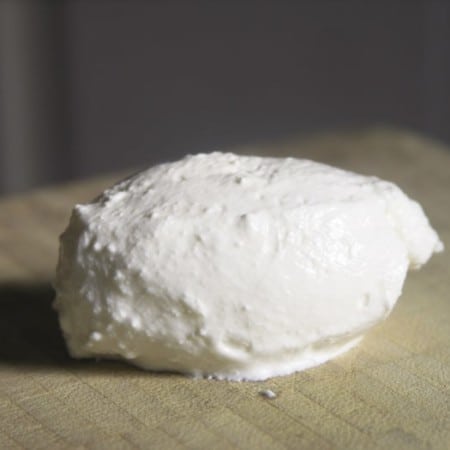
Place the strainer over a bowl and allow to drain at room temperature for 6-12 hours, or until it reaches your desired consistency.  Voilà! Mascarpone!  At a fraction of the cost of store bought and a fraction of the fussiness of traditionally made mascarpone.

…For comparison’s sake, I’ll share the traditional way to make it as well. While the traditional method appears easier, I have always found that I needed to fuss with it more.  I always have to scrape around the edge of the cheesecloth with a silicone spatula to help release some of the liquid.  I always find it has to drain significantly longer than the normal 12 hours.  And maybe, just maybe, I’m messing it up, but if I am, at least I’m consistent about it.  I’ll stick with the method that works for me.  Novel idea, I know.

If you prefer the traditional recipe, by all means, make it!  I’d love to hear from anyone who decides to try both. If you’re an old hand at making traditional mascarpone and you have some tips for me, please share them.  I’d really love to have two foolproof methods.

Traditional Mascarpone

Yield: About 2 pounds of mascarpone

Ingredients:

  • 2 quarts Half and Half or Light Cream, pasteurized
  • 1/2- 3/4 teaspoon tartaric acid

Necessary equipment:

  • a square, about 24-inches by 24-inches, of  Ultra Fine Cheesecloth(commonly called butter muslin)
  • a small instant read thermometer, available in the kitchenware departments at most department stores and big grocery stores.  If they sell spatulas, they usually sell these thermometers.  Also available at at Amazon.com.
  • a fine mesh, stainless steel strainer
  • 2-1/2 quart capacity saucepan with lid

Add cold water to the bottom pan of a double boiler but not so much that the top pan floats.  Fit the top pan in place and add the cream.  Over medium heat, bring the cream up to 185°F.

Sprinkle the tartaric acid over the top and stir for 5 minutes, maintaining 185°F.  The cream should thicken immediately.  Remove the top pan from the double boiler and stir for two additional minutes.

Transfer to a dampened ultra fine cheesecloth or dampened coffee filter lined fine-mesh strainer and allow to drain in the refrigerator for 12-24 hours or until it reaches the desired thickness.  This is very perishable and must be consumed within 48 hours of being made.

Blueberry Tiramisu

Truthfully, this dessert should be called ‘Why I almost ceased being a dog-owner’. But I’ll start at the beginning…

A good friend -who shall remain unnamed since she played hooky from work to come play in the kitchen with me- and I spent a couple hours working on this masterpiece. We made the ladyfingers from scratch.  The mascarpone cream?  It was made of homemade mascarpone* and eggs from my chickens.  The blueberry compote was crafted from blueberries that the boys and I had picked and frozen last August. The homemade orange syrup for dunking the cookies was mixed with equally homemade Grand Marnier*.

*Show of hands, please.  Who wants to know how to make homemade mascarpone and/or Grand Marnier?  I’ll leave it up to you folks, but I’ll say this.  You can make 2 pounds of homemade mascarpone for about $6.00 and a quart of Grand Marnier for about the same amount of money. Any takers?  Tell me in the comments.

We assembled our tiramisu, popped it in the refrigerator and sat on easy chairs with our feet up to solve the world’s problems over a cuppa the finest.  Well, we tried anyway.  We didn’t get a whole lot further than discussing whether Kevin Gillespie (from Top Chef) was every bit as cool as he seemed on the show or whether he was actually cooler.  (Result: Cooler.  Definitely.)

We helped ourselves to dainty servings -due mainly to the fact that we ate the entire time the tiramisu ‘settled’ in the chill chest-  and ate it in raptures.

While I waved good-bye to *Whoops!  Almost said her name!* I fantasized about the size of the serving I would eat after the boys were in bed for the night.  I had it all planned out.

I would put a fluffy down blanket around my shoulders and tuck myself into the corner of the couch with a sinfully large bowl of the tiramisu and my copy of “Right ho, Jeeves!”

The Evil Genius came down from his lab and grabbed a large bowlful of tiramisu.  Since it was a bitterly cold day, he popped the lid on the trifle dish and sat it out on the porch to stay cold.  Then ‘it’ happened.  He leapt from his chair and ran toward the door with a look of panic on his face.  The cause of alarm became clear when I heard two things at the same time; Monsieur Evil yelling, “HAMBONE!” and the sound of a trifle dish skittering across the porch floor.

My 85-pound hound dog who is not under-fed by any stretch of the imagination ate my tiramisu.

And I have never wanted to own a dog less in my entire life.  Unless you count the time he ate my triple batch of lemon curd…

My plans for the evening flew out the front door along with a few well-aimed expletives at the dog.

My mother asked the next day whether the dog had experienced any discomfort from eating the better part of a very rich dessert.  My response?

“I sure hope so.”

At least I got a couple pictures to help me mourn…

For a printer-friendly version of this recipe minus the dog-related sob-story and pictures, click here!

Blueberry Tiramisu

Ingredients for ‘The Dunk’:

  • 1 clementine or tangerine, washed carefully
  • 1 cup sugar
  • 1 cup water
  • 1/3 cup Grand Marnier or other orange liqueur

Ingredients for Mascarpone Cream:

  • 4 large eggs, separated
  • 1 pound mascarpone (This is about 2 cups of mascarpone.)
  • 3/4 cup plus 2 Tablespoons granulated sugar

Ingredients for Blueberry Compote:

  • 3 cups frozen or fresh blueberries
  • 1/2 cup water
  • 2 Tablespoons cornstarch or arrowroot powder
  • 1/2 cup granulated sugar
  • the zest of one orange or 1/2 teaspoon orange extract

Additional ingredients:

  • 50 ladyfinger cookies, homemade or purchased
  • fresh blueberries and orange zest, optional for garnish

This is not complicated, but it helps streamline the process if it is done in order.  To simplify, I’ll number each step of the process.

1. Begin by creating the syrup that will be used to moisten the ladyfingers; referred to hereafter as ‘the dunk’. Add the cup of sugar to the cup of water in a small saucepan. Stir until the sugar is dissolved and bring to a full-rolling boil.  As soon as it begins boiling, remove from heat. Make several cuts in the clementine or tangerine so that it is sliced deeply enough to release some of the juice, but not deeply enough to break up the fruit.  Gently drop the clementine into the syrup, cover with a tight fitting lid and let it steep and cool for 30 minutes.  After 30 minutes, fish the fruit out, gently squeeze over the bowl and discard the fruit.  Pour syrup into a mid-sized bowl, stir in the Grand Marnier and place in the refrigerator to chill completely…

2. Make the blueberry compote. In a small bowl, stir together the 1/2 cup of sugar and 2 Tablespoons of cornstarch or arrowroot powder.  Toss with the blueberries and orange zest (or orange extract) in a medium saucepan.  Add the water and stir over medium-low heat until the blueberries start to give up some of their juices.  When there is more liquid in the pan, raise the heat to medium or medium-high and continue stirring until the blueberries begin to burst and simmer.  Allow to simmer for 3 minutes, stirring constantly.  Remove from the heat and chill in the refrigerator until cold all the way through.

3.  Prepare the mascarpone cream. Carefully crack and separate the yolks and whites from your large eggs.  Place the yolks and 3/4 cup of sugar into the bowl of your stand mixer or a large mixing bowl.  Using the whisk attachment, whip on medium-high speed until the yolk mixture looks thick, creamy and light-yellow.  Add the mascarpone all at once and whip on medium-high speed until evenly combined, about 2 minutes.  If using the stand-mixer, transfer to a large mixing bowl and set in the refrigerator.  If using a large mixing bowl and hand-mixer, simply put the bowl into the refrigerator and turn your attention to the whites.

Mega Important Tip: If you are using the stand-mixer, carefully wash and dry the bowl and whisk attachment before proceeding!

Whip the egg-whites on high with the whisk attachment on your stand mixer until they form soft peaks.  (In other words, when you raise the whisk from the egg whites it should form a little curlicue on top that looks like the tip of a warm Hershey’s Kiss.) With the mixer still running on high, add the remaining two tablespoons of sugar.  Run for one minute, stop the mixer to scrape down the sides, and return to high until firm peaks form. (This means that when you raise the whisk from the egg whites, you should be able to recognize exactly where it left the egg whites and there should be no droopy curlicue.  The whites should be very shiny and glossy at this point.

Use a spatula to scrape about 1/3 of the beaten egg whites onto the mascarpone mixture.  Use a whisk to incorporate the whites.  This lightens the mascarpone cream a bit so that you can more easily fold the remaining whites into it.  Scrape the rest of the beaten whites onto the mascarpone cream.  Use a rubber or silicone spatula to fold the whites into the cream. Don’t panic!  While it sounds futzy, it’s really easy to fold egg whites into heavier mixtures.  The best way to do this is to picture your mixing bowl as a clock.  Insert the spatula, blade side down, into the center of the mixture and gently plunge it to the bottom of the bowl.   Pull the spatula back toward six o’clock.  When you hit the edge of the  bowl, rotate the spatula so that the flat part scrapes against the bowl.  Turn the spatula back blade side up at a 45-degree angle.  Lift the spatula, and the contents on top of it and gently turn it over.  Rotate the bowl about 15 minutes (a quarter turn) and repeat until there are no little white ‘clumps’ of egg white remaining. By this point, you should have an even, creamy and fluffy mascarpone cream.  Place this, lightly covered, into the refrigerator until you’re ready to proceed (but no longer than an hour in advance!)

4. Time to assemble!  Plunge the ladyfinger cookies, one at a time, into ‘The Dunk’ and count to 2.  Lift for an additional 2-count to let extra syrup drip away and then arrange cookies snugly over the bottom of your trifle dish or serving dish.  Scoop about 1/4 of the blueberry compote onto the ladyfingers and spread toward the edges.  Top with 1/4 of the mascarpone cream and spread toward the edges.  Repeat the layers -dunked ladyfingers, blueberry compote, mascarpone cream- until you run out of one item or space to fill. Tightly cover the dish and refrigerate for at least 2 hours prior to serving.

5. The payoff: time to eat! Scoop into serving dishes and eat as is or garnish with fresh blueberries and orange zest.